














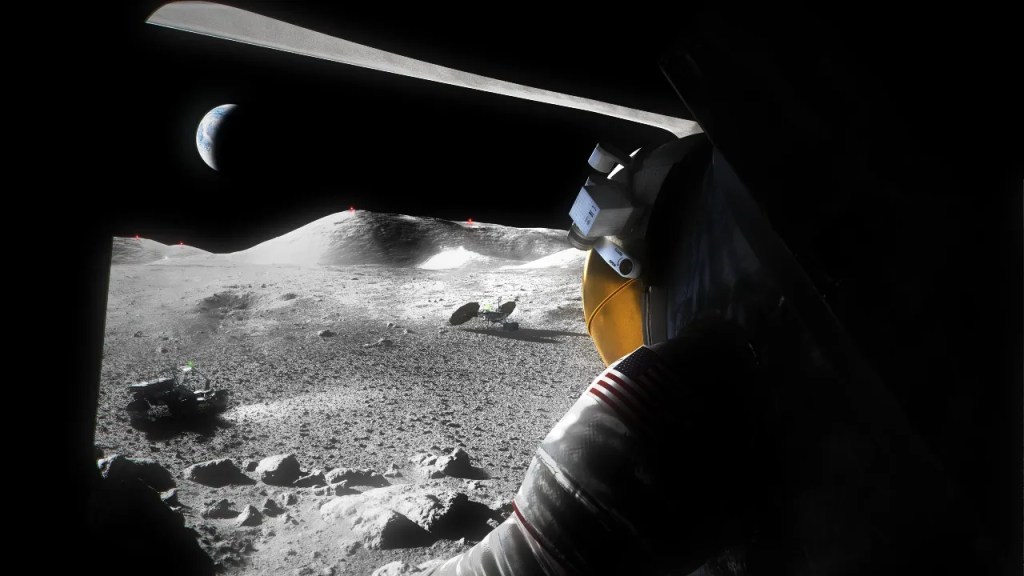






Visuomotor Control Laboratory
The Visuomotor Control Laboratory at NASA Ames Research Center conducted neuroscience research with the aim of understanding the link between eye movements and brain function. The lab worked to systematically validate the use of oculometrics to quantify visual motion perception (for a review, see Stone, L. S., Beutter, B. R., Eckstein, M. P., & Liston, D. (2009). Oculomotor control: Perception and eye movements. In L. R. Squire (Ed.) Encyclopedia of Neuroscience, Vol. 7, pp. 503-511) and has developed hardware and software tools for this purpose.
Robust Human-Systems Interfaces
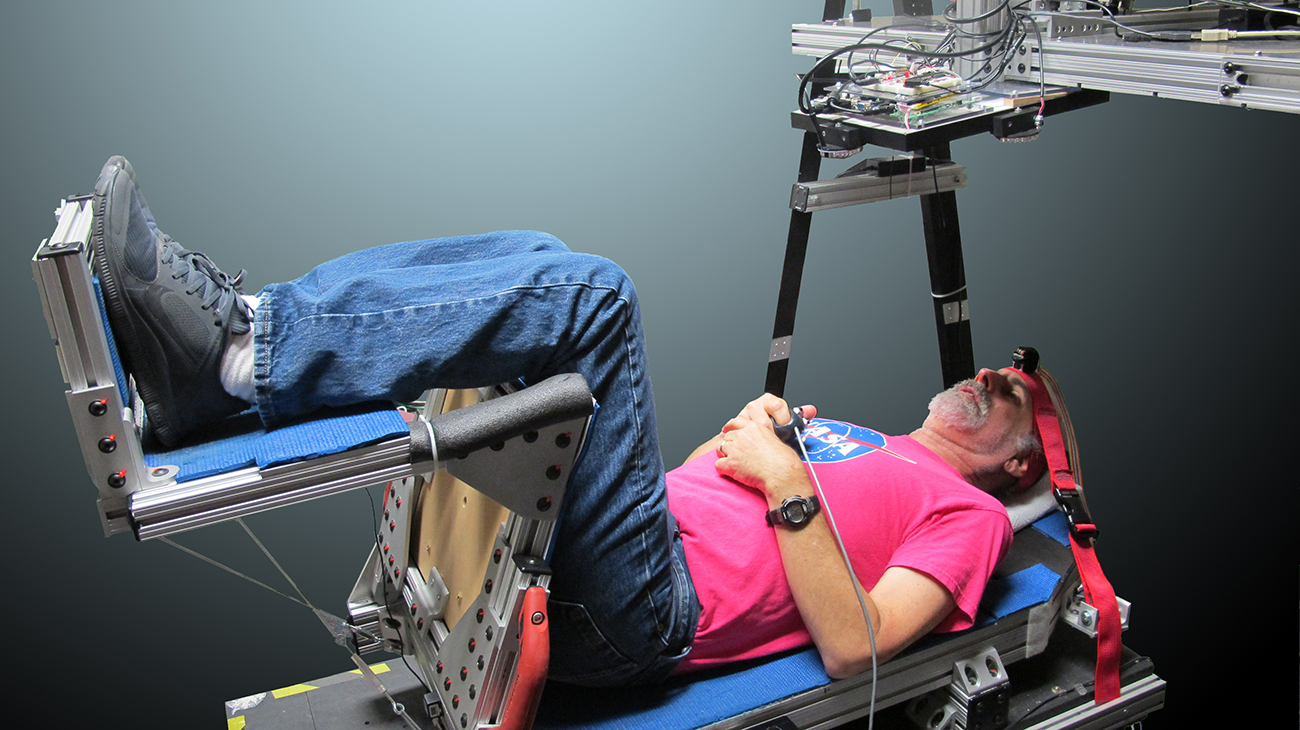
Earth-bound human performance generally must overcome a constant downward gravitational load (+1 Gz), whereas astronauts are required to perform under a wide range of altered and challenging gravitational loads into the chest, both static (up to ~4 Gx) and during dynamic (up to ~0.5 Gx) vibration. In particular, during the high-Gx plus vibration conditions of launch, the crew will need to monitor displays, requiring accurate target localization and gaze stabilization/control, and may be called upon to reach towards and throw switches requiring, in addition, accurate motor control of the hand and arm within the altered force field. Using the 20-g centrifuge and vibration facilities at Ames, we quantified the effects of sustained (+1 or +3.8 Gx) and dynamic (±0.5 Gx at 8, 12, or 16 Hz) gravitational loads (in isolation and combination) on human sensorimotor control in order to dissect the vestibular, visual, and motor limitations on human performance.
Oculometrics
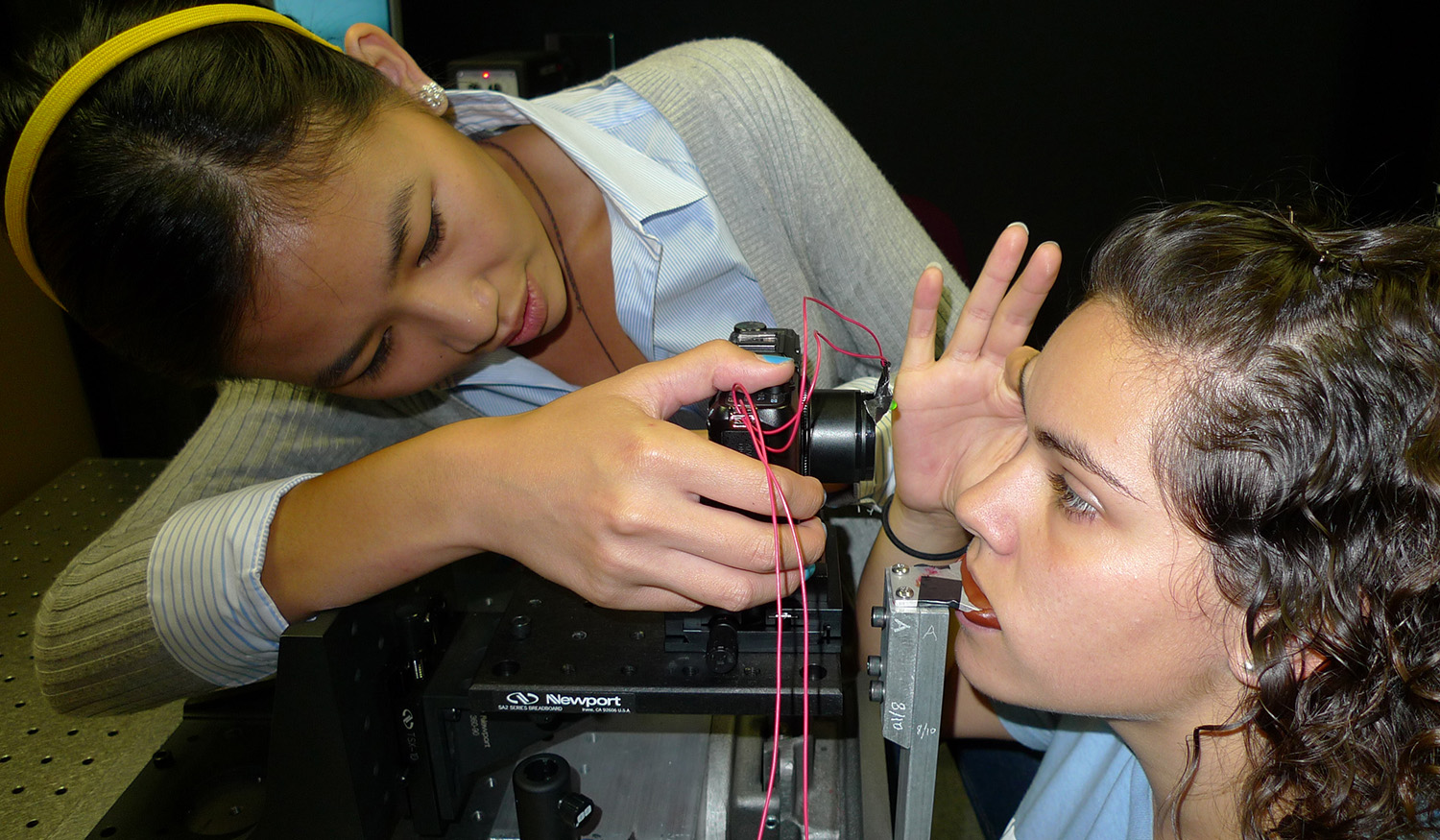
Voluntary eye movements provide a model system to investigate the links between action, perception, and cognition because the visual stimuli can be carefully crafted and controlled, and the motor action can be easily and precisely quantified (e.g., Stone et al., 2009). Two types of voluntary eye movements, saccades and smooth pursuit, are guided using sensorimotor signals from a network of cortical and subcortical structures, having extensive reciprocal connections with a number of visual cortical areas. Using eye-movement choices as a model system, we investigated the types of signals (i.e., decision variables, top-down modulations, internal noise) that contribute to both perception and oculomotor choice behavior.
Comprehensive Oculomotor Behavioral Response Assessment (COBRA)
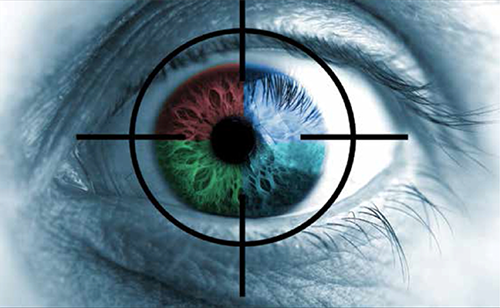
This novel technology is a screening tool to screen for neurological disorders or injury detecting oculomotor signatures. The tool can be used to measure/monitor the severity and nature of such symptoms. Eye movements are the most frequent, shortest-latency, and biomechanically simplest voluntary motor behavior, and thus provide a model system to assess perceptual and sensory processing disturbances arising from trauma, fatigue, aging, environmental exposures, or disease states. Scientists at NASA have developed and validated a rapid, non-invasive, eye-movement-based testing system to evaluate neural health across a range of brain regions. The technology applies a 5-minute behavioral tracking task consisting of randomized step-ramp radial target motion to capture several aspects of neural responses to dynamic visual stimuli, including pursuit initiation, steady-state tracking, direction and speed tuning, pupillary responses, and eccentric gaze holding.
To assess various aspects of dynamic visual and visuomotor function including peripheral attention, spatial localization, perceptual motion processing, and oculomotor responsiveness, NASA developed a simple five-minute clinically relevant test that measures and computes more than a dozen largely independent eye-movement-based (oculometric) measures of human neural performance. This set of oculomotor metrics provide valid and reliable measures of dynamic visual performance and may prove to be a useful assessment tool for mild functional neural impairments across a wide range of etiologies and brain regions. The technology may be useful to clinicians to localize affected brain regions following trauma, degenerative disease, or aging, to characterize and quantify clinical deficits, to monitor recovery of function after injury, and to detect operationally-relevant altered or impaired visual performance at subclinical levels. This novel system can be used as a sensitive screening tool by comparing the oculometric measures of an individual to a normal baseline population, or from the same individual before and after exposure to a potentially harmful event (e.g., a boxing match, football game, combat tour, extended work schedule with sleep disruption, blast or toxic exposure, space mission), or on an ongoing basis to monitor performance for recovery to baseline.
The technology provides a set of largely independent metrics of visual and visuomotor function that are sensitive and reliable within and across observers, yielding a signature multi-dimensional impairment vector that can be used to characterize the nature of a mild deficit, not just simply detect it. Initial results from peer-reviewed studies of Traumatic Brain Injury, sleep deprivation with and without caffeine, and low-dose alcohol consumption have shown that this NASA technology can be used to assess subtle deficits in brain function before overt clinical symptoms become obvious, as well as the efficacy of countermeasures.
The Benefits of COBRA are:
- Fast: scans take ~5 minutes
- Portable: compact, deployable system
- Inexpensive compared to CT/MRI or other current clinical imaging systems
- Evaluates status of brain function, not structure, so has direct operational implications
- Does not expose patients to radiation
- Analysis routines are automated and compatible with disparate data collection methods
- Customized user defined setting in software
Noteworthy Publications
L.S. Stone, B.R. Beutter, M.P. Eckstein & D.B. Liston (2009) Perception and Eye Movements, In: Squire LR (ed.) Encyclopedia of Neuroscience, volume 7, pp. 503-511. Oxford: Academic Press.
L.S. Stone, B.R. Beutter, M.P. Eckstein & D.B. Liston (2009) Saccade Detection During Smooth Tracking, Displays 34 (2013) 171-176.
L.S. Stone, T.L. Tyson, P. Cravalho, N.H. Feick & E.E. Evans (2013) Distinct Pattern of Oculomotor Impairment Associated with Acute Sleep Loss and Circadian Misalignment, Physiology, 2019; 0:1-18.
* Please note, this webpage is not actively maintained and is for historical reference only.