
















Computational Vision Laboratory
Mission Statement
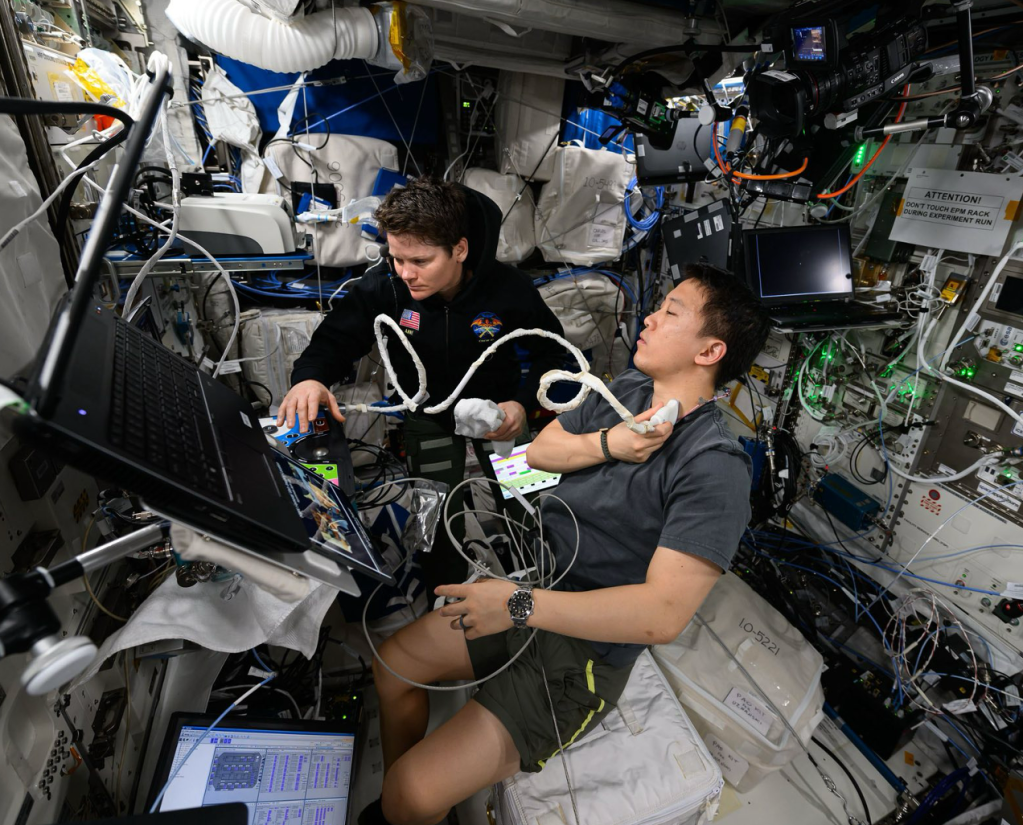
The Computational Vision Laboratory seeks to develop parsimonious and interpretable models of human vision and conduct experiments to glean insights into visual function. We apply these insights to operational challenges in space and aeronautics – such as health surveillance in crew via eye-movement assessment or simulating neural activity and visuomotor control under certain environmental constraints, such as microgravity.
Lab Overview
The lab has a current interest in using eye movement data to quantify visuomotor performance and to model the underlying neural control system using control theory, state space representation, and machine learning.
Research Areas/Projects
Eye Movements and Vision
The lab has a central interest in examining eye movement behavior and visual processing. Recent work has investigated neural mechanisms of adaptation in the gaze holding system and probing mild neural impairment using the Comprehensive Oculomotor Response Assessment (COBRA), a NASA-developed oculometric technology.
Computational Modeling of Vision
We use control theory and state space representation, among other approaches, to simulate neural dynamics of eye movement control and visual processing. We also study how biological learning would naturally reach certain neural behaviors given certain input statistics. Here, we would apply machine learning techniques to artificial neural networks to simulate these bio-plausible learning regimes.
Brain-Like Computation in Vision and Beyond
Brain-like computation has shown to be a useful constraint in developing effective computational tools beyond neuroscience. Our lab is open to applying known principles in the brain (and physics) to problems in vision and beyond
Personnel
Terence Tyson, Lab Director
Ph.D., Vision Science, University of California, Berkeley (in progress)
M.S., Human Factors/Ergonomics, San Jose State University (2018)
B.S., Psychology, Mathematics Emphasis, University of California, Davis (2013)
Collaborators
Erin Flynn-Evans, Fatigue Countermeasures Laboratory Lead, NASA Ames Research Center
Jorge Otero-Millan, Assistant Professor of Optometry and Vision Science, School of Optometry & Vision Science, UC Berkeley
Leland Stone, NASA Ames Associate, NASA Ames Research Center
Publications
Tyson, T. L., Perez, D. F., & Otero-Millan, J. (2026). Distortion of perceived visual space after prolonged horizontal eccentric gaze holding. Vision Research, 240, 108729.
Flynn-Evans, E., Tyson, T. L., Costedoat, G., Pradhan, S., & Stone, L. S. (2026). Chronic Sleep Restriction Induces Oculomotor Impairment with Inadequate Compensation. SLEEP Advances, zpaf095.
Dempsey, D., Sargent, R., Hobbs, A., Latorella, K., Huang, Z., Niemann, C. & Null, C. (2024). Trade Space Analyses: Balancing Crew and Mission Design Parameters (No. NESC-RP-20-01525).
Berneshawi, A. R., Seyedmadani, K., Goel, R., Anderson, M. R., Tyson, T. L., Akay, Y. M. & Stone, L. S. (2024). Oculometric biomarkers of visuomotor deficits in clinically asymptomatic patients with systemic lupus erythematosus undergoing long-term hydroxychloroquine treatment. Frontiers in Ophthalmology, 4, 1354892.
Tyson, T. L., Flynn-Evans, E. E., & Stone, L. S. (2023). Differential saccade-pursuit coordination under sleep loss and low-dose alcohol. Frontiers in Neuroscience, 16, 1067722.
Chandarana, M., Shyr, M., & Tyson, T. L. (2023). Predictive Model for Workload in Remote Operators During sUAS Contingency Scenarios. In AIAA AVIATION 2023 Forum (p. 3334).
Smith, C. L., Rorie, R. C., Chandarana, M., Tyson, T. L., Keeler, J., & Tran, V. (2023). Helicopter pilot assessments of the Airborne Collision Avoidance System XR with automated maneuvering. In AIAA AVIATION 2023 Forum (p. 3683).
Hou, C., Tyson, T. L., Uner, I. J., Nicholas, S. C., & Verghese, P. (2021). Excitatory contribution to binocular interactions in human visual cortex is reduced in strabismic amblyopia. Journal of Neuroscience, 41(41), 8632-8643.
Tyson, T. L., Feick, N. H., Cravalho, P. F., Flynn‐Evans, E. E., & Stone, L. S. (2021). Dose‐dependent sensorimotor impairment in human ocular tracking after acute low‐dose alcohol administration. The Journal of Physiology, 599(4), 1225-1242.
Smith, C. L., Sadler, G., Tyson, T., Brandt, S., Rorie, R. C., Keeler, J. & Dolgov, I. (2021). A cognitive walkthrough of multiple drone delivery operations. In AIAA Aviation 2021 Forum (p. 2330).
Rorie, R. C., Smith, C., Sadler, G., Monk, K. J., Tyson, T. L., & Keeler, J. (2020, October). A Human-in-the-Loop evaluation of ACAS Xu. In 39th Digital Avionics Systems Conference (DASC).
Stone, L. S., Tyson, T. L., Cravalho, P. F., Feick, N. H., & Flynn‐Evans, E. E. (2019). Distinct pattern of oculomotor impairment associated with acute sleep loss and circadian misalignment. The Journal of Physiology, 597(17), 4643-4660.
Verghese, P., Tyson, T. L., Ghahghaei, S., & Fletcher, D. C. (2016). Depth perception and grasp in central field loss. Investigative Ophthalmology & Visual Science, 57(3), 1476-1487.
Geng, J. J., Blumenfeld, Z., Tyson, T. L., & Minzenberg, M. J. (2015). Pupil diameter reflects uncertainty in attentional selection during visual search. Frontiers in Human Neuroscience, 9, 435.
Contact Us
Terence Tyson, terence.l.tyson@nasa.gov