








Human Systems Integration Division
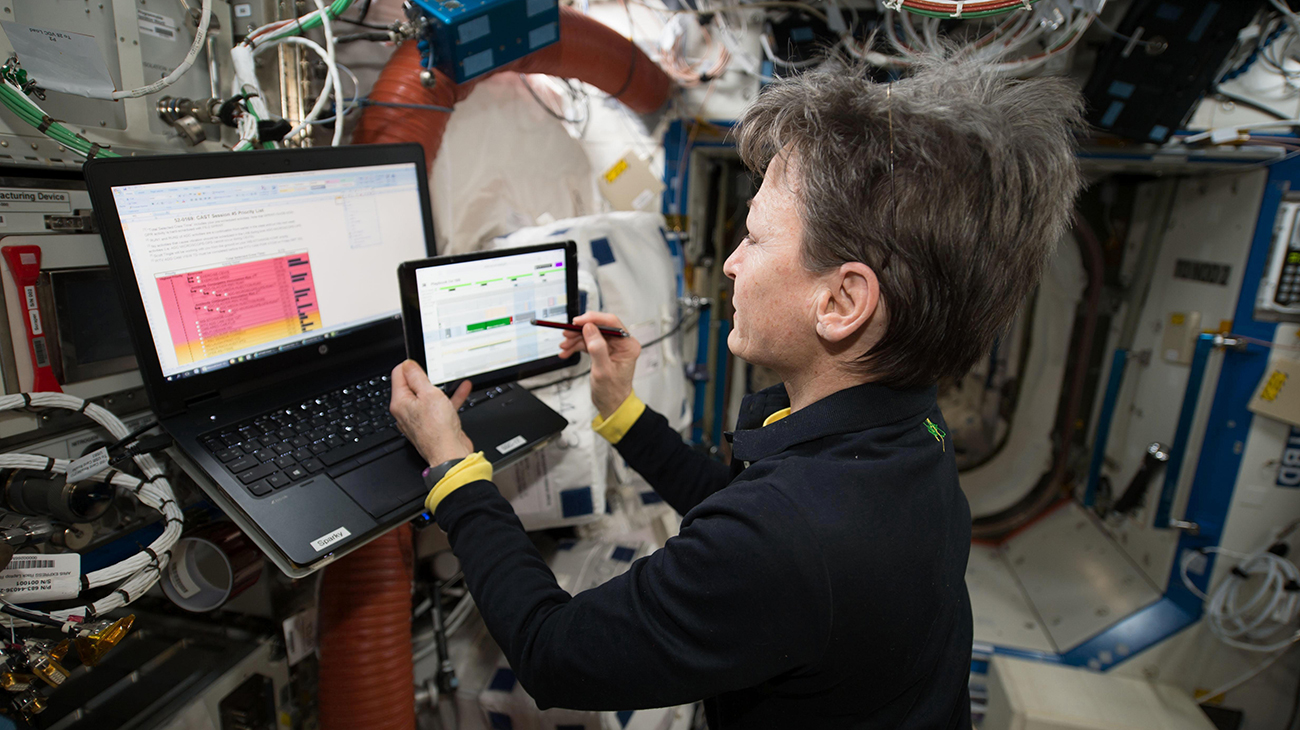
Humans are arguably the most critical element in the safety, reliability, and performance of complex systems. Our highly adaptive problem-solving capabilities create resilient operations across aerospace applications, especially with the advent of increasingly intelligent software and hardware systems. Advances in machine learning, adaptive automation, advanced display technologies, and information accessibility create new challenges for human performance and new opportunities for human-automation teaming.
In aeronautics, humans are the backbone of a national aviation system that must handle growing consumer demands. In space, long-duration exploration missions will require revolutionary changes in the roles of the astronauts and mission controllers to support autonomous operations. For both aeronautics and space, the design of hardware and software systems must address the need for safe, efficient and cost-effective operations, both in-flight and on the ground.
Location
NASA Ames Research Center, Moffett Field, CA
Founded
January, 1989
People
130+
division chief
Jessica Nowinski
Research Branches
The Human Systems Integration Division is composed of three research branches.

Human-Computer Interaction
The Human-Computer Interaction (HCI) Group contributes to the development of measurably better NASA software through careful application of user-centered research and design methods.
Human Performance
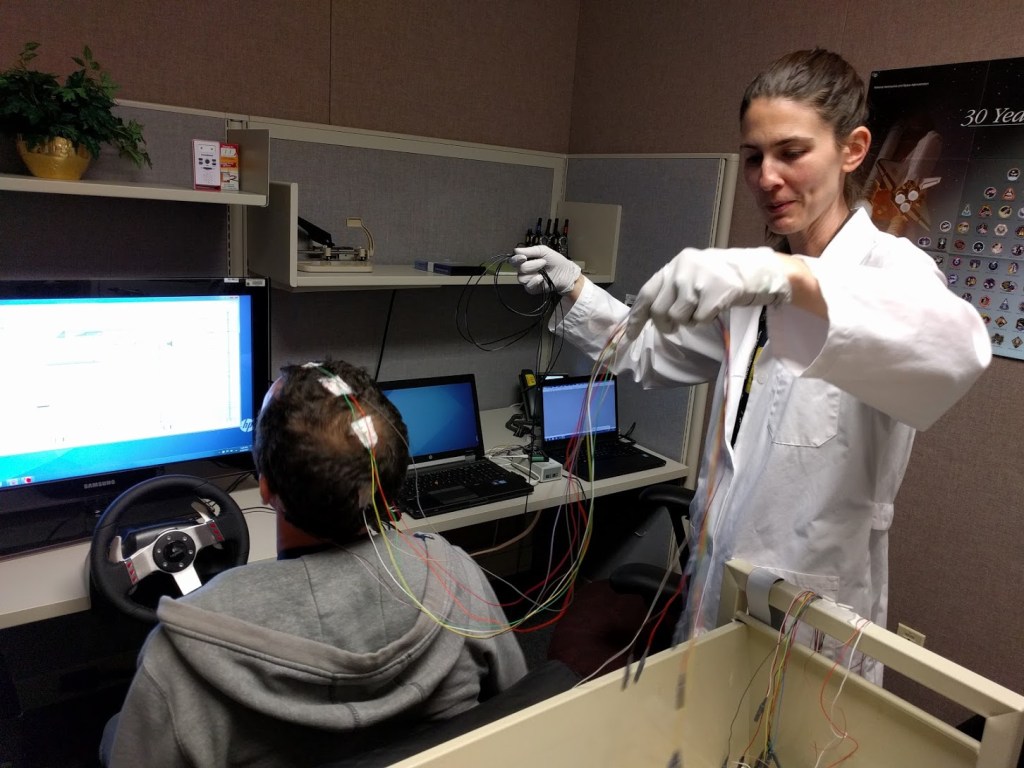
The Human Performance Group performs research and technology development to enhance health, productivity, and safety in aerospace environments.
Integration and Evaluation
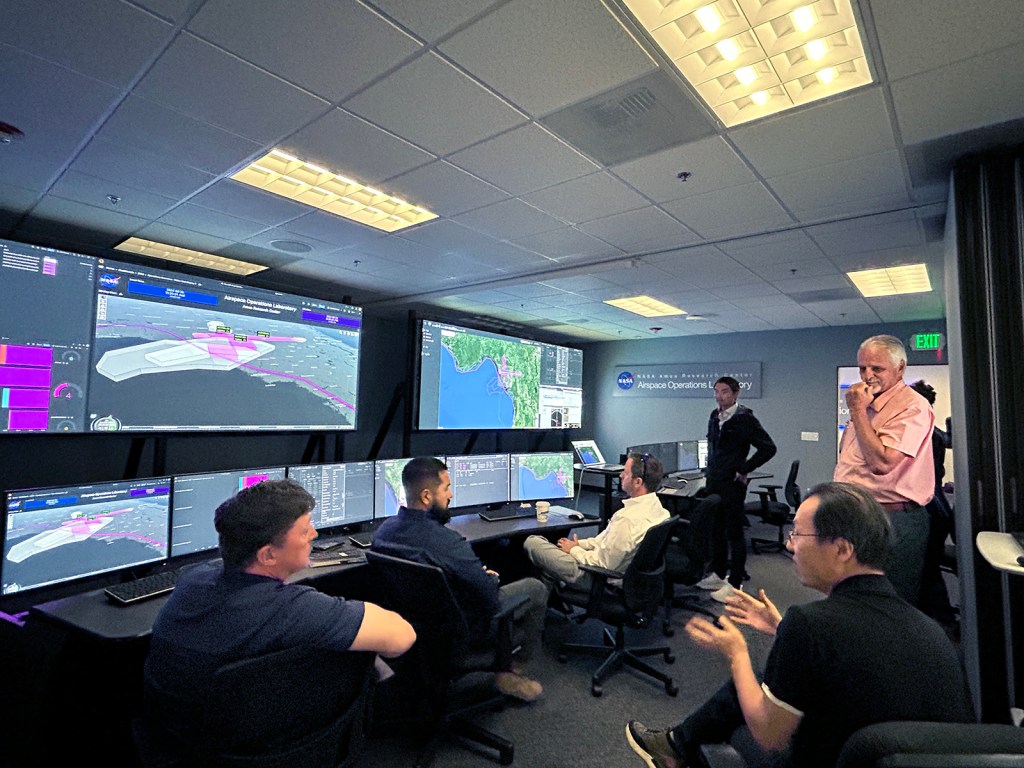
The Integration and Evaluation Group is committed to improving the efficiency and safety of the Air Transportation System, with emphasis on emerging operations enabled by increased automation.
Latest News
High Airspace Traffic Management
Airspace Operations Laboratory Researchers and Higher Airspace Traffic Management Team Recognized for High‑Altitude Traffic Management Innovation
6/8/26
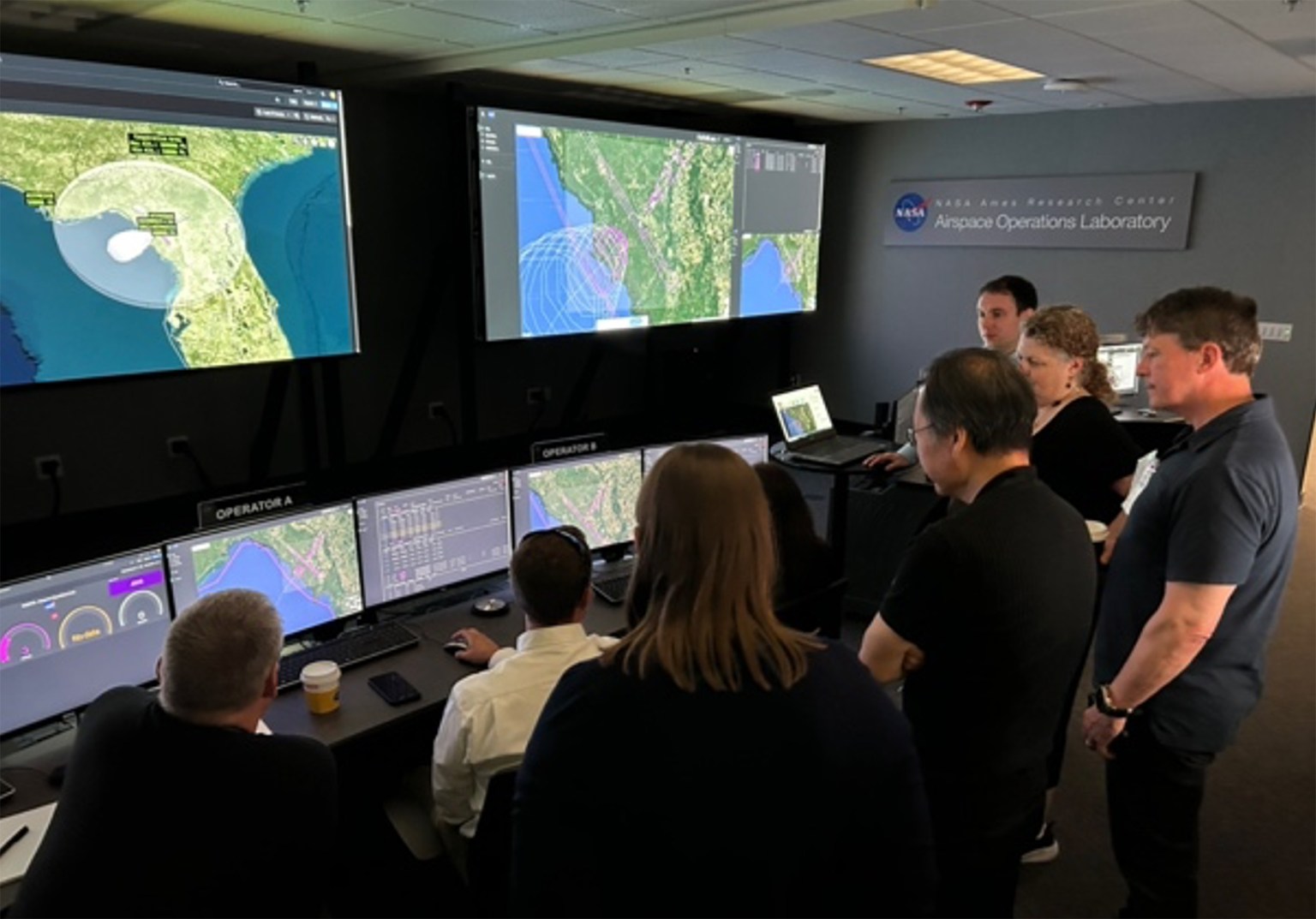
The NASA Air Traffic Management eXploration (ATM‑X) Project’s Opening Upper Class E: High Airspace Traffic Management Collaborative Evaluation earned top honors by winning the “Seamless Skies for All” category at the Seamless Skies Awards on May 26. This achievement recognizes the project’s significant contributions to advancing airspace management and enabling more efficient, safe, and integrated high‑altitude operations.
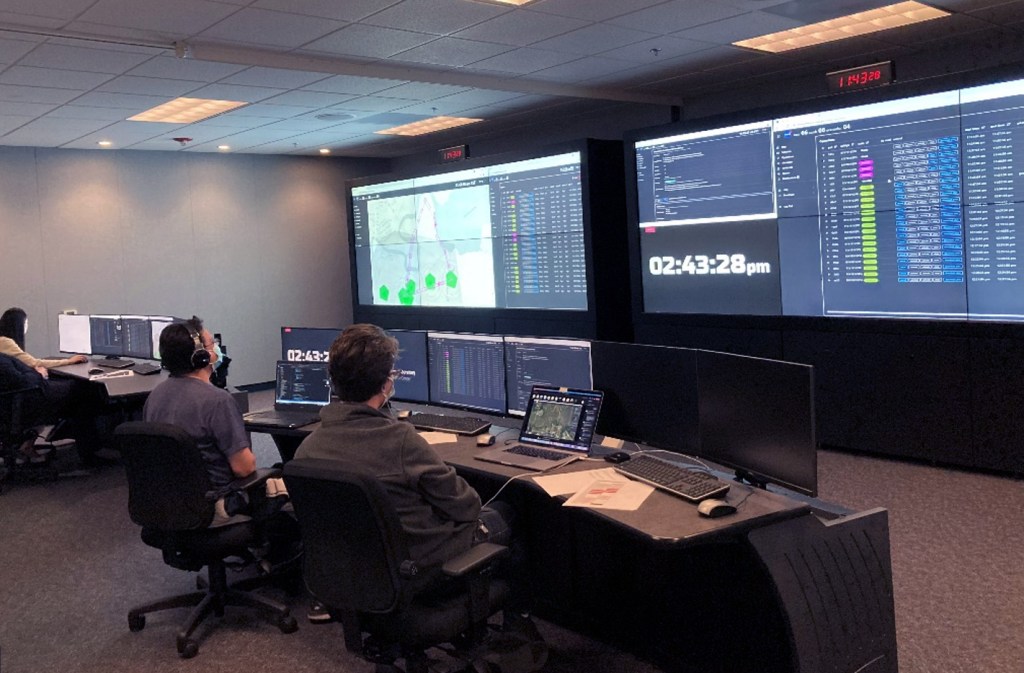
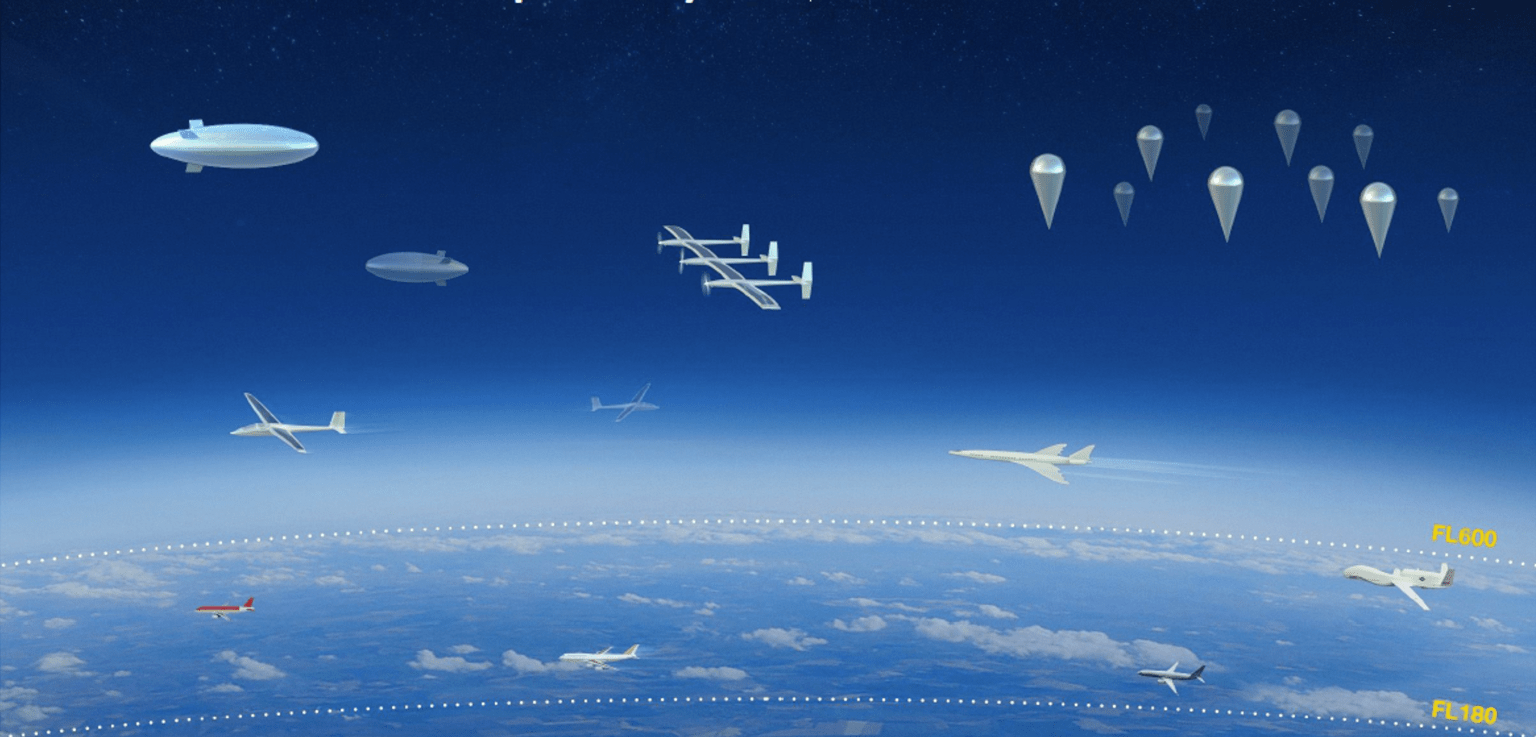
The Human Systems Integration Division’s Airspace Operations Laboratory (AOL) played a central role in this accomplishment. The team designed and executed a real‑time simulation environment that allowed multiple high‑altitude platforms—such as long‑endurance balloons, airships, and fixed‑wing solar‑powered vehicles—to operate within a shared digital ecosystem. Their work integrated live flight data with simulated position and intent information and used automated conflict‑detection tools to manage dynamic traffic in upper airspace.
Conducted in summer 2025 with participation from industry partners, the Federal Aviation Administraion (FAA), and Department of War (DoW) observers, the collaborative evaluation demonstrated the team’s technical leadership and innovation. Winning this award highlights the AOL team’s impact on shaping future concepts and capabilities for the National Airspace System.
Aviation Safety
NASA's Aviation Safety Reporting System (ASRS) Celebrates 50 Years
5/21/26
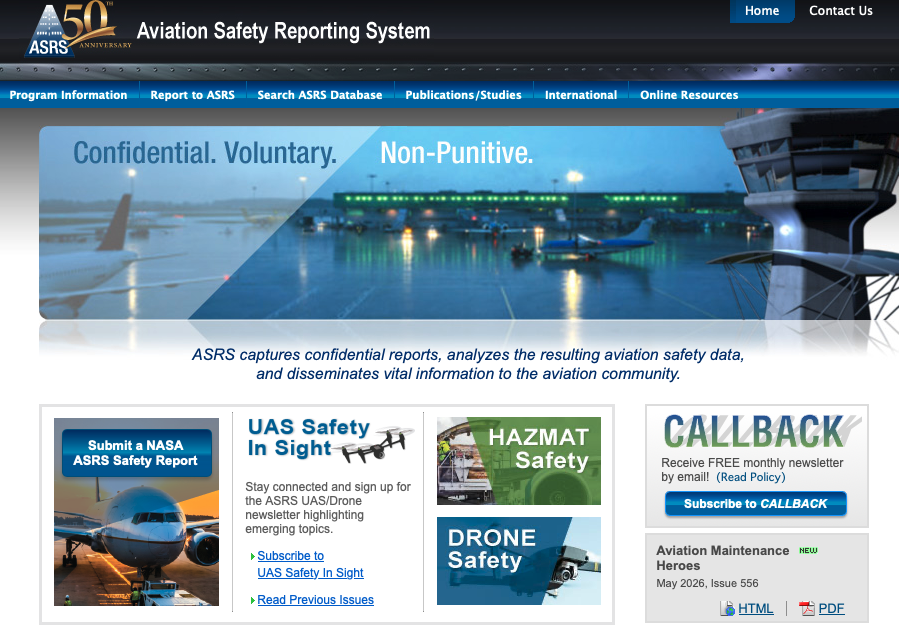
April 15th, 2026 marked the 50th anniversary of the NASA Aviation Safety Reporting System (ASRS) operated by NASA Ames Research Center since 1976. In that time, ASRS has received more than 2.3 million voluntary, confidential reports describing safety issues, near misses, and close calls from aviation professionals across the national Airspace System (NAS) including pilots, air traffic controllers, dispatchers, cabin crew, maintenance technicians, ground operations, and drone operators.
ASRS receives more than 350 reports a day. A small team analyzes each one and works to rapidly share urgent safety information with the aviation community. ASRS highlights emerging issues, shares best practices, and thereby helps prevent future accidents through a variety of communication products including safety alerts, monthly teleconferences, newsletters, analyses, and a public database of reported aviation incidents.
ASRS data informs research and development efforts across NASA and government agencies including the Federal Aviation Administration (FAA) and the National Transportation Safety Board (NTSB). Its insights have contributed to decades of human factors research on a vast array of topics such as Crew Resource Management, Pilot-ATC communication, checklist design, pilot decision making, fatigue management, low visibility landing and surface operations, automation management, and the integration of Unmanned Aircraft Systems in the NAS.
ASRS data also support FAA regulation, policy, procedures, and initiatives such as airspace classification, runway incursion mitigation, and Notice to Air Missions (NOTAM) modernization. The NTSB values the insights gleaned from ASRS reports to inform accident investigations and develop mitigations to prevent future accidents. ASRS data have been used to monitor the safety impacts of emerging risks such as COVID-19, 5G Interference, and commercial space launches.
Artemis II Mission
The Human Systems Integration Division Provides Multiple Contributions to the Artemis II Mission and Launch
4/8/26
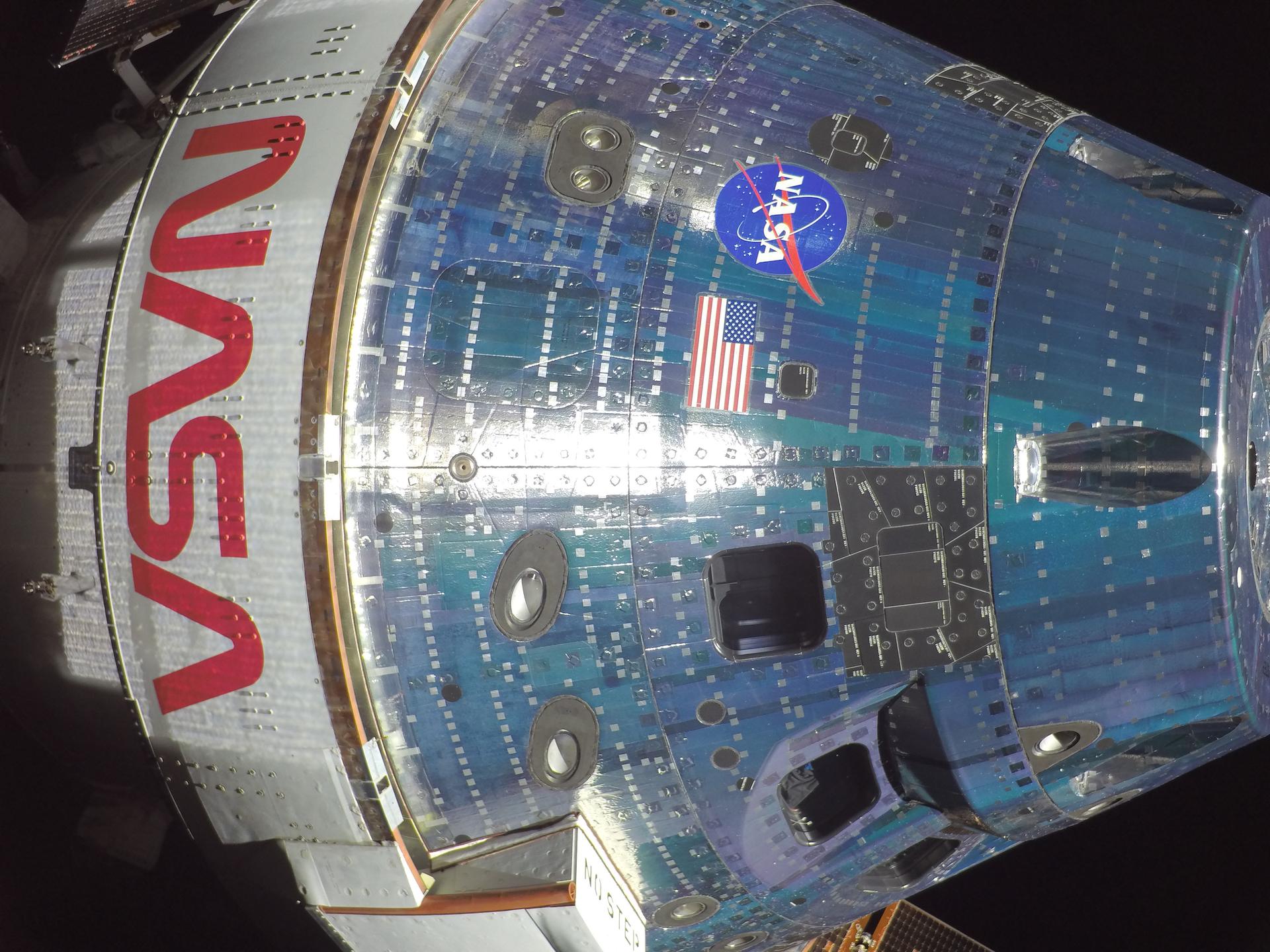
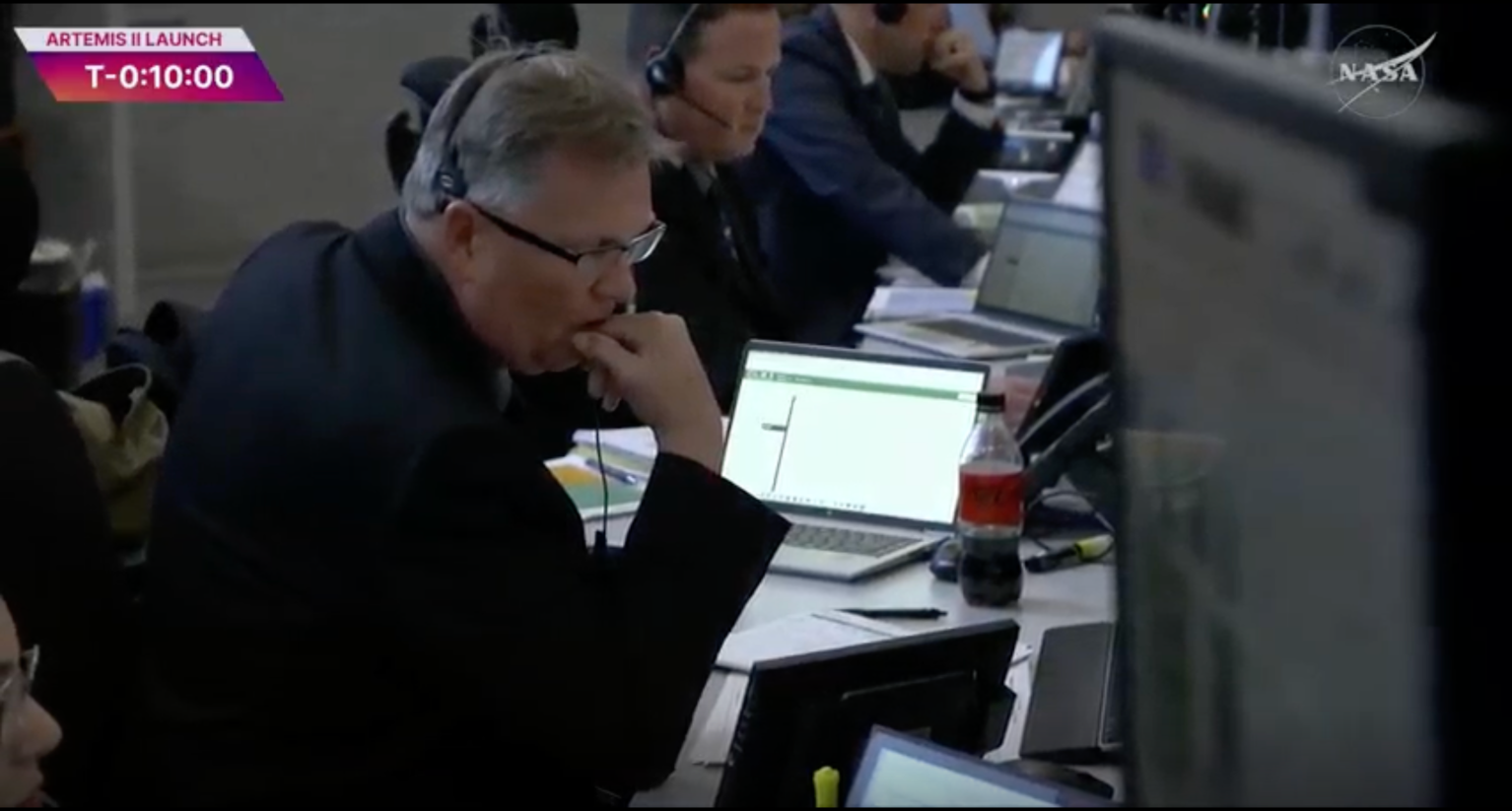
The Human Systems Integration Division at NASA Ames Research Center has been heavily involved in multiple aspects of NASA’s Artemis II mission and launch, contributing critical software support to mission operations personnel, safety support via fatigue countermeasures and ongoing on-site observational research during the mission.
The Cross-Program Integrated Data System (CPIDS) team, part of the Human-Computer Interaction Group (HCI), developed a collection of software solutions that provided real-time support for Artemis II launch operations and mission support personnel. Two CPIDS applications, the Launch Commit Criteria Management System (CP-LMS) and the Cross-Program Operations and Maintenance Requirements and Specifications Management System (CP-OMS), contributed to a successful launch by allowing launch support personnel at Kennedy Space Center to quickly monitor and troubleshoot any pre-launch anomalies. Several other CPIDS tools will continue to be used throughout the duration of the Artemis II mission to track in-flight anomalies, identify items for investigation, and provide immediate access to schematics of the Orion capsule.
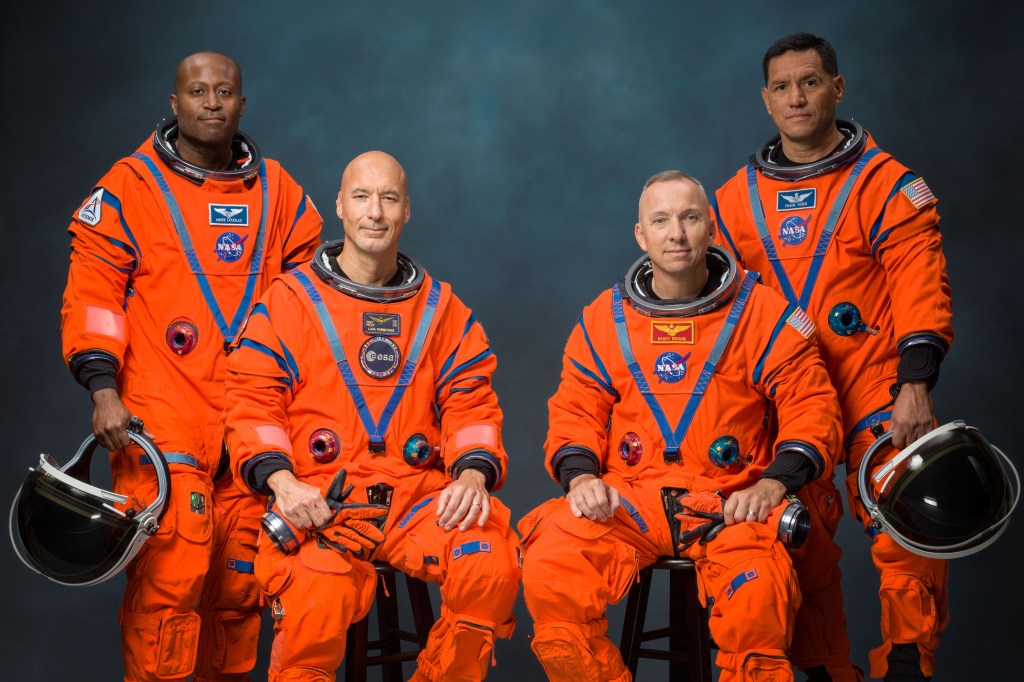
Of course, these tools will provide the most benefit when their human operators are able to perform at an optimal level. In the lead-up to the Artemis II launch, the Human Systems Integration Division’s Fatigue Countermeasures Laboratory provided guidance to mission personnel and the Artemis II astronauts around sleep schedules and other circadian rhythm-related issues which may affect their performance during the complex and strenuous 10-day mission.
Finally, to study and collect as much data as possible from the Artemis II mission, several Human Systems Integration Division researchers were deployed to Johnson Space Center to conduct observational research on anomaly recording, data analysis, and real-time decision-making. These observations will assist with further refinement and improvement of the Division’s support for future NASA missions.
Air Traffic Management/Wildfire Response
Airspace Operations Laboratory Researchers Present and Moderate Discussions at the ACERO Workshop
1/29/26
Members of the Human Systems Integration Division’s Airspace Operation Laboratory (AOL) presented research materials and moderated knowledge elicitation sessions at the ACERO Post-TCL1 Technology Transfer and UTM BVLOS Workshop on January 27, 2026. The workshop brought together NASA, the Federal Aviation Administration (FAA), industry partners, and public safety stakeholders for a full day of in-person activities at NASA Ames Research Center.
ACERO team members had an in-depth exchange on research outcomes and operational pathways following the completion of Technical Capability Level 1 (TCL1). The workshop opened with program-level context on the TCL framework and ACERO objectives, followed by detailed briefings on the Portable Airspace Management System (PAMS) system, including flight test results, and performance analysis.
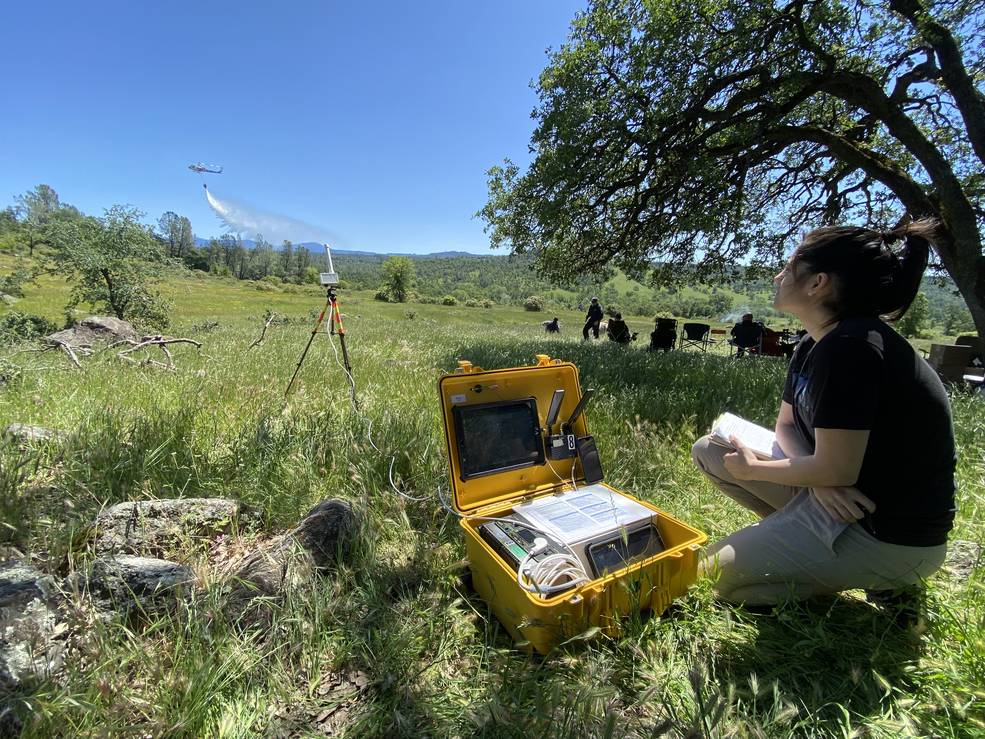
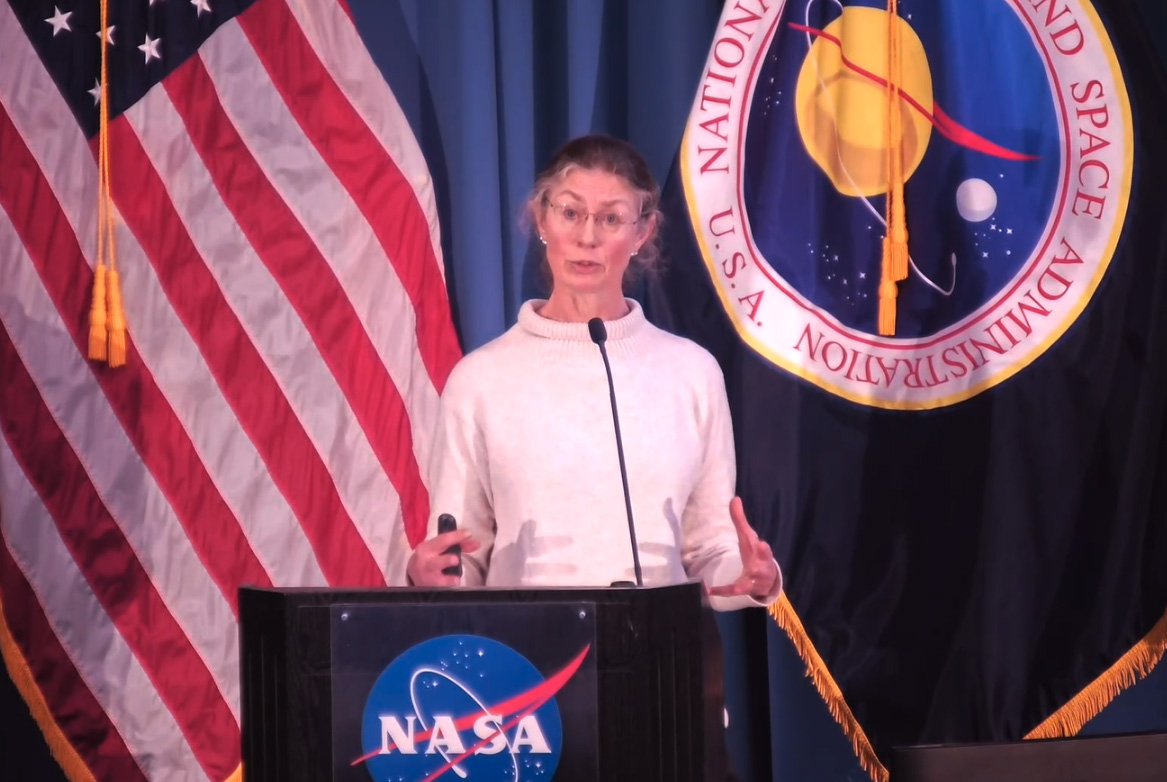
Dr. Lynne Martin was on hand to present details of the human factors research that they have been conducting in the field with wildland fire response teams from multiple agencies. Afternoon presentations framed Unmanned Aircraft System Traffic Management Beyond Visual Line of Sight (UTM BVLOS) operations within the broader UTM ecosystem, covering public safety integration, key sites, and emerging regulatory pathways. The interactive breakout sessions included focused discussion on topics such as strategic deconfliction, conformance monitoring, and operational priority. The workshop concluded with synthesis of breakout findings, open discussion of upcoming opportunities, and closing remarks reinforcing collaboration toward safe, scalable BVLOS and emergency response operations.
Human-Computer Interaction
NASA Playbook Provides Mission Planning Support as CHAPEA Mission Reaches 100-day Milestone
1/28/26
The Crew Health and Performance Exploration Analog (CHAPEA) research team at NASA Johnson Space Center is conducting a series of missions to simulate a year-long stay on Mars. Data collected during these missions will allow NASA researchers to study potential food system design, resource management, and other potential effects on physical and behavioral health and performance. Each mission will consist of four crew members living in the CHAPEA habitat, an isolated 1,700 square foot habitat.
In collaboration with this project, NASA Ames’ Human-Computer Interaction (HCI) Group provides the mission software Playbook tool that enables planning, scheduling, and execution of crew timelines. Additionally, Playbook provides the essential capability of a multimedia chat interface that simulates the long communication latencies expected on Mars (up to 22 minutes delay). This is also the first time Playbook has supported timelines of this length, supporting search of hundreds of messages and activities – a new technical achievement for the software.
Higher Airspace Traffic Management
Human Systems Integration Division Researcher Briefs on NASA Efforts in Higher Airspace Traffic Management
12/9/25
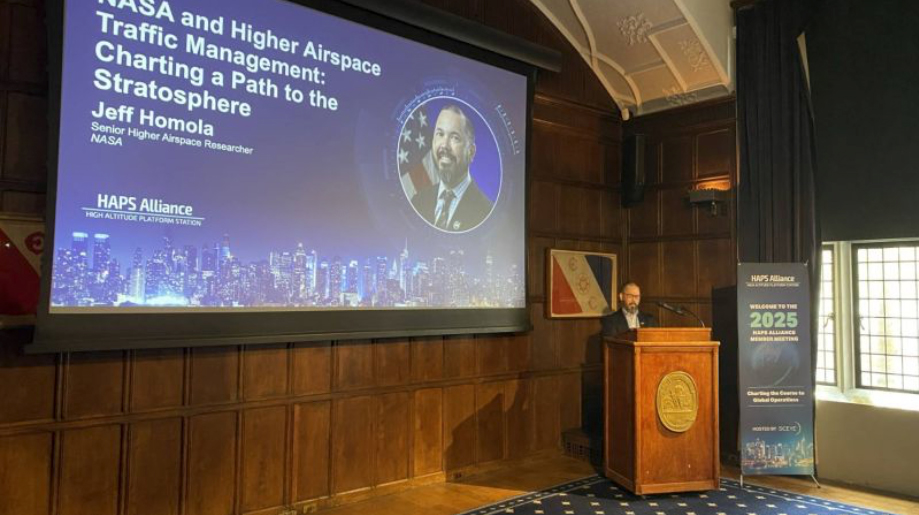
On November 20-21, 2025, Human Systems Integration Division researcher Jeff Homola participated in the High Altitude Platform Systems (HAPS) Alliance Member Meeting in New York, NY. This meeting is the premiere industry event for higher airspace operators, associated technologies, and government stakeholders. Given NASA’s leading role in the research on integrating these unique aircraft into the airspace and the Human Systems Integration Division’s central role, Jeff attended and presented at the member meeting to brief attendees on NASA’s recent accomplishments and potential paths ahead. Much of this briefing focused on the successful real-time simulations that were conducted this past summer with partners Aerostar (Aerostar International LLC), Sceye, and AV utilizing the NASA-developed Higher Airspace Traffic Management architecture.
The impact of participating in this meeting was: 1) the continued solidification of NASA and US leadership in the approach to airspace integration in domestic and international airspace; and 2) define key points of reference and identify emerging needs with current and new collaborative stakeholders in charting a path toward operational implementation of new higher airspace technologies.
Aviation Safety
NASA Paper Titled “Measuring Monitoring Skills Using Crew Briefing Task” Receives Best Paper Award
12/5/25
A paper written by researchers (Dorrit Billman, et.al.) in NASA’s Human Systems Integration Division won the “Best Paper” award for the Aerospace Systems Technical Group at the 2025 Human Factors and Ergonomics Society annual meeting. The paper, titled “Measuring Monitoring Skills Using Crew Briefing Task”, sought to address the issue of inadequate monitoring, and its contribution to aviation accidents and incidents over the years. NASA researchers were able to mitigate some of these risks by identifying the skills and knowledge needed for effective anticipatory monitoring and improving the training and assessment requirements to do so.
The work was supported by the Human Contribution to Safety group within the System-Wide Safety Project. It presented methods for online measurement of anticipatory monitoring using a briefing task that assessed the effectiveness of an on-line tutorial developing anticipatory monitoring skills. The monitoring skill takes on additional importance when projecting behavior of automated systems adds to the monitoring burden. The research provides new data types and develops practical, effective methods for improving and measuring monitoring.
> Click here to see the News archive
Division Information and Resources



Featured Research and Projects
SIMULATORS
ACELeRATE
Aerospace Cognitive Engineering Lab Rapid Automation Test Environment (ACELeRATE)
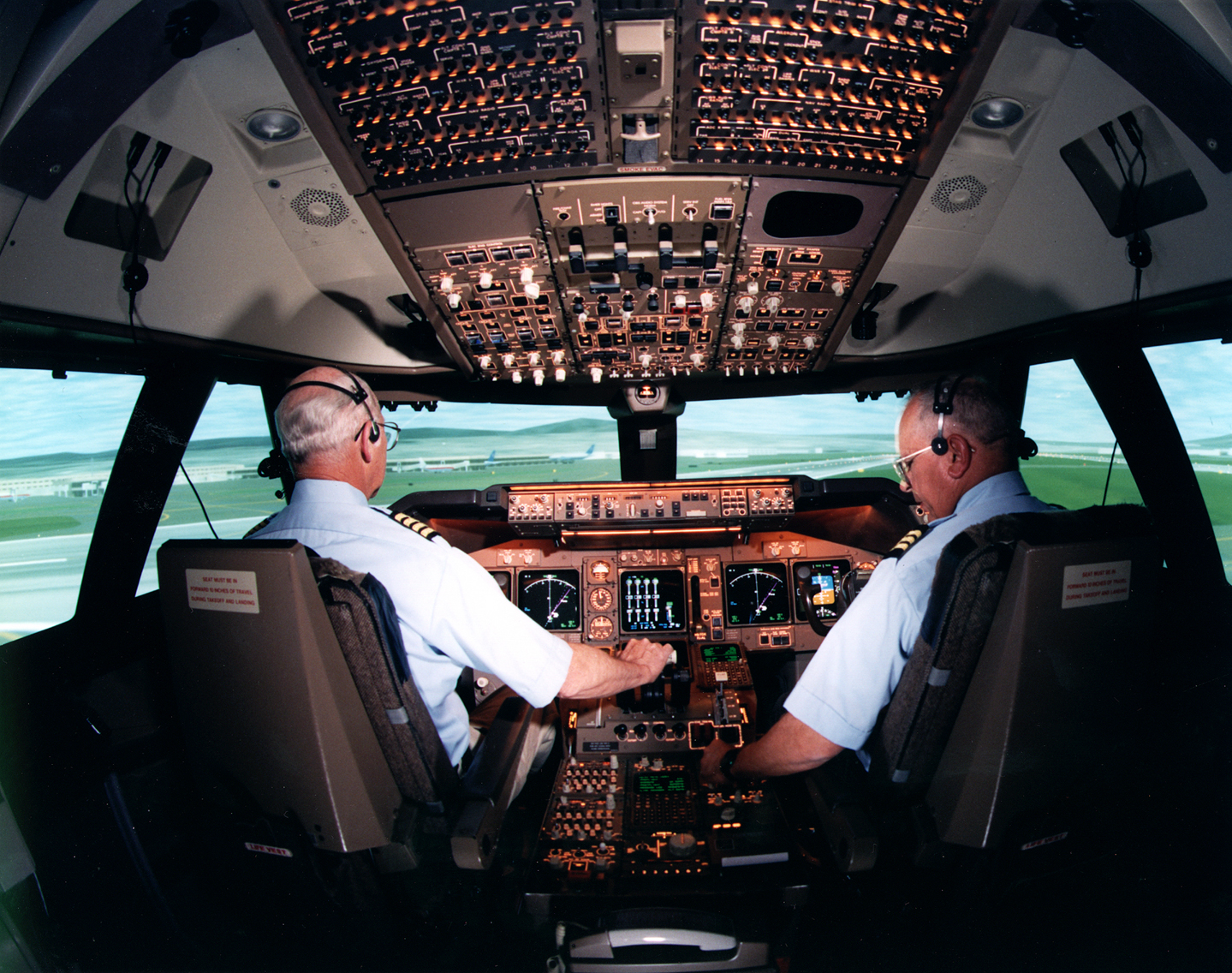
A new generation of aerospace innovators are looking for ways to quickly and efficiently transport people in a safe and environmentally friendly manner. In the not-too-distant future, passengers and goods are expected to routinely fly aboard a new breed of cleaner, smarter air vehicles. This represents a new and significant challenge to the Federal Aviation Agency (FAA) which is responsible for aircraft certification, pilot licensing, operating approval and airspace integration. Aerospace Cognitive Engineering Lab Rapid Automation Test (ACELeRATE) simulator. ACELeRATE is an adaptable fixed-base aircraft simulator focused on the investigation of the performance and interaction of pilots and increasingly automated aircraft systems.
Learn More about ACELeRATE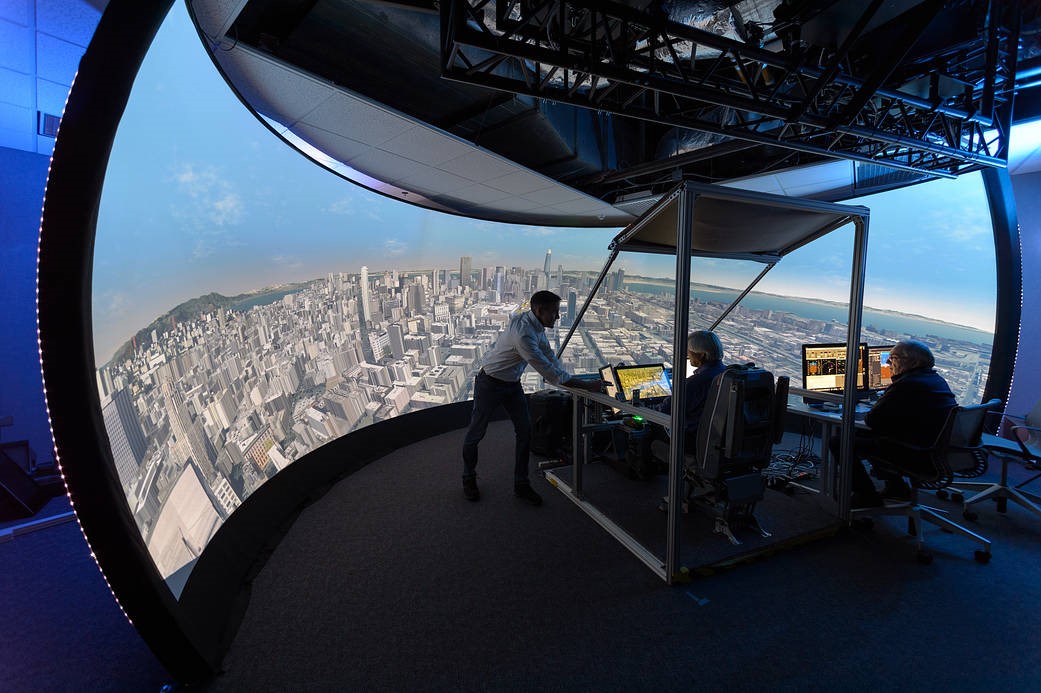
EMERGENCY RESPONSE OPERATIONS/TRAFFIC MANAGEMENT
ACERO
Advanced Capabilities for Emergency Response Operations
Every year, thousands of wildfires burn roughly 1.5 million acres of land across the United States, causing billions in damages, and incurring around $2.9 billion in annual firefighting costs. Utilizing their expertise in air traffic management, advanced aviation technologies and Unmanned Aircraft Systems (UAS), NASA researchers and scientists are developing and testing new technologies to improve wildland fire coordination and operations for emergency response operators. Human Systems Integration Division researchers, home to the Airspace Operations Laboratory (AOL), are playing a pivotal role in this endeavor.
Learn More about ACERO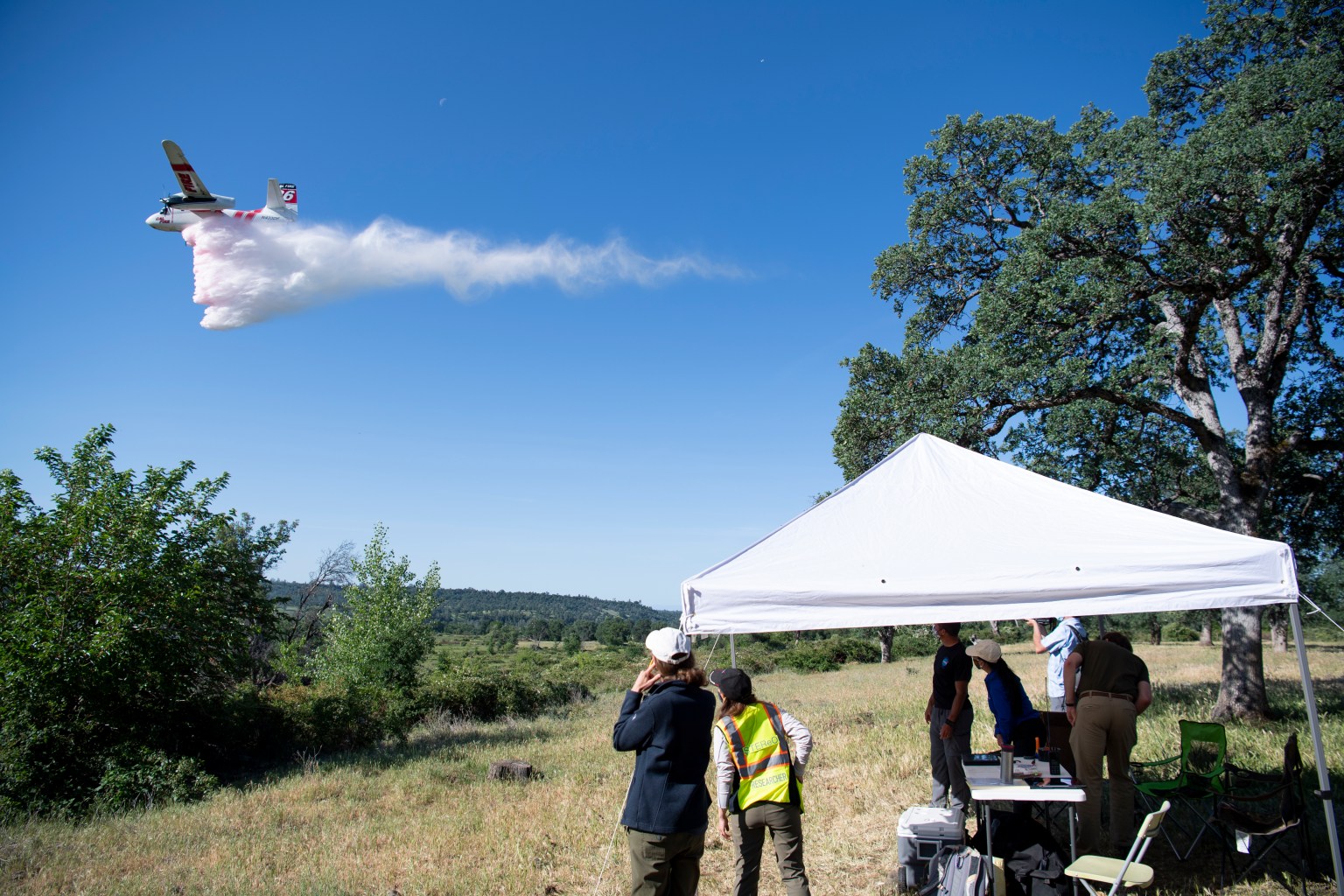
HUMAN-COMPUTER INTERACTION
CPIDS
Cross-Program Integrated Data System
The Cross-Program Integrated Data System (CPIDS) is a collection of digital solutions developed and managed by the Human-Computer Interaction (HCI) group in the Human Systems Integration Division. The CPIDS project implements common solutions and standard integration mechanisms using cost-effective, well-established technology to share data between disparate computer systems, leverage originating and authoritative sources, and minimize data conversions and process burdens
Learn More about CPIDS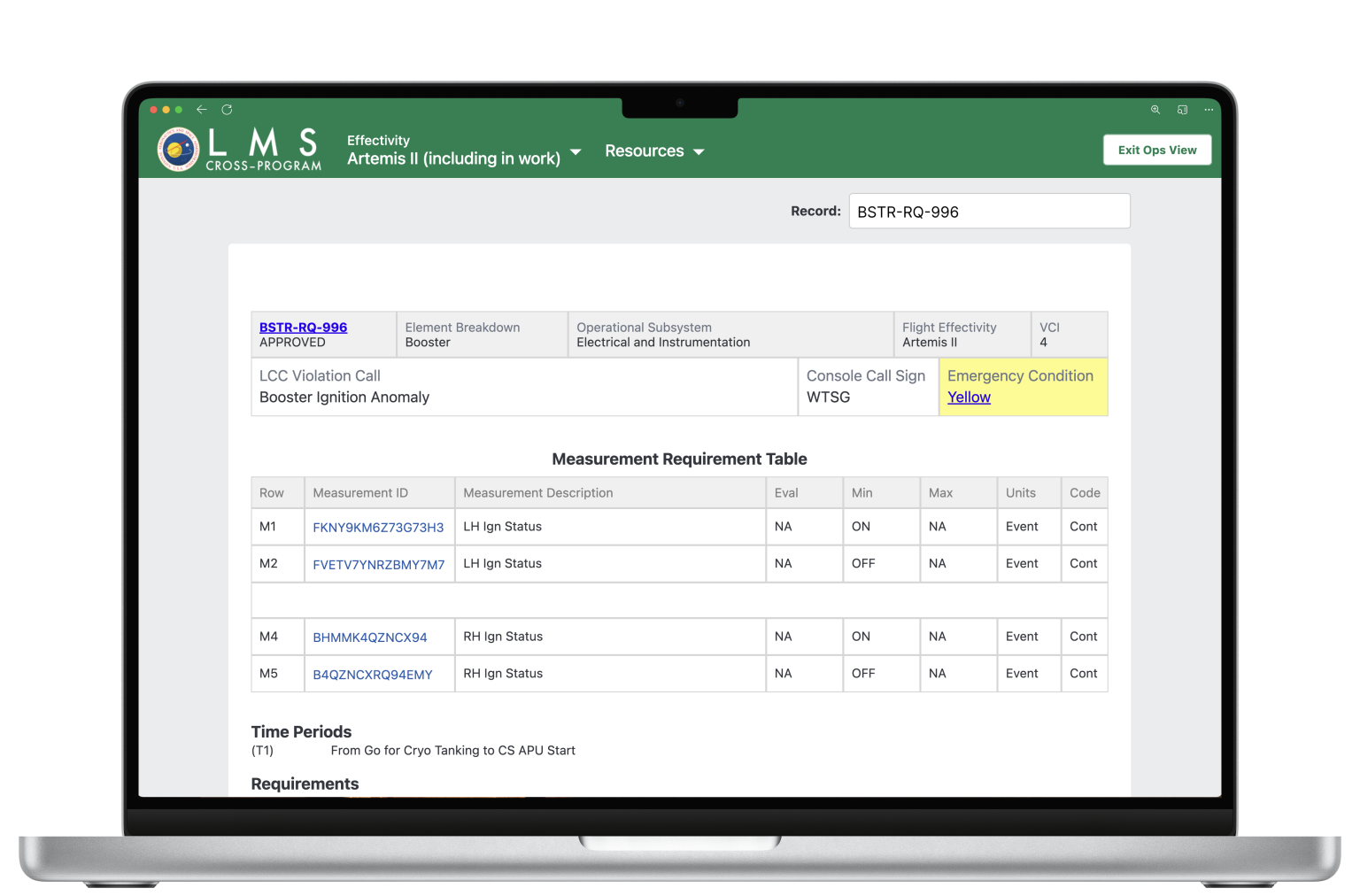
AIR TRAFFIC MANAGEMENT
ETM
Upper Class E Traffic Management
Upper-Class E Traffic Management (ETM) is an airspace management concept for National Airspace System (NAS) flight operations at or above FL600. As recent advances in technologies increase the demand in the stratospheric airspace, the diversity of vehicle types and the mixture of operating paradigms present new opportunities for a cooperative and interactive traffic management perspective.
ETM is part of the NAS Exploratory Concepts and Technologies (NExCT) Sub-Project of the Air Traffic Management-Exploration (ATM-X) project under the Airspace Operations and Safety Program (AOSP) within the Aeronautics Research Mission Directorate (ARMD).
HUMAN PERFORMANCE
Fatigue- Artemis II
Sleep and Wake Countermeasures
In support of NASA’s Artemis II mission, the Fatigue Countermeasures Laboratory at NASA Ames Research Center is helping to maximize the safety performance of Astronauts on this critical mission around the Moon. The aim of the Artemis II Speed and Wake Study was to investigate different interventions and their ability to assist with sleep and alertness for Astronauts during the Artemis lunar human spaceflight missions.
Learn More about Fatigue- Artemis II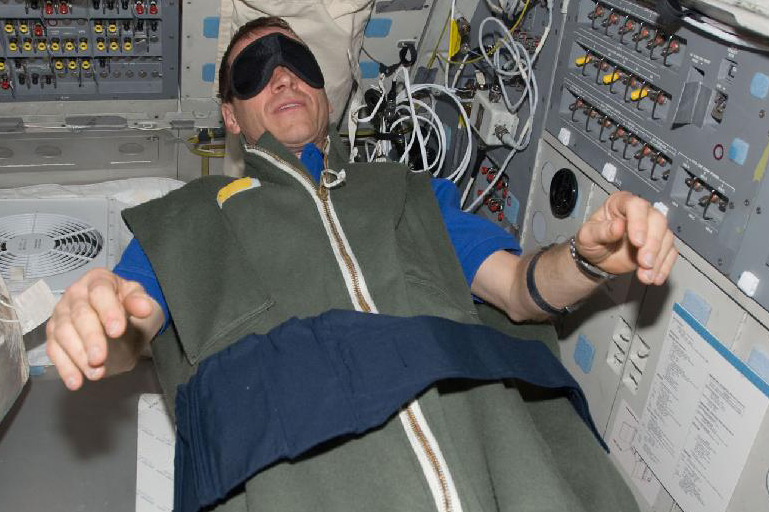
HUMAN-COMPUTER INTERACTION
Playbook
Playbook Mission Planning Tool
Playbook is a mission planning tool developed by the Division’s Human-Computer Interaction (HCI) group. It is a software platform designed to support the next generation of planning, scheduling, and execution tools for space exploration. Timeline scheduling includes ability to model activities, resources, and constraints as well as supports violation checking and resolution. Execution capabilities include procedure integration, tracking status of activities, and multimedia communication.
Learn More about Playbook