





















Cockpit Display Design/Intelligent Spacecraft Interface Systems
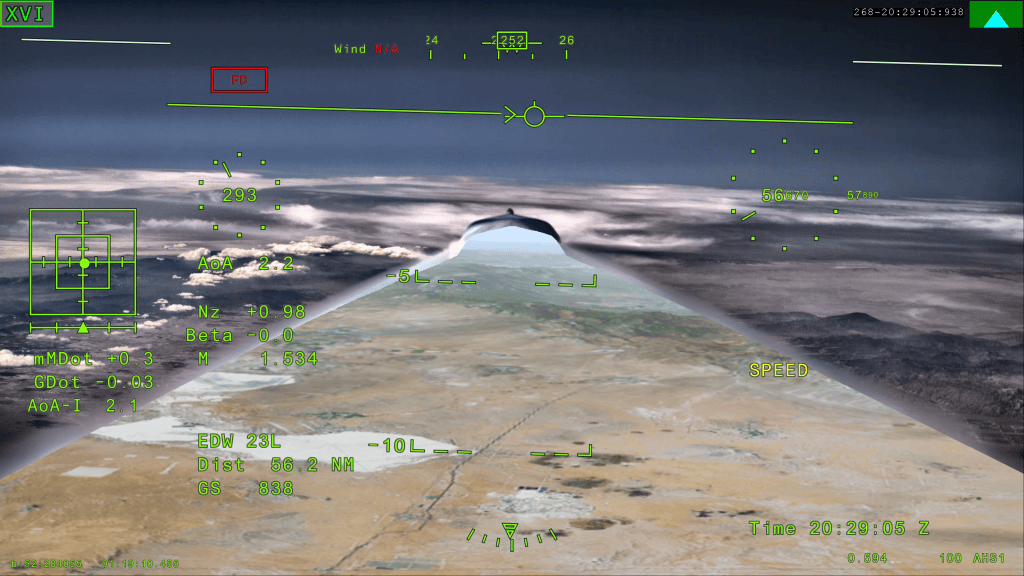
NASA Human Factors researchers played an integral role in the development and design of advanced spacecraft cockpit displays in order to enhance crew/vehicle safety and ensure mission success.
Space Shuttle Cockpit Displays
Research Objective
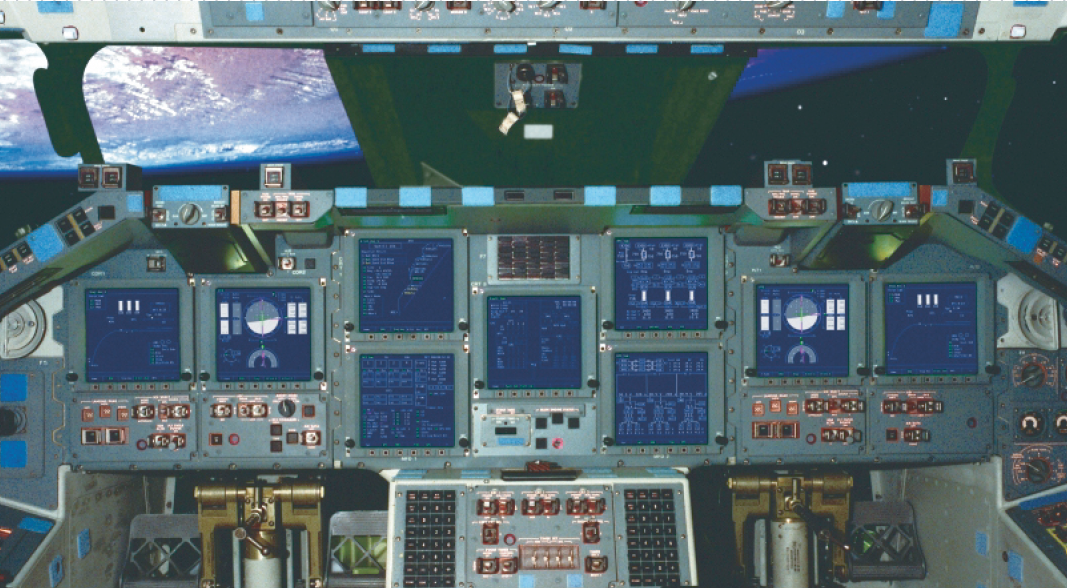
Over the course of the three decades that the Space Shuttle was in operation, dramatic advances occurred in display technology and user interface design. Capitalizing on these advances, the Cockpit Avionics Upgrade project (based at NASA Johnson Space Center) redesigned the display formats on the liquid crystal displays (LCDs) of the Space Shuttle cockpit. The objective of the redesign was to enhance flight safety by presenting the crew with flight- and vehicle-critical information in a user-friendly form that enhanced situational awareness.
Research Approach
Human Factors experts from NASA Ames Research Center helped to design and evaluate upgraded displays that presented complex information in an intuitive manner. Existing display formats made only limited use of graphics. The upgraded displays typically provided more of their information in a graphical form that better matched the operator’s mental model of the system being depicted. For example, the proposed display format for the reaction control system included a graphic depiction of jet availability, enabling the crew to tell “at a glance” which jets could be fired and which are unavailable. The existing displays were also primarily monochromatic, which made it difficult for an observer to locate and focus attention on a critical piece of information such as an off-nominal parameter. The proposed display formats exploited a color-coding scheme to reduce clutter and help manage the viewer’s attention. For example, critical parameter readings (such as temperatures and pressures) turned red when the reading is off-nominal. The value then becomes a color singleton that drew the viewer’s attention automatically.
Research Impact
The new display formats gave Space Shuttle crews better and more rapid decision-making capability under off nominal conditions, enhancing flight safety and the crew’s ability to meet the mission objectives.
Intelligent Spacecraft Interface Systems Lab
Research Objective
1. Test and evaluate advanced spacecraft operations concepts and associated crew-vehicle interfaces during dynamic flight phases via human-in-the-loop simulation support testing by verification and testing by analysis
2. Develop computational models of human performance in complex multi-tasking environments to automate the process of testing and evaluating candidate operational concepts in next-generation spacecraft cockpits.
Research Approach
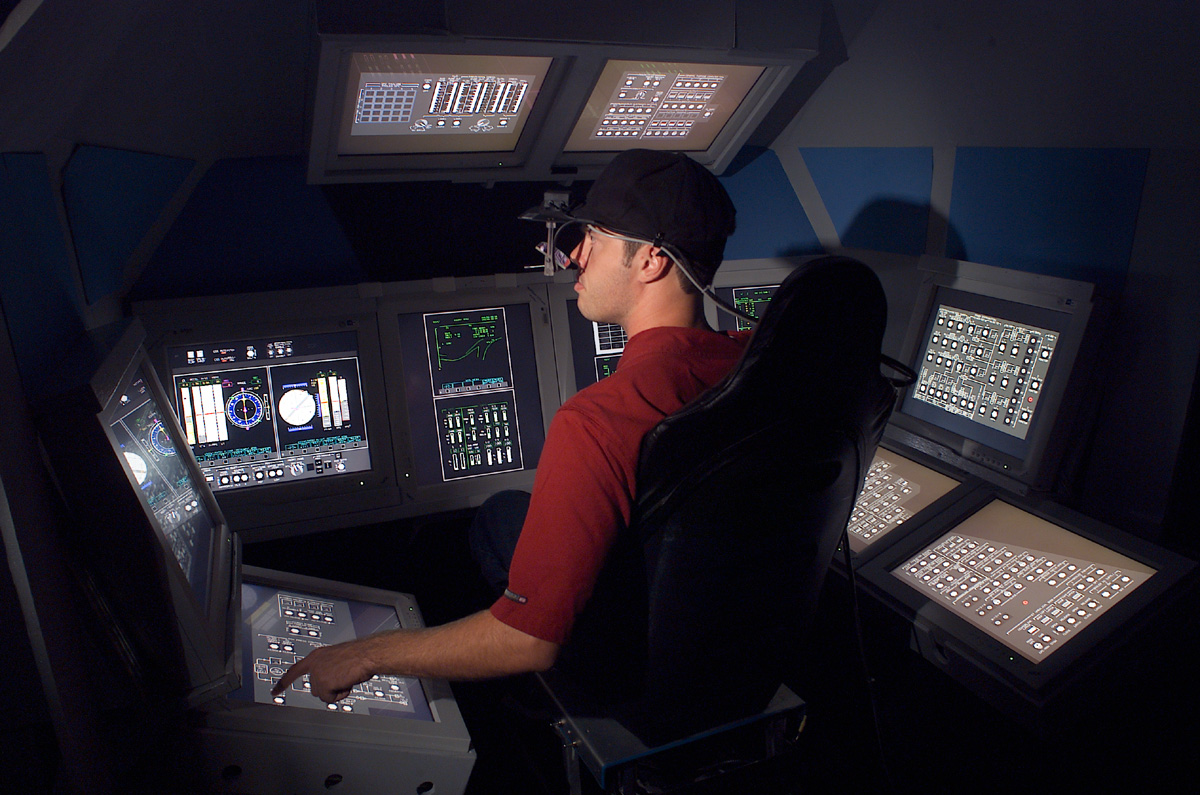
The ISIS lab combined state of the art human behavioral measurement tools (ISCAN head-tracker, reconfigurable flat-panel monitors, and data collection software) to conduct and analyze operator performance during part-task simulations of off-nominal scenarios during dynamic phases of spacecraft flight (ascent/entry). Analyses of eye movements were combined with analyses of traditional human factors performance measures (e.g., switch throws, key presses, hand control inputs, latencies, error rates, and subjective workload ratings) to determine operators’ information acquisition, attentional allocation, and display usage strategies.
Research Impact
Our findings assisted the spacecraft development community in the design, test, evaluation, and validation of operational concepts and supported user interfaces for next-generation crewed vehicles. In addition, our results fed a parallel development effort to build a human performance modeling tool capable of predicting complex stochastic oculomotor behaviors, such as scan patterns and fixation durations. The goal was to use the tool to streamline the process of testing and evaluating candidate operational concepts and associated operator interfaces for next-generation spacecraft.
Noteworthy Publications
McCann, R.S., McCandless, J.W., Johnston, J. (1993). Attentional Limitations with Head-up Displays, Proceedings of the Seventh International Symposium on Aviation Psychology, 70-75. Columbus: Ohio State University.
McCandless, J.W., McCann, R.S. (2002). Development of New Displays for the Cockpit of the Space Shuttle, IBM 6th Annual Make Information Technology (IT) Easy 2002 Conference.
McCandless, J.W., McCann, R.S., Berumen, K., Gauvain, S., Palmer, V., Stahl, W., hamilton, A. (2005). Evaluation of the Space Shuttle Cockpit Avionics Upgrade (CAU) Displays, Proceedings of the Human Factors and Ergonomics Society 49th Annual Meeting. Sep. 26-30. Orlando, FL. 10-14.
* Please note, this webpage is not actively maintained and is for historical reference only.