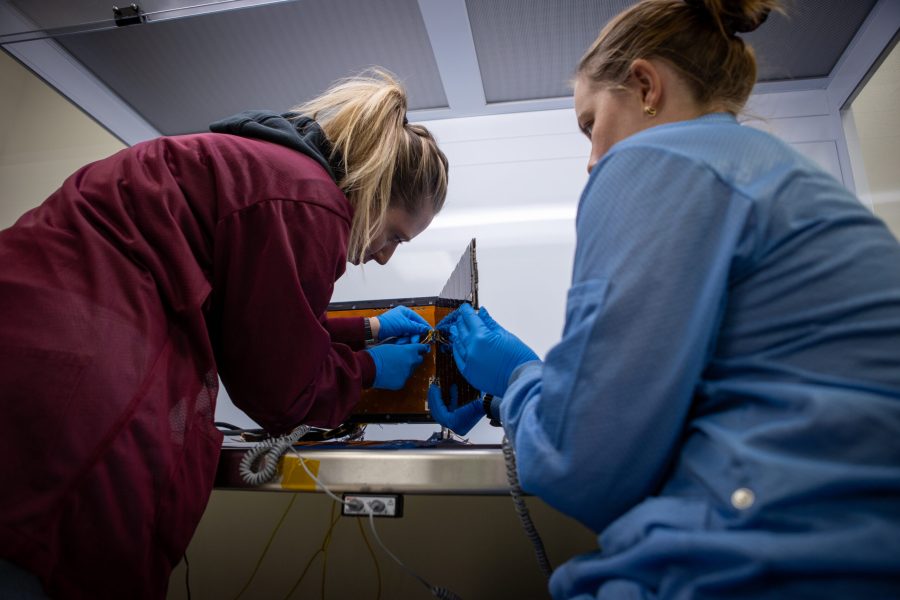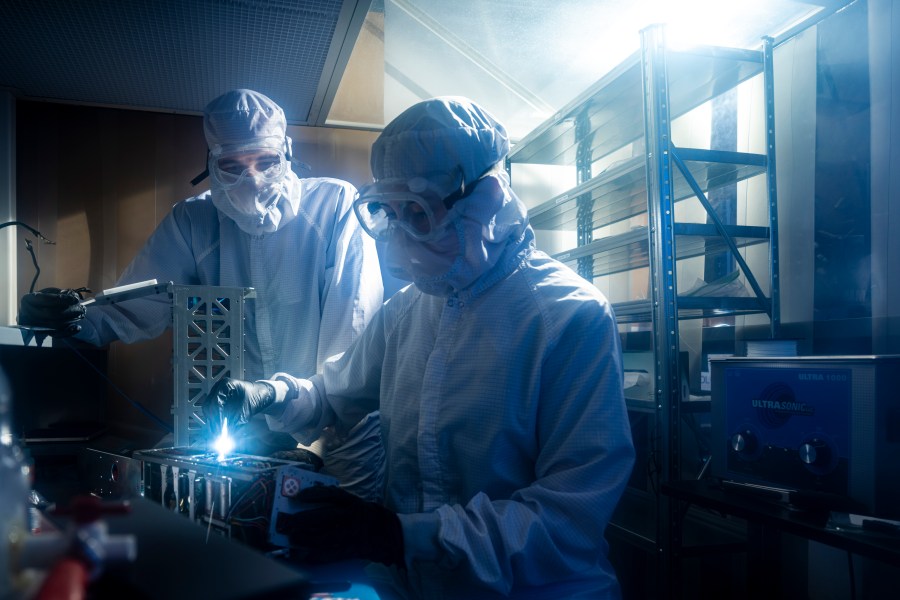











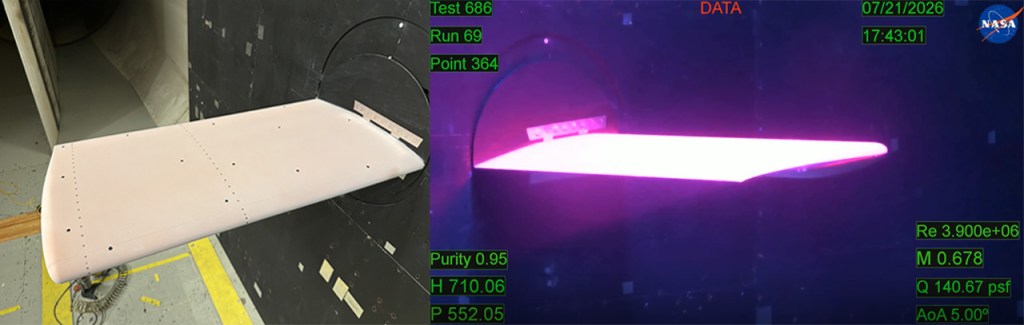






NASA’s four Starling spacecraft, Blinky, Pinky, Inky, and Clyde, have successfully completed commissioning and are now in swarm experiment configuration. The spacecraft have successfully completed several mission activities working to advance satellite swarm technologies. Payload commissioning was delayed due to several anomalies the team needed to investigate, including a larger volume of GPS satellite data …
NASA’s Starling CubeSats Maneuver into Swarm Configuration
NASA’s Starling spacecraft are getting in formation: the mission team has spent the last two months troubleshooting issues and commissioning the four spacecraft, nicknamed Blinky, Pinky, Inky, and Clyde. Pinky, Inky, and Clyde have successfully completed their propulsion system commissioning and have executed maneuvers to get into their swarm operations configuration, maintaining a range between …
Communications Achieved for NASA’s Four Starling CubeSats
Mission managers have established command communications with all four of NASA’s Starling CubeSats! The spacecraft are progressing through payload and propulsion tests, the final stage of a pre-operations checklist called commissioning. The Starling spacecraft – which project team members nicknamed Blinky, Pinky, Inky, and Clyde – are part of an ambitious test to develop self-coordinating …
NASA’s Starling Commissioning Begins, Team Works to Bolster Comms
Each of NASA’s four Starling spacecraft stabilized themselves, deployed solar panels, and made initial contact shortly after their July 17 launch. Starling operators report nominal health for all the CubeSats. The spacecraft are undergoing a series of preparation and testing activities, called commissioning, ahead of their mission to demonstrate autonomous communications, positioning, maneuvering, and decision-making …
Starling CubeSats Have Deployed
NASA’s four Starling CubeSats are confirmed to have deployed from the Rocket Lab’s Electron kick stage. The spacecraft, which are designed to work together as a “swarm,” have reached low Earth orbit to begin their mission to test technologies for autonomous positioning, networking, maneuvering, and decision-making. Now, the Starling swarm will power up and attempt …
Starling: We Have Liftoff!
NASA’s Starling mission, has lifted off from the launch pad aboard Rocket Lab’s Electron rocket. The four CubeSats are on their way to low Earth orbit to test new autonomous spacecraft swarm technologies. Rocket Lab is providing a live launch broadcast, available on the company’s website. Connect with us on social media for ongoing launch …
It’s Launch Day for NASA’s Starling Mission!
Welcome to launch day for NASA’s Starling CubeSat mission! A team of four satellites wait atop a Rocket Lab Electron rocket for liftoff from Launch Complex 1 in Māhia, New Zealand. This launch, named Baby Come Back, will send Starling’s cereal box-sized satellites, called CubeSats, to low Earth orbit, where they will test new autonomous …
NASA Awards SpaceX Launch Services Task Order for CubeSat Mission

NASA has awarded Space Exploration Technologies Corp. of Hawthorne, California, one task order to launch two CubeSat Launch Initiative missions as part of the agency’s Venture-class Acquisition of Dedicated and Rideshare (VADR) launch services contract. The CubeSats are targeted to launch no earlier than 2025 on a SpaceX Falcon 9 rocket. NASA will specify payloads …
Seeking Signal Acquisition
The final two TROPICS CubeSats successfully deployed from a Rocket Lab Electron rocket after launch. The rocket named Coming To A Storm Near You lifted off at at 11:46 p.m. EDT Thursday, May 25, (3:46 p.m. NZST Friday, May 26th). The team is now working to seek signal acquisition from this pair of TROPICS CubeSats. …
TROPICS CubeSats Have Deployed
NASA’s TROPICS CubeSats have deployed from the Rocket Lab Electron kick stage. The two CubeSats will reach low Earth orbit to begin their mission. Each of the CubeSats was designed to last approximately two years, but analysis, lifetime testing of key parts, and on-orbit experiences with similar hardware could help the satellites surpass their design …