











Overview
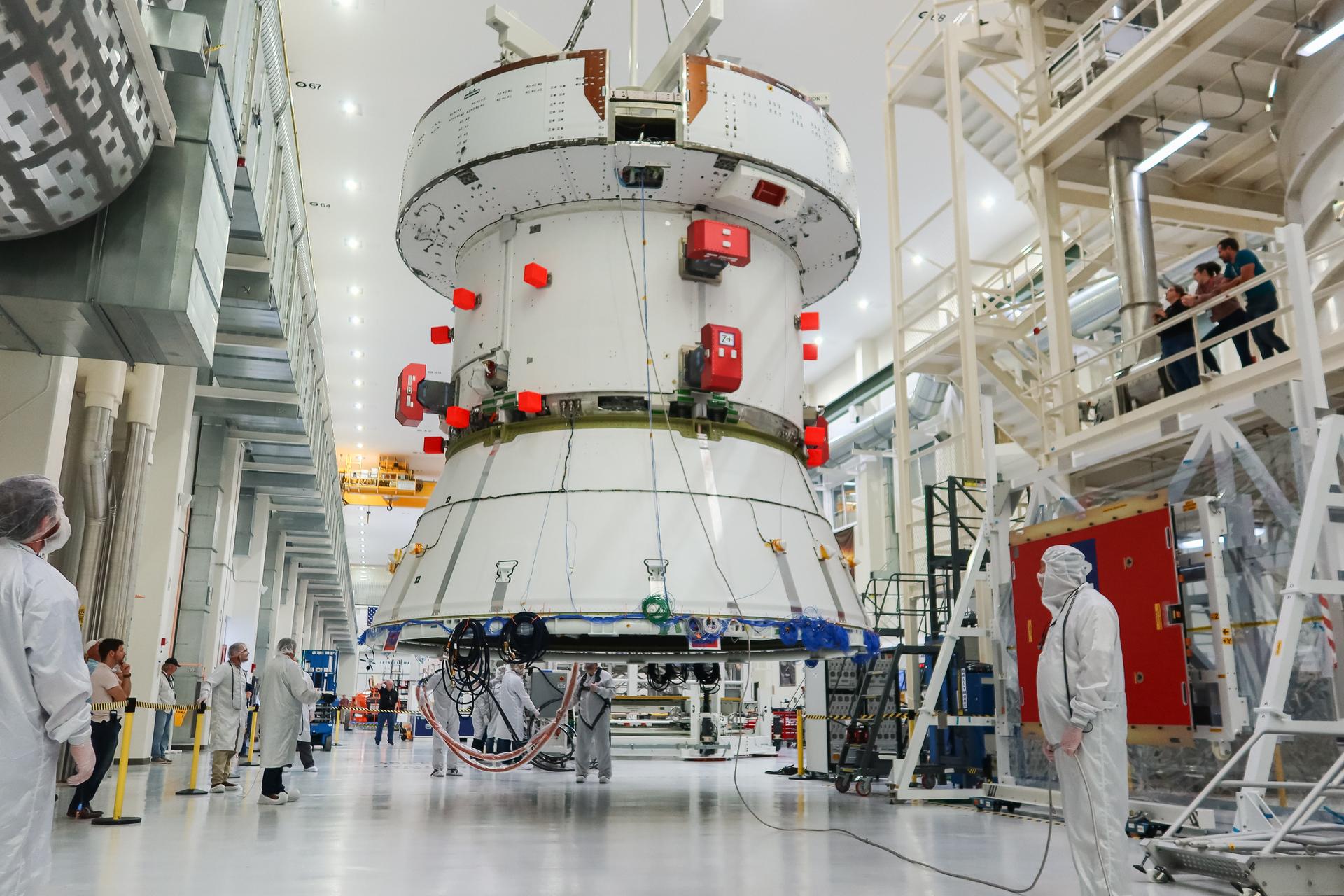
The service module is located below the crew module and is designed for long-duration missions to deep space destinations. It provides critical functions for Orion, including propulsion, thermal control, and electrical power generated by the solar arrays. It also provides commodities necessary for life support, including consumables for the astronauts such as water, oxygen and nitrogen.
The service module is cylindrical, unpressurized, and about 13 feet high, including the main engine and tanks for gas and propellant. The service module’s structure, built by Thales Alenia Space in Italy, is covered with Kevlar to absorb shocks from micrometeorites and debris impacts.
During launch, the service module fits into a 17-foot-diameter housing surrounded by three fairing panels, called spacecraft adapter jettison (SAJ) panels, that protect it from the harsh environments of launch, such as heat, wind, and acoustic vibrations. Once Orion is above the atmosphere, the fairing panels surrounding the service module will be jettisoned and its four solar arrays will unfurl. After the spacecraft separates from the upper stage of the SLS rocket, the service module will propel Orion on its mission and help it return to Earth, detaching before the crew module enters Earth’s atmosphere.
The service module is assembled at Airbus facilities in Bremen, Germany, with components supplied by companies across 10 European countries and the United States. Once completed, it is shipped to NASA’s Kennedy Space Center in Florida, where it is integrated with the rest of the Orion spacecraft.
Crew Module Adapter
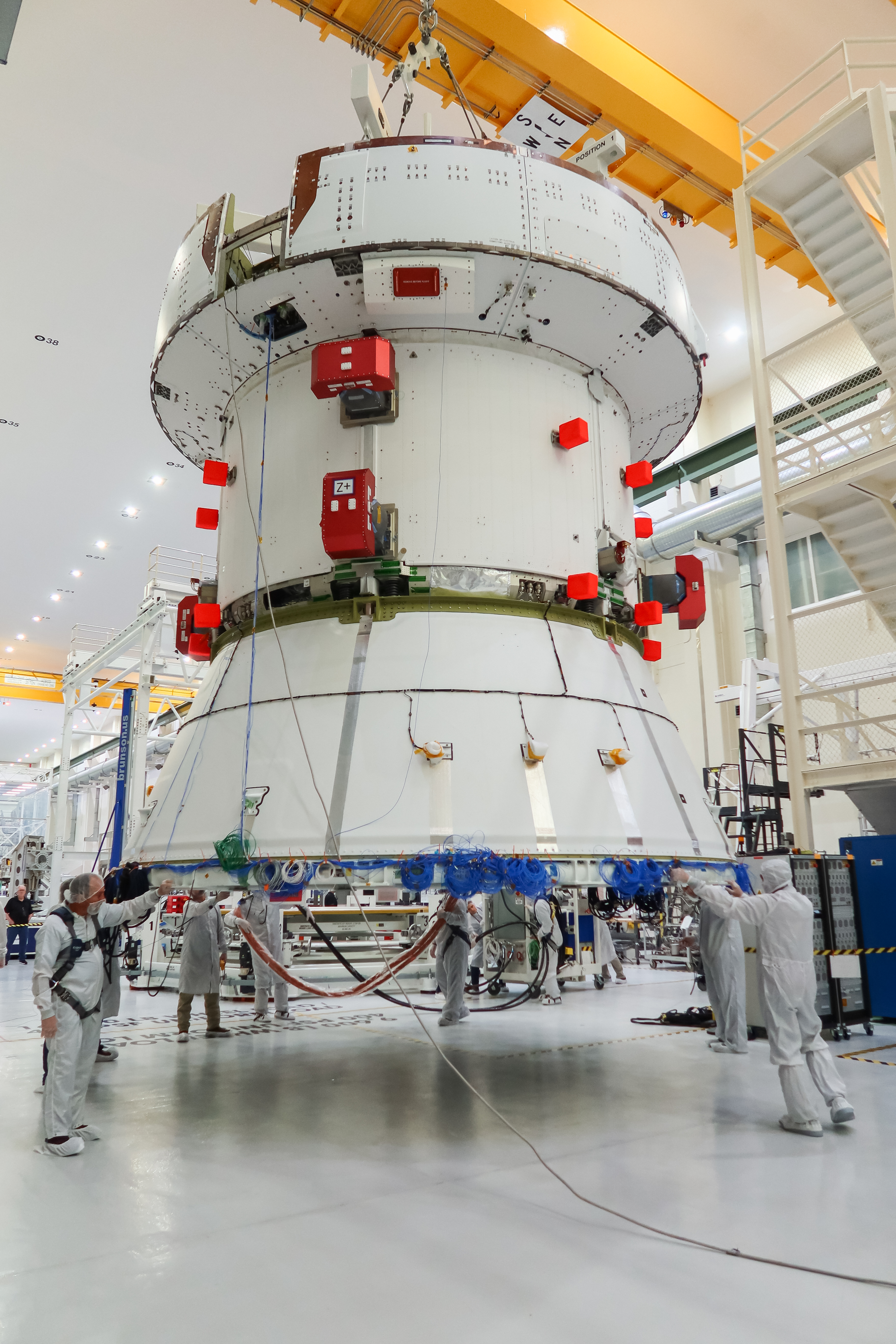
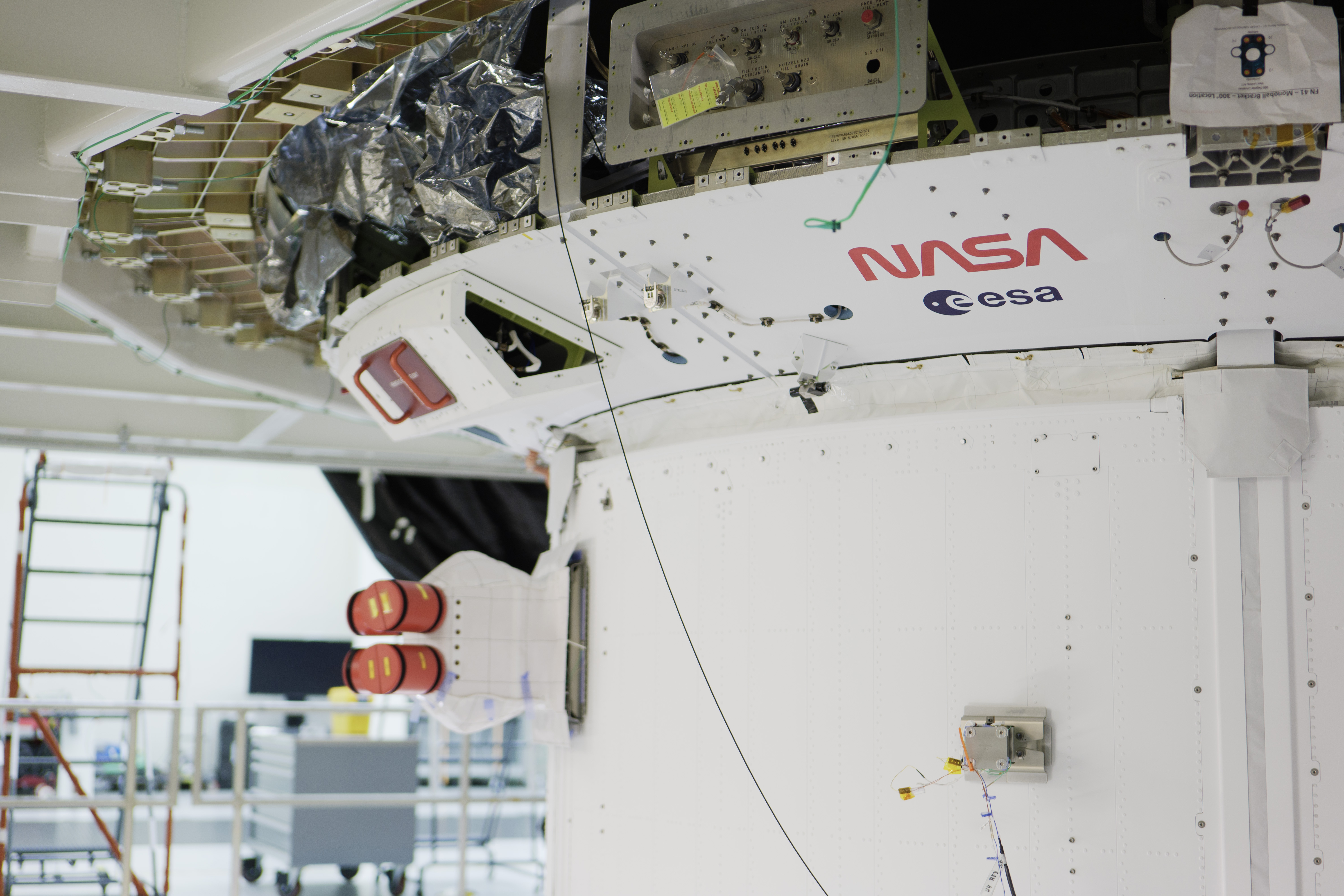
During launch, the service module is held in place between the Orion crew module adapter — which connects the service module to the spacecraft’s crew module — and the spacecraft adapter, which attaches to the Orion stage adapter to connect the service module to the SLS rocket. The crew module adapter houses electronic equipment for communications, power, and control, and it includes an umbilical connector that bridges the electrical, data, and fluid systems between the modules.
Consumable Storage
The consumable storage system of the service module provides potable water, nitrogen, and oxygen to the crew module. Potable water is provided by the water delivery system and stored in four tanks with metal bellows, covering usable water needs of the crew for the duration of the mission. Oxygen and nitrogen is provided by the gas delivery system and stored in four tanks.
Propulsion
The farther into space a spacecraft ventures, the more capable its propulsion systems need to be to maintain its course with precision and ensure its return home. In addition to its function as the main propulsion system for Orion, the service module is responsible for orbital maneuvering and position control. It’s equipped with a total of 33 engines: one main engine, eight auxiliary engines, and 24 reaction control thrusters.
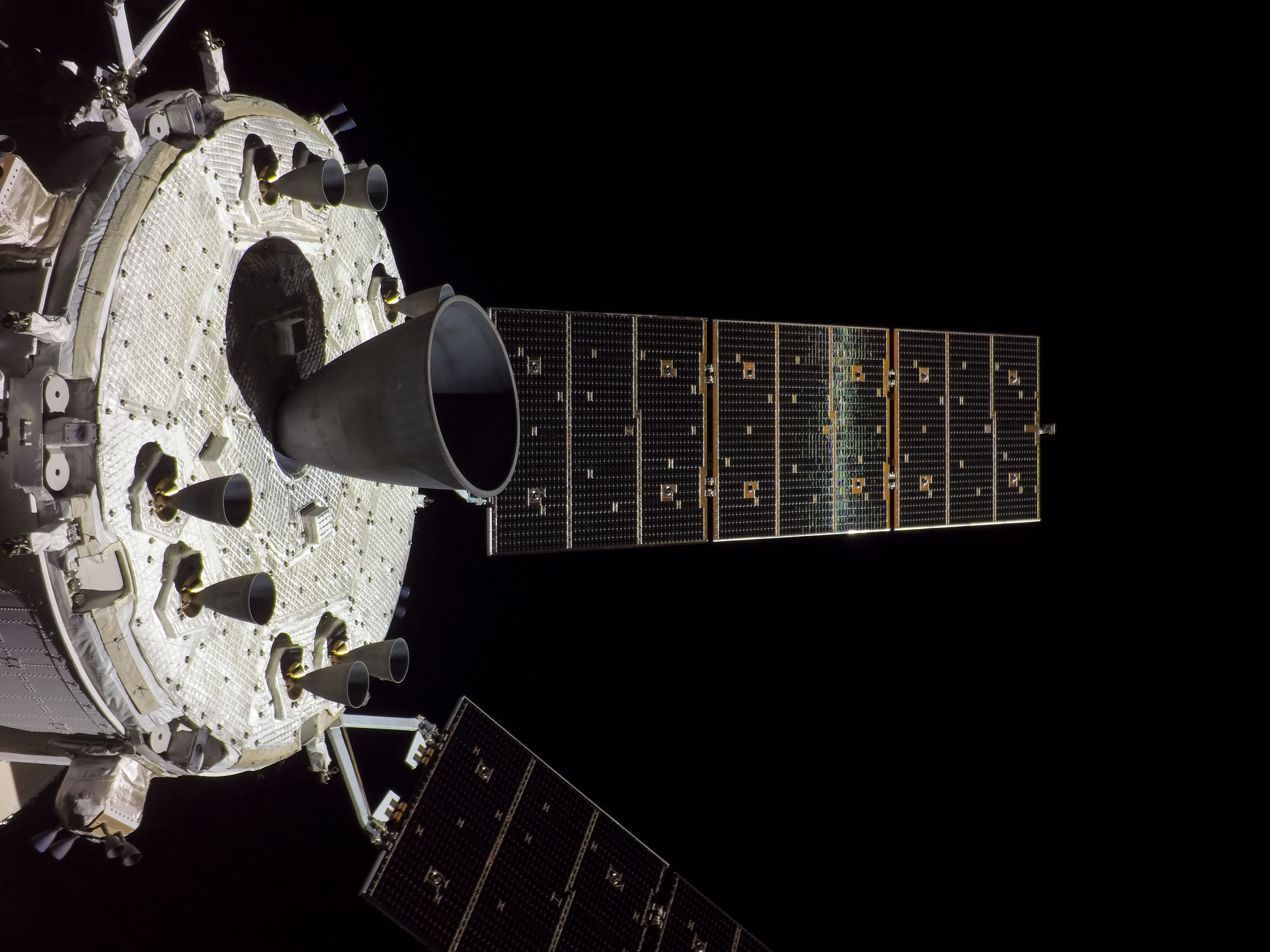
The main engine is an orbital maneuvering system engine previously flown on space shuttle missions, provided by NASA and made by Aerojet Rocketdyne. The auxiliary engines are R4D-11 engines, also made by Aerojet Rocketdyne and provided by NASA. The reaction control thrusters are provided by ESA and are the same model as those used on the Automated Transfer Vehicles built by ESA that carried cargo and resupply goods from Earth to the International Space Station between 2008 and 2015.
The main engine will provide major in-space maneuvering capabilities throughout the mission, including performing the translunar injection burn needed to put Orion on a path toward the Moon. The eight auxiliary engines are also used for translational maneuvers, essentially backing up the main engine. The 24 reaction control thrusters are used to steer and control Orion in orbit, but usually only 12 are used, and the other 12 serve mostly as backup. The propulsion system can also be used during some late phases of the launch for potential abort scenarios.
Artemis III Orbital Maneuvering System Engine Flight History
| Flight | Date | Orbiter |
| STS-51B | 04/29/1985 | Challenger |
| STS-51F | 07/29/1985 | Challenger |
| STS-61C | 01/12/1986 | Columbia |
| STS-118 | 08/08/2007 | Endeavour |
| STS-123 | 03/11/2008 | Endeavour |
| STS-126 | 11/14/2008 | Endeavour |
| STS-127 | 07/15/2009 | Endeavour |
| STS-130 | 02/08/2010 | Endeavour |
| STS-134 | 05/16/2011 | Endeavour |
Artemis II Orbital Maneuvering System Engine Flight History
| Flight | Date | Orbiter |
| STS-101 | 05/19/2000 | Atlantis |
| STS-106 | 09/08/2000 | Atlantis |
| STS-98 | 02/07/2001 | Atlantis |
| STS-104 | 07/12/2001 | Atlantis |
| STS-110 | 04/08/2002 | Atlantis |
| STS-112 | 10/07/2002 | Atlantis |
Artemis I Orbital Maneuvering System Engine Flight History
| Flight | Date | Orbiter |
| STS-41G | 10/05/84 | Challenger |
| STS-51J | 10/03/85 | Atlantis |
| STS-61B | 11/26/85 | Atlantis |
| STS-27 | 12/02/88 | Atlantis |
| STS-30 | 05/04/89 | Atlantis |
| STS-33 | 11/22/89 | Discovery |
| STS-31 | 04/24/90 | Discovery |
| STS-41 | 10/06/90 | Discovery |
| STS-37 | 04/05/91 | Atlantis |
| STS-43 | 08/02/91 | Atlantis |
| STS-44 | 11/24/91 | Atlantis |
| STS-45 | 03/24/92 | Atlantis |
| STS-46 | 07/31/92 | Atlantis |
| STS-101 | 05/19/00 | Atlantis |
| STS-106 | 09/08/00 | Atlantis |
| STS-98 | 02/07/01 | Atlantis |
| STS-104 | 07/12/01 | Atlantis |
| STS-110 | 04/08/02 | Atlantis |
| STS-112 | 10/07/02 | Atlantis |
Power
The service module’s electrical power system provides power for the Orion spacecraft, manages the power generated by the four solar-array wings of the service module, and charges the main batteries on the crew module. Each solar array wing consists of three panel sections, and each panel is approximately 6.5 by 6.5 feet (2 by 2 meters). The total length of each wing is nearly 23 feet (7 meters). There are a total of 15,000 gallium arsenide cells on the four arrays used to convert light into electricity, and the arrays can turn on two axes to remain aligned with the Sun for maximum power.
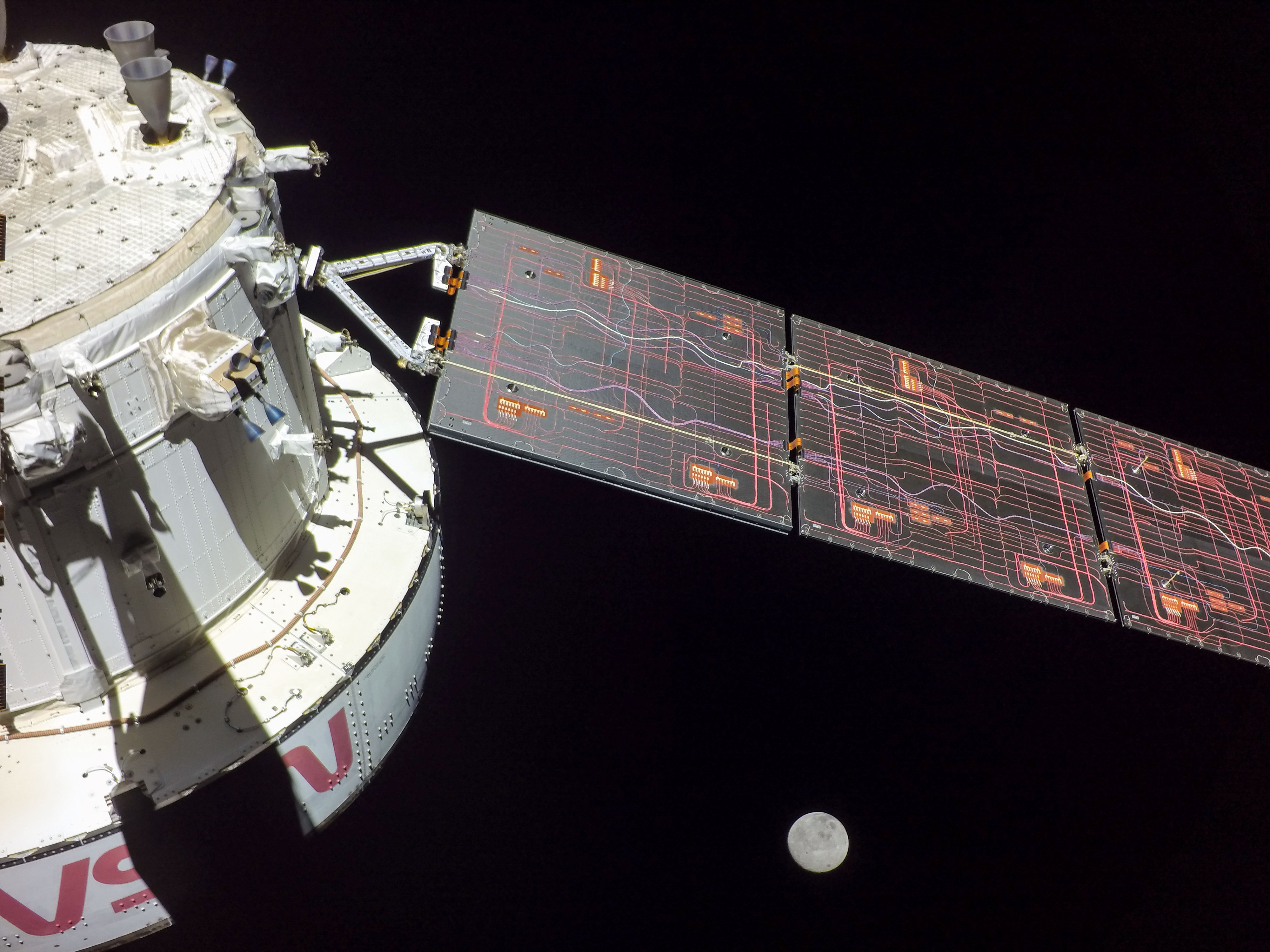
A power control and distribution unit provides the power interface between the service module and the crew module adapter, distributes electrical power to service module’s electrical equipment, and protects the power lines.
Thermal Control
The service module’s thermal control system includes radiators and heat exchangers to keep the equipment and astronauts at a comfortable temperature. The thermal control system includes an active portion, which transfers the heat of the entire spacecraft to the service module’s radiators, and a passive portion, which protects the service module from internal and external thermal environments.
Avionics
Computers control all aspects of the service module. The service module’s avionics manage the powered equipment of the module and the data-exchange services, which are based on instructions received from Orion’s flight computers in the crew module. Nearly seven miles of cables send commands and receive information from sensors.