

















Overview
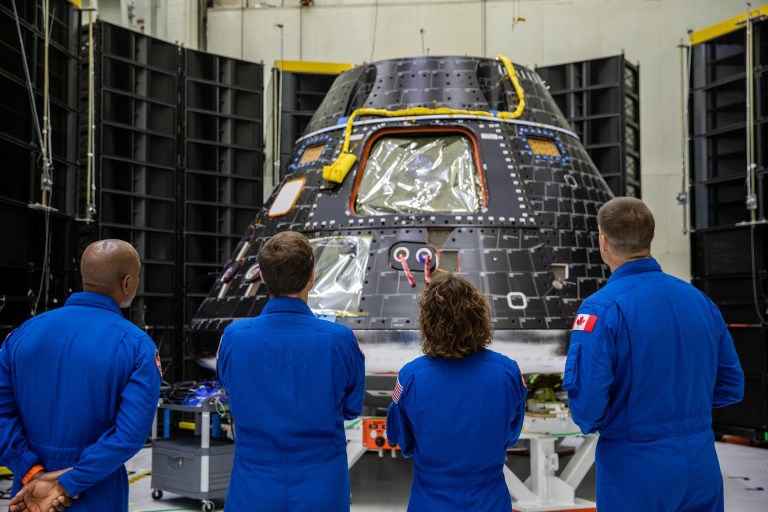
The crew module can accommodate four crew members on missions for up to 21 days without docking with another spacecraft, and provides a safe habitat through launch, in-orbit operations, landing, and recovery. Orion’s cabin has a habitable volume of 330 cubic feet, giving the crew about as much living space as two minivans.
Crew modules for Artemis missions are built by prime contractor Lockheed Martin, with primary structure welding performed at NASA’s Michoud Assembly Facility in New Orleans. Hundreds of suppliers across the nation provide Orion piece parts and components, which are delivered to the Operations and Checkout Building at NASA’s Kennedy Space Center for assembly. There, teams outfit Orion with these parts and systems and perform testing before transferring the spacecraft to NASA’s Exploration Ground Systems (EGS) team for final launch preparations.
Pressure Vessel
Orion’s crew module pressure vessel is the underlying frame of the crew module that provides an air-tight, habitable space for astronauts during the mission. The pressure vessel is assembled at NASA’s Michoud Assembly Facility in New Orleans by prime contractor Lockheed Martin. It is designed to withstand the harsh and demanding environment of deep space and is the core structure upon which all the other elements of Orion’s crew module are integrated.
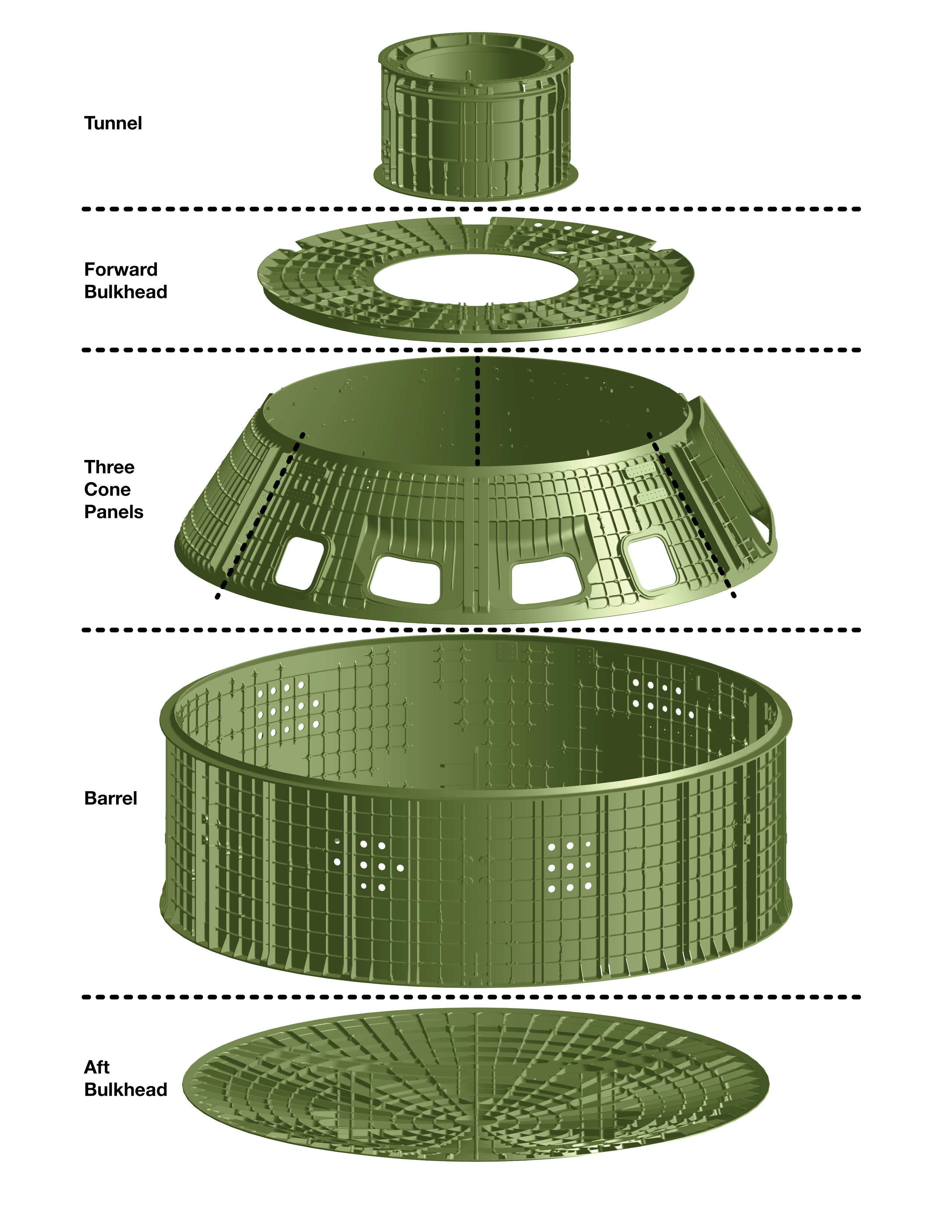
The pressure vessel’s exterior is comprised of seven large aluminum alloy elements that are manufactured by two key subcontractors, AMRO Fabricating Corp. in South El Monte, CA and Ingersoll Machine Tools in Rockford, IL. AMRO provides the pressure vessel’s three cone panels and Ingersoll provides the barrel, tunnel, forward and aft bulkheads.
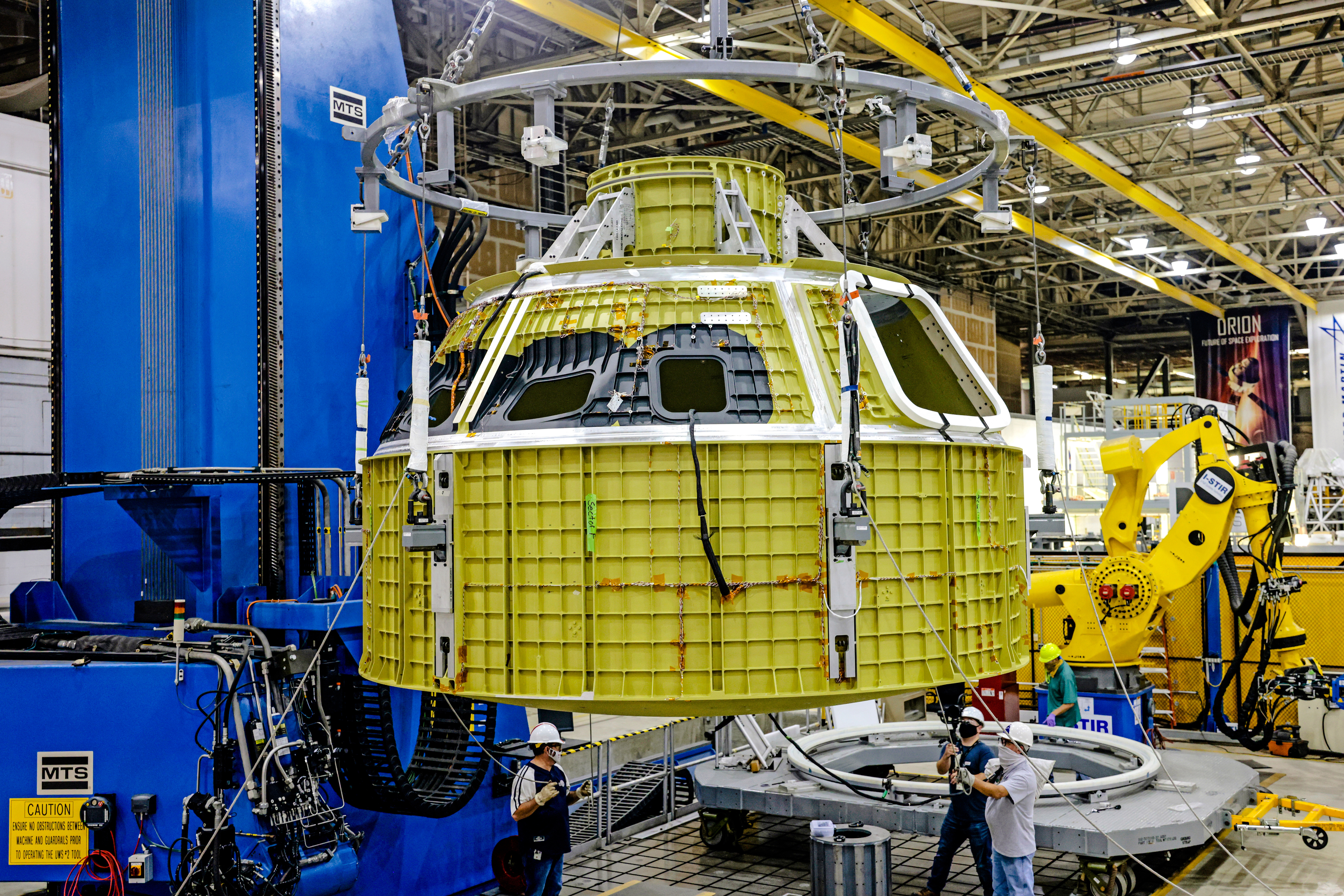
Once all the elements arrive at Michoud, they are welded together in detailed fashion. Orion’s original designs required 33 welds to create the pressure vessel. Engineers refined the design to reduce the number of welds to seven on Artemis I and missions beyond, saving 700 pounds of mass on the spacecraft.
The cone panels are joined with three welds to form the angled mid-section of the pressure vessel where the windows and hatch are located. Another weld connects the tunnel – which will allow astronauts to move between the crew module and other spacecraft through the docking hatch – and the forward bulkhead, which is at the top of the spacecraft and houses many of Orion’s critical systems, such as the parachutes that deploy during entry into Earth’s atmosphere. The forward bulkhead is then welded to the top of the cone panels to form what is called the forward structure.
The spacecraft’s barrel section, which is the largest single piece of the spacecraft, is welded to the aft bulkhead, which is the bottom portion of the vehicle, in order to form the aft structure. Technicians install Orion’s backbone assembly, a bolted structure consisting of nine pieces, inside the aft structure.
The seventh and final major structural weld, also called the closeout weld, combines the forward and aft structures to complete the pressure vessel. Once welding of the crew module’s pressure vessel is complete, it is shipped to NASA’s Kennedy Space Center where it undergoes further assembly.
The pressure vessel is joined using a method called friction-stir welding. Friction-stir welding produces incredibly strong bonds by transforming metals from a solid into a “plastic-like” state, and then using a rotating pin tool to soften, stir and forge a bond between two metal components to form a uniform welded joint, a vital requirement of next-generation space hardware.
Engineers undertake a meticulous process to prepare for welding. They clean the segments, coat them with a protective chemical, and prime them. They then outfit each element with strain gauges and wiring to monitor the metal during the fabrication process. Prior to beginning work on the pieces destined for space, technicians weld together a pathfinder, a full-scale version of the current spacecraft design, in order to refine their techniques and ensure proper tooling configurations.
Seven Welds of Orion’s Pressure Vessel
Pressure Vessel Cone
| PVC-1 | D-E (hatch) to A-F (windows) cone weld |
| PVC-2 | A-F to B-C cone weld |
| PVC-3 | B-C to D-E cone weld |
Pressure Vessel
| PV-1 | Tunnel to forward bulkhead weld |
| PV-2 | Forward bulkhead to top of cone panels weld (becomes the forward structure) |
| PV-4 | Barrel to aft bulkhead weld (becomes the aft structure) |
| PV-3 | Closeout weld – forward structure to aft structure weld (bottom of cone panels to barrel) |
Backshell
The backshell, which covers Orion’s pressure vessel on the sides of the crew module, is made up of 1,300 thermal protection system tiles. These tiles are made of a silica fiber material called AETB-8 (Alumina Enhanced Thermal Barrier), similar to the tiles used for more than 30 years on the space shuttle. They incorporate a stronger coating called “toughened uni-piece fibrous insulation,” which was used toward the end of the Space Shuttle Program. On average, the tiles are 8-inches by 8-inches and many are standard in size, allowing them to have the same dimensions with the same part number.
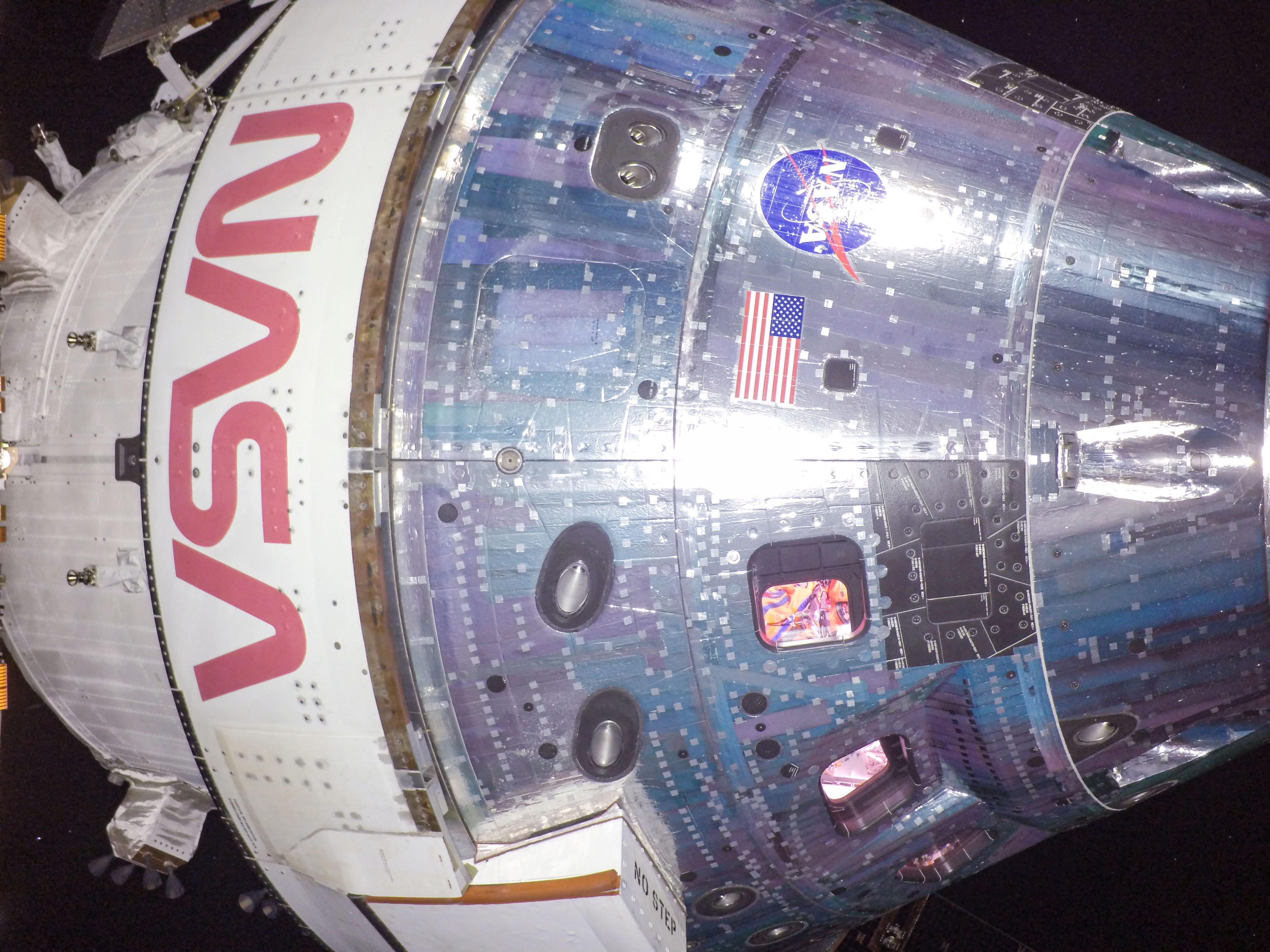
The tiles protect the spacecraft from in-space micrometeoroid debris, as well as extreme temperature variances ranging from the -350-degree Fahrenheit (-212-degree Celsius) coldness of space to the 5,000-degree (2,760-degree Celsius) heat when entering Earth’s atmosphere at lunar-return velocities. Spacecraft returning from the Moon re-enter Earth’s atmosphere faster and hotter than spacecraft from low Earth orbit.
Forward Bay Cover
On Orion’s crew module, the forward bay cover protects the top portion of the capsule, as well as the parachutes, during launch, orbital flight, and re-entry. It is covered with the same thermal protection tiles as the backshell. After the spacecraft re-enters Earth’s atmosphere, the forward bay cover is jettisoned at an altitude of approximately 23,000 feet to allow for the parachutes to deploy. The parachute system includes a series of 11 parachutes that are deployed in a sequence to slow down the crew module from about 325 mph to 20 mph or less, providing a safe speed for splashdown into the ocean.
Heat Shield
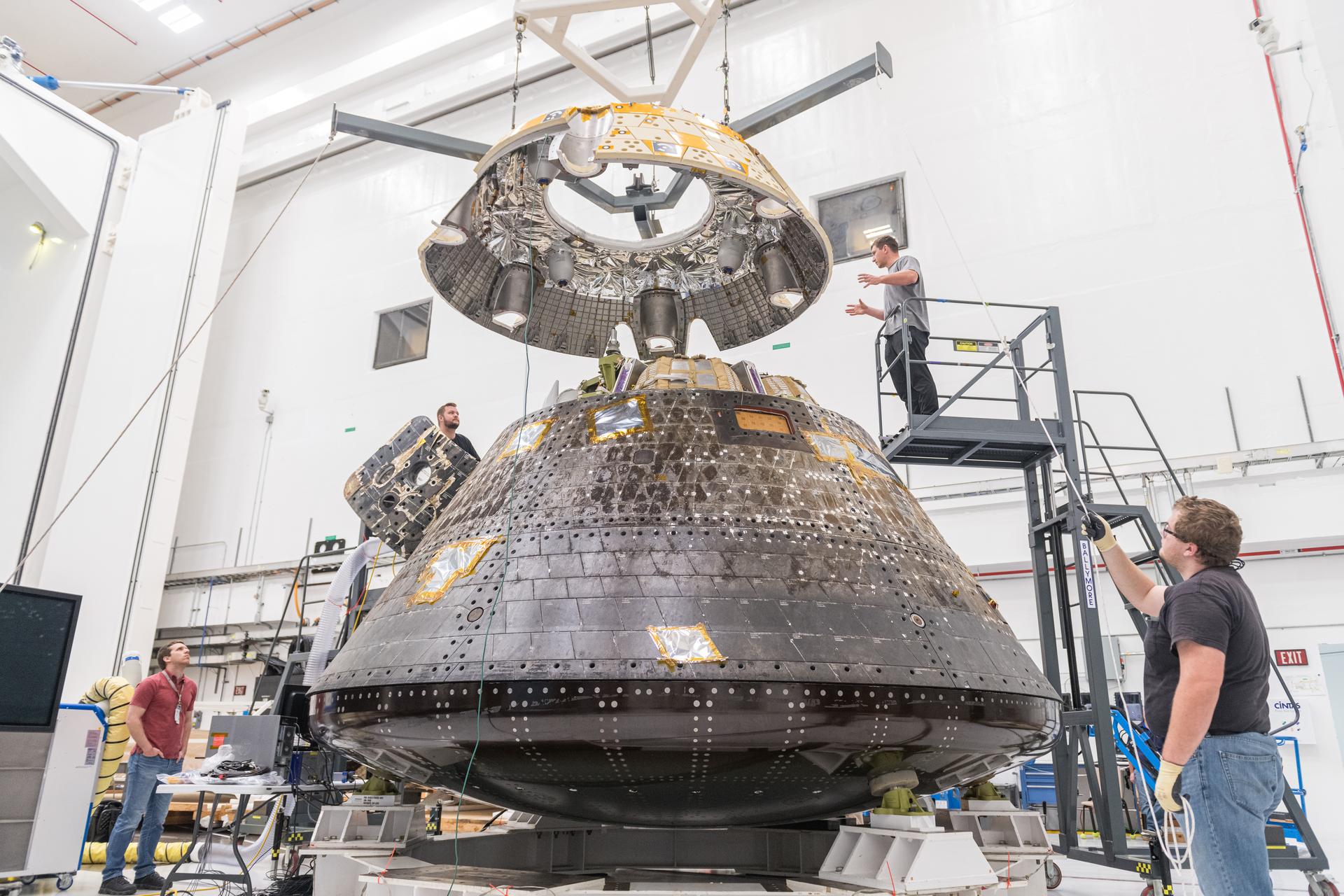
The bottom of the Orion capsule is covered by the world’s largest ablative heat shield, measuring 16.5 feet in diameter. The heat shield sheds intense heat away from the crew module as Orion returns to Earth, traveling about 25,000 mph and enduring temperatures about half as hot as the surface of the Sun at nearly 5,000 degrees Fahrenheit (2,760 degrees Celsius). The outer surface of the heat shield is made of 186 billets, or blocks, of an ablative material called Avcoat, a reformulated version of the material used on the Apollo capsules. The Avcoat is bonded to a titanium skeleton and composite skin that gives the shield its shape and provides structural support for the crew module during descent and splashdown. During descent, the Avcoat ablates, or burns off, in a controlled fashion, transferring heat away from Orion.
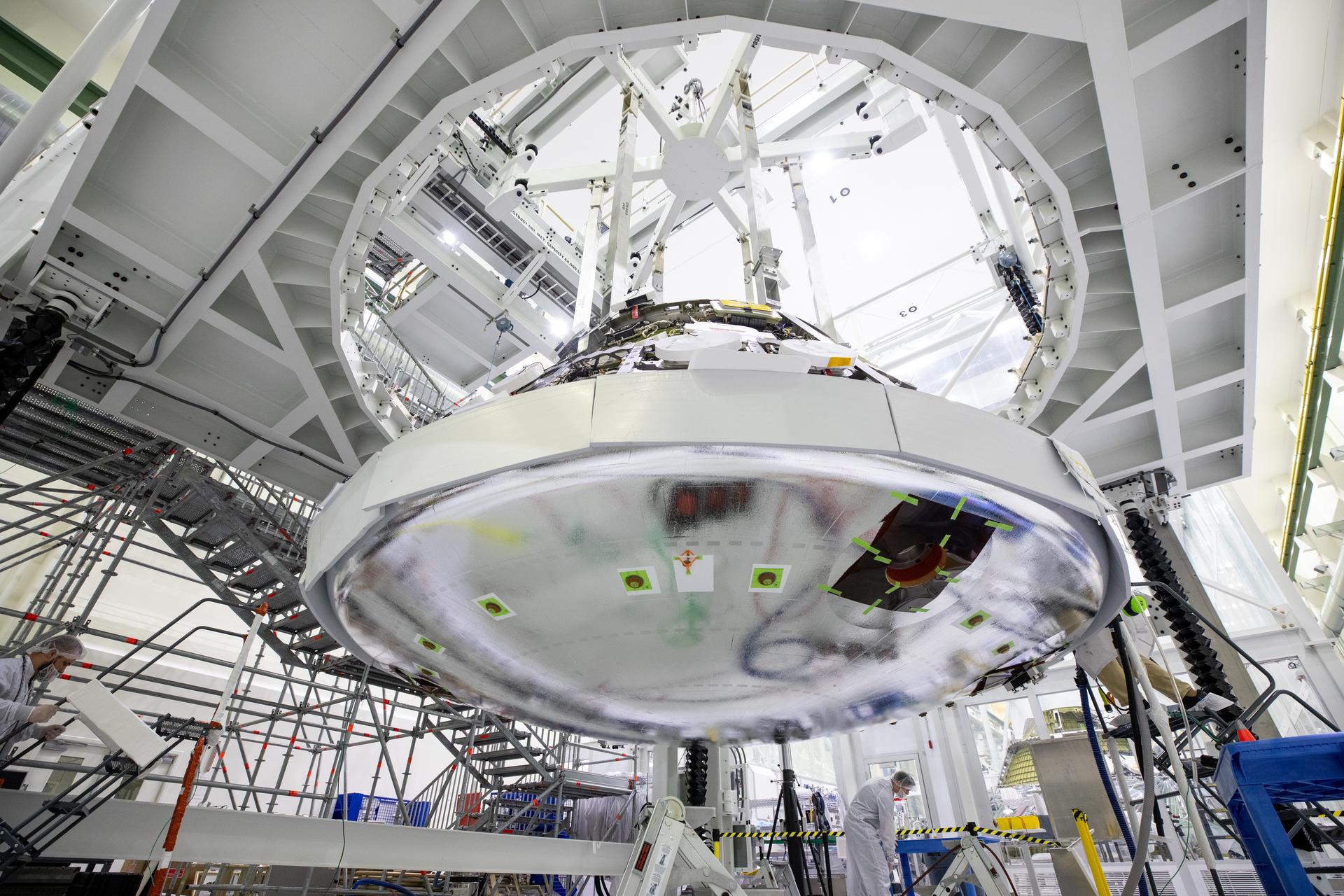
The Avcoat is first made into large blocks at NASA’s Michoud Assembly Facility in New Orleans and then shipped to NASA’s Kennedy Space Center in Florida. There, it is machined into 186 unique shapes before applied onto the heat shield. Engineers look for voids in the bond lines and measure the steps and gaps between the blocks. The gaps are filled with an adhesive material and then reassessed. After the thermal protection system has been applied and inspected, engineers and technicians put the heat shield through a thermal cycle test. This testing ensures that the thermal protection blocks are properly bonded and will perform as expected when exposed to temperature extremes during the mission. The heat shield is then given a coat of white epoxy paint. Aluminized tape is applied after the painted surface dries to dissipate electrical surface charges and maintain acceptable temperatures. Once all testing has been completed, the heat shield is bolted to the crew module.
Propulsion System
The crew module has a propulsion system comprised of 12 small engines called reaction control system thrusters. These are provided by Aerojet Rocketdyne and provide full control of crew module translation and rotation. When the crew module separates from the service module for reentry into Earth’s atmosphere, the 12 thrusters control the spacecraft’s return by firing bursts of propellant in varying sequences.
Hatches
The Orion spacecraft has three hatches: the crew module side hatch, the launch abort system (LAS) hatch, and docking hatch. The crew module hatch and LAS hatch enable safe crew entry and exit during nominal and emergency operations. The docking hatch enables crew transfer to other spacecraft, such as the human landing system planned for future crewed missions, and provides an additional crew exit path after landing. The ground crew closes the crew module and LAS hatch during prelaunch procedures after the flight crew is inside the spacecraft.
Crew Module Side Hatch
The side hatch is the primary entry and exit point for the crew. It features two complex hinges, a mechanical latch train operated by a gearbox and handle, manual handles, and a counterbalance system to assist with opening. It is built to withstand space and re-entry conditions, with thermal protection system panels and a window for visibility.
On the launch pad, the side hatch is closed first. The hatch has a pressurized counterbalance system that resists closure and must be vented in order to close. Initially held in an “auto lock” position, the hatch is manually pushed slightly open to release the lock before counterbalance venting, allowing it to close slowly. It is then latched externally and verified via ground systems. The counterbalance is repressurized to ensure the hatch can open in emergencies or after landing. Seal and cabin pressure leak checks follow using hatch interfaces. These steps — venting, closing, latching, repressing, and leak checks — take about an hour. Finally, exposed valves and fittings on the hatch are covered with thermal protection system panels for flight.
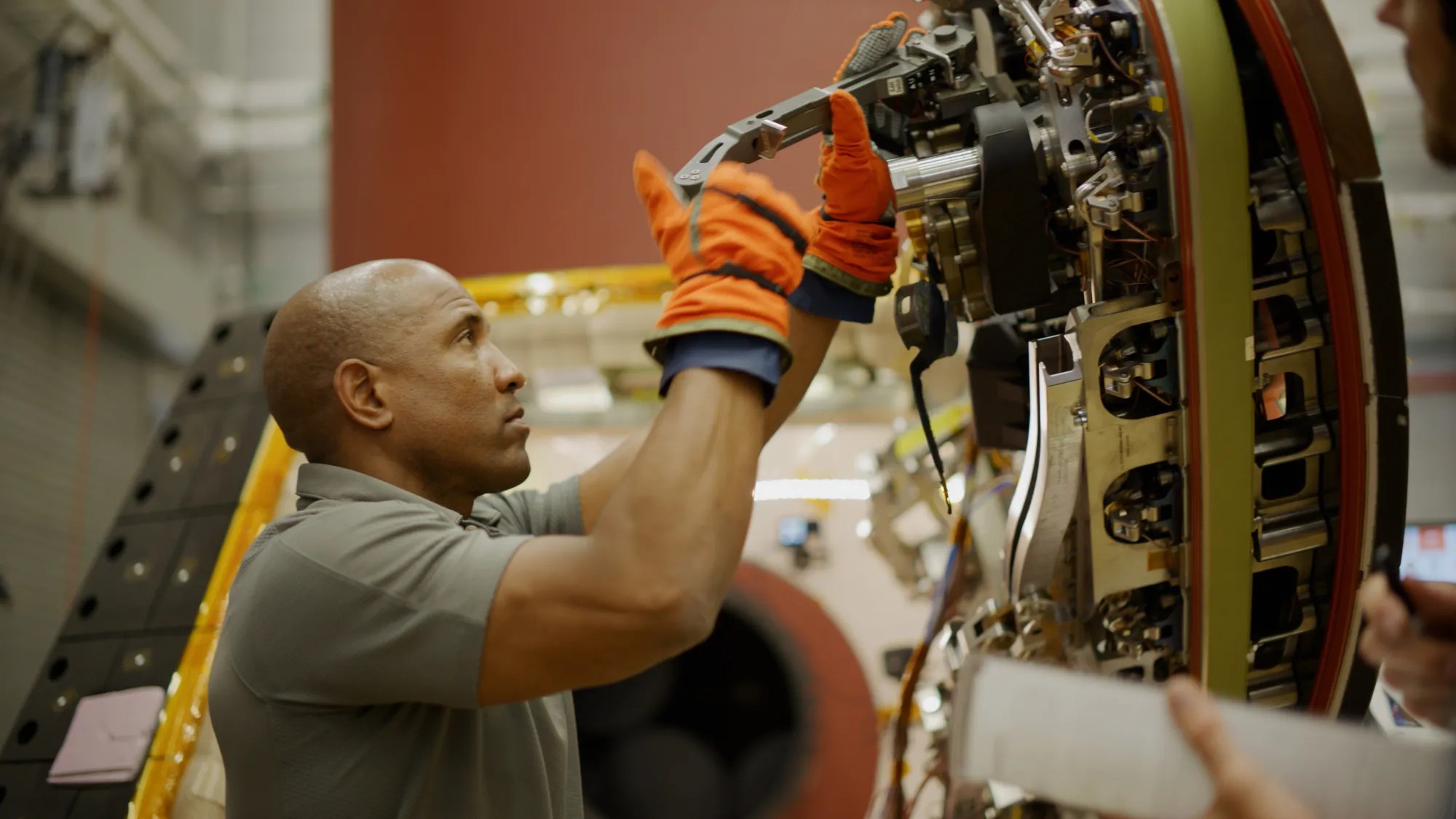
In the case of an emergency on the launch pad, the side hatch can be opened using a pyrotechnic system activated by the ground crew via lanyard, or the flight crew by removing a safety pin and hitting a paddle. The flight crew can unstrap, vent the cabin, and activate the pyros to initiate exit. The counterbalance helps push the hatch open, followed by the LAS hatch.
After landing, the recovery team removes the access panels, services the counterbalance, and assists with the crew’s exit from the side hatch. External pyros can also be used during recovery if rapid access is needed. If the side hatch is inaccessible, the docking hatch can be opened by the recovery team for crew exit . The crew may also open the docking hatch from the inside and deploy their own ladder. The counterbalance can be vented again to allow the side hatch to be reclosed after recovery.
Launch Abort System Hatch
The LAS hatch covers the side hatch until the LAS is jettisoned during flight. It shares similar structural and hinge configurations but uses a pneumatic latch train, where gas pressure drives the latches. Like the side hatch, it includes a window and manual handles.
After the side hatch is closed, the closeout crew manually pushes the LAS hatch shut, working against a permanently pressurized gas strut. Unlike the side hatch, which closes as the counterbalance is vented, the LAS hatch requires about 100 pounds of force per person to close. It is held open by an auto-lock mechanism that must be manually released.
Once shut, the closeout crew holds the LAS hatch in place while another team pneumatically latches it with ground equipment. A closeout panel is then installed to cover exposed components. This process takes about 30 minutes and differs from the side hatch, mainly in the manual force required and the use of a gas strut instead of a vented counterbalance.
In an emergency, the LAS hatch can be opened by the ground crew using a handle that instantly disengages the latches.
Before launch, the flight crew has minimal interaction with the hatches. Once suited, leak-checked, and strapped in, they remain seated while the ground crew handles all hatch operations, including closing, checking for leaks, and securing panels. In the event of a scrub, the crew may initiate their exit through the side hatch themselves, with the ground crew first opening the LAS hatch.
Parchutes
Also contained within the crew module are systems to support Orion’s safe return to Earth. Orion’s parachute system is designed to ensure a safe landing for astronauts returning from deep space missions to Earth in the crew module at speeds exceeding 25,000 mph, as well as during abort scenarios. While Earth’s atmosphere will initially slow the spacecraft down to 325 mph, the parachutes will slow Orion to a safe speed of 20 mph or less for landing in the Pacific Ocean.
The parachute system includes 11 parachutes made of 36,000 square feet of parachute canopy material and attached to the top of the spacecraft with more than13 miles of Kevlar lines. Parachute deployment begins at about five miles in altitude with three forward bay cover parachutes used in conjunction with pyrotechnic linear thrusters to ensure separation of the forward bay cover, which protects Orion and its parachutes during the heat of reentry. The forward bay cover parachutes are packed using a hydraulic press, with forces as high as 3,000 pounds.
Two drogue parachutes are deployed to slow and stabilize the crew module during descent and establish proper conditions for main parachute deployment to follow. The drogues are deployed by cannon-like mortars from the crew module forward bay at 100 feet per second (68 mph). The drogues are packed using a hydraulic press, with forces as high as 10,000 pounds.
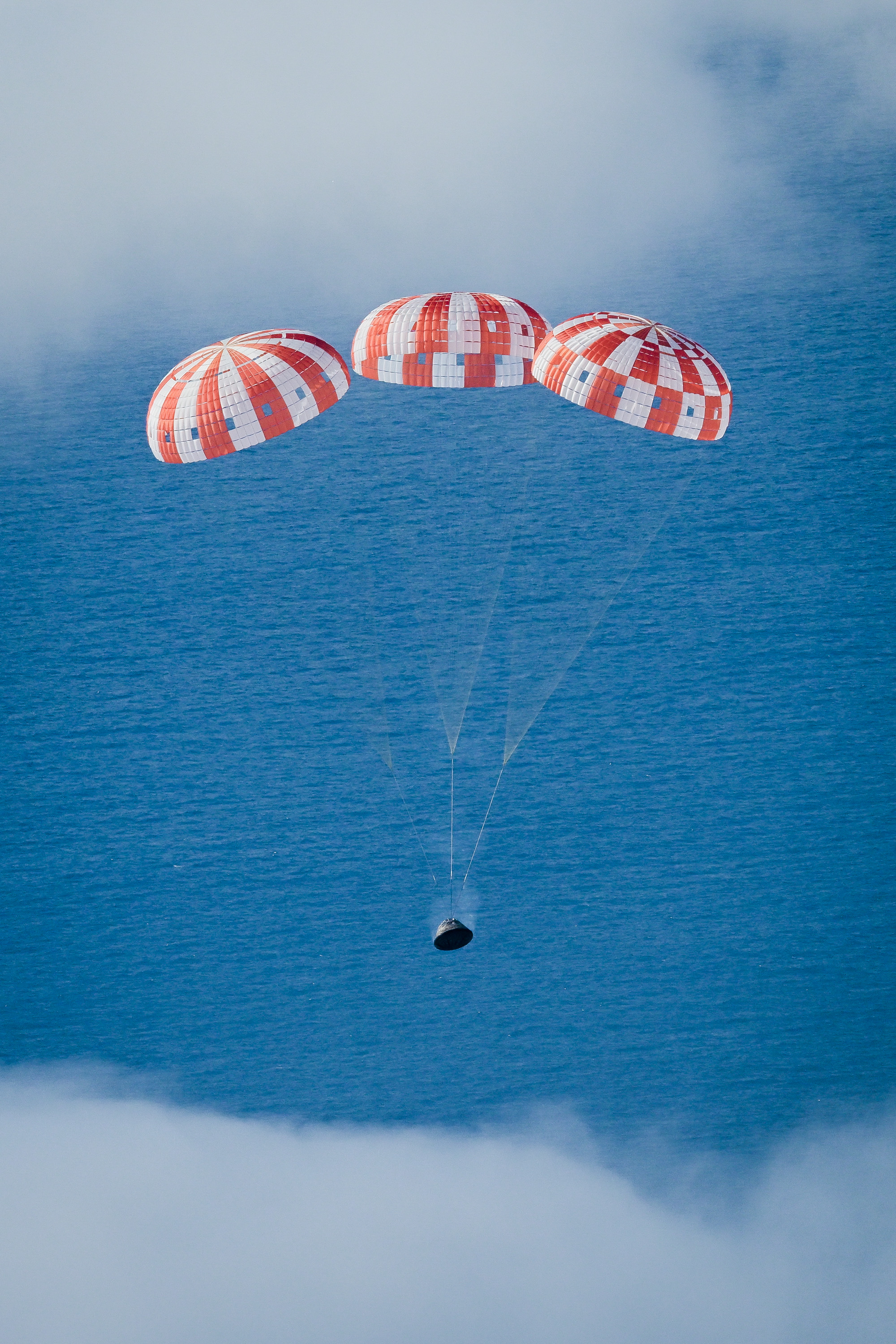
Three pilot parachutes will lift and deploy the main parachutes from the crew module forward bay. They are mortar-deployed from the crew module forward bay at 112 feet per second (76 mph). The pilots are packed using a hydraulic press for convenience but are much lower density and can be “hand packed” if required.
The three main parachutes then slow the crew module to a speed that ensures astronaut safety during landing. Each of Orion’s main parachutes weighs 270 pounds and is packed densely to fit in the top part of the spacecraft. Once fully inflated, the three mains would cover almost an entire football field. The mains are packed using a hydraulic press, with forces as high as 50,000 pounds. They are autoclaved with a vacuum applied to the parachute at 190 degrees Fahrenheit (88 degrees Celsius) for 48 hours to help “set” the packing and remove atmospheric moisture.
Embedded in several parachutes are pyrotechnic riser cutters, which use fuses set to ignite at specific times and push blades through bulletproof materials, severing the lines at precise moments and allowing the parachutes to unfurl to complete the deployment sequence. Within 10 minutes of descent through Earth’s atmosphere, everything must deploy and assemble itself in a precise sequence to slow Orion and its crew for a safe splashdown in the ocean. The parachute system also is designed to keep the crew safe in several scenarios, such as mortar failures that could prevent a single parachute from deploying, launch aborts, or other conditions that produce loads close to the maximum material capability.
The parachute system was developed and tested by NASA and the agency’s contractor partners. Parachutes are designed and fabricated by Airborne Systems in Santa Ana, California; the mortars are provided through Lockheed Martin by General Dynamics Ordinance & Tactical Systems, located in Seattle; and project management is performed by Jacobs Engineering’s Engineering Science Contract Group in Houston.
Parachute Quick Facts
Three Forward Bay Cover Parachutes (FBCP)
| Diameter | 7 ft. |
| Length | 100 ft. |
| Weight | 8 lbs. each |
| Material | All Kevlar materials |
| Deployment Altitude | 26,500 ft. |
| Deployment Vehicle Speed | 475 ft. per sec. (324 mph) |
| Density | Approx. 49 lbs. per cubic ft. (roughly the same as oak) |
| Final Packed Size | 7.2” by 6.9” (0.16 cubic ft.) cylinder |
Two Drogue Parachutes
| Diameter | 23 ft. |
| Length | 100 ft. |
| Weight | 60 lbs. each |
| Material | Kevlar and Nylon materials |
| Deployment Altitude | 25,000 ft. |
| Deployment Vehicle Speed | 450 ft. per sec. (307 mph) |
| Density | Approx. 40 lbs. per cubic ft. (roughly the same as oak) |
| Final Packed Size | 16.5” by 16.2” (2 cubic ft.) cylinder |
Three Pilot Parachutes
| Diameter | 10 ft. |
| Length | 70 ft. |
| Weight | 9 lbs. each |
| Material | Kevlar and Nylon materials |
| Deployment Altitude | 9,500 ft. |
| Deployment Vehicle Speed | 190 ft. per sec. (130 mph) |
| Density | Approx. 35 lbs. per cubic ft. (roughly the same as pine) |
| Final Packed Size | 6.8” by 13.3” (0.3 cubic ft.) cylinder |
Three Main Parachutes
| Diameter | 116 ft. |
| Length | 220 ft. |
| Weight | 270 lbs. each |
| Material | Kevlar and Nylon materials |
| Deployment Altitude | 9,000 ft. |
| Deployment Vehicle Speed | 190 ft. per sec. (130 mph) |
| Density | Approx. 44 lbs. per cubic ft. (roughly the same as oak) |
| Final Packed Size | Approx. 7 cubic ft. irregular shape to fit into the vehicle forward bay |
Crew Module Uprighting System
When Orion splashes down in the Pacific Ocean off the coast of San Diego, it will stabilize in one of two positions: the top of the capsule pointed up, or top pointed down. The crew module uprighting system (CMUS) deploys a series of five bright orange helium-filled bags on the top of the capsule to flip Orion right side up in the event it stabilizes upside down.
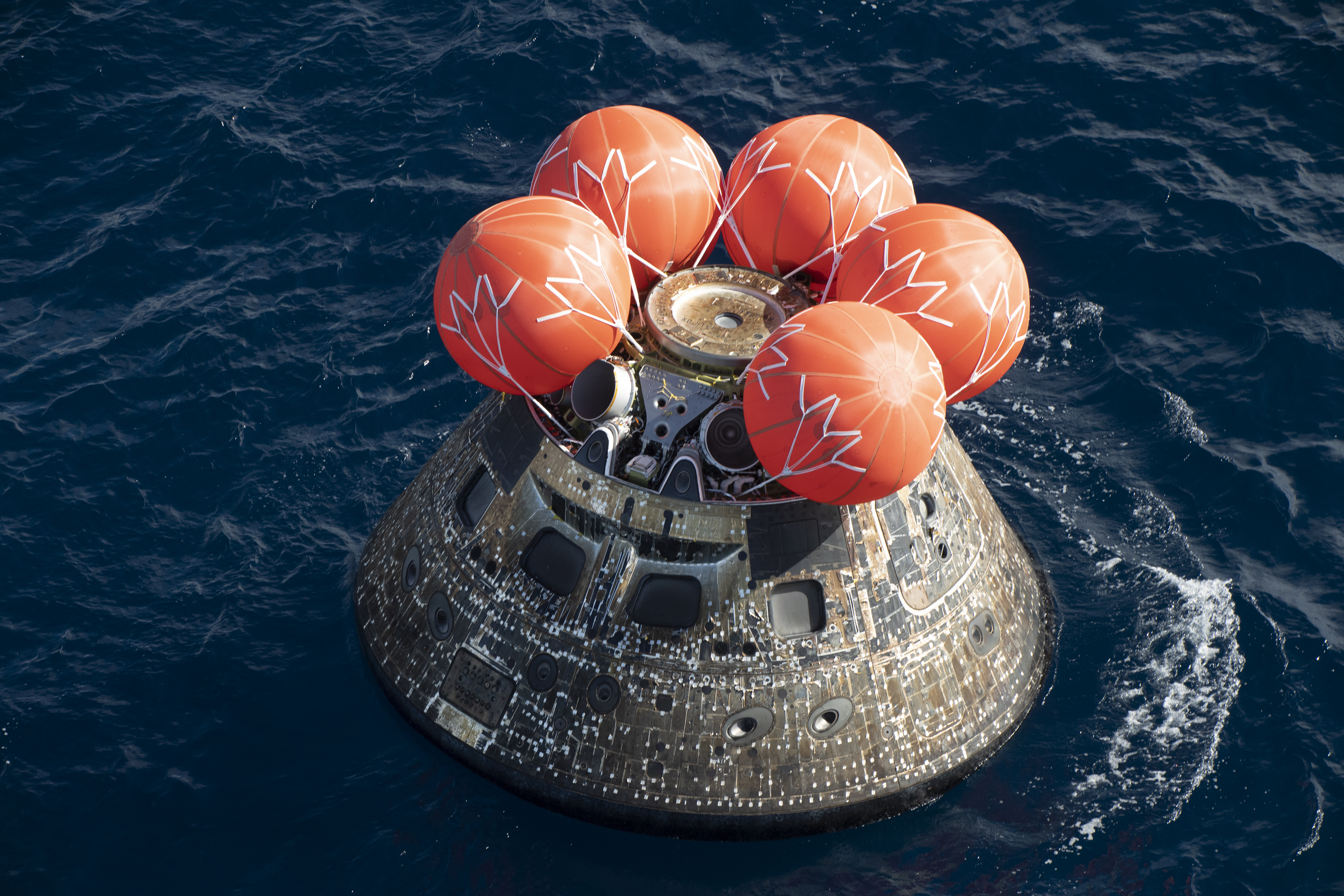
The five bags that make up the CMUS are packed in hard containers and installed on top of the capsule inside the structural gussets between the parachutes and other equipment. The bags are inflated with helium gas that is stored in pressure vessels located close by the bags. Each bag has an independent inflation system. The system initiates after landing and opens a valve for helium to flow into the uprighting bags. As the gas fills the bags, they deploy from their containers and inflate to their full volume.
The CMUS will deploy regardless of the landing position of the capsule. It takes less than four minutes for the CMUS to upright the capsule, and the system will keep Orion upright and stable after splashdown in the ocean and for at least 24 hours, if necessary. The capsule must be upright for crew module communication systems to operate correctly and to help protect the health of the crew members inside on future missions from health impacts due to extended time hanging upside down in seat harnesses.