























Multi Sector Planner (MSP)
Air traffic control in the en route airspace environment in the United States (U.S.) had traditionally been performed by a team, consisting of a radar-controller (R-side) and a second controller referred to as a data-controller (D-side) or a radar-associate. Several developments in the technology supporting air traffic management- digital data communication among controllers and between controllers and aircraft, improved positioning accuracy for flight operations, conflict prediction, and sector complexity assessment- have enabled consideration of new organizational structure and functional standards for team operations. One such consideration was a modification of a standard configuration to include a “multi-sector planner” (MSP) position in the team. This MSP position had been investigated in several research and field studies, both in the U.S. and in Europe. The concept provided a spectrum of redistributed roles and responsibilities among the air traffic management team members including physical relocation. The feasibility and effectiveness of two variations of these concepts were investigated initially with the Cognitive Systems Engineering evaluative methodology described in Corker et al (2007).
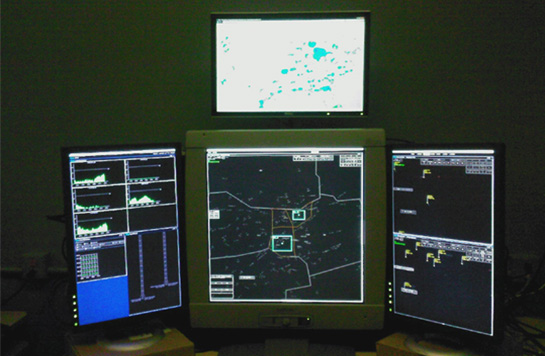
The two concepts for the MSP position that were developed for the FAA in 2005 by researchers from NASA Ames and San Jose State University were: a “Multi-D” concept, where the MSP acts as a D-side controller for several radar controllers, and an “area flow planner” concept. In 2006, a human in the loop (HITL) simulation was conducted to compare both concepts to a baseline condition. Results from this simulation led to selection of the area flow planner concept for further development.
The role of the area flow planner MSP, as tested in 2006, was to support the radar controller by planning ahead and smoothing “medium-term” traffic flows for the three sectors within their area of responsibility. Under this concept the MSP had responsibility for managing traffic flows and balancing traffic loads within the multi-sector region of airspace.
While the 2006 simulation demonstrated initial feasibility of the MSP position as an effective member of the air traffic controller team, it was not designed to assess how successfully the MSP could monitor and manage flow problems within his or her own area while also providing assistance to adjacent MSPs. Follow-on research in this area was recommended and was completed, along with the development of communication tools and decision aids, and of appropriate procedures, roles and responsibilities for effective integration of this position within the facility and the NAS.
Follow-up Research
Follow-up research activities continued to build on the results from 2006 and followed the primary recommendations. The objectives included:
(1) Develop procedures for MSP-MSP interactions both within and across facility boundaries. Evaluate impact and feasibility considering that (a) each MSP is actively managing within-area flow responsibilities, while responding to external requests for assistance; and (b) there is an inherent dependency on upstream actions to accomplish local goals. This dependency means that effective collaboration procedures are crucial to the position’s success.
(2) Expand the definition of roles, responsibilities, and procedures, integrating the MSPs within the larger context of air traffic control and traffic management operations.
(3) Determine the information and decision support tool the MSP needs for situation assessment, traffic flow manipulation, and for coordination with others (R-sides, D-sides, adjacent MSPs, adjacent and underlying facilities, TMU, and front-line managers).
These objectives were addressed in a series of activities, including: cognitive walkthroughs, simulation shakedown/walkthroughs, and a 4-week HITL evaluation. The objective of the first two walkthroughs was to develop and refine the MSP concept of operations, with particular focus on interactions between the MSP and other positions; the MSP’s information and automation support requirements; and identifying research issues and planning the 2009 HITL simulation. Technologies available on the MSP position as well as communication means to facilitate automated interaction with other ATC operators were prototyped by the AOL R&D team based on the 2006 findings and the walkthrough activities described above.
Multi-Sector Planner Publications
K. Corker, D. Liang, P. U. Lee, & T. Prevot (2007) New Air Traffic Management Concepts Analysis Methodology: Application to a Multi-Sector Planner in US Airspace, Air Traffic Control Quarterly Vol 15 (4)
T. Prevot, P. U. Lee, L. Martin, J. S. Mercer, E. A. Palmer, & N. M. Smith (2006) Tools for Trajectory-Based Air Traffic Control and Multi Sector Planning, HCI-Aero 2006, Seattle, WA, September 2006