

















Functional Allocation
In conjunction with NASA Langley Research Center, NASA’s Airspace Operations Lab explored issues and ideas for allocating separation assurance functions to meet the future air transportation needs. A separation assurance system primarily performs the functions necessary to ensure that aircraft remain safely separated from other traffic. Such a system is also simultaneously concerned with the avoidance of severe weather, the conformance of flights to a variety of operational constraints, and the overall expeditious flow of traffic from origin to destination.
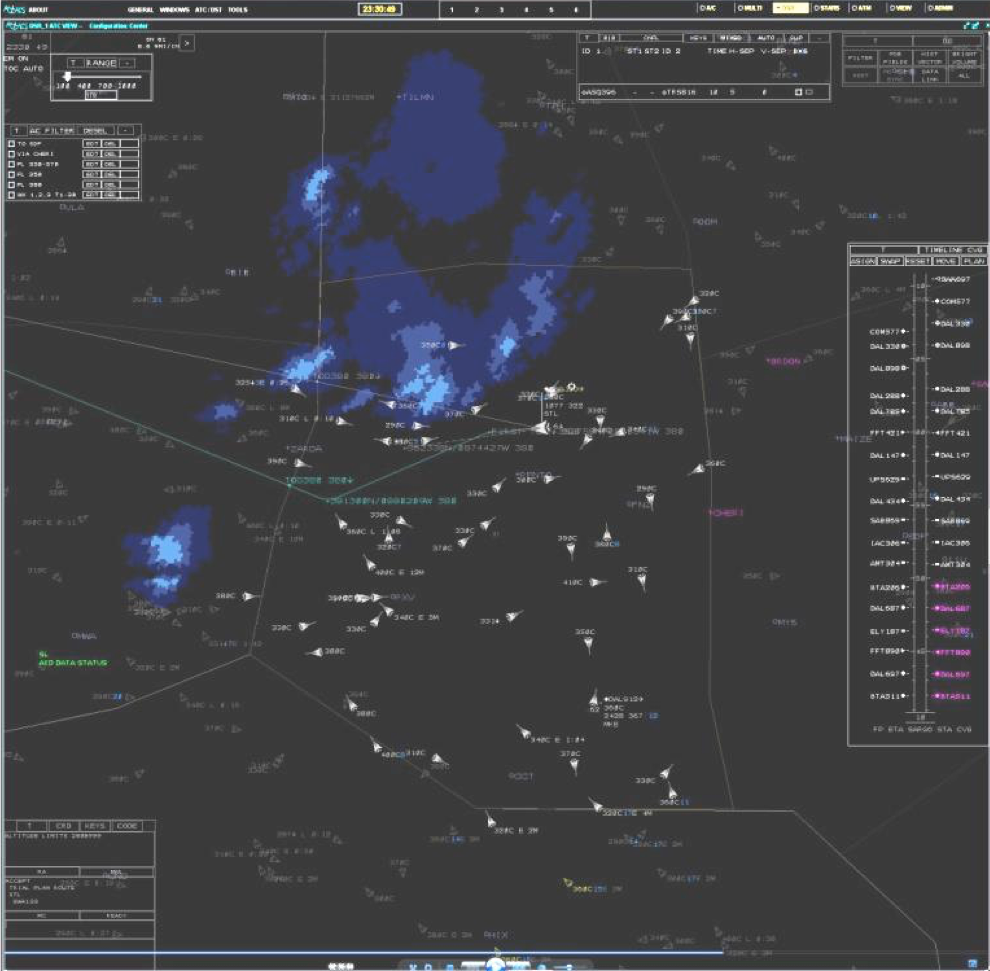
In the old system, air traffic services provided these functions. Howeve, with the higher modern levels of operations, this can result in excessive controller workload, limited capacity and, often, inefficient operations. With continued increases in traffic, these weaknesses can be exacerbated. New automation in the air, on the ground and/or the cloud, and powerful new communication technologies have enabled different ways to allocate trajectory management and separation assurance functions.
NASA’s functional allocation research successfully identified the strengths and weakness of different allocations of separation assurance functions amongst the wide variety of agents participating in the air traffic operation. This research helped provide a roadmap to ensure that fundamental research is pointed towards an efficient final state. The future system has helped handle growing travel in a safe, efficient, and sustainable manner.
Functional Allocation Publications
T. Prevot, J. Mercer, L. Martin, J. Homola, C. Cabrall & C. Brasil (2010) Functional Allocation for Ground-Based Automated Separation Assurance in NextGen
D. Wing, T. Prevot, J. Murdoch, C. Cabrall, J. Homola, L. Martin, J. Mercer, et.al (2010) Comparison of Airborne and Ground-Based Function Allocation Concepts for NextGen Using Human-In-The-Loop Simulations, 10th AIAA Aviation Technology, Integration and Operations (ATIO) Conference, Fort Worth, Texas
J. Homola, T. Prevot, J. Mercer, C. Brasil, L. Martin et.al (2010) A Controller-in-the Loop Simulation of Ground-Based Automated Separation Assurance in a NextGen Environment, Second ENRI International Workshop on ATM/CNS (EIWAC 2010): Safety, Efficiency, and Environmental Issues, Tokyo, Japan