










Flight Deck Display Research Laboratory (FDDRL)
The Flight Deck Display Research Laboratory (FDDRL) supported the research and development of airside displays and interfaces. To that end, researchers and developers collaborated to prototype and vet concepts. Experiments were designed to focus on particular issues of interest and were appropriately scaled in scope. The research concepts were then refined and matured iteratively between development and experimentation.
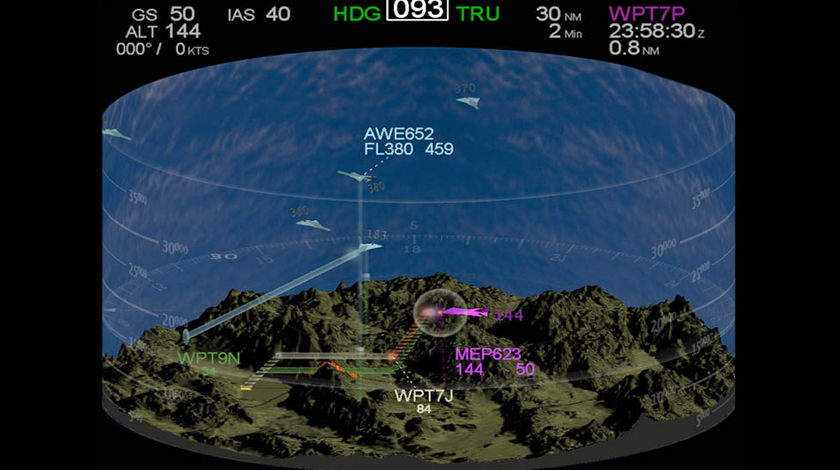
The lab’s principal product was the Cockpit Situation Display (CSD). The CSD, designed around the lab’s advanced Cockpit Display of Traffic Information (CDTI), was originally built for, and incorporated into, the 2004 Distributed Air-Ground Traffic Management (DAG-TM) simulations. In that project, it served as the primary visual interface for both medium-fidelity single and multi-pilot simulators. It also served as the primary visual interface for the high-fidelity full-mission Advanced Concepts Flight Simulator at the Ames Crew Vehicle System Research Facility. Since its inception, many of the lab’s part-task experiments have examined, or leveraged, CSD technologies. CSD stations have been deployed at several institutions throughout the country where they were used collaboratively with the FDDRL to study significant human-in-the-loop (HITL) issues.
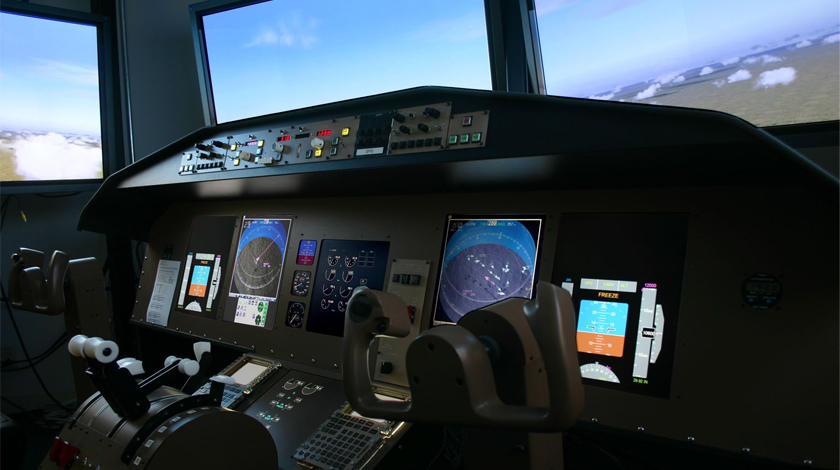
The CSD was designed to be easy to configure, allowing its various features and embedded tools to be selectively enabled or disabled. This, in turn, made it an easily used research platform, and the basis for much experimentation and exploration. Within the FDDRL, the CSD formed the basis for fast prototyping and subsequent HITL examination of near and far-term airspace concepts and flight deck procedures.
Noteworthy Publications
Johnson, W.W., Kaiser, M.K., Foyle, D.C. (1992). Beyond the cockpit: The visual world as a flight instrument, Paper presented at the 63rd Annual Scientific Meeting of the Aerospace Medical Association, Miami Beach, FL, May.
Battiste, V., Johnson, W.W. (2001). Flight Deck Tools for distributed air ground decision making in future ATM. NASA Research Report
Johnson, W.W., Battiste, V. (2002). Enabling Cockpit-Based Self-Separation. NASA Research Report
Johnson, W.W., Battiste, V., Granada, S., Johnson, N., Dao, Q., Wind, D., Tang, A. (2005). A Simulation Evaluation of a Human-Centered Approach to Flight Deck Procedures and Automation for En Route Free Maneuvering, Proceedings of the 12th International Symposium on Aviation Psychology, Oklahoma City, OK.
* Please note, this webpage is not actively maintained and is for historical reference only.