











Distributed Team Decision-Making (DTDM)
The objective of the Distributed Team Decision-Making (DTDM) project was to improve mission safety by 1) determining the effects of task/crew-related stressors on team performance 2) developing technologies to detect psychosocial dysfunction in teams and 3) identifying effective team interaction strategies as countermeasures to assure mission success.
Since the beginning of human space flight, crucial incidents relating to the psychological, behavioral, and interpersonal aspects of crew performance have jeopardized crew safety and mission success in U.S. space programs. Successful long-duration space missions will depend on the ability of crewmembers to collaborate effectively under highly stressful conditions.
Interpersonal relationships will be of particular concern as crewmembers on long-duration space missions become more diverse in terms of culture, gender and professional backgrounds. Tensions are likely to result from miscommunications and misunderstandings based on differing cultural norms and expectations.
This four year project examined (a) how team composition affected team effectiveness, affect and cohesion, (b) whether stress-identification strategies predicted team performance across diverse crews, (c) whether there was an ideal group composition, and (d) the effectiveness of various training approaches to counteract team dysfunction.
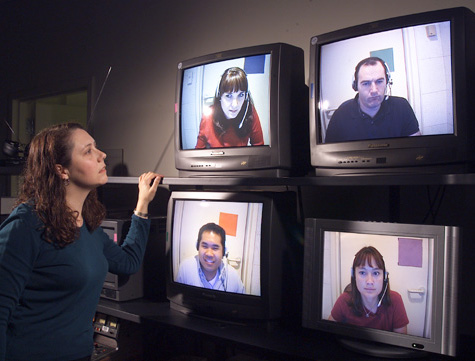
The research performed by the Distributed Team Decision Making team addressed Risk #18 in the NASA Critical Path Roadmap under Human Behavior and Performance: Human performance failure due to poor psychosocial adaptation, which is classed as a Type I Risk and is ranked #1.
The specific research questions addressed by the Distributed Team Decision Making project included:
- What were the fundamental behavioral and social stressors during long-duration missions that would most likely affect crew performance, both on an individual and a team level?
- What specific factors contributed to the eventual breakdown of individual and team performance?
- What behaviors, experiences, personality traits and leadership styles that optimize performance could be identified and used to select and assemble the best teams for long-duration missions?
The expected benefits of our research included:
- Non-invasive measures of team functioning
- Tools for self assessment and team feedback
- Predictors of team breakdown
- Countermeasures to prevent or mitigate team dysfunction within multi-cultural or mixed gender team environments
- Guidelines for selecting and training crews for successful mission performance (self-management and decision making)
Noteworthy Publications
Orasanu, J.M. (1993). Decision-making in the cockpit, In E. L. Wiener, B. G. Kanki, & R. L. Helmreich (Eds.), Cockpit resource management (pp. 137–172). Academic Press.
Orasanu, J.M., Sala, E. (1993). Team Decision Making in Complex Environments, In G. A. Klein, J. Orasanu, R. Calderwood, & C. E. Zsambok (Eds.), Decision making in action: Models and methods (pp. 327-345). Norwood, NJ: Ablex Publishers.
Orasanu, J.M., Serfaty,D. (1996). Team Decision Making in Complex Environments, Proceedings of the Human Factors and Ergonomics Society 40th Annual Meeting.
* Please note, this webpage is not actively maintained and is for historical reference only.