
















State-of-the-Art of Small Spacecraft Technology
Welcome to the online home of the 2026 NASA State-of-the-Art Small Spacecraft Technology report.
Download the 2026 State-of-the-Art Report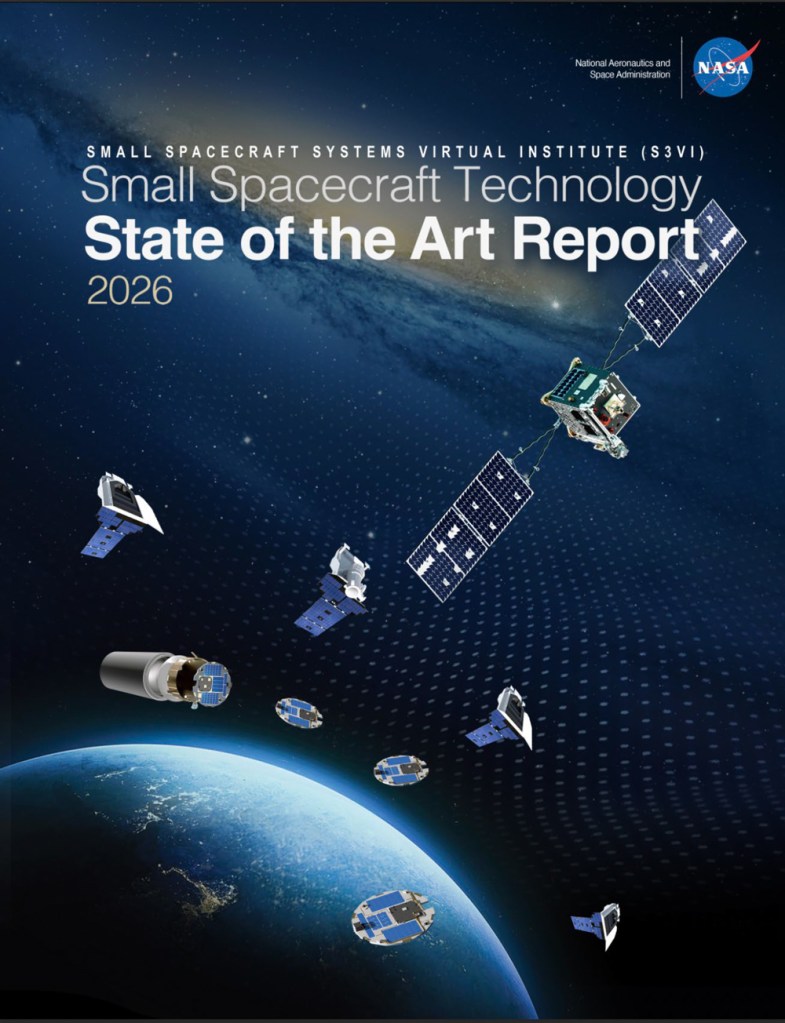
For SOA related inquiries, please email: arc-sst-soa@mail.nasa.gov.
Change Summary
| Published Date | Edition | Chapter | Description of Changes |
| May 2026 | 2026 | Complete Spacecraft Platforms | Entire chapter updated. |
| Power | Entire chapter updated. | ||
| In-Space Propulsion | Entire chapter updated. | ||
| Guidance Navigation & Control | Updates to Rendezvous, Proximity, Operations, and Docking section. | ||
| Structures, Materials, and Mechanisms | Minor edits throughout chapter. | ||
| Thermal Control | Minor edits throughout chapter. | ||
| SmallSat Avionics | Entire chapter updated. | ||
| Communications | Free Space Optical Communications and Future Communications Technology Sections updated. | ||
| Launch, Integration, Deployment, and Orbital Transport | Updates to Launch Paradigm; Included hardware tables; Orbital Maneuvering Vehicle section updated. | ||
| Ground Data Systems and Mission Operations | Updated content in Ground Segment Services, Ground Station Components, Ground Data and Supporting Systems sections. | ||
| ID and Tracking | Minor edits throughout chapter. | ||
| Deorbit Systems | Minor edits throughout chapter. | ||
Preface
NASA’s Small Spacecraft Technology State-of-the-art report is updated annually to capture new information on publicly available small spacecraft systems from NASA and other sources. Each chapter captures the development status of current state-of-the-art SmallSat technologies, along with design considerations for readers when identifying components for a mission. The organizational approach for each chapter includes an introduction to the technology, the current development status of procurable systems, and summary tables of the technologies surveyed. In this way, each chapter presents a stand-alone report on the given spacecraft subsystem, with updated information on new and maturing technologies and reference missions as applicable.
When the first edition of this report was published in 2013, 247 CubeSats and 105 other non-CubeSat small spacecraft under 50 kilograms (kg) had been launched worldwide representing less than 2% of the total mass launched into orbit over multiple years. Small satellite flight heritage has greatly increased since then, with small spacecraft becoming the primary means for commercial, government, private, and academic institutions to access space. Since 2023, there has been an influx of mini-class small spacecraft constellations with a mass of 201–600 kg, as well as a new generation of larger small spacecraft constellations weighing 600–1,200 kg (1). While updates in all chapters reflect this growth in the small spacecraft market, a focused effort was made to update areas reflecting recent technology developments that may ultimately bridge existing technology gaps.
This edition features updates that reflect the next generation of small spacecraft missions. Demands for larger platforms are discussed in the Complete Spacecraft Platforms chapter and expanded upon in the Integration, Launch, Deployment, and Orbital Transport chapter. This new launch paradigm indicates an increase in Orbital Maneuvering/Transport Vehicle (OMV/OTV) services as well as in autonomous spacecraft capabilities to support higher payload data throughput. The SmallSat Avionics chapter received a complete rewrite that expands on the increasing onboard processing capabilities of SmallSats and CubeSats. Future RF and Optical Communications technologies and missions are highlighted in the Communications chapter, and in the Guidance, Navigation, and Control chapter, the RPOD section was updated to reflect recent interest and developments. All content in the Power Systems and In-Space Propulsion chapters was updated to reflect continued progression toward more capable SmallSats.
This report should not be considered a comprehensive overview of all technologies, but rather a general overview of current state-of-the-art SmallSat technologies and their development status. It should be noted that technology maturity designations may vary with changes to payload, mission requirements, reliability considerations, and/or the environment in which performance was demonstrated. Readers are highly encouraged to contact companies for further information regarding the performance and maturity of the described technology. Any companies mentioned in this report are for informational purposes only and do not constitute an endorsement by NASA.
References
- Bryce and Space Technology. “SmallSat by the Numbers, 2025.” Accessed March 14, 2026. [Online] Available at: https://brycetech.com/reports/report-documents/Bryce_Smallsats_2024.pdf
Previous editions of this report can be found at the S3VI Small Spacecraft Body of Knowledge webpage: https://www.nasa.gov/smallsat-institute/small-spacecraft-body-of-knowledge