












Suggested Searches

Watch the Skies

  • Look For The Harvest Moon This Weekend

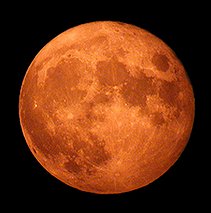
    Take a moment to gaze at the beautiful harvest moon this Saturday, September 29th.(Image credit: NASA)The harvest moon gets its name from agriculture. In the days before electric lights, farmers depended on bright moonlight to extend the workday beyond sunset. It was the only way they could gather their ripening crops in time for market. …

  • Once in a Blue Moon

    One way to make a Blue Moon is by using a blue filter.

    Image credit: NASA/MSFCOn Aug. 31, if the night sky is clear, you will be able to see the second full moon of the month, which is called a “blue moon.”You may have heard the expression, “once in a blue moon,” meaning “almost never,” because having 13 full moons in a calendar year — instead of …

  • Perseid Peak Performance

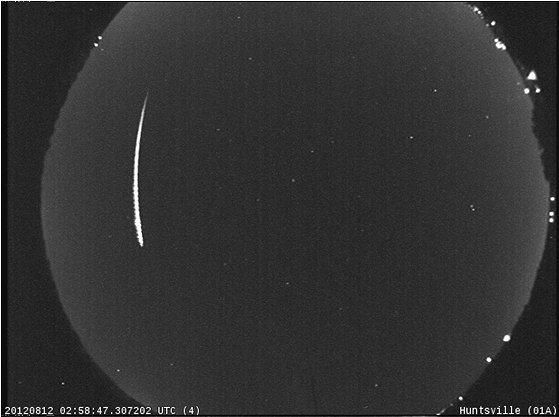
    The All Sky camera network captured over 183 multi-station Perseid meteors Saturday night. Some truly spectacular events — see images below. The Perseids have been observed for at least 2,000 years and are associated with the comet Swift-Tuttle, which orbits the sun once every 133 years. Each year in August, the Earth passes through a cloud …

  • MSFC Watches the Transit of Venus

    The transit of Venus on June 5th this year sparked much attention worldwide. Astronomers and the general public alike gathered around telescopes or grabbed their solar filter glasses to observe this rare alignment of the Sun, Venus and Earth. Members of the Natural Environments Branch brought together their telescopes to have a viewing party at …

  • Bright Fireball Over Georgia

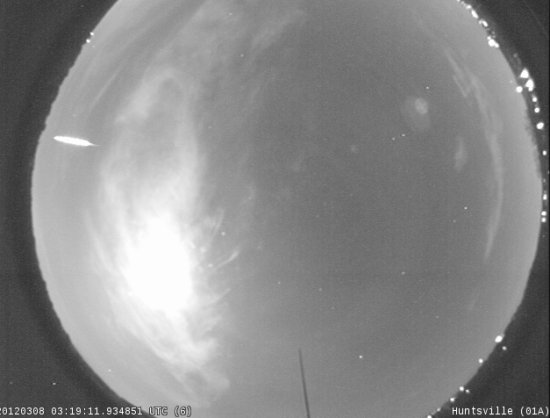
    The NASA Meteoroid Environment Office can confirm a bright fireball observed by several eyewitnesses in Alabama, Georgia and Tennessee on Mar. 7, 2012 at 10:19:11 p.m. EST. The fireball was observed by three NASA cameras located at Marshall Space Flight Center in Huntsville, Ala., Tullahoma Tenn., and Cartersville, Ga. The meteor was first recorded at …

  • The Worm Moon?

    The next full Moon is on Thursday, March 8, 2012.  The Moon will be 180 degrees away from the Sun in Earth-based longitude at 4:40 am EST, and will appear full for about three days around this time, from Tuesday evening through Friday morning.The full Moon in March is known by many names: the Worm …

  • NASA Cameras Catch Speeding Fireball

    There was a bright fireball visible over north Georgia, eastern Tennessee, and South Carolina at 7:02:36 PM EST last night. All 4 NASA meteor cameras in the SouthEast picked it up 48 miles above the town of Rossville, just south of Chattanooga, moving at 9 miles per second (32,400 mph) slightly north of east. The …

  • Asteroid 433 Eros Approaches Earth

    Credit:  NASA/MSFC/Meteoroid Environment Office/Rhiannon Blaauw Asteroid 433 Eros made a close approach to Earth the morning of January 31st coming within 0.17 AU (15 million miles) of our planet. In this set of images taken that morning, the bright moving dot near the center of the field is the 21 mile long Eros. Somewhere on …

  • NASA All Sky Fireball Network Watches the Skies

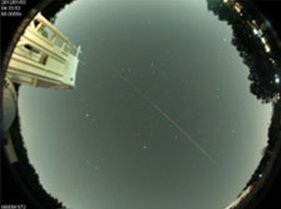
    A meteor streaks across the skies above Huntsville, Ala. (NASA) The night sky is constantly changing. The Earth rotates and revolves about the sun, creating a backdrop of stars that is always in motion. The moon grows large in the sky, and then smaller again, in a seemingly endless cycle. Now and then, brilliant streaks …

  • Rare Double Quadrantid Meteor Sighting

    The wide-field meteor camera at NASA’s Marshall Space Flight Center recorded these two simultaneous Quadrantid meteors on Jan. 4 at approximately 5 a.m. EST. Moving at 92,000 mph, the meteors flashed across the field of view in just over a second. Credits: NASA/MSFC/Meteoroid Environments Office