













Science and Suits Fill Schedule as Crew Preps for Cargo Missions
The Expedition 75 crew spent Thursday on a variety of research including an exercise study and a space physics investigation and servicing spacesuits. The orbital residents are also gearing up for a variety of cargo missions departing from and launching to the International Space Station this month.
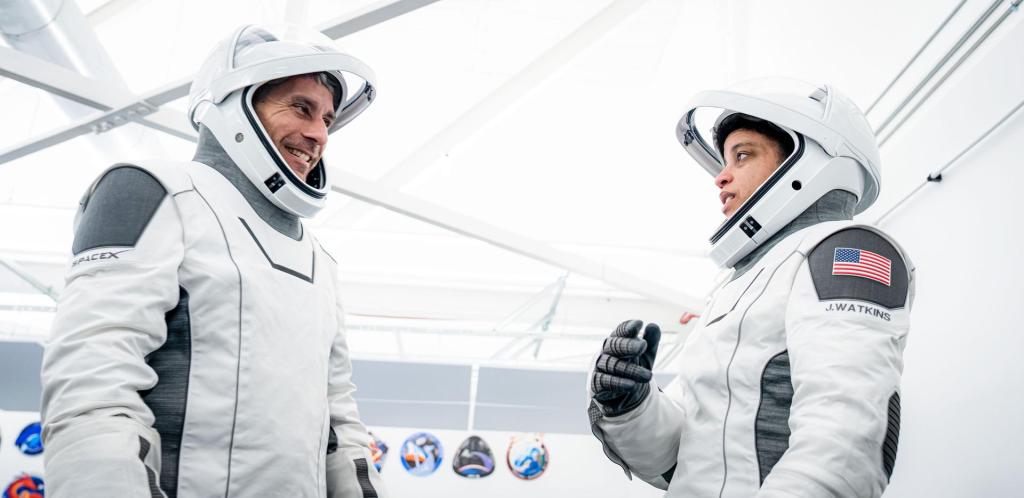
NASA flight engineers Jessica Watkins and Luke Delaney took turns conducting whole-body strength training on the advanced resistive exercise device (ARED) located inside the Tranquility module. Watkins and Delaney specifically pulled as hard as they could on a fixed bar at thigh length on the ARED to measure their overall strength and power. Measurements from the workout portion of the Standard Measures study are documented to help doctors understand how living in microgravity affects the human body.
At the beginning of her shift, Watkins took a computerized test to measure how working in microgravity affects her cognitive abilities such as decision making, spatial orientation, and more. Afterward, she inspected the European Enhanced Exploration Exercise Device (E4D), an advanced space workout device located inside the Columbus laboratory module. Watkins also recorded a video that was sent to Earth and the Voyager 1 spacecraft congratulating the mission for reaching a distance of one light day from Earth.
Delaney joined flight engineers Anil Menon of NASA and Joshua Kutryk of CSA (Canadian Space Agency) for spacesuit maintenance on Thursday inside the Quest airlock. Delaney installed a battery adapter inside a spacesuit emergency jet pack, checked the functionality of its components, then stowed the device. Menon assisted Kutryk as he cleaned spacesuit cooling and water systems that keep astronauts safe and comfortable during a spacewalk.
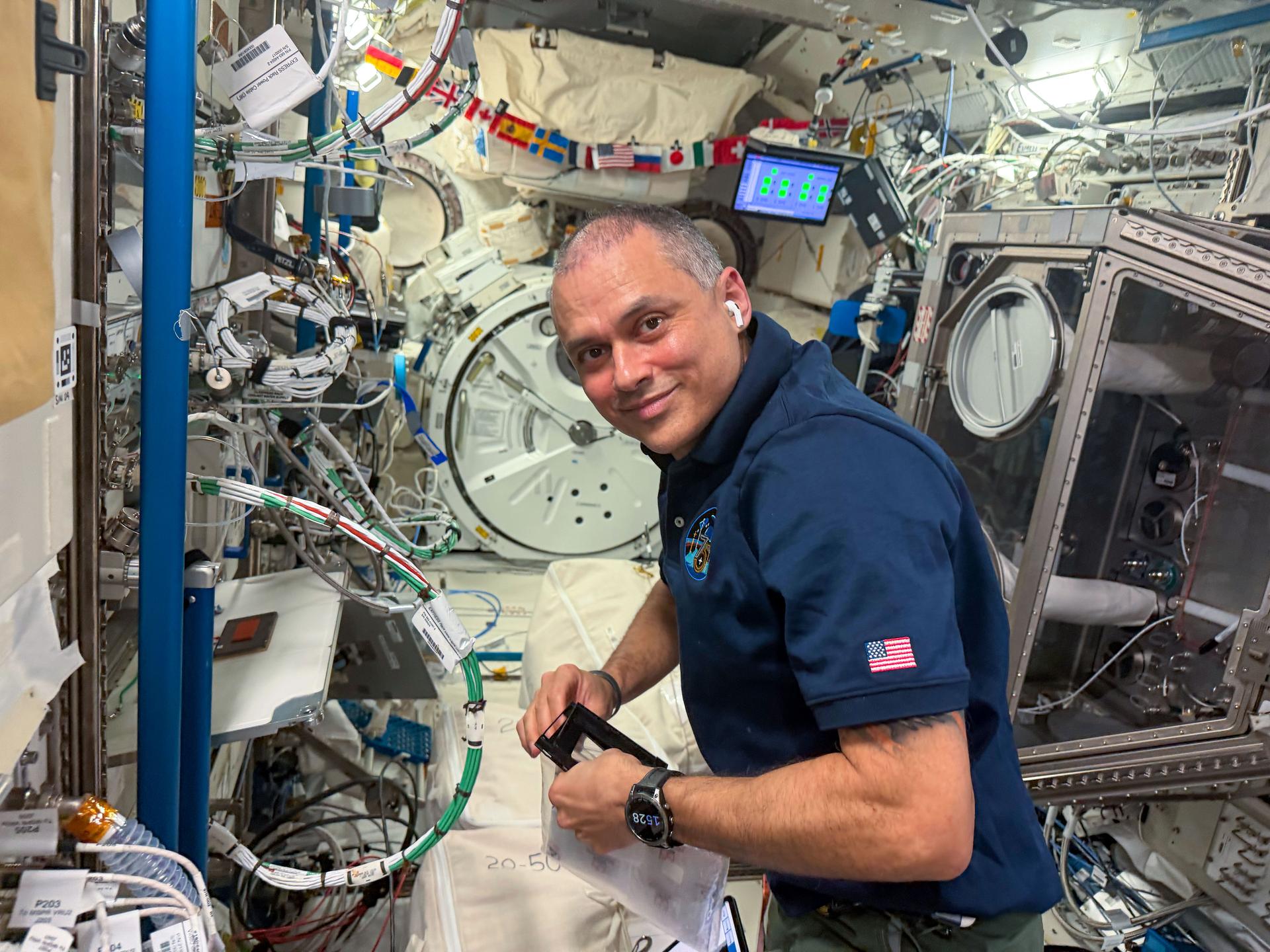
Earlier, Menon also familiarized himself with the operation of the Astrobee free-flying robotic assistants in the Kibo laboratory module. Next, he photographed 3D colloidal crystals for a space manufacturing investigation in the Harmony module.
A SpaceX Dragon spacecraft is targeted to depart the orbital outpost no earlier than 11:05 a.m. EDT on Friday, Nov. 20, completing a space delivery mission that began on Oct. 15. Dragon will return 3D bioprinted blood vessels, antibiotic-resistant bacteria, a circadian lighting system, a spacesuit, and more for retrieval and analysis after it splashes down in the Pacific Ocean the next day.
NASA and Northrop Grumman have announced they are targeting no earlier than Nov. 29 for the launch of a Cygnus XL spacecraft atop a SpaceX Falcon 9 rocket to resupply the Expedition 75 crew. Cygnus XL will deliver about 11,000 pounds of science investigations, supplies, and equipment to the International Space Station
Roscosmos cosmonauts Pyotr Dubtov and Anna Kikina trained to use the Zvezda service module’s tele-robotically operated rendezvous unit, or TORU, which can remotely control an approaching spacecraft if necessary. Flight engineer Sergey Teteryatnikov swapped hard drives and updated software on laptop computers inside the Nauka science module that support the European robotic arm.
Learn more about station activities by following the space station blog, @space_station on X, as well as the ISS Facebook and ISS Instagram accounts.
Get the latest from NASA delivered every week. Subscribe here.
