















Week Ends With Soldering, Lunar Simulations, and Cargo Mission Preps

Expedition 75 wrapped up its week completing a lead-free soldering experiment, simulating a lunar landing, and exercising for research, among other advanced science activities. The International Space Station residents are also preparing for the arrival of a cargo mission and continuing housekeeping duties.
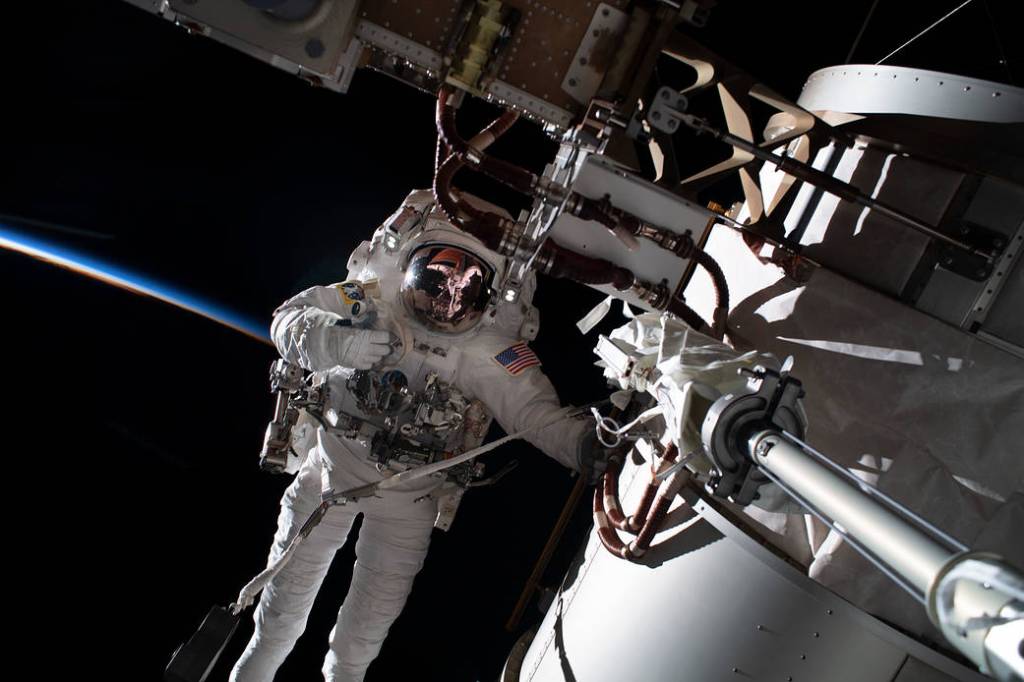
NASA flight engineer Anil Menon conducted the last run of the MIYOKA investigation that uses a lead-free soldering technique to demonstrate the safe manufacturing and repairing of electronics in microgravity. He worked in the Harmony module to solder components on a circuit board that will be returned to Earth and compared to identical ground-soldered samples. Afterward, NASA flight engineer Jack Hathaway placed the cooled-down soldering iron, the completed circuit board, and experiment tools in storage containers then cleaned Harmony’s maintenance work area returning it to its normal configuration.
Menon and Hathway also joined each other in the cupola and carefully cleaned its seven windows. The duo used gentle wiping techniques and specialized materials to prevent scratches on the windows then taped up gaps between the panes to prevent dust buildup.
Station commander Jessica Meir began her day in the cupola for a lunar landing simulation. Working with hand controllers, a laptop computer, and audio signals, Meir practiced a lunar descent while adjusting speed and controlling orientation. The Manual Piloting study may help researchers understand how microgravity can affect cognitive function potentially leading to disorientation while operating a spacecraft. At the end of her shift, she partnered with Menon for ultrasonic inspections inside the Zarya module.
Flight engineer Sophie Adenot of ESA (European Space Agency) began her shift working out on the new European Enhanced Exploration Exercise Device (E4D). The E4D’s controller software tracked her performance helping researchers evaluate its effectiveness for use on future long-duration missions. She later downloaded biomedical data collected from her smart watch to a computer tablet then held a conference with doctors on the ground for the RelaxPro experiment that seeks to reduce crew stress and improve sleep quality.
Flight engineer Andrey Fedyaev worked throughout Friday in the orbital outpost’s Roscosmos segment inspecting and cleaning laptop computers, power supply units, and ventilation systems.
A Progress 96 cargo spacecraft from Roscosmos is orbiting Earth toward the International Space Station for a docking on Saturday. Flight engineers Pyotr Dubrov and Anna Kikina will be on duty monitoring Progress during its automated rendezvous and docking to Poisk module scheduled for 9:46 a.m. EDT. After about two hours of leak and pressure checks, Dubrov and Kikina will open the spacecraft’s hatch to begin unpacking nearly three tons of food, fuel, and supplies. Live coverage begins at 9 a.m. on NASA+ and a variety of other platforms. Learn where to watch online: https://www.nasa.gov/live
Learn more about station activities by following the space station blog, @space_station on X, as well as the ISS Facebook and ISS Instagram accounts.
Get the latest from NASA delivered every week. Subscribe here.
