















NASA CubeSats Advance Space Weather, Tech Research

Editor’s note: The article has been updated to reflect who developed AEPEX
Several NASA science and technology payloads launched in the early morning hours on March 30 to test new thermal protection methods, improve in‑space communications, and study Earth’s atmosphere, advancing future innovation and exploration.
The missions launched aboard a SpaceX Falcon 9 rocket from Space Launch Complex 4 East at Vandenberg Space Force Base in California as part of the company’s Transporter-16 commercial rideshare mission.
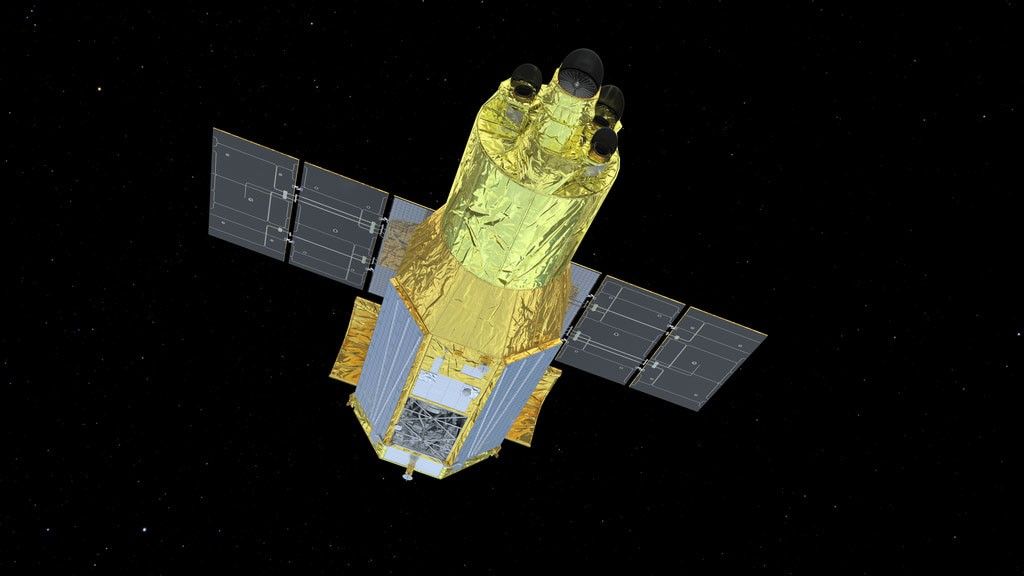
The Atmosphere Effects of Precipitation through Energetic X-rays (AEPEX) CubeSat, developed and operated by the University of Colorado, Boulder, is studying how energetic particles transfer energy from the radiation belts into the upper atmosphere. Its findings will help improve our understanding of space weather, which can affect radio communications and satellites. NASA’s CubeSat Launch Initiative (CSLI) selected AEPEX as part of its 12th round of CubeSat selections in 2021. The initiative is a low-cost pathway for conducting scientific investigations and technology demonstrations in space, offering students, teachers, and faculty hands-on experience designing, developing, and assembling flight hardware.
Three other satellites will improve the accuracy of the World Magnetic Model, which is used for national security, aviation, and mobile devices. The satellites were developed through the National Geospatial-Intelligence Agency MagQuest Challenge and supported by NASA’s Center of Excellence for Collaborative Innovation.
The agency also will test three key technologies aboard the TechEdSat-23 CubeSat: a radiation sensor, a miniaturized National Oceanic and Atmospheric Administration Data Collection System radio, and an exo-brake device for rapid deorbiting of spacecraft. These technologies will support advances in radiation shielding, satellite communications, and space weather monitoring. NASA secured the launch services for this CubeSat through its VADR (Venture-Class Acquisition of Dedicated and Rideshare) contract.
The Realizing Rapid, Reduced-cost high-Risk Research project Spacecraft 10 (R5-S10) CubeSat, supported by NASA’s Small Spacecraft and Distributed Systems portfolio, will test flying techniques that allow spacecraft to safely operate at close distances – capabilities that could support future in-space inspection and servicing missions. The CubeSat, deployed from the Vigoride orbital service spacecraft and operated by Momentus Space, will transfer demonstration data via in-space Wi-Fi technology developed by the Solstar Space Company.
Also hosted aboard the Vigoride orbital service spacecraft is a power processing system from CisLunar Industries. The company’s Electric Power Intelligent Conversion technology is designed to transform power ranging from 1 to 100 kilowatts with greater than 95% efficiency, using smaller, lighter designs than current state-of-the-art systems.
In the coming weeks Varda Space’s W6 capsule will collect heat and pressure data during reentry, testing NASA-made instrumented heat shield tiles. The tiles use a new manufacturing method that reduces production time and material variability, which are important improvements for future missions.
By flying alongside commercial payloads as one customer among many, NASA uses cost effective rideshare opportunities to accelerate technology development, innovation, and discovery, which helps to strengthen the orbital economy.
NASA’s Space Technology Mission Directorate manages the agency’s Small Spacecraft and Distributed Systems office, Flight Opportunities program, and the Center of Excellence for Collaborative Innovation. NASA’s Launch Services Program based at the agency’s Kennedy Space Center in Florida manages both the CubeSat Launch Initiative and VADR contracts.
