











NASA’s Parker Solar Probe passed laser illumination testing the week of Nov. 27, 2017. During this test, each segment of the spacecraft’s solar panels was illuminated with lasers to check that they were still electrically connected after the vigorous vibration and acoustic testing completed earlier this fall.
The PI’s Perspective: Wrapping up 2017 En Route to Our Next Flyby

New Horizons is in good health and cruising closer each day to its next encounter: a flyby of the Kuiper Belt object (KBO) 2014 MU69 (or “MU69” for short). If you follow our mission, you likely know that flyby will occur on New Year’s Eve and New Year’s Day 2019, which is just barely over …
Astronauts Command Robotic Arm to Release Cygnus Cargo Craft

After delivering almost 7,400 pounds of cargo to support dozens of science experiments from around the world, the Orbital ATK Cygnus cargo spacecraft has departed the International Space Station. At 8:11 a.m., Expedition 53 Flight Engineers Mark Vande Hei and Joe Acaba of NASA gave the command to release Cygnus. On Tuesday, Dec. 5, ground …
Cygnus Cargo Craft Leaves Station Wednesday Morning

The Orbital ATK Cygnus cargo spacecraft is set to leave the International Space Station on Wednesday, Dec. 6. NASA Television and the agency’s website will provide live coverage of Cygnus’ departure beginning at 7:45 a.m. EST. Cygnus arrived to the space station Nov. 14 with nearly 7,400 pounds of cargo to support dozens of science …
SpaceX Launch Slips, Cygnus Leaving and BEAM Stay Extended

SpaceX has delayed the launch of its next Dragon resupply mission to the International Space Station to no earlier than Dec. 12. Back on orbit, the Cygnus cargo craft is getting ready to leave the orbital lab and an experimental module has its stay in space extended for at least another three years. NASA and …
ISS Daily Summary Report – 12/05/2017
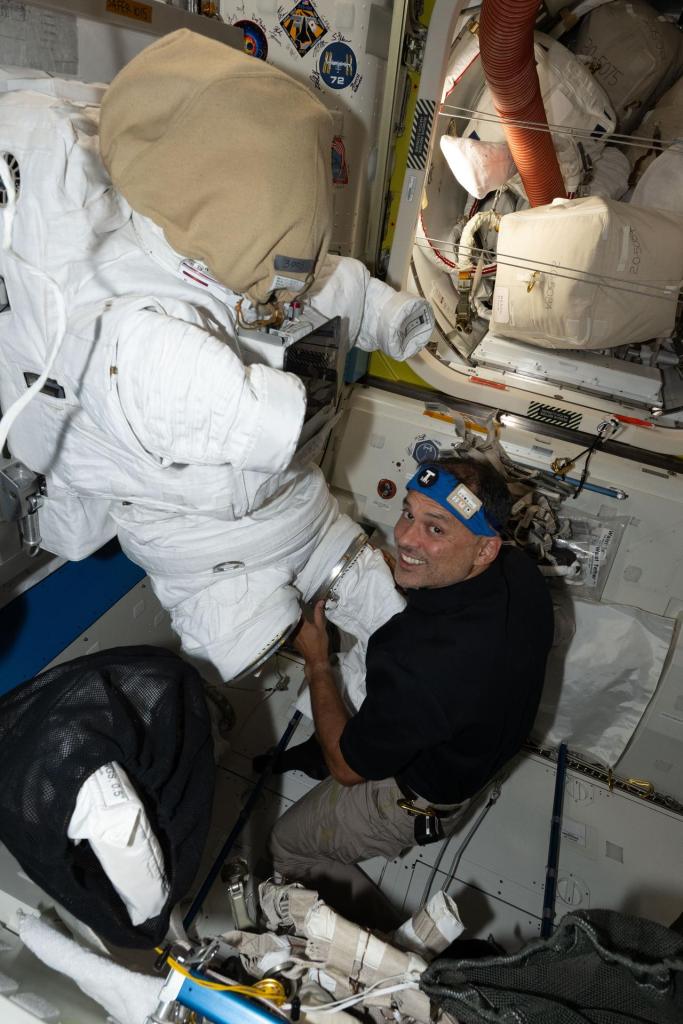
Cygnus unberth: This morning, the crew egressed Cygnus. They then configured the vestibule and prepared to depressurize the vestibule. Ground teams identified EMI as the cause of the pressure probe anomaly and successfully depressurized the vestibule. Later, the Cygnus vehicle was unberthed and positioned it for the GPS shadowing (“photobomb”) Developmental Test Objective (DTO). Cygnus …
GOES-S Spacecraft Arrives at Kennedy Space Center

The next satellite in line to join NOAA’s environment-monitoring network is one significant step closer to launch following its delivery Monday to NASA’s Kennedy Space Center in Florida. Geostationary Operational Environmental Satellite-S (GOES-S) arrived at the Florida spaceport aboard a U.S. Air Force C-5M Super Galaxy cargo transport aircraft which touched down on Kennedy’s Shuttle …
ISS Daily Summary Report – 12/04/2017
Earth Imagery from ISS Target Operations: Over the weekend, the crew captured images and video footage of Japan, the Sahara Desert, the India-Himalayas-Tibetan Plateau, Seattle and the Pacific Northwest, and Ireland to Moscow at night. Today the crew captured images of the Himalayas, facing northwest up the mountain range. The Earth Imagery from ISS investigation …
Heading South, to New Zealand and Beyond
Greetings from New Zealand! Soon, we’ll report back from even further south. We’re headed to the heart of the Antarctic ice sheet, to collect measurements on the ground for the ICESat-2 mission. ICESat-2 is a NASA satellite, scheduled for launch in 2018, that will measure the height of ice sheets, glaciers, and sea ice in unprecedented detail. […]
GOES-S to Add to Advanced Weather Satellite Constellation

The Geostationary Operation Environmental Satellite-S (GOES-S) is the second in a series of four advanced geostationary weather satellites. The GOES-R Series – consisting of the GOES-R, GOES-S, GOES-T and GOES-U spacecraft – significantly improves the detection and observation of environmental phenomena that directly affect public safety, protection of property and our nation’s economic health and …