
Suggested Searches

Blogs

  • NASA’s Mobile Launcher Arrives at Vehicle Assembly Building 

    NASA’s mobile launcher enters the Vehicle Assembly Building

    After successfully being used to launch the Artemis II lunar test flight on April 1, NASA’s mobile launcher now is inside NASA Kennedy’s Vehicle Assembly Building (VAB) in Florida in preparation for the Artemis III test flight mission rocket stacking operations.  NASA’s Exploration Ground Systems Program rolled the launcher on a 4-mile trek from Launch Pad 39B to the VAB along the crawlerway on April 16. The trip, which normally takes eight to 12 hours on top of the agency’s crawler-transporter 2, had several built-in pauses to […]

  • Latest NASA X-59 Flights Go Higher and Faster

    NASA’s X-59 flies above the Mojave Desert on a clear day. The white aircraft has light gray, red, and blue accents, with a NASA logo and the number 859 on its tail. It appears flying level over the desert landscape, with a mountain range visible on the horizon and a trail of clouds above.

    NASA’s X-59 experimental aircraft has made its highest and fastest flights so far, expanding its operational range and making progress toward supersonic flight. In a pair of test flights on April 10 and April 14, the aircraft reached new altitudes and speeds, reaching 43,000 feet and 528 to 627 mph (approximately Mach 0.8 to 0.95 […]

  • NASA CubeSats Advance Space Weather, Tech Research

    A long-exposure image of a rocket launch

    Editor’s note: The article has been updated to reflect who developed AEPEX Several NASA science and technology payloads launched in the early morning hours on March 30 to test new thermal protection methods, improve in‑space communications, and study Earth’s atmosphere, advancing future innovation and exploration. The missions launched aboard a SpaceX Falcon 9 rocket from […]

  • NASA CubeSat Begins Mission to Study Radio Waves in Space

    Rocket lifting off at night

    Editor’s Note: This post was updated April 21, 2026, to reflect mission funding by the U.S. National Science Foundation. NASA’s latest small satellite mission is now in orbit studying how natural and human-made radio waves travel from Earth’s surface into space, helping scientists better understand and predict changes in the near‑Earth space environment. The Climatology […]

  • NASA Heliophysics Spacecraft Witness Comet’s Demise

    On April 4, comet C/2026 A1 (MAPS) plunged toward the Sun — flying about twice as far from our star as the Moon is from Earth. Comet watchers held their collective breath, waiting to see whether comet MAPS would survive its sweltering passage by the Sun. The SOHO (Solar and Heliospheric Observatory) spacecraft — a joint NASA and ESA […]

  • NASA Begins Implementation for ESA’s Rosalind Franklin Mission to Mars

    NASA has given approval for the agency’s Rosalind Franklin Support and Augmentation (ROSA) project to begin implementation, underscoring the agency’s continued partnership with ESA’s (European Space Agency) Rosalind Franklin mission. The mission is led by ESA and that agency is responsible for providing the spacecraft, including the carrier module, the landing platform, as well as […]

  • Station Orbits Higher as Crew Runs New Science Experiments

    The Roscosmos Progress 93 cargo craft, docked to the rear port of the Zvezda service module, fires its engines to raise the International Space Station's orbit. This reboost maneuver positioned the orbital outpost at the correct altitude for the arrival of the Soyuz MS-28 crew spacecraft on Nov. 27 and the undocking of the Soyuz MS-27 crew spacecraft on Dec. 8.

    The International Space Station is orbiting higher today after the Progress 93 resupply ship, docked to the Zvezda service module, fired its engines for just over five minutes Wednesday night. The orbital reboost places the space station at the correct altitude for the upcoming Progress 95 cargo mission scheduled to resupply the Expedition 74 crew at the end of April.

  • NASA’s Mobile Launcher Rolls Ahead of Artemis III Preparation

    NASA's mobile launcher 1 rolls from Launch Pad 39B to the Vehicle Assembly Building at the agency's Kennedy Space Center in Florida.

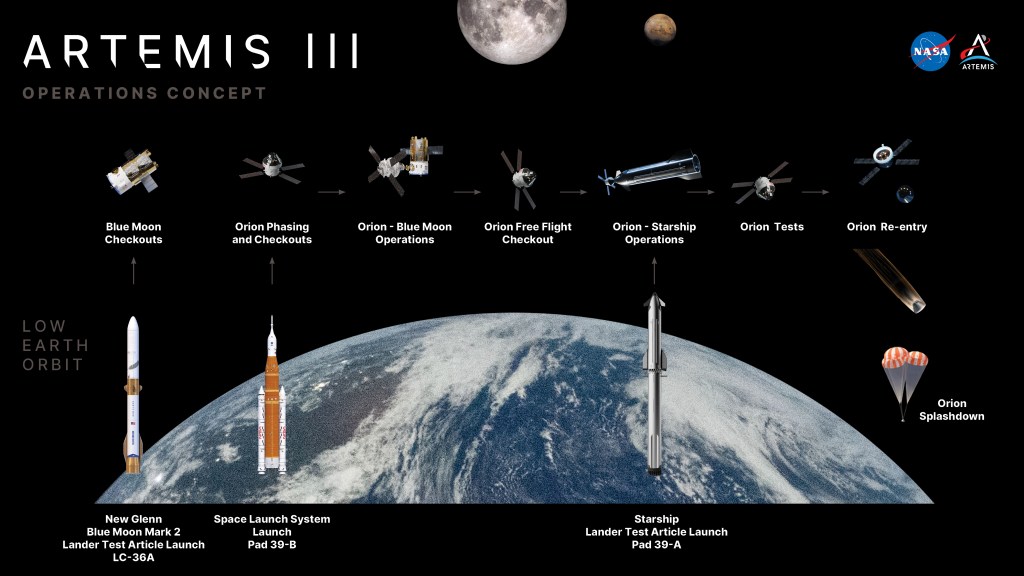
    Following the conclusion of NASA’s Artemis II test flight, teams at the agency’s Kennedy Space Center in Florida are shifting focus to Artemis III, which is targeted to launch next year, by rolling the mobile launcher from Launch Complex 39B to NASA’s Kennedy Vehicle Assembly Building (VAB) in Florida in preparation for rocket stacking operations.  The mobile launcher began its approximately 4-mile trek on top of the agency’s crawler-transporter 2 at 8:11 a.m. EDT Thursday, […]