







Moon Crater Contains Usable Water, NASA Says (www.nytimes.com)→The Moon, at least at the bottom of a deep, dark cold crater near its south pole, seems to be wetter than the Sahara, scientists reported Thursday.
What's the moon made of? NASA mission finds it's nothing so simple as cheese. (www.washingtonpost.com)→Gazing at the moon will just never be the same.
Moon Not Only Has Water, but Lots of It (www.wsj.com)→There is a lot more water on the moon than previously believed, according to an analysis of NASA data being published Friday, a finding that may bolster the case for a manned base on the lunar surface.
'Moon Bombing' Data Shows South Pole Crater is Wetter Than Some Parts of Earth (www.popsci.com)→ The moon's south pole could be a pleasantly moist place to put a moon base.
The Tricked-Out 747 That Peers High Into the Heavens (www.discovermagazine.com)→The SOFIA flying observatory soars above 99.8 percent of the water vapor in Earth’s atmosphere, allowing extremely crisp images of distant objects.
Enough Water on the Moon to Consider Space Station, U.S. Scientists Say (www.bloomberg.com)→The amount of water discovered on the moon last year when scientists purposely slammed a rocket into the lunar south pole may be enough to help set up a space fueling station, according to latest data from the mission.
LCROSS mission may have struck silver on the moon (www.newscientist.com)→The title of the 1909 hit song By the Light of the Silvery Moon was not just poetic, it was also prophetic.
LCROSS venture gave useful data, scientists say (www.sfgate.com)→The NASA spacecraft that bombed the moon with an empty Centaur rocket casing last year transformed a dark and frozen crater floor into a frigid oasis with plenty of water and a "whole laundry list of chemicals" useful for humans returning to the lunar surface, the mission's leader said Thursday.
Moon's water is useful resource, says Nasa (www.bbc.co.uk)→There are oases of water-rich soil that could sustain astronauts on the Moon, according to Nasa.
Moon Crater Holds More than Just Water (www.discovery.com)→Carbon dioxide, ammonia, silver and more were found in a lunar crater. But where did they come from?
Moon's Silver Hints at Lunar Water Origins (www.nationalgeographic.com)→It's not just poetic to call it a silvery moon: In addition to water, a NASA probe that crashed into a lunar crater last year churned up unexpected concentrations of silver and mercury, aka quicksilver, a new study says.
Moon Crater Has More Water Than Parts of Earth (www.space.com)→A frigid crater at the moon's south pole is jam-packed with water ice, with some spots wetter than Earth's Sahara desert, boosting hopes for future lunar bases.
The Moon Hides Ice Where the Sun Don’t Shine (www.wired.com)→The moon is pockmarked with cold, wet oases that could contain enough water ice to be useful to manned missions.
Moon's surface may hold enough water for a manned base (www.guardian.co.uk)→Analysis of debris thrown up when a rocket was crashed into a crater on the moon suggests about 5.6% of the material there was frozen water.
Last Year's Moonshot Splashed Up Lots Of Water (www.npr.org)→When NASA blasted a hole in the moon last year in search of water, scientists figured there would be a splash.
What's the moon made of? NASA mission finds it's nothing so simple as cheese. (www.washingtonpost.com)→Hidden away in the moon's deep shadows are caches of frozen water, organic compounds such as methane, toxins such as mercury and even traces of silver and sulfur - a previously unimagined trove of lunar chemistry, scientists announced Thursday.
NASA and DARPA Plan ‘Hundred-Year Starship’ To Bring Humans to Other Worlds And Leave Them There Forever (www.popsci.com)→If NASA ever gets a clear directive for interplanetary exploration, a new Hundred-Year Starship could be their version of the Mayflower.
NASA Developing Tech to Reach and Colonize Other Worlds (www.wired.com)→If human space exploration is going to extend to celestial bodies farther away than the moon or even Mars, we need to develop a tremendous amount of new technology in order to do it.
Goldilocks planets waiting for just-right rockets (www.usatoday.com)→Goldilocks planets, not too hot and not too cold for life, look more likely, and less like a fairy tale for astronomers.
Rocket scientist aims to relaunch propulsion technology (www.cnet.com)→The time has come to jettison the traditional chemical rocket propulsion system and move to one powered by beamed microwaves, say a group of researchers.
Purdue University to open office at NASA Ames (www.bizjournals.com)→The Boilermakers are coming to Mountain View.
500th Alien Planet Could Be Discovered This Month (www.space.com)→Less than 20 years after first finding a planet beyond our solar system, astronomers are poised to hit a big milestone — the discovery of alien world No. 500.
How do you find life on an alien planet? (www.msnbc.msn.com)→After spending decades searching for alien planets capable of harboring life, astronomers may have found one. So how can they check to see if life actually exists on this alien world?
Flames at Moffett from firefighting training exercise at airfield (www.mv-voice.com)→Flames may be visible from Highway 101 at Moffett Field today and later in the week as Santa Clara County fire departments and firefighters and first responders from the NASA Ames Research Center conduct a training session at the airfield.
Aircraft fire training at NASA Ames (audio slideshow) (www.cnet.com)→Airport firefighter training has gone mobile, and this week it traveled to the San Francisco Bay Area--raging fire, billowing smoke, and all.
The Kepler spacecraft's search for other worlds (www.astronomy.com)→This month's issue of Astronomy explains how the spacecraft named after a 17th-century astronomer is using its namesake's laws of planetary motion to search for other worlds, revisits 10 of the Cassini mission's greatest successes at Saturn, helps readers debunk some of astronomy's most persistent myths, reviews the Orion 8-inch f/4.0 Newtonian Astrograph Reflector, and more.
How do you find life on an alien planet? (www.msnbc.msn.com)→Radio telescopes may search for patterns in emissions of electromagnetic radiation from world 20 light-years away.
Flames at Moffett from firefighting training exercise at airfield (www.mv-voice.com)→Flames may be visible from Highway 101 at Moffett Field today and later in the week as Santa Clara County fire departments and firefighters and first responders from the NASA Ames Research Center conduct a training session at the airfield.
Eshoo: NASA authorization a win for Ames (www.bizjournals.com)→Rep. Anna Eshoo on Wednesday called the passage by the House of Representatives of the National Aeronautics and Space Administration Authorization Act of 2010 "a win for NASA and a win for our state and work force."
Cloud Computing: For NASA, An Open-Source Cloud Isn’t Rocket Science (www.cio.com)→NASA’s Nebula open-source cloud computing initiative offers quick infrastructure provisioning.
If There's Life on Alien Planet Gliese 581g, How Do We Find It? (www.space.com)→After spending decades searching for alien planets capable of harboring life, astronomers may have found one. So how can they check to see if life actually exists on this alien world?
New Evidence Suggests Icebergs in Frigid Oceans on Ancient Mars (www.space.com)→Ancient Mars once had surprisingly frigid primeval oceans complete with their own icebergs, new evidence suggests.
NSF awards $12M to school science partnership (www.bizjournals.com)→California State University, East Bay received a five-year, $11.96 million grant from the Math and Science Partnership Program at the National Science Foundation to fund the San Francisco Bay–Integrated Middle School Science Project.
NASA’s Green Frontier (www.executivegov.com)→While NASA has been knocked off its orbit lately, one of its most recent endeavors never left the ground but is still leading the pack in innovation.
Martian methane lasts less than a year (www.astronomy.com)→Scientists think wind-driven processes can add strong oxidizers to the atmosphere, which could soak up methane more rapidly.
NASA rewrites the history of life on Mars (www.abclocal.go.com)→The Viking missions to Mars cost NASA almost a billion dollars in 1976, and NASA has always believed it got what it paid for -- the first landings and biological experiments on the red planet.
Mystery on Mars: Why Methane Fades Away So Fast (www.space.com)→Methane on Mars can disappear from the planet's atmosphere mysteriously fast, fading in less than a Martian year (or about 22 Earth months), a new study finds.
Opening up a key piece of the Bay Trail (www.mercurynews.com)→In the end, it was just snipping a bolt, opening a gate, pulling back a fence.
Crucial 'missing link' of Bay Trail to open today behind Moffett Field (www.mercurynews.com)→A 2.4-mile stretch of new Baylands trail behind Moffett Field will open today.
A Night With the Moon: Skywatchers Savor Lunar Views In Global Event (www.space.com)→At first it seemed like rain would spoil everything. But despite early threats of foul weather, the clouds parted right on time and 8-year-old Alexandra Chin – along with hundreds of other skywatchers – took a long, deep look at the moon on Saturday (Sept. 18).
NASA does a dry run for deep space (www.msnbc.com)→NASA's Desert RATS exercise is in full swing, and that means astronauts in mocked-up spacesuits and monster rovers are roaming the Arizona desert to practice for a journey to Mars.
An Astronaut Field Trip (www.insidescience.org)→NASA practices for a visit to the planet Mars and other destinations in the deserts of the Southwest.
NASA backs bid for World Expo 2020 at Moffett Field (www.mercurynews.com)→Fresh on the heels of Gov. Arnold Schwarzenegger's announcement of plans to try to lure World Expo 2020 to Moffett Field, the site's federal landlord said Monday it loved the idea of having Silicon Valley host its first world's fair, even though the campaign is still long on ambition and short on detail.
ECU student intern, space scientist speaks at ECU's NASA Day (www.adaeveningnews.com)→Kristy Watson of Pauls Valley, an East Central University senior pursuing a bachelor’s degree in both cartography (with a geotechniques concentration) and biology, will give a presentation Tuesday, Sept. 21 about her experiences as a summer intern at the NASA Ames Research Center at Moffett Field, Calif.
Will millions flock to Moffett Field for the 2020 World Expo? (www.mv-voice.com)→Moffett Field is a possible site for major world event.
Former NASA Ames director Clarence 'Sy' Syvertson dead at 84 (www.mercurynews.com)→Clarence "Sy" Syvertson, director of the NASA Ames Research Center from 1977 to 1984 and an employee of the facility for more than 30 years, died Monday.
NASA Aims to Keep Skies Green (www.executivegov.com)→NASA held a Green Aviation Summit this week at its Ames Research Center to discuss ways to make air travel more efficient and environmentally friendly.
Accepted Notion of Mars as Lifeless Is Challenged (www.nytimes.com)→For all the triumph of NASA’s 1976 Viking mission, which put two unmanned spacecraft on Mars, there was one major disappointment: The landers failed to find carbon-based molecules that could serve as the building blocks of life.
Ice caves of Mars pinpointed by climate study (www.usatoday.com)→Future Mars explorers may want to pack a flashlight to explore possible ice caves on the Red Planet, suggest NASA scientists.
Collaborations To Bring Space Excitement To Next Generation (www.redorbit.com)→In a series of innovative collaborations this summer -- including a public service announcement with recording artist Mary J. Blige and a 'physics of football' segment at recent National Football League youth camps -- NASA is getting the word out that studying science, technology, engineering and math (STEM) is a great way to open the door to a bright future.
Mos Def, Goapele and NASA Help Kids Discover Space (www.essence.com)→Like Mary J. Blige and First Lady Michelle Obama's math and science initiatives, rapper/ actor Mos Def and neo-soul singer Goapele want to make math and science discovery appealing to kids of color.
New Mars tests find possible life ingredients (www.washingtonpost.com)→Thirty-four years after NASA's Viking missions to Mars sent back results interpreted to mean there was no organic material - and consequently no life - on the planet, new research has concluded that organic material was found after all.
1976 Look at Mars Soil May Have Missed Life’s Building Blocks (www.wired.com)→Martian soil could contain the building blocks of carbon-based life after all, a new study suggests, despite the negative results of an analysis performed by the Viking missions 34 years ago.
Where Are All The Hot Jupiters? (www.redorbit.com)→Bad news for planet hunters: most of the "hot Jupiters" that astronomers have been searching for in star clusters were likely destroyed long ago by their stars.
Missing piece inspires new look at Mars puzzle (www.astronomy.com)→New experiments suggest that chlorine compounds from NASA's Viking landers then thought to be contaminants from cleaning fluids might indeed have contained carbon-based chemicals, the building blocks of life.
NASA rewrites the history of life on Mars (www.abclocal.go.com)→The Viking missions to Mars cost NASA almost a billion dollars in 1976, and NASA has always believed it got what it paid for -- the first landings and biological experiments on the red planet.
iPad App offers live streaming video from NASA Television (www.thomasnet.com)→Available at Apple App Store, NASA App HD provides interactive map with links to all agency's field centers, quick links to feature stories and launch schedules, scrolling alerts banner, and NASA Featured link.
Tissue Genesis gets NASA award (www.bizjournals.com)→Tissue Genesis has been awarded the NASA Ames Team Honor Award for its work in implementing cell biology research on NASA’s Shuttle Discovery launched earlier this year from the Kennedy Space Center in Florida.
Going to infinity and beyond (www.gulfnews.com)→Three Emirati students who interned at Nasa talk to Campus Notes about what it means to be pioneers among their peers.
Nasa Commons: 50 years of photos from the space agency (www.guardian.co.uk)→A new archive contains some wonderful curios and documents how far technology has come.
Blast off on your iPad with NASA HD (www.thenextweb.com)→The iPad, not Space: the final frontier.
SOFIA May Answer Many Galactic Mysteries (www.softpedia.com)→The newly-completed SOFIA airborne telescope may hold the key to unlocking some of the mysteries our galaxy hides, such as for example how it was possible for millions of stars to develop in the presence of a supermassive black hole.
NASA launches free iPad app (www.cnet.com)→NASA is capitalizing on the success of the iPad with a new app that offers mission information, photos, videos, and factoids.
NASA brings historic photos to Flickr Commons (www.cnet.com)→NASA is now providing images detailing its early years on Flickr's Commons archive, the space agency announced on Monday.
Classic NASA photos rocket onto Flickr (www.msnbc.com)→Almost 200 images in first of many batches the space agency plans to share.
NASA posts archived photos on Flickr (www.latimes.com)→Images documenting more than half a century of NASA history have been posted on photo-sharing website Flickr.
Young Emirati women aim for the stars at Nasa (www.thenational.ae)→On June 1, Shamma al Qassim boarded a plane bound for the US as the first Emirati woman to become a Nasa intern.
NASA Crowdsources Historic Image Archive Data (www.universetoday.com)→Who doesn't love looking at old pictures, especially ones from our first steps?
New Planets (a Lot of Them) in the Cosmic Family (www.time.com)→In the old days — which is to say, the 1990s — discovering a new planet orbiting a distant star was enough to keep an astronomer in the news for days, and maybe even lead to a cover story in TIME. Nowadays, with the extrasolar planet count well into the 400s, even finding an entire alien solar system, while not exactly routine, is not unheard of.
NASA says it has discovered two planets orbiting a distant star (www.usatoday.com)→NASA announced today that the Kepler space mission looking for signs of Earth-like planets has discovered two planets, and possibly a third, orbiting the same star.
Kepler space telescope finds pair of distant planets, NASA says (www.cnn.com)→Two planets slightly smaller than Saturn have been discovered orbiting a distant star, a first for NASA's Kepler space telescope, whose mission is to look for signs of planets passing in front of stars, the space agency said Thursday.
Telescope Detects Possible Earth-Size Planet (www.nytimes.com)→Scientists working with NASA’s Kepler satellite reported Thursday that they might have spotted a planet just 1.5 times the diameter of Earth around a Sun-like star 2,000 light-years away.
Kepler telescope finds two planets – and a possible new use (www.csmonitor.com)→NASA's planet-hunting Kepler spacecraft has bagged its first multiple-planet solar system – two Saturn-size planets circling a star 2,283 light-years from Earth, in the constellation Lyra.
Kepler spies Saturn-sized worlds (www.bbc.co.uk)→The US space agency's Kepler planet-hunter has spied a star that has two Saturn-sized objects circling it.
Kepler spots planets transiting their star (www.tgdaily.com)→NASA's Kepler telescope has for the first time observed a planetary system with two planets passing in front of their star.
NASA scientists discover two giant planets (www.sfgate.com)→NASA's Kepler spacecraft, whose powerful telescope is scanning the stars in the Milky Way, has discovered two giant planets with abruptly changing orbits around their star that could offer insights into the birth and history of solar systems everywhere in the galaxy, scientists say.
Kepler Discovers Multi-Planet System (www.universetoday.com)→The Kepler mission has discovered a system of two Saturn size planets with perhaps a third planet that is only 1.5 times the radius of Earth.
Newfound Alien Planets May Include Smallest One Yet (www.space.com)→A tantalizing group of alien planets that may include the smallest, most Earth-sized world yet seen has been discovered around a star like our sun, NASA announced Thursday.
With Two New Saturns, Kepler Starts Its 'Top 400' Countdown (www.sciencemag.com)→NASA came under criticism in June when it announced that its space-based telescope Kepler had detected 706 potential new exoplanets, but only released data for 306 of the candidate planets.
Kepler finds first double planet transiting system (www.astronomynow.com)→The Kepler space mission has discovered two new Saturn-sized planets and a possible third planet one and a half times bigger than Earth orbiting a star over 2,200 light years away in the constellation Lyra.
Kepler craft discovers a multi-planet star system (www.washingtonpost.com)→NASA's Kepler spacecraft has discovered the first confirmed planetary system with more than one planet "transiting," or crossing in front of, a central star.
New Planet System Found—May Have Hidden "Super Earth" (www.nationalgeographic.com)→A newly discovered planetary system orbiting a sunlike star may conceal a rare super-Earth, according to data from NASA's Kepler space telescope.
Astronomers Identify Two New Solar Systems (www.npr.org)→In the field of astronomy these days, it's raining planets. Two leading teams of planet hunters announced this week that they'd found entire solar systems — one with two or three planets, the other with as many as seven.
Two Exoplanets in an Interactive Dance (www.skyandtelescope.com)→And the exoplanet news just keeps on coming.
Kepler probe finds two Saturn-sized planets orbiting a single star 2,000 light years away (www.dailymail.co.uk)→Two giant Saturn-sized planets have been spotted passing in front of the same star, Nasa scientists announced today.
Kepler discovers two Saturn-sized planets (www.flatoday.com)→NASA's Kepler telescope, launched from Cape Canaveral in March 2009 atop a United Launch Alliance Delta II rocket, has discovered two Saturn-sized planets orbiting another star, officials announced today.
Synchronised planets could help weigh alien Earths (www.newscientist.com)→NASA's Kepler space telescope normally cannot "weigh" the extrasolar planets it finds, instead measuring their physical size. But the discovery of its first multiple planet system shows the telescope can weigh planets that are gravitationally linked with their neighbours.
Institute Seeks World-Class Lunar Research (www.aviationweek.com)→NASA’s Lunar Science Institute (NLSI) at the Ames Research Center here brings to that body the same interdisciplinary approach that the center’s Astrobiology Institute has pursued over the past decade in the origin, evolution, distribution and future of life in the universe.
Planet Hunters Bag Systems With Super-Earths and Double Saturns (www.wired.com)→The planet-hunting Kepler spacecraft has discovered two Saturn-like planets orbiting a single star. The new planetary system, the first in which both planets can be seen crossing in front of their star, may also contain an Earth-sized companion.
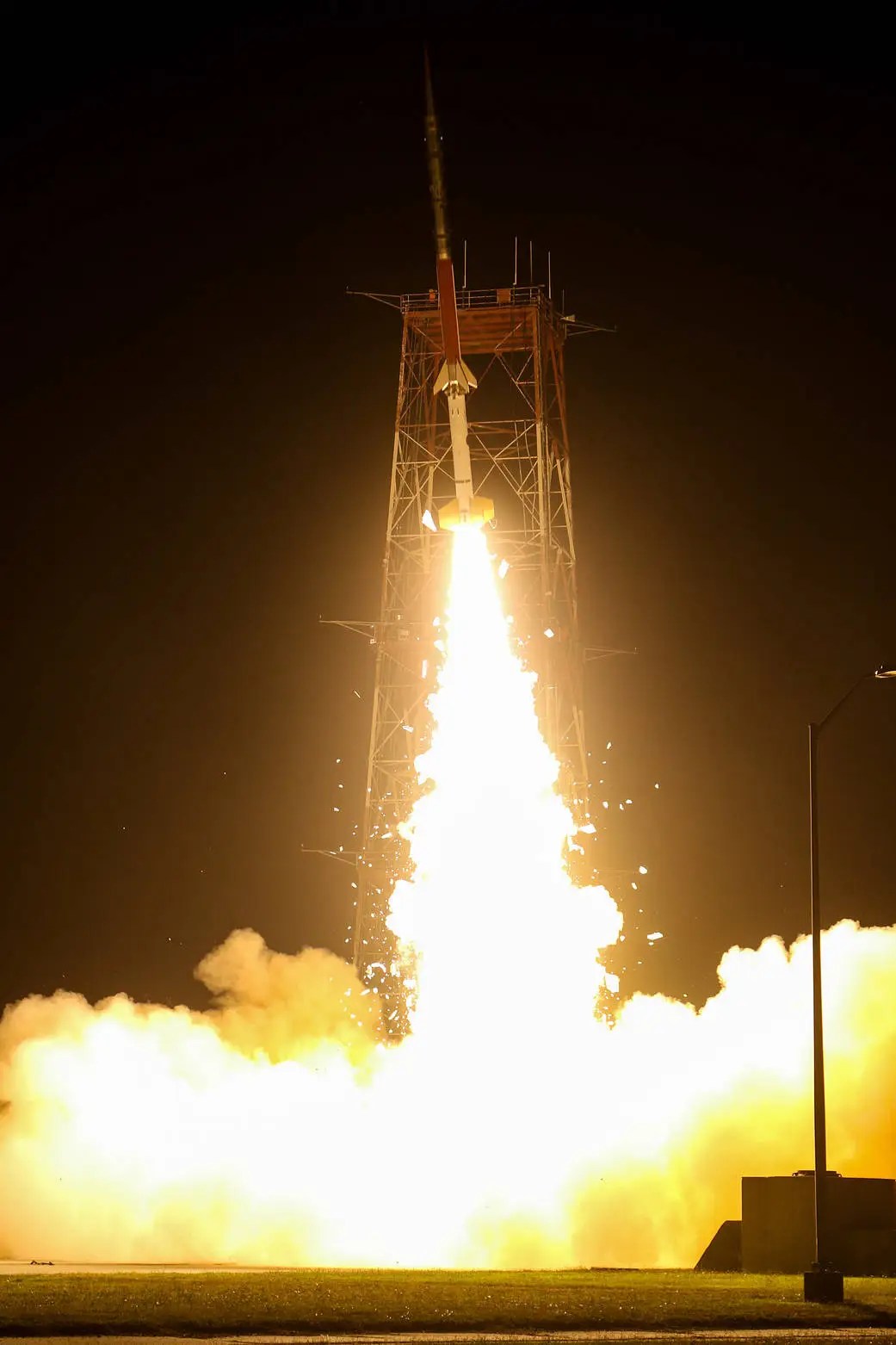
NASA Tests Launch Abort System at Supersonic Speeds (www.techmagdaily.com)→One of the critical aspects of human space flight is the ability to protect astronauts in case of a failure on the launch pad and during the climb to orbit.
NASA's SOFIA Will Likely Help Solve Mysteries About Our Galaxy (www.sciencedaily.com)→How were millions of young stars able to form at the center of our Milky Way galaxy in the presence of an enormous black hole with a mass 4 million times that of the sun? This and other important questions may be answered by the NASA mission SOFIA, which is scheduled to make its first scientific measurements in the next few months.
NASA gives glimpse of world's most realistic flight simulator (www.mercurynews.com)→It's called NASA's Vertical Motion Simulator. In layman's terms, it's perhaps the most realistic flight simulator in the world, a video-gamer's dream.
Treasured flight simulator celebrates 30 years (www.mv-voice.com)→The electro-mechanical wonder at NASA Ames known as the Vertical Motion Simulator had its 30th anniversary last Friday.
NASA to Reveal Big News From Planet-Hunting Spacecraft Thursday (www.space.com)→NASA is expected to make an announcement Thursday on the progress of its Kepler spacecraft, which has been staring at one patch of space for evidence of other worlds.
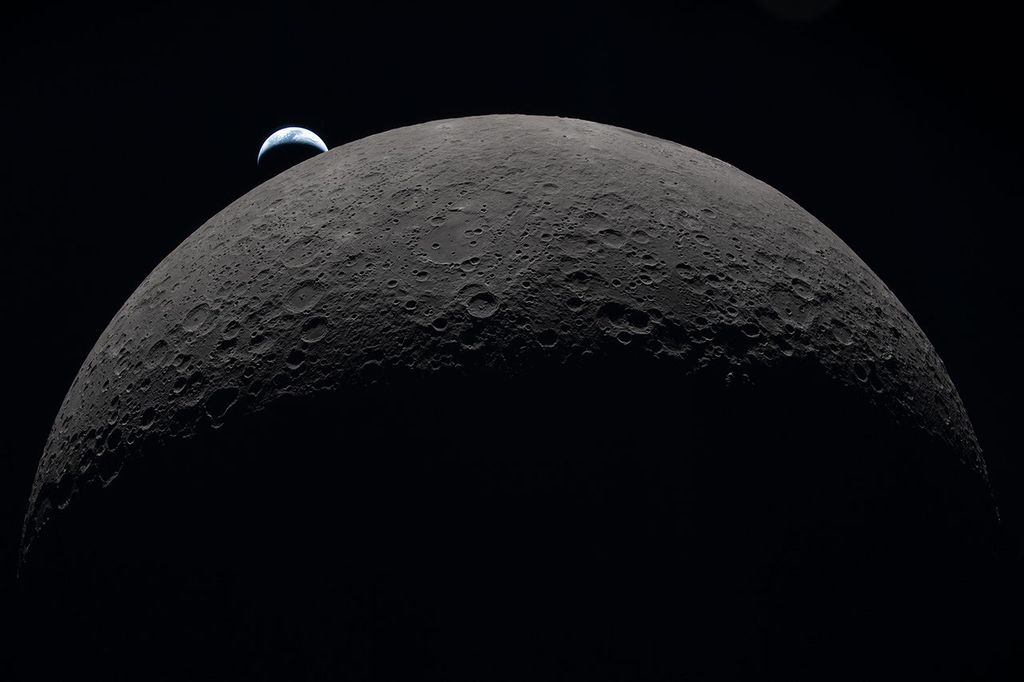
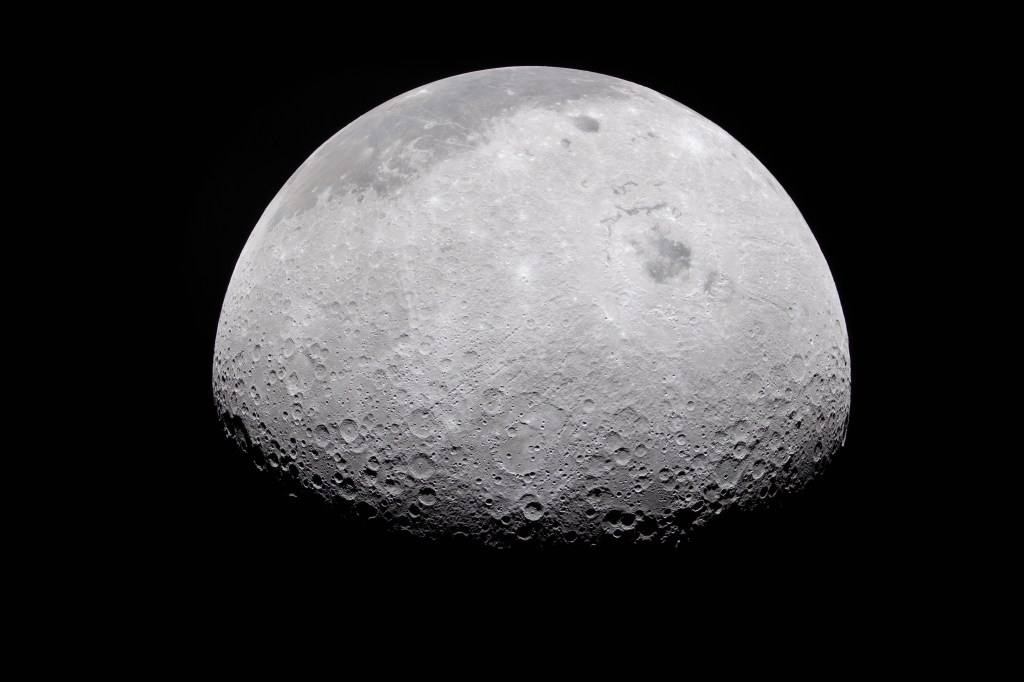
The Moon is Shrinking, Like a Wrinkled Apple (www.discovery.com)→The moon is a permanent feature in our skies, but is it as unchanging as it seems?
NASA Jump-starts Space Technology Program (www.spacenews.com)→Senior NASA officials are so eager to jump-start advanced technology efforts that they sought and won congressional approval to devote $36.5 million in 2010 funding to eight high-priority research projects.
NASA speaker at Wichita Aero Club touts commercial space industry (www.bizjournals.com)→Dr. Alan Weston, director of programs at the NASA Ames Research Center, says space travel will become a commercial industry and Wichita could help lead the way.
DARPA Eyes Small Satellite Development (www.informationweek.com)→The Department of Defense’s research arm is modifying a program to build a wirelessly connected small-satellite network to provide a more scalable set of technologies that can be integrated through open standards.
Is Space the Valley’s Next Frontier? (www.techcrunch.com)→A little more than a year ago, I was in London at a dinner party and my friend Matt Ogle was glued to his phone, hanging on every update he could find about an impending shuttle launch.
What Now? (www.pressheretv.com)→The shuttle is retiring & President Obama doesn't want to spend the money to take a trip back to the Moon. Where does that leave NASA? And how can the space agency attract talent if Google pays more? Dr. Pete Worden, head of NASA's Ames Research Center in Silicon Valley ponders the future.
NASA Institute Seeks Lunar Research (www.aviationweek.com)→NASA’s Lunar Science Institute at Ames Research Center here brings the same interdisciplinary approach that the center’s Astrobiology Institute has pursued over the past decade as it seeks to understand the origin, evolution, distribution and future of life in the universe.
SOFIA Observatory Finishes Open-Door Flight Tests (www.digitaljournal.com)→NASA's SOFIA flying observatory recently completed the second series of envelope-expansion flight tests with its telescope door open.
NASA Ames working on atmosphere study (www.kliv.com)→NASA Ames Research Center has entered into a collaboration to study the atmosphere.
Life at the SETI Institute: SETI Gurls (www.huffingtonpost.com)→Every summer, the SETI Institute hosts 15-20 college students from around the country as part of its Astrobiology Research Experience for Undergraduates (REU) internship program.
Twinkle, twinkle, little dot (www.sciencenews.org)→Are you a planet or are you not?
NASA Ames looking to pay for Hangar One restoration with its own funds (www.mercurynews.com)→NASA Ames Research Center is gearing up to restore Hangar One, an official said, and despite the agency's long-running claims that it couldn't afford to do the work, the money may come from within NASA after all.
NASA chief technologist Robert Braun: ‘We intend to take considerable risks’ to innovate (www.smartplanet.com)→NASA chief technologist Bobby Braun was appointed to his job in February when NASA revived the chief technologist office.
NASA's chief technologist seeks to develop transformative programs (www.mercurynews.com)→When Bobby Braun was a Ph.D. student in aeronautics and astronautics at Stanford, he couldn't imagine holding the "dream job" he's doing now -- NASA's chief technologist, the first person in that role since Braun was at Stanford in the 1990s.
Next giant leaps for NASA tech (www.msnbc.com)→Alan Boyle writes: Rocket refueling stations and new kinds of engines for deep-space travel are high up on NASA's wish list for new technologies.
Fresh Scar on the Moon's Surface (www.discovery.com)→With all the hoopla about the Moon having or not having water, let's not forget our satellite's best-known features: its craters.
No One Can Hear You Scream (www.walrusmagazine.com)→At Mars on Earth, on Canada’s Devon Island, researchers prepare for space travel’s worst dangers.
Scan and Mold Yourself at Home with a Budget DIY 3-D Scanner (www.popsci.com)→The 3-D scanner is the love child of a webcam and a laser.
NASA asks for information to restore Hangar One (www.mercurynews.com)→In a possible step toward preserving Hangar One, NASA Ames Research Center has issued a "request for information" about what it would take to replace the Mountain View landmark's toxic walls, as well as the cost.
William McDonough On Cradle-To-Cradle Design (www.forbes.com)→William (Bill) McDonough is perhaps best known for redesigning Ford Motor's River Rouge plant with a vast green grass roof.
NASA Helps in Upcoming Asteroid Mission Homecoming (www.techmagdaily.com)→This artist's concept depicts the Hayabusa spacecraft (left) and sample return capsule (right) entering the atmosphere over South Australia. That's when the Japan Aerospace Exploration Agency (JAXA) expects the sample return capsule of the agency's technology demonstrator spacecraft, Hayabusa, to boomerang back to Earth.
Walls of Hangar One's cork room are contaminated, must be removed, Navy says (www.mercurynews.com)→Hangar One's historic "cork room" will likely lose its cork.
Navy: Hangar One's contaminated cork walls must go (www.mv-voice.com)→Unless NASA Ames takes on the responsibility of dealing with some newfound toxic dust, it appears that the U.S. Navy is moving full steam ahead in tearing down some historic cork walls inside Moffett Field's Hangar One.
NASA Mind Training Tackles Motion Sickness (www.discovery.com)→Do you feel woozy during long car rides? NASA researchers believe it's all in the mind and they have a training program to thwart it.
Yvonne Pendleton: Moon went from interesting to fascinating (www.earthsky.org)→Astrophysicist Yvonne Pendleton is director of NASA’s Lunar Science Institute, which leads the U.S. space agency’s science efforts to explore and understand Earth’s moon.
Best hope for saving Arctic sea ice is cutting soot emissions, says Stanford researcher (www.stanford.edu)→The quickest, best way to slow the rapid melting of Arctic sea ice is to reduce soot emissions from the burning of fossil fuel, wood and dung, according to a new study by Stanford researcher Mark Z. Jacobson.
Farmers Look To Adopt Space-Age Technology (www.ksbw.com)→NASA is diverting some of its attention from space programs and solar systems to help California farmers.
Cheaper, Better Satellites Made From Cellphones and Toys (www.wired.com)→Instead of investing in their own computer research and development, engineers at the NASA Ames Research Center are looking to cellphones and off-the-shelf toys to power the future of low-cost satellite technology.
Rumors in Astrophysics Spread at Light Speed (www.nytimes.com)→ Dimitar Sasselov, an astrophysicist at the Harvard-Smithsonian Center for Astrophysics, lit up the Internet last month with a statement that would stir the soul of anyone who ever dreamed of finding life or another home in the stars.
Summer of Innovation at NASA Ames (www.kliv.com)→ NASA Ames Research Center is celebrating its Summer of Innovation by opening its doors to Middle School students for Exploration Day.
NASA Simulates Space Exploration At Remote Arctic Crater Site (www.iewy.com)→NASA personnel are among a group of international researchers who are in the Canadian Arctic assessing concepts for future planetary exploration as part of the Haughton-Mars Project, or HMP-2010.
Bill that commits $10 million to replace Hangar One's shell passes key subcommittee (www.mercurynews.com)→Efforts to preserve Moffett Field's historic Hangar One received a significant boost Tuesday when a key congressional subcommittee endorsed a bill that would allocate $10 million for the task.
Kepler mission on the verge of more planet discoveries (www.spaceflightnow.com)→The Kepler space telescope has uncovered a treasure trove of candidate planets the size of Earth circling other stars, potentially reshaping scientists' view of the universe.
LRO Provides New Crater Analysis Method (www.softpedia.com)→The orbiter has been around the Moon since 2009.
Meet Google’s Space Commander (www.nytimes.com)→Google, as you may know, runs a search engine and sells ads. How odd then that Tiffany Montague works at the company.
$10M Hangar One facelift passes committee (www.bizjournals.com)→A $10 million restoration has been approved for Hangar One at Moffett Field, according to Rep. Anna G. Eshoo (D-Palo Alto).
Is the moon really a 'been there done that' world? (www.csmonitor.com)→In the past year, we've learned that the moon is a very different place than what we had thought. Should we be so quick to disregard a manned mission?
Alameda preschoolers get firsthand taste of space shuttle life (www.insidebayarea.com)→News alert for 3- to 7-year-olds: Astronauts wear diapers during spacewalks.
Four decades later, recovering lunar images (www.cnet.com)→Between 1966 and 1967, the U.S. launched a series of five unmanned Lunar Orbiter missions that photographed and mapped 99 percent of the lunar surface.
Supercomputer reproduces a cyclone's birth, may boost forecasting (www.labspaces.net)→As a teen in his native Taiwan, Bo-wen Shen observed helplessly as typhoon after typhoon pummeled the small island country.
Yvonne Pendleton named head of lunar institute (www.sfgate.com)→Yvonne Pendleton, a pioneer astrophysicist at NASA's Ames Research Center in Mountain View, has been named director of the center's Lunar Science Institute, the space agency announced.
Happy Birthday to NASA’s moon mission (www.smartplanet.com)→Over 500 lunar scientists are gathered at NASA Ames this week to discuss the U.S.’s most ambitious moon mission since the Apollo program — NASA’s Lunar Crater Observation and Sensing Satellite and the Lunar Reconnaissance Orbiter (LCROSS/LRO).
NASA scientists share analyses of watery moon (www.mercurynews.com)→From last year's big kerplunk, scientists discovered water on the moon.
NASA Evaluates Nebula Cloud Platform For Broader Use (www.informationweek.com)→NASA's Nebula cloud-computing platform may soon take on a more prominent position at the agency to replace on-premises technology as a cost saving and efficiency measure.
Ames to host lunar lecture (www.mv-voice.com)→At a special open-to-the-public event, space historian Andrew Chaikin will discuss lunar exploration and astronomer/artist Jose Francisco Salgado will present a multimedia demonstration entitled, "Communicating Science through Art," on Wednesday, July 21 at 7 p.m. at NASA Ames.
Lunar Forums and Anniversaries (www.universetoday.com)→I'm attending the NASA Lunar Science Institute's Lunar Forum at Ames Research Center in California, which will feature sessions on recent scientific results as well as talks on future opportunities for lunar science, education and outreach.
An air and space museum for Hangar One? (www.mv-voice.com)→Preservationists organize 'Smithsonian West' campaign.
Moffett airfield up for grabs? (www.mv-voice.com)→Silicon Valley's private jets could use it, says county airports director.
Va. Firm Picked as Chileworks Integrator (www.spacenews.com)→Millennium Engineering and Integration Co. of Arlington, Va., was tapped as the lead systems integrator for the Pentagon’s new Rapid Response Space Works facility, according to a July 14 NASA press release.
Go to Mars from your computer (www.publicradio.org)→Do you want to go to Mars? Of course you do. And of course you can’t. Sorry.
Armchair Astronauts Can Take a High-Def 3D Mars Tour (www.discovery.com)→For space enthusiasts who just can’t wait for humans to get to Mars, NASA’s got the next best thing.
Microsoft and NASA Team Up On 3-D Space Images (www.space.com)→WorldWide Telescope, Microsoft’s galactic version of Google Earth, has been steadily increasing its fidelity ever since it launched in 2008.
Plans to destroy Hangar One relics may be unnecessary (www.mv-voice.com)→Navy rethinks plans to trash lights, walls and buildings inside historic structure.
NASA Wants to Help You Stop Throwing Up (www.msn.com)→Can't go on a long car ride without feeling queasy? Don't worry -- you're not a wimp if you get green in the gills in the minivan.
NASA and Microsoft Bring Mars to the Web in 3D (www.takesontech.com)→NASA and Microsoft Research are bringing Mars to life with new features in the WorldWide Telescope software that provides viewers with a high-resolution 3-D map of the Red Planet.
Innovation at risk (www.paloaltoonline.com)→Federal funding that has historically sustained Silicon Valley economic growth is threatened.
NASA and Microsoft Provide Mars 3-D Close Encounter (www.physorg.com)→NASA and Microsoft Research are bringing Mars to life with new features in the WorldWide Telescope software that provide viewers with a high-resolution 3-D map of the Red Planet.
Microsoft's WorldWide Telescope updated with better views of Mars, night sky (www.engadget.com)→We haven't heard a ton about Microsoft's WorldWide Telescope project since it launched in beta form back in 2008, but the company has been busy working with NASA to improve it since then, and it's now finally showing off the results.
Conduct Virtual Explorations of Mars with New WorldWide Telescope Feature (www.universetoday.com)→Love 3-D imagery of Mars? There's now a firehose just for you!
Microsoft's telescope gets a better view of Mars (www.cnet.com)→Microsoft has made a number of improvements to its Worldwide Telescope project, including partnering with NASA to offer much better imagery of the planet Mars.
After 3 Years of Data Crunching, NASA and Microsoft Release Stunning New Interactive Mars Tour (www.popsci.com)→Using Microsoft's WorldWide Telescope program, you can now take an interactive tour of Mars with the highest-resolution images available of the Red Planet -- something even scientists have never been able to see before.
NASA delivers Mars in high definition (www.msn.com)→NASA is partnering with Microsoft Research's WorldWide Telescope to offer half a billion high-resolution images of Red Planet sights, ranging from past rover tracks to future landing zones for Mars-bound astronauts.
A hub of innovation (www.paloaltoonline.com)→NASA Research Park blends government, venture capital, education and startups
Explorers return to Mars in Canada (www.msnbc.com)→Researchers have set up camp in the Canadian Arctic once again, testing the tools and techniques that could be used on future human missions to Mars, the moon ... or wherever.
Novel University Project Tackles Future of Space Exploration (www.space.com)→Top students from 35 nations around the globe have kick-started this year's activities at Singularity University, taking on a set of humanity's grand challenges — an agenda that includes recasting the future of space exploration.
Mountain View's Hangar One continues on path to dismantling (www.mercurynews.com)→As the Navy and its contractors get closer to dismantling Hangar One, the historic airship hangar at Moffett Field in Mountain View, preservationists continue calling on the Navy to save the unique "cork room" inside.
World Cup 2010: Nasa tests confirm Jabulani is 'unpredictable' (www.telegraph.co.uk)→American space agency Nasa has joined the growing list of critics of the official World Cup match ball after subjecting the Jabulani to a series of aerodynamic tests.
NASA piles on the Jabulani hate (www.yahoo.com)→"Appalling." "The guy who designed this ball never played football." "The worst ball that I have seen in my life." So says everyone from Iker Casillas to Robinho to Fabio Capello. Former Liverpool striker Craig Johnson even wrote a passionate 12-page letter to Sepp Blatter, president of FIFA, on how the Adidas ball "could ruin the game as we know it."
SOFIA Telescope First Results Being Analyzed (www.theepochtimes.com)→NASA’s airborne observatory - the Stratospheric Observatory for Infrared Astronomy (SOFIA) telescope - took its first flight in May and the images from the flight are currently being analyzed by experts at NASA, according to reports on Friday.
NASA's Flying Telescope Sees Early Success (www.npr.org)→NASA has begun operating a flying telescope powerful enough to record the birth of distant stars and planets.
Early stages of crater birth captured on camera (www.newscientist.com)→They move too fast for human eyes to see, but a camera has tracked individual sand particles spraying from an impact site in the first moments of crater formation.
History salvaged from Moffett Federal Airfield hangar set for demolition (www.mercurynews.com)→The massive airplane hangar at former Naval Air Station Moffett Field is set to be completely stripped and retrofitted this year to stem the release of toxic chemicals coating the outer shell of the hangar. But the Navy and NASA are salvaging as much of the history contained in the hangar as possible.
Gabriel Slate's Tech Report (www.kron4.com)→NASA Ames Hosts One of the World's Most Powerful Computers.
NASA Needs You: 6 Ways to Help an Astronomer (www.wired.com)→Space is a big place, and even with their giant telescopes, astronomers just can’t cover it all.
Nuclear Bombs Could Save Earth from Asteroids (www.space.com)→If a massive asteroid is hurtling toward Earth and threatening to sterilize the entire planet, blasting it to pieces with nuclear bombs might seem fit for a Hollywood movie.
Probing Pavilion Lake (www.astrobio.net)→“For all intents and purposes,” says Allyson Brady of the University of Calgary, Pavilion Lake, in British Columbia, “seems to be a pretty normal lake. There are fish in it; people have cottages around the lake, you can go swimming.” It’s a lovely place to bring the family for a summer vacation.
Eshoo 'disturbed' by plan to demolish Hangar One's cork room (www.mv-voice.com)→In a terse letter to U.S. Navy Secretary Ray Mabus, Congresswoman Anna Eshoo says she is "disturbed" by news reports about the planned demolition of the unique "cork room" inside Moffett Field's Hangar One, and she asks pointed questions about why the Navy is set to destroy the historic structure.
Kepler Discovers Hundreds of New Planets (www.planetary.org)→It’s been a year now since Kepler completed its first round of observations, and the early results are now in.
The Moon: Damp from Day One (www.skyandtelescope.com)→When I returned from a week in Australia (to help welcome home Japan's Hayabusa spacecraft), my overloaded In Box was chock full of fascinating astronomy news.
Alien planet? NASA spacecraft spots hundreds of candidates. (www.csmonitor.com)→Alien planet hunt: Scanning for habitable worlds outside our solar system, NASA's Kepler mission has already spotted hundreds of candidates.
World Cup: How Altitude Could Cause Players to Overshoot (www.livescience.com)→World Cup players might notice some strange things happening to their kicks because of the peculiar aerodynamics of playing soccer at the high altitude of the Johannesburg, South Africa, stadium, a NASA scientist warned today.
First Data Sets Pour Out Of Kepler (www.aviationweek.com)→Scientists are using ground-based telescopes and the Hubble and Spitzer orbiting observatories to begin the painstaking task of weeding out the “maybes” from false alarms in the initial data sets from NASA’s Kepler mission as they search for Earth-like exo-planets outside our Solar System.
Kepler: A Tidal Wave of Exoplanet Candidates (www.skyandtelescope.com)→It’s a rich universe out there.
NASA: Neptune-sized planets orbiting other stars (www.usatoday.com)→NASA Kepler space telescope data Tuesday suggests most planets orbiting nearby stars so far detected by the mission are Neptune-sized.
Kepler space telescope finds possible planets (www.sfgate.com)→The Kepler space telescope seeking Earth-like planets in a far-off region of the Milky Way has discovered more than 700 planetary "candidates" - some that just might be the right size and in the right places for life to be possible.
Orbiting telescope spots possible planets (www.latimes.com)→NASA's Kepler telescope has identified more than 700 so-called extrasolar planets, which obit around stars other than the sun.
Telescope sees possible planets near 706 stars (www.dispatch.com)→But data on 400 other stars kept for study by NASA.
An avalanche of alien planets (www.msn.com)→Researchers have confirmed the existence of six new planets beyond our solar system, with hundreds of other new worlds potentially waiting in the wings.
Kepler craft reports apparent planetary bonanza (www.sciencenews.org)→Surveying thousands of stars for telltale twinkles that signal the passage of an orbiting planet, NASA’s Kepler spacecraft has discovered a whopping 706 candidate planets beyond the solar system.
New Worlds to Explore? Kepler Spacecraft Finds 750 Exoplanet Candidates (www.universetoday.com)→The Kepler spacecraft has found over 750 candidates for extrasolar planets, and that is just from data collected in the first 43 days of the spacecraft's observations.
Kepler Exoplanet Controversy Erupts (www.discovery.com)→One of the biggest astronomical stories to unfold over the last decade or so is the story of exoplanets (or "extra-solar planets").
Exoplanet Hunter’s First Data Withholds the Good Stuff (www.wired.com)→The planet-hunting space telescope, Kepler, released its first big batch of data today.
NASA computers donated to Park Avenue Elementary (www.appeal-democrat.com)→They went from a NASA site in Silicon Valley to a school in Sutter County to serve students who needed more computers — spurring a photo thank-you from the youths.
Stars align for local astronomer (www.mv-voice.com)→NASA Ames' Cuzzi wins top honor for planetary work.
Japanese Probe Set to Land in Australian Outback Sunday, Returning First Asteroid Sample to Earth (www.popsci.com)→A Japanese meteor-investigator probe will become a meteor itself when it returns to Earth over the weekend. The Hayabusa probe is screaming toward Earth at asteroid speed, according to scientists at NASA’s Ames Research Center. Scientists hope it is carrying samples obtained from a 2005 visit to the small asteroid Itokawa.
Hunt on for asteroid dust and solar system secrets (www.yahoo.com)→A team of eager scientists flew into the Australian Outback on Monday to recover a Japanese space capsule they hope contains the first-ever asteroid samples that could provide clues into the evolution of the solar system.
NASA Pursues ‘Whisper Mode’ In World’s Biggest Wind Tunnel (www.wired.com)→As more and more helicopters are used for everything from medical transportation to news gathering, more and more people on the ground are complaining about the noise.
Strange Discovery on Titan Leads to Speculation of Alien Life (www.space.com)→New findings have roused a great deal of hoopla over the possibility of life on Saturn's moon Titan, which some news reports have further hyped up as hints of extraterrestrials.
Titan: Oasis For Life As We Don't Know It? (www.discovery.com)→There’s a potential new wild card in our search for life on other planets.
Could New Life Form Lurk on Saturn's Biggest Moon? (www.aolnews.com)→There may be life on Titan, Saturn's hazy, red moon.
Bigger is better for NASA Ames supercomputer (www.mv-voice.com)→In the world of supercomputing, it seems that size really does matter -- and in that respect, NASA's Ames Research Center certainly has something to boast about.
Merely Human? That’s So Yesterday (www.nytimes.com)→On a Tuesday evening this spring, Sergey Brin, the co-founder of Google, became part man and part machine. About 40 people, all gathered here at a NASA campus for a nine-day, $15,000 course at Singularity University, saw it happen.
Hints of life found on Saturn moon (www.newscientist.com)→Two potential signatures of life on Saturn's moon Titan have been found by the Cassini spacecraft.
In the Hunt for Planets, Who Owns the Data? (www.nytimes.com)→We are about to find out just how generous nature really is.
NASA Ames Helps Kids Learn Math With Flight Controllers (www.mv-voice.com)→Three air traffic controllers helped children from ACE Charter School in San Jose use their math skills last Tuesday at NASA Ames.
NASA Guts 747, Adds 17-Ton Telescope (www.nationalgeographic.com)→After 13 years of planning and building, NASA's latest high-flying telescope—seen above during an April test flight—opened its infrared eye for the first time last week from aboard a modified Boeing 747 jumbo jetliner.
Jet-Mounted Telescope Sees First Light (www.wired.com)→A new flying observatory snapped its first pictures of the infrared night sky last week. The Stratospheric Observatory for Infrared Astronomy, or SOFIA, a joint project between NASA and the German Aerospace Center, saw heat escaping from clouds in Jupiter’s atmosphere and the star-forming heart of galaxy M82 on its maiden voyage May 26.
SOFIA Sees Jupiter's Ancient Heat (www.discovery.com)→The Stratospheric Observatory for Infrared Astronomy, or SOFIA, took off for its maiden flight during the early hours of Wednesday morning and the "first light" images of the observations taken during the flight are available.
"First Light" for a Flying Telescope (www.skyandtelescope.com)→Last week marked the debut of an impressive addition to astronomers' means of seeing the universe.
Sofia Begins Imaging Operations (www.aviationweek.com)→The Boeing 747SP-based Sofia observatory developed by NASA and the Germany Aerospace Center, DLR, has completed its first airborne measurements.
US-German flying observatory sees 'first light (www.sacbee.com)→A new U.S.-German infrared observatory mounted in a jumbo jet has made its first in-flight night observations.
NASA's Airborne Infrared Observatory Sees "First Light" (www.scientificcomputing.com)→The Stratospheric Observatory for Infrared Astronomy (SOFIA), a joint program by NASA and the German Aerospace Center, achieved a major milestone May 26, 2010, with its first in-flight night observations.
UAE Students Embark On NASA Internships (www.abudhabicityguide.com)→Three UAE students will today depart to the United States to begin their internships with the National Aeronautics and Space Administration (NASA), the renowned US space agency. This marks the first time NASA’s two - 10 month training program has been offered to non-US citizens.
Planetary Scientist Jeff Cuzzi Wins Kuiper Prize (www.scientificcomputing.com)→Jeff Cuzzi, a planetary scientist at NASA Ames Research Center, Moffett Field, CA, has been named the winner of the 2010 Gerard P. Kuiper Prize, the most prestigious individual award in planetary sciences.
Asteroid Probe's Return to Earth Keeps Scientists on Edge (www.space.com)→A "welcome home" team of eager scientists is anxiously awaiting this month's return of a Japanese asteroid probe and its planned nosedive into Australia because — just maybe — it is toting a tiny, but prized, piece of space rock.
Flying NASA Telescope Snaps First Photos from Stratosphere (www.space.com)→NASA's newest infrared telescope has taken to the skies to capture its first views of the cosmos from a stratospheric perch – one that allows it gaze out a huge hole in the side of high-flying jumbo jet.
Boeing 747-mounted telescope takes first pictures of space (www.seattlepi.com)→The Stratospheric Observatory for Infrared Astronomy made its first in-flight night observations Wednesday, NASA announced Friday.
Telescope in the Sky Makes Debut Flight (www.discovery.com)→An infrared telescope designed to study star formation, extrasolar planets and other celestial phenomena opened its eye on the universe for the first time Wednesday, from a vantage point 35,000 feet above ground.
SOFIA team rehearses for first flight (www.rdmag.com)→When SOFIA took off from a runway at NASA's Dryden Aircraft Operations Facility in Palmdale, Calif., on the evening of May 25, the dozens of researchers behind the mission likely felt a few first-time jitters.
Flying Telescope Escapes 13-Year Purgatory to Glimpse Heavens (www.sciencemag.org)→After cost overruns and delays that threatened to keep it grounded forever, a NASA airplane observatory is finally ready to take to the skies.
UAE students to get training for space mission (www.sify.com)→Three engineering students of the United Arab Emirates (UAE) will be trained for space missions by the US space agency NASA.
Life at the SETI Institute: David Morrison, Carl Sagan Center Director (www.huffingtonpost.com)→David Morrison has joined the SETI Institute staff as the Director of the Carl Sagan Center for Study of Life in the Universe.
You Too Can Explore Space (www.techinsider.nextgov.com)→Just when you thought there was an automated process for everything, one of the most forward-thinking areas of science decided to ditch computers for some good old-fashioned human problem-solving.
Heads Up, Citizen Scientists: The Moon Needs You! (www.npr.org)→We're seeing the most detailed images of the moon's surface ever captured from afar — thanks to NASA's Lunar Reconnaissance Orbiter, or LRO. The space probe carries a super-powerful camera, which photographs every bit of the moon's surface for scientists to examine.
Vintage war planes come to Moffett Field (www.mv-voice.com)→Three WWII-era fighter and bomber aircraft will be available for up-close exploration May 21 through 29 at Moffett Federal Airfield as part of the Collings Foundation's Wings of Freedom Tour, a nationwide tour bringing rare wartime aircraft to the public.
Asteroids emerge as next frontier of space exploration (www.usatoday.com)→Lost in space, so to speak — amid Capitol Hill bickering among Apollo-era astronauts over axed moon missions — is NASA's contemplated next destination.
NASA wants you on the moon (www.techeye.net)→NASA has launched a new Citizens Science project called Moon Zoo that allows you to explore the moon and help it identify craters and other interesting sites.
A new way to explore our Moon (www.astronomy.com)→From the group that brought you Galaxy Zoo — the citizen science project where you help categorize galaxies — comes Moon Zoo.
Citizen Science Goes to the Moon (www.universetoday.com)→Have you ever wanted to explore the Moon? Well, now you can as a virtual astronaut, and you can help lunar scientists answer important questions, as well.
On NASA space shuttle Atlantis, germs floating with the astronauts (www.smartplanet.com)→NASA is studying the effect of microgravity on the growth of bacteria, which may become a problem on long space flights, according to chief scientist Ken Souza, who was at NASA Ames this morning to see Atlantis off.
Sofia Observatory Poised For First Missions (www.aviationweek.com)→Astronomers will compete for early places on NASA’s Stratospheric Observatory for Infrared Astronomy (Sofia) airborne observatory as the start of science missions nears, following completion of envelope expansion flights with the telescope cavity door open.
McGill student lands coveted NASA internship (www.montrealgazzette.com)→Aspiring astronaut Laura Drudi very down to Earth
NASA-Ames touts its role as a Silicon Valley job engine (www.sfgate.com)→NASA's Ames Research Center generated 5,300 jobs and $877 million in total annual economic activity in the nine-county San Francisco Bay Area in 2009, according to a new economic benefits study.
Dreaming of space, grounded in town (www.indiatimes.com)→Six talented students from the Somalwar Nikalas and Ramdaspeth branches and three college students from city who have brought laurels to city by making it to the prestigious ‘space settlement design contest’ organised annually by National Aeronautics and Space Administration (NASA) unfortunately would not be able to visit Chicago, USA, for making presentations in the absence of sponsors.
A public invitation to visit the moon (www.cnet.com.com)→NASA's plans to visit the moon may be shelved for the time being, but that doesn't mean that you can't take a trip to the lunar surface. And you won't even need to get fitted for a space suit.
Your chance to be a lunar scientist (www.scientificamerican.com.com)→Scientists are appealing to space fans to help identify features on the Moon - and even to discover the wreckage of long-lost spacecraft.
Report: NASA Ames boosts Bay Area's economy (www.mv-voice.com.com)→The United States economy gets a substantial return on every tax dollar spent by NASA Ames, which generates $877 million a year for the Bay Area's economy alone, according to a new report.
Students study Mars (www.contracostatimes.com)→Life on Mars will be explored during a recognition event Tuesday of high school astrobiology interns who have been researching the subject.
Jobs … The Final Frontier (www.sanjose.com.com)→A manned trip back to the moon may be off the table for the next few decades, but plenty of men and women will be heading to NASA.
NASA Ames helping local economy (www.kliv.com.com)→A new report says the local economy is getting a big boost from activity at the NASA Ames Research Center at Moffett Field.
Science group says 'immune booster' for space travel not so far off (www.mercurynews.com)→Space has often been referred to as the final frontier for human travel, but a group of Monta Vista High School students see it as a business opportunity.
Open source is NASA's next frontier (www.gcn.com)→New CTO lays out his vision for the future.
Photos: Inside Nasa's supercomputing centre (www.zdnet.co.uk)→The Pleiades supercomputer, one of the supercomputers based and maintained at Nasa's Ames Research Center, is the world's sixth most powerful computer.
Water Ice Found on the Surface of an Asteroid for the First Time (www.scientificamerican.com)→The asteroid 24 Themis has organic material and a layer of frost, bolstering theories that asteroids could have seeded Earth with both water and the precursors to life.
Enabling Chemistry Experiments In Space (www.pubs.acs.org)→The nanosatellite isn’t exactly “nano,” but it is small: It is roughly the size of a shoebox and weighs about 5.5 kg, said Andrew L. Mattioda, deputy chief of the astrophysics branch at the National Aeronautics & Space Administration (NASA) Ames Research Center, in Moffett Field, Calif.
Searching for Intelligent Life Out There (www.cbsnews.com)→Astronomers Seek Signs of Life Beyond Our Solar System, and New Planetary Discoveries Are Expanding Their View
Inside Nasa's flying telescope for infrared astronomy (www.bbc.co.uk)→Nasa has unveiled a powerful new tool in its quest to unravel the mysteries of the universe - a giant telescope mounted inside a jumbo jet called Sofia.
Sofia Nears Clearance For Science Missions (www.avaiationweek.com)→NASA is moving closer to the start of science missions using the Stratospheric Observatory for Infrared Astronomy (Sofia) airborne telescope upon the imminent completion of envelope expansion flights with the aircraft’s telescope cavity door open.
Blimp Hangar's Future Up in the Air (www.online.wsj.com)→What's 1,133 feet long and 198 feet high and toxic all over? The answer sits alongside Highway 101 within Moffett Field, the former Navy base-turned-NASA facility between Mountain View and Sunnyvale. Known as Hangar One, it is the West Coast's biggest dirigible facility—and the subject of a passionate local movement to preserve the giant building.
US-German airborne telescope to scan the skies (www.abcnews.go.com)→A NASA Boeing 747 carrying a huge German-made infrared telescope is on the verge of scanning the skies for the first time after years of development.
NASA Cloud Guru Named CTO For IT (www.informationweek.com)→The brains behind the Nebula cloud computing effort moves to NASA HQ to drive IT innovation for the space agency.
NASA Explores Semantic Search (www.informationweek.com)→Technology from Google and Smartlogic allows semantic searches on 50 years of data on the agency's space-flight program.
NASA shows off Boeing 747-mounted telescope (www.blog.seattlepi.com)→NASA Tuesday offered the first media tour of the world's largest airborne observatory.
Hawaii, NASA Reach Agreement (www.kitv.com)→Hawaii and NASA came to an agreement on Tuesday. The governor held a news conference with the director of NASA's Ames Research Center to sign a partnership agreement.
Isles' new frontier? Space (www.starbulletin.com)→Space pioneers looking for a launching pad have received a major boost from President Barack Obama. Against resistance by former astronauts, the president says he wants to rely on private companies to fly into space over the next few years, and Hawaii is fortunate in being in the mix as a takeoff point.
Image Gallery: Inside NASA's Nebula Compute Cloud (www.informationweek.com)→NASA engineers have developed a cloud computing environment in a portable container that's about to go into broader testing.
Telescope team may be allowed to sit on exoplanet data (www.nature.com)→NASA panel agrees to Kepler team request to withhold key observations.
Nasa Ames Research Center: Vertical Motion Simulator (www.bestofthebaytv.com)→ Moffett Hosts Out of This World Festival (www.nbcbayarea.com)→ Liftoff at Yuri's Night (www.news.cnet.com)→In a two-day celebration of Soviet cosmonaut Yuri Gagarin's first flight into space on April 12, 1961, thousands of people at NASA Ames Research Center in Mountain View, Calif., joined revelers around the world Saturday for Yuri's Night. The party is now in its 10th year of commemorating the spirit and innovation of space exploration.
Moffett a space-age playground for 'Yuri's Night' (www.mv-voice.com)→Stunt planes, hip-hop, crazy art and more mark NASA celebration in honor of Russian cosmonaut
Have a blast: NASA Ames hosts giant space party and concert, 'Yuri's Night' (www.mercurynews.com)→Astronauts and rockets may seem standard fare at Moffett Field's NASA Ames Research Center, but a hip-hop and alt-rock concert?
Yuri's Night at NASA celebrates the spirit of exploration (www.news.cnet.com)→Hundreds of people at NASA Ames Research Center in Mountain View, Calif., joined revelers around the world Saturday night for Yuri's Night, an annual worldwide party to celebrate Soviet Cosmonaut Yuri Gagarin's first flight into space on April 12, 1961, and honor the spirit of exploration and innovation in art and culture.
NASA Confirms There Is Water on the Moon—But Where Did It Come From? (www.popularmechanics.com)→A month after it sent the LCROSS (Lunar Crater Observation and Sensing Satellite) probe hurtling into the Cabeus crater near the moon's south pole, NASA revealed today that it has uncovered irrefutable evidence of "significant quantities" of water.
NASA Ames helps with Shuttle experiment (www.kliv.com)→As space shuttle Discovery blasts off on its next mission on Monday, it will contain an experiment with its origins at Moffett Field. Scientists from NASA Ames Research Center will be studying how mouse stem cells are affected by being in space for a prolonged period of time.
Outer space: Nasa's multi-screen wonder wall (www.dailymail.co.uk)→You may think you've got a pretty good widescreen set-up at home, but nothing comes close to Nasa's hyperwall-2.
Could investors fund city's transit future? (www.mv-voice.com)→A company that has set up shop at NASA Ames Research Park claims its system for automated pod travel could lift Mountain View out of its traffic and public transportation woes -- and the city may not have to spend a dime on it.
NASA awards contract for hypersonic vehicle R&D (www.eetimes.com)→Among the issues that must be resolved before humans can travel beyond Earth orbit and the moon are shielding astronauts from prolong exposure to radiation and other medical issues like the loss of bone density on trips measured in years.
Moon Water Comes in Three Different Flavors, Say Scientists (www.foxnews.com)→Since the surprise discovery last year of trace amounts of water on the moon, scientists have been redefining their concept of Earth's rocky neighbor. Now researchers say the water on the moon comes in three different flavors.
Not All Moon Water Alike, Says Scientist (www.cbsnews.com)→Following the discovery last year of trace amounts of water on the moon, scientists have been analyzing the data returned by probes mapping the lunar surface, and have determined that different forms of water compounds exist there.
NASA's Ames director envisions role of 'interplanetary Internet' (www.mercurynews.com)→S. Pete Worden's office looks out on the steel frame of what the director of NASA's Ames Research Center says will be "the first lunar building on Earth" — essentially energy independent, as a moon base would have to be. "Sustainability Base" will be the most energy-efficient federal building ever built, consuming no fossil fuel as it draws energy from solar and geothermal sources.
Is There Water On The Moon? Bucketloads. (www.discovery.com)→Unless you've been in hibernation through the winter months, you have probably heard that water has been discovered on the moon. It's not as if water wasn't predicted to exist at the bottom of the coldest craters, it's just that there appears to be a lot more than scientists ever dreamed.
NASA 'committed' to re-skinning Hangar One (www.mv-voice.com)→In a meeting Thursday night, NASA and Navy officials said that, for the first time, they are jointly "committed" to preserving historic Hangar One at Moffett Field, and that various options for restoring the Hangar will probably be released by the end of March.
New Suborbital Spaceships Spark Scientific Frenzy (www.space.com)→Anticipation is on the rise for a new crop of commercial suborbital spaceships that can serve the scientific and educational market.
Homeland Security Develops Super Cell-All Smartphone Technology (www.thegovmonitor.com)→Crowdsourcing cell phones to detect dangerous chemicals.
NASA rep says Hangar One will get new walls (www.mercurynews.com)→The fight over who has to pay to put new panels on Hangar One has been decided, and now the Navy and NASA Ames say they'll work together to help the space agency find a way to fund it.
NASA Uses Fish to Fight Space Sickness (www.space.com)→Astronauts love doing zero-G stunts on the International Space Station, but only after the urge to vomit from space sickness has faded. Now fish, snails and other animals could help understand whether living in space can create long-term or even permanent damage in the inner ear.
NASA program used to make 'map of everything' (www.abclocal.go.com)→Ames Research Center in Mountain View recently won its own "Oscar", NASA's Software of the Year Award. Its mapping program is being used by a Milpitas company to aid earthquake rescue operations in Chile and in Haiti.
One year ago, Boulder-built Kepler was launched to look for Earth-like planets (www.dailycamera.com)→One year ago Saturday, NASA's Kepler spacecraft, built in Boulder by Ball Aerospace, was successfully launched into the night sky to search for planets that could be similar to our own -- other worlds that might support life.
Meet the 'Indiana Jones' of NASA (www.smartplanet.com)→NASA scientist Chris McKay takes his work to the far reaches of planet Earth, studying extreme conditions in order to find life on other planets.
Ski Luna! (www.skyandtelescope.com)→Right now I'm enduring winter in snow-encrusted Boston, but my head is in The Woodlands, Texas, where more than 1,200 researchers have gathered for the annual Lunar and Planetary Science Conference.
Space Foundation — Ice Is Nice As LCROSS Mission Wins John L. "Jack" Swigert, Jr. Award (www.satnews.com)→The final proof has been validated, and so the mission that definitively proved the presence of water on the Moon has been selected as the 2010 recipient of the Space Foundation's John L. "Jack" Swigert, Jr., Award for Space Exploration.
More evidence piles up that the moon harbors lots of ice (www.scientificamerican.com)→Chandrayaan 1, the first moon mission launched by the Indian Space Research Organization, did not last long—in August 2009, controllers lost contact with the probe 10 months into its two-year mission.
Launch of the Bloom box fuel cell generates a slice of Apple hype (www.guardian.co.uk)→What brings Arnold Schwarzenegger to eBay HQ? An ex-Nasa scientist's cheap energy invention made from sand inscribed with special inks.
The Telescope-Toting 747 That Sees More than Hubble (www.popsci.com)→In the movies, opening the door on a plane at 45,000 feet is disastrous. But this spring it will be standard procedure on one 747—one carrying a telescope high enough to capture the cosmos better than ever before.
NASA’s New Jumbo Jet Keeps Giant Eye on Heavens (www.wired.com)→It’s just your typical little research project: a Boeing 747 with a 17-ton infrared telescope in back, searching for newborn galaxies and signs of extraterrestrial organic matter.
Gabriel Slate's Tech Report (www.kron.com)→NASA launches new plane for telescopic research.
A better way to go where no one has gone before (www.sfgate.com)→NASA's budget proposed by the Obama administration contains a bold approach to humans traveling off planet, repairs years of cuts to the science program and restores the leading-edge technology that NASA has pioneered in the past.
What's The Next Breakthrough In Government IT? (www.informationweek.com)→Government agencies aren't known as hotbeds of IT innovation, but there are definitely some bold, game-changing moves underway in government technology. Here are five such initiatives. We're looking for others.
Stairway to Heaven (www.trueslant.com)→When I say the word “Zeppelin” – safety may not be the first thought that comes to mind…”Oh, the humanity” might…but these days the Zeppelin is not your grandfather’s airship.
Livermore Lab unveils technology to save truckers billions of gallons of diesel fuel (www.pleasantonweekly.com)→After more than a decade of research, scientists at Lawrence Livermore National Laboratory Tuesday unveiled technology that they say could save 3.4 billion gallons of diesel fuel each year in the trucking industry.
Navistar, NASA testing trucking aerodynamics (www.todaystrucking.com)→ Future aerodynamic technology current being tested by NASA and Navistar could save the trucking industry nearly $10 billion annually.
Google and Mountain View Recast Company-Town Model (www.nytimes.com)→It is no secret that Silicon Valley is one long string of company-dominated towns.
NASA devices to save trucks $10 billion a year in diesel? (www.dailyenergyreport.com)→The Daily Energy Report for Friday February 19, 2010 discusses how special devices currently being tested at NASA’s Ames Research Center could save the U.S. trucking industry $10 billion a year in diesel fuel.
Suborbital science gets boost (www.msnbc.msn.com)→More than 250 researchers, space industry entrepreneurs and NASA officials gathered today at the Next-Generation Suborbital Researchers Conference in Boulder, Colo., to give a boost to the concept of doing research on private-sector spaceships.
A Drop in the Bucket (www.astrobio.net)→The search for water on other planetary bodies has taken a giant leap forward in recent months.
Six Cal faculty join National Academy of Engineering (www.bizjournals.com)→Six people on U.C. Berkeley’s faculty were elected to the National Academy of Engineering.
NASA, Air Force, national lab partner to improve mpg (www.cnet.com)→Just a 12 percent increase in fuel efficiency for America's trucking industry could translate into a savings of $10 billion, or 3.4 billion gallons of diesel fuel--as well as prevent 36 million tons of carbon dioxide from being released into the atmosphere annually.
AERODYNAMIC DRAG: Lawrence Livermore Labs Looks To Reduce 'Big-Rig' Emissions (www.ktvu.com)→Saving the nation $10 billion annually in diesel fuel costs may be possible in a few years, thanks to new devices...
No dragging down these trucks: Aerodynamic big-rig devices tested at Moffett Field wind tunnel (www.mercurynews.com)→The semi-truck looks pretty much like a semi-truck. But take a second look and you'll notice a few add-ons — the kind that researchers say could save 3.4 billion gallons of diesel fuel and $10.2 billion per year.
NASA Ames developing better fuel economy for semi trucks (www.kron.com)→Gabriel Slate's latest Tech Report video.
The New Streamliners: Big Rigs Save Fuel, CO2 (www.kqed.org)→The wind tunnel at NASA's Ames Research Center in Mountain View is the largest in the world.
New technology could make trucks more 'green' (www.abclocal.go.com)→If you have ever stood by a highway and felt the blast wave of a large truck passing by, that experience may become a thing of the past, or at least, one greatly reduced. If and when that happens, thank a researcher at Lawrence Livermore Laboratory and an experiment he brought to the world's largest wind tunnel at Nasa Ames in Mountain View.
Wind Tunnel Could Help Save Trucking Billions (www.kcbs.com)→It may seem out of place, but a semi-truck is undergoing tests at the NASA Ames Research Center in Mountain View.
'SuperTruck’ draws Navistar attention (www.truckersnews.com)→The wind tunnel at NASA's Ames Research Center in Mountain View is the largest in the world.
Devices under NASA testing could save trucking billions (www.cnet.com)→The American trucking industry could save as much as $10 billion, or 3.4 billion gallons of diesel fuel, a year if devices being tested in a joint public-private initiative at the world's-largest wind tunnel here are rolled out nationally.
A Space-Age Big Rig (www.forbes.com)→Navistar and others are using NASA wind tunnels and supercomputers to develop sleek, fuel-efficient heavy trucks.
NASA explores the cloud with Nebula (www.gcn.com)→Home-grown cloud computing environment designed to let outside scientists contribute.
Livermore Lab tests big rigs in NASA wind tunnel (www.sanfrancisco.bizjournals.com)→Lawrence Livermore National Laboratory is seeking to improve the fuel efficiency of big semi trucks by testing drag-reducing devices in a giant wind tunnel at Moffett Field.
Episode 42: SOFIA – A Telescope on a Plane (www.laboutloud.com)→Dana Backman is the Outreach Director for SOFIA – The Stratospheric Observatory for Infrared Astronomy.
Object no longer thought to be a comet (www.sfgate.com)→A puzzling object that seemed to be a comet flying inside the solar system's asteroid belt is no comet at all, but the remains of a violent collision between two fossil rocks that populate the belt, astronomers say.
NASA still plans to house airships in Hangar One (www.mv-voice.com)→A NASA Ames official said on Tuesday that the agency still hopes to use Moffett Field's historic Hangar One to house airships, standing by a proposal made a year ago.
Moon Exploration is Not Dead (www.space-travel.com)→It's clear by now that America's grand plans for returning astronauts to the Moon have been quashed, at least in the short term.
No shooting for moon, but budget good for Ames (www.sfgate.com)→The deputy director of NASA's Ames Research Center called President Obama's proposed $19 billion space agency budget "overwhelmingly positive" for the Mountain View facility Tuesday even in light of the president's decision to end an ambitious program to send humans back to the moon.
NASA Ames expects new jobs under budget proposal (www.mercurynews.com)→President Barack Obama's decision to change the nation's direction in space programs to emphasize climate research and unmanned missions will mean more money, more partnerships with valley companies — and more jobs for Silicon Valley's NASA base, officials say.
Obama's budget boosts NASA Ames (www.mv-voice.com)→Loss of moon mission means big gains for research at Moffett
Interview with Chris C. Kemp, CIO, NASA Ames Research Center (www.ciozone.com)→ Conley builds on SolFocus success with B2U Solar (www.cleantech.com)→A new cleantech company has been born.
$1 million NASA grant will help Idaho students learn math (www.idahostatesman.com)→Idaho has received a nearly $1 million grant from NASA to expand Idaho Science and Aerospace Scholars Program, a competitive math and science program for high school juniors, Superintendent of Schools Tom Luna and astronaut Barbara Morgan said on Friday.
We will find 'twins of Earth' this year, says astronomer Michel Mayor (www.timesonline.co.uk)→Scientists will have detected the first truly Earth-like planet outside the solar system by the end of the year, one of the world’s leading astronomers predicted yesterday.
A record four South Bay students named Intel Science Talent Search finalists (www.mercurynews.com)→Two seniors at San Jose's Lynbrook High School have been named finalists in the prestigious Intel Science Talent Search, part of a record-setting showing that fortifies local schools' standing as science and technology superpowers.
NASA brings aerospace technology to new energy-efficient building (www.sanjose.bizjournals.com)→NASA will collaborate with San Ramon-based Integrated Building Solutions Inc. to create an environmental monitoring system within a building that keeps track of energy usage.
Raydiance Partners with NASA Ames to Develop Advanced Microfluidics Technology for Space Applications (www.businesswire.com)→NASA’s Small Spacecraft Division to Employ Raydiance Smart Light Ultrafast Laser in Building Next-Generation Devices
Airborne Observatory Passes Next Stage of Testing (www.universetoday.com)→If you've ever been out observing and the clouds roll in, undoubtedly you've thought, "If I could only get above all of these stupid clouds, the sky would look great!" Well, NASA's Stratospheric Observatory for Infrared Astronomy (SOFIA) is capable of doing just that: SOFIA is an infrared telescope mounted on a 747SP airliner that used to be a passenger plane for Pan Am.
NASA Builds Greenest Gov Building Ever (www.news.discovery.com)→A green building called the Sustainability Base is being constructed at NASA’s Ames in Mountain View, Calif., and will serve as a testbed for intelligent systems that monitor and manage indoor conditions.
NASA Nebula - Obama's own private cloud? (www.theregister.co.uk)→The open-source Amazon-like compute cloud under development at NASA's Ames Research Center could become a means of hosting websites across the US government.
Green tech: NASA brings space tech down to earth (www.fcw.com)→NASA is getting into the green tech business, it seems, by using software designed for such things as the International Space Station and Mars Rover missions to control indoor energy systems.
NASA Space Tech to Make Green Buildings More Efficient (www.cleantechnica.com)→NASA has announced a plan to develop next-gen intelligent, automated monitoring systems for both offices and research environments.
NASA To Apply Lessons Of Low-Cost Moon Mission (www.aviationweek.com)→NASA’s first use of a low-cost, modular spacecraft design will be put into an unusually low orbit of the Moon to sample its atmosphere and dust and create a profile that will be useful for studies throughout the Solar System.
Still no resolution on Hangar One debate from the White House (www.mercurynews.com)→Nearly four months after Hangar One's fate was left in the hands of the White House, the Office of Management and Budget still hasn't made a decision about who should pay to put the Moffett Field landmark's cover back on, a Navy official announced Thursday.
Inside Sofia, NASA's Airplane-Mounted Telescope (www.popsci.com)→After a slew of successful of space telescope repair missions and launches in recent months, NASA is taking it easy these days.
As more planets emerge, astronomers are confident they'll find one like Earth (www.washingtonpost.com)→It seems increasingly likely that, as they stare at the heavens, astronomers are going to find an Earth out there, or at least something that they can plausibly claim is a rocky planet where water could splash at the surface and -- who knows? -- harbor some kind of life.
NASA flies Boeing 747 with big telescope door open (www.blog.seattlepi.com)→On Dec. 18, NASA for the first time opened the doors of its Stratospheric Observatory for Infrared Astronomy in flight.
Astronomers: We Could Find Earth-Like Planets Soon (www.abcnews.go.com)→Excited astronomers say they could find Earth-like planets in just a few years.
Kepler's Hunt for Earths Shows Progress at Space Conference (www.popularmechanics.com)→The discovery of exoplanets—worlds around stars other than our own—back in the early 1990s revolutionized the science of astronomy and our perspective on the cosmos.
SOFIA Flying Telescope Passes Key Test (www.redorbit.com)→Most astronomers wouldn't dream of opening their observatory's doors in 100 mph winds. Yet NASA's new SOFIA telescope recently flew in an airplane at 250 mph with doors wide open.
News Hub: Five Planets Discovered (www.online.wsj.com)→The Kepler telescope has found five previously unknown planets.
Astronomy Meeting Highlights New Planets, Hubble Images (www.pbs.org)→It's been a busy week for astronomy news, as more than 3,000 space scientists have gathered to present new research at the annual American Astronomical Society meeting in Washington, D.C.
NASA: Kepler Telescope Spots Five Planets Outside Solar System (www.cio.com)→NASA reported this week that its Kepler space telescope has discovered five uninhabitable planets outside of the solar system.
Kepler Scientists Find Five Very Hot Planets (www.sci-tech-today.com)→Opening a new chapter in planet hunting, scientists reported Monday that they had discovered five worlds orbiting nearby stars by using the Kepler space telescope.
Loral To Supply Propulsion System for Lunar Probe (www.spacenews.com)→Space Systems/Loral will provide the propulsion system for NASA’s lunar dust- and atmosphere-monitoring satellite, scheduled for launch in 2012, under a contract announced Jan. 6 by Palo Alto, Calif.-based Loral.
NASA discovers five new planets (news.zdnet.co.uk)→NASA's Kepler space telescope, launched in March 2009, has discovered its first five planets.
NASA telescope detects 5 sizzling exoplanets (www.sfgate.com)→NASA's new space telescope Kepler has discovered five odd fiery-hot planets in its epochal search for life-sustaining planets in the depths of the Milky Way, scientists reported Monday.
Planet-Hunting Telescope Unearths Hot Mysteries (www.npr.org)→NASA's new planet-hunting telescope has found two mystery objects that are too hot to be planets and too small to be stars.
Kepler detects five 'hot Jupiters' in six weeks (www.spaceflightnow.com)→A robotic planet-hunting telescope in deep space has detected five new blistering worlds beyond the solar system, but the Kepler probe's search for Earth-like planets is just beginning.
Planet-Hunting Telescope Unearths Hot Mysteries (www.space.com)→Kepler Planet-Hunting Mission Finds 5 New Lightweight Worlds
As Tourism and Advertising Slide, a Zeppelin Company Tries to Stay Aloft (www.nytimes.com)→At high noon on Oct. 25, 2008, the zeppelin Eureka glided over the Golden Gate Bridge, around San Francisco’s waterfront, and then south to land lightly at Moffett Field in Mountain View — the first dirigible to grace the region’s skies since the days when Silicon Valley was more famous for its peaches than for its personal computers.
Five New Planets Discovered (www.nytimes.com)→William J. Borucki, an astronomer at NASA’s Ames Research Center in Mountain View, led the mission that resulted in the discovery of five new planets.
Planet-Hunting Telescope Unearths Hot Mysteries (www.nytimes.com)→NASA's new planet-hunting telescope has found two mystery objects that are too hot to be planets and too small to be stars.
Nasa's Kepler planet-hunter detects five worlds (news.bbc.co.uk)→Nasa's Kepler Space Telescope has detected its first five exoplanets, or planets beyond our Solar System.
Five New Planets Found; Hotter Than Molten Lava (www.nationalgeographic.com)→Five new planets have been found orbiting distant stars—the first confirmed new worlds from NASA's recently launched Kepler space telescope mission, astronomers announced today.
Kepler Spacecraft Spots 5 New Exoplanets (www.scientificamerican.com)→NASA hopes that Kepler will eventually turn up habitable, Earth-like worlds
NASA's Kepler finds its first five planets - an odd assortment (www.csmonitor.com)→NASA's Kepler space telescope is just beginning its three-year mission to find Earth-like planets in habitable zones around stars. The first new planets it has found, announced Monday, include two so hot they would melt iron.
NASA's Kepler probe finds five strange new planets (www.mercurynews.com)→In what astronomers called an exciting step toward detecting Earth-like planets, a spacecraft operated by NASA's Ames Research Center has found five strange new planets, beginning to reveal how the structure of our solar system fits into the rest of the universe.
Kepler telescope has turned up five 'exoplanets,' NASA scientist announces (www.washingtonpost.com)→The universe is looking more familiar and yet stranger at the same time.
Kepler telescope finds five new worlds (www.timesonline.co.uk)→A space telescope that hunts Earth-like planets orbiting distant stars has scored its first success, with the discovery of five new worlds beyond the solar system.
New Exoplanet Hunter Makes First 5 Discoveries (www.wired.com)→The Kepler Space Telescope, a designated planet-hunting satellite, has found its first five planets, among them an odd, massive world only as dense as Styrofoam.
Kepler telescope spots 'Styrofoam' planet (www.newscientist.com)→A giant planet with the density of Styrofoam is one of a clutch of new exoplanets discovered by NASA's Kepler telescope.
NASA Kepler space telescope spies five hidden planets (www.computerworld.com)→NASA's star-gazing space telescope Kepler has spotted five new planets orbiting stars beyond our own solar system.
Space Telescope Finds its First Extrasolar Planets (www.usnews.com)→NASA's planet-hunting Kepler mission is off to a precocious start.
Kepler scientists find five very hot planets (www.usatoday.com)→Opening a new chapter in planet hunting, scientists reported Monday that they had discovered five worlds orbiting nearby stars by using the Kepler space telescope.
Real life 'Avatar' moon waiting to be found, scientists say (www.cnn.com)→The portrayal of alien life on far-flung planets has been a favorite storyline for filmmakers down the years and is a perennial hit with audiences. "Avatar" has proved no different with the film doing record business at the box-office. Director James Cameron's latest offering has once again renewed speculation that a real-life alien moon "Pandora" could be found. Scientists all over the world are constantly gazing skywards looking for life in the distance reaches of the universe and powerful telescopes like Hubble and NASA's recently launched Kepler telescope are casting light into new previously undiscovered corners of the universe.
Search for new Earth: five new planets found (www.smh.com.au)→NASA's Kepler space telescope has discovered five new planets beyond the solar system, the US space agency says, just 10 months after Kepler launched into space to find Earth-like planets.
Quest for Alien Earths Discovers Five Planets (www.foxnews.com)→The list of known planets in the galaxy just got bigger, thanks to the first observations from NASA's new Kepler space telescope.
Kepler Discovers Planets-like Objects Hotter Than Stars (www.universetoday.com)→The Kepler mission announced the discovery of 5 new extrasolar planets today at the American Astronomical Society meeting in Washington, DC, each with some very unusual properties.
Mountain View's top 10 stories of 2009 (www.mv-voice.com)→Like most California communities, Mountain View felt the pain when the nation's and the state's economies fell apart in the economic downturn of 2009.
2009 review: The year in space (www.newscientist.com)→Astronomers found water on the moon and saw the most distant object yet, but space radiation hit a record high and the Spirit rover struggled for life
NASA: all is well on Boeing 747SP open-door front (www.flightglobal.com)→NASA reports positive results from initial open-door testing of its Stratospheric Observatory for Infrared Astronomy (SOFIA), a research platform that includes a 19t telescope mounted on a Boeing 747SP (N747NA).
Top 10 Science stories of 2009 by Scientific American (www.itwire.com)→The science publications organization Scientific American has listed what it considers the top 10 science stories for 2009.
'Not your grandfather's moon anymore' (www.cnn.com)→Forget almost everything you ever thought you knew about the moon.
The year in space (www.msnbc.msn.com)→The highest highlight of 2009 was clearly the revival of the Hubble Space Telescope, a mission that blended moments of beauty and brute force 350 miles above the earth. Or was it?
Science review of 2009 (www.telegraph.co.uk)→Water found on the moon, Large Hadron Collider sabotage theories and that barbecue summer...
Airborne telescope will unlock secrets of the cosmos (www.astronomy.com)→The Stratospheric Observatory for Infrared Astronomy jet flew for two minutes with the telescope's doors fully opened.
70 years of wonder at NASA Ames (www.mv-voice.com)→Space agency gives Voice an exclusive tour of facilities key to nation's aeronautical research.
SOFIA Telescope Finishes Flight Tests (www.news.softpedia.com)→Yesterday, NASA reached an important milestone in its development of the first airborne infrared telescope, dubbed SOFIA.
Salt ponds could be clue to life on Mars (www.sfexaminer.com)→A scientist who searches for extraterrestrial life will use a zeppelin airship to watch red salt ponds turn green while the environment is changed from near-Martian conditions into wetlands.
NASA Uses Algae to Turn Sewage Into Fuel (www.space.com)→NASA may concern itself largely with space exploration, but it also wants to keep Earth on a steady course in the face of rising energy costs and climate change.
NASA App Is a Must-Have Tool for Armchair Astronomers (www.lifehacker.msn.com)→Space junkies with an iPhone or iPod touch, listen up: NASA released an app compiling pretty much everything going on in the space program to give you access to images, mission info, countdown clocks, and more, all in one place.
Key Sofia Observatory Test Set (www.aviationweek.com)→NASA plans to begin opening the telescope cavity door on its Stratospheric Observatory for Infrared Astronomy (Sofia) aircraft in-flight for the first time later this month following the successful completion of a functional check sortie from Dryden Aircraft Operations Facility in Palmdale, Calif., on Dec. 9.
Looking for alien Earths? Here they come (www.msnbc.msn.com)→Space probes pick up exoplanets galore, beginning with the weirder ones
Cloud computing could pave way for open government (www.fcw.com)→Cloud computing could play a key role in how federal agencies adhere to new open government requirements from the White House to share information with the public, according to Chris Kemp, the chief information officer at NASA’s Ames Research Center.
Hunt for new worlds goes into overdrive (www.msnbc.msn.com)→Four hundred years ago, Galileo Galilei changed the world by peering through a 3-foot-long telescope and spying the moons of Jupiter. Today, the world — or, more accurately, our collection of worlds — is on the brink of a change that could be just as dramatic.
Agencies to justify not using cloud computing to OMB (www.federalnewsradio.com)→The Office of Management and Budget will require agencies to develop an alternative analysis discussing how they could use cloud computing for all major technology projects for the fiscal 2012 budget.
Los Altos student attends hands-on NASA program (www.losaltosonline.com)→Los Altos student Jaya Chandra spent her summer immersed in hands-on learning as she worked side-by-side with NASA researchers in Mountain View.
NASA launches app for iPhone and iPod Touch (www.computerworld.com)→NASA App 1.1 gives users launch countdown info, mission data and info for orbiter viewing.
NASA tweaks its iPhone app (www.macworld.com)→NASA has updated its popular and free self-titled iPhone app. Version 1.1 of NASA App sports new features and enhancements, including tracking features and more detailed mission content.
NASA cooks up ingredients for life (www.msnbc.msn.com)→Experiment attempts to understand how life takes hold in vacuum of space.
Anti-gravity treadmill: Therapy that's like a walk on the moon (www.mercurynews.com)→A treadmill developed at NASA Ames Research Center more than a decade ago for exercising in space has seen more athletes than astronauts lately.
Nasa reproduces a building block of life in laboratory (www.popularmechanics.com)→Nasa scientists studying the origin of life have reproduced uracil, a key component of our hereditary material, in the laboratory.
To Deflect an Asteroid, Try a Lasso, Not a Nuke (www.wired.com)→To save the world from the real threat of a major asteroid impact, one engineer has imagined a scheme similar to George Bailey’s wish to lasso the moon for his sweetheart in “It’s a Wonderful Life.”
FOR KIDS: Moon crash, splash (www.sciencenews.org)→NASA scientists smash a rocket into the moon and discover water vapor and ice in a lunar crater.
NASA’s Nebula: The Cloud in a Container (www.datacenterknowledge.com)→What do you get when you combine cloud computing and data center containers? You get NASA’s Nebula, the space agency’s new data powerhouse, which provides on-demand computing power for NASA researchers.
10 Most Brilliant Innovators of 2009: Kepler Space Telescope (www.popularmechanics.com)→As president of his Delavan, Wis., high school science club in the 1950s, William Borucki helped build a device—a magnetometer coupled with ultraviolet and infrared transmitters—to contact UFOs.
NASA Scientists Say Martian Meteorite May Have Brought Life to Earth (www.popsci.com)→Martians may have already landed on Earth, at least in ancient microbial form. The same NASA team that discovered the controversial Allen Hills meteorite has shared new data that points to a biological origin for structures within the Martian rock, Spaceflight Now reports.
Nasa motion tech simulates lunar landings (news.zdnet.co.uk)→The Vertical Motion Simulator (VMS) at Nasa Ames Research Center in Mountain View, California, is the world's largest high-fidelity motion-based simulation system.
A Permanent Outpost on the Moon? (www.nytimes.com)→The discovery of a significant amount of water on the Moon, announced recently by NASA, has fired up space enthusiasts and would-be lunar colonists.
NASA Predator scans California burn areas (www.mercurynews.com)→An unmanned NASA Predator aircraft equipped with an infrared imaging sensor has flown over large areas burned by two California wildfires to help the Forest Service assess damage, the administration said Tuesday.
NASA Ames breakthrough: algae makes biofuel (www.nytimes.com/)→Thanks to technology developed at Moffett Field's NASA Ames, fuel for cars, trucks and planes can now be produced at your local sewage treatment plant.
The Wet Side of the Moon (www.nytimes.com/)→Picture a habitat atop a hill in warm sunlight on the edge of a crater near the south pole of the Moon.
'2012' doesn't hold up to scientific analysis (www.sfgate.com/)→Listen up! Only three years from now, on Dec. 21, a violent flameout on the sun will blaze and the world will come to an end - almost.
Water found in lunar impact probably came from comets (www.newscientist.com/)→The mystery of where the moon's water came from may soon be solved.
LCROSS's Successful Smashing (www.pbs.org/)→Last week NASA announced the preliminary results of the moon smashing LCROSS mission that NOVA scienceNOW covered this past summer, and now it's official. There is definitely water on the moon.
Water on the Moon! (www.online.wsj.com/)→Extraterrestrial ice could transform our space program.
Paradox lost: molecular collisions kept early Earth warm (www.newscientist.com/)→Some 2.5 billion years ago, the sun was so faint the oceans should have been ice.
U.S. study finds surprise within greenhouse gases (www.itwire.com/)→Researchers from NASA and Purdue University found that carbon dioxide and methane are not as important as fluorine (F) compounds such as chlorofluorocarbons, hydrofluorocarbons, perfluorocarbons, and nitrogen fluoride when it comes to producing greenhouse gases (GHGs).
Apps of the Week: To infinity, and beyond! (www.cnn.com/)→Space Shuttle Atlantis has blasted off, on its way to the international space station. The annual Leonid meteor shower peaked Tuesday. And NASA just found water on the moon. The past week in space news has been buzzier than, well, Buzz Aldrin.
NASA finds 'lots of water' from moon crash tests (www.computerworld.com/)→Satellite data shows there may be lunar water than NASA had thought.
The (Attempted) Rebirth of Silicon Graphics (www.businessweek.com/)→Silicon Graphics Inc., or SGI, is one of the storied Silicon Valley names. Co-founded by Jim Clark (who later co-founded Netscape) in 1981, SGI was a pioneer in powerful desktop engineering workstations and, later, super-powerful servers.
'The moon is alive,' NASA says after water discovery (www.latimes.com/)→The mission that plunged a rocket into the moon's surface last month detected about 25 gallons of water in the form of vapor and ice -- enough to inspire hope for a lunar colony.
Developer selected for NASA Research Park (www.mv-voice.com/)→TMG Partners and "The Related Companies" have been selected to be master developers of a unique $1 billion research park at Moffett Field in a partnership with NASA Ames and local universities.
NASA scientist converts iPhone into chemical sniffer (www.siliconindia.com/)→Cell phones have increasingly become mobile labs and tech tools for researchers, and now NASA has gotten in on the act.
Is Doomsday Coming? Perhaps, but Not in 2012 (www.nytimes.com/)→NASA said last week that the world was not ending — at least anytime soon.
Report: LAX taxiway modifications would improve safety (www.dailybreeze.com/)→The relocation of two high-speed taxiways and the construction of a third taxiway on the north airfield may improve safety at Los Angeles International Airport, according to a report released Monday.
Hangar One siding issue still unresolved (www.insidebayarea.com/)→The question of whose responsibility it is to re-skin Hangar One after its contaminated panels are peeled off remains unanswered, with a federal agency yet to decide whether NASA or the Navy should foot the bill.
Cell phone sensor aims to crowd source chemical attack information (www.biorepwatch.com/)→NASA scientists have developed a new chemical sensor that allows iPhones to identify low airborne concentrations of chemicals including ammonia, chlorine gas and methane.
77-Acre ‘Green’ Community Gains Master Developer (www.globest.com/)→A three-million-square-foot mixed-use community on 77 acres within the NASA Research Park here will serve as a test-bed for advances in green technologies.
NASA finds 'significant' water on moon (www.cnn.com/)→NASA said Friday it had discovered water on the moon, opening "a new chapter" that could allow for the development of a lunar space station.
Water Found on Moon, Scientists Say (www.nytimes.com/)→There is water on the Moon, scientists stated unequivocally on Friday, and considerable amounts of it.
Splash! NASA moon strikes found significant water (www.sfgate.com/)→It turns out there's lots of water on the moon — at least near the lunar south pole.
Water Ice Hides In Moon's Dark Craters (www.npr.org/)→NASA has new evidence that dark craters on the moon contain hidden stores of water in the form of ice.
NASA: Water found in moon crater (www.usatoday.com/)→The moon is wet, say NASA scientists Friday, reporting the results of daring impact probe of lunar polar craters.
NASA discovers 'significant' amount of water on moon (www.washingtonpost.com/)→Water on the moon, once a wild conjecture, appears to have become an established fact.
'Significant amount’ of water found on moon (www.space.com/)→It's official: There's water ice on the moon, and lots of it. When melted, the water could potentially be used to drink or to extract hydrogen for rocket fuel.
Lunar Crater Contains ‘Significant’ Amount of Water (www.bloomberg.com/)→NASA discovered a “significant amount” of water in a crater near the moon’s south pole, the agency said today as it unveiled the results of an experiment that slammed a rocket into the lunar surface.
Lunar Impactor Finds Clear Evidence of Water Ice on Moon (www.wired.com/)→There is water on the moon, NASA confirmed today, and lots of it.
NASA Discovers Large Lunar Ice Field (www.ktvu.com/)→A team of NASA scientists announced Friday the discovery of a large amount of water on the moon's south pole.
Evidence of water found in moon crater (www.abclocal.go.com/)→NASA has officially announced that there is significant amounts of water on the moon in the form of ice. Scientists at NASA Ames made the stunning confirmation Friday morning.
LCROSS Confirms "Buckets"of Water on the Moon (www.universetoday.com/)→The LCROSS team announced today the mission successfully uncovered water during the Oct. 9, 2009 impacts into the permanently shadowed region of Cabeus cater near the moon’s south pole.
Moon Crash Works -- There Is Water There (www.abcnews.go.com/)→Scientists who crashed two spacecraft into a crater on the moon said on Friday they found water in the dust they kicked up, just as they had hoped.
'Large amounts' of water on Moon (www.news.bbc.co.uk/)→Nasa's experiment last month to find water on the Moon was a major success, US scientists have announced.
$79m Nasa blast finds enough water for man on Moon to have bath (www.timesonline.co.uk/)→Substantial water reserves have been found beneath the Moon’s surface, Nasa announced yesterday, paving the way for a permanent lunar base.
Water found on Moon after Nasa 'bombing' mission (www.telegraph.co.uk/)→A "significant amount" of frozen water has been found on the Moon, Nasa has announced.
Nasa 'ecstatic' after LCROSS impact reveals water on moon (www.guardian.co.uk/)→Crash of LCROSS probe on moon throws up water, promising plentiful source of drinking water and fuel for human mission.
NASA Develops Chemical Detecting iPhone Add On (www.geeky-gadgets.com/)→There are many things the iPhone can do with the tons of apps available to download, now scientists at NASA’s Ames Research Center have created an add on for the iPhone that can detect chemicals in the air.
NASA brings chemical sensor to iPhone (www.computerworld.com/)→If you are in need of finding out if there is ammonia, chlorine gas or methane in the air around you, there’s an iPhone app for that.
NASA Scientist Converts iPhone into Chemical Sniffer (www.popsci.com/)→A new plug-in iPhone device can detect airborne ammonia, chlorine gas and methane.
NASA Space Technologies Go Mainstream (www.informationweek.com/)→In its annual report, the space agency identifies 49 technologies that are being repurposed in the private sector, including scheduling software for hospitals and a tuning circuit for 3G networks.
NASA Live Digital Network Brings Apollo 11 Experts Into Classrooms (www.earthtimes.org/)→Forty years after humans first walked on the moon, NASA is offering the next generation of explorers a chance to learn how the challenges of the Apollo 11 mission were met. Through a series of interactive educational videoconferences, students will hear firsthand accounts of the people who made the lunar landing possible.
Was life founded on cyanide from space crashes? (www.newscientist.com/)→Life may have been built on a foundation of cyanide formed in the fiery wakes of asteroids plunging through Earth's atmosphere, high-speed impact experiments suggest.
NASA is preparing a mission to study the fragile atmosphere of the moon (www.spacepragmatism.net/)→Now the moon is like a ghost town. Nothing moves. Here and there, one exploration vehicle Apollo left (or base of a dusty lunar lander) is to spend time as a silent witness to past human activity.
LCROSS wins 2009 Aviation Week Program Excellence Award (www.unarnetworks.blogspot.com)→LCROSS has been awarded the 2009 Aviation Week Program Excellence Award in the System Level Production/Sustainment category.
Satellite launched into moon wins award for Northrop (www.dailybreeze.com)→LCROSS, the satellite that NASA slammed into the moon last month, was awarded the 2009 Aviation Week Program Excellence Award in the System Level Production/Sustainment category.
NASA Ames celebrating 70 years (www.paloaltoonline.com)→"We've tested every military aircraft that's ever flown," Ames Research Center Historian Jack Boyd, who began working at Ames in 1947, said at a celebration of NASA Ames' 70th anniversary this week.
TONIGHT: NASA Ames celebrates 70 years (www.mv-voice.com)→NASA Ames Director Pete Worden, Mayor Margaret Abe-Koga and Ames historian Jack Boyd are all scheduled to speak during a ceremony this evening in celebration of NASA Ames' 70th anniversary, which is Dec. 20.
NASA offers one giant app for mankind (www.cnn.com)→Space buffs can now keep up with NASA's mission launches by launching an app.
Shy moon gives up its secrets in a plume (www.computerweekly.com)→The first image of lunar material raised by the impact of NASA's LCROSS mission has been released, a week after the impact occurred. It was taken by a spacecraft trailing behind the impactor, whose bird's-eye view allowed it to see what has so far eluded the best telescopes on Earth and in Earth's orbit.
Piloting a lunar rover (www.news.cnet.com)→For a few minutes Thursday, as I steered one of NASA's K10 intelligent robots across a small field of rocky, sandy terrain, I could almost imagine myself piloting the rover across the surface of Mars or the moon.
iPhone + NASA = Fabtastic Space Geek App (www.wired.com)→ Is that the US space agency in your pocket or...? (www.theregister.co.uk)→If you've ever been enjoying yourself at the pub only to be seized by an uncontrollable urge to know the position of the International Space Station - right. this. minute. — sweet mobile relief has arrived courtesy the good ol' US of A space agency.
Nasa releases iPhone application (www.telegraph.co.uk)→Nasa has released its own iPhone application, which allows users to view the space agency’s vast library of images and to track spacecraft in real time.
NASA launches an iPhone app (www.blogs.discovermagazine.com)→NASA just released a new app for the iPhone, and I like it. It has info on missions, pictures, videos (links to YouTube), and more. It’s a pretty slick app, professionally put together.
NASA iPhone app full of surprises for space geeks (www.reviews.cnet.com)→That's one small step for man, one giant leap for iPhone.
This Week's 10 Best iPhone Apps (www.gizmodo.com)→In this week's incidentally infringing app roundup: NASA enters the iPhone's orbit, Earthworm Jim is ALIVE, your handset learns two tricks it should've known already, rhythm gaming goes pro, and Loopt users crudely proposition one another.
Moon-dirt diggers win $750,000 in prizes (www.msnbc.msn.com)→NASA awards money to three teams for lunar robot prototypes.
Lunar Digging Bots Roll Away with $750,000 in Prizes (www.popsci.com)→Robot diggers successfully completed a timed trial for the first time at NASA's lunar dirt excavation challenge.
Robots Win $750,000 Digging Fake Moon Dirt (www.space.com)→After years of competition, NASA's moon dirt digging challenge finally has some winners.
NASA's LCROSS Lunar Mission Pays Homage to Hitchhiker's Guide (www.escapistmagazine.com)→Moments before crashing into Earth's Moon, NASA's LCROSS probe paid homage to Douglas Adams' Hitchhiker's Guide to the Galaxy novels via ... Twitter, of all things.
NASA moon crash did kick up debris plume as hoped (www.latimes.com)→Images are released showing that the lunar mission may be more successful than it first appeared. Scientists 'are blown away by the data returned.'
Craft kicked up debris on moon after all (www.sfgate.com)→The spacecraft that bombed the moon in search of water last week may have failed to raise the towering plume of dust and rocks that sky watchers had hoped for, but the impact did create a broad pile of fine lunar debris and vapor, scientists reported Friday.
Moon Plume Detected! NASA’s Lunar Crash Wasn’t a Flop, After All (www.discovermagazine.com)→The lack of fireworks after a NASA probe struck a crater on the moon’s surface disappointed observers watching from Earth, and many initially questioned the mission’s success. However, new images show a mile-high plume of lunar debris from the Cabeus crater shortly after the space agency’s Centaur rocket struck Oct. 9 [AP].
NASA LCROSS Moon crash mission: debris plume spotted (www.telegraph.co.uk)→A first image of debris kicked up by the NASA LCROSS mission, which crashed a rocket into the Moon to search for water, has been released.
NASA finally sees plume from moon impact (www.msnbc.msn.com)→NASA scientists have finally seen in their data a debris plume created by the impact of a moon probe last week.
NASA photos show moon strike created plume (www.google.com)→NASA's much-hyped mission to hurl a spacecraft into the moon turned out some worthwhile data after all, scientists said.
NASA Moon Bombing Mission May Have Worked Out After All (www.gizmodo.com)→So that anticlimactic moon bombing NASA attempted the other day may have kicked up a little dust, instead of absolutely nothing as once feared.
New images show puny plume from moon crash (www.sciencenews.org)→The Centaur rocket that was deliberately crashed into one of the moon’s southern craters October 9 did in fact kick up a plume, even though the plume was not initially as large as hoped.
Scientists try to calm '2012' hysteria (www.latimes.com)→As an upcoming action movie fuels Internet rumors, several scientists make public statements: The world will not end in 2012, and Earth is not going to crash into a rogue planet.
CIA building secure cloud-based system (www.computerworld.com)→One of the U.S. government's strongest advocates for cloud computing is also one of its most secretive operations: the Central Intelligence Agency.
NASA embarks on Sustainability Base (www.sustainableindustries.com)→NASA is shuttling $20.6 million into its new research center at Moffet Federal Airfield north of Sunnyvale, Calif., in an attempt to create a test bed of cleantech and green building innovation.
Next Stop: The Moon (www.npr.org)→The moon has been getting a lot of traffic recently. Missions from the U.S., India, and Japan have all flown by, or into, our lunar neighbor. Planetary scientist Paul Spudis explains how the data collected may help make the moon a pit stop for future planetary missions.
More details on NASA's moon-blasting mission (www.blogs.usatoday.com)→NASA's moon-crater-blasting Lunar CRater Observation and Sensing Satellite (LCROSS) mission punched a 92-foot-wide hole in the lunar landscape and lofted a plume 4 to 5 miles high, report mission scientists.
Flying NASA lab peers under a melting Antarctica to study collapsing ice sheets, implications (www.sfexaminer.com)→Hoping to better understand how a melting Antarctica could swamp the planet, a NASA plane outfitted with lasers and ground-penetrating radar made its first flight over the icy continent on Friday.
Nasa team scours Moon crash data (www.bbcnews.co.uk)→Nasa scientists have been outlining their preliminary results after crashing two unmanned spacecraft into the Moon in a bid to detect water-ice.
Temperature Spike Detected From Lunar Crash (www.dsc.discovery.com)→NASA's much publicized crash of two spacecraft into the frozen depths of lunar crater last week may have been a visual bust, but a spacecraft flying overhead 90 seconds after the impact found a huge temperature spike.
NASA investigating Moon crash information(www.news.icm.ac.uk)→NASA is filtering through the preliminary data collected after two unmanned spacecraft intentionally crashed into the Moon in an attempt to verify the existence of water ice.
In Test of Water on Moon, Craft Hits Bull’s-Eye (www.nytimes.com)→Scientists who slammed a bus-size projectile into the Moon on Friday, hitting exactly the spot they were aiming for, say it will take weeks to figure out what they did, and did not, see.
NASA Releases Satellite Thermal Images of 'Moon Bombing' (www.popsci.com)→We waited, we watched, and for the most part, we were disappointed. But the lack of visual fireworks during last week's "moon bombing" doesn't mean the mission was a scientific dud.
Moon orbiter detects pole-plunge hotspots in dark bottom (www.theregister.co.uk)→The LCROSS (Lunar Crater Observation and Sensing Satellite) mission saw a spent Centaur rocket stage make a high-angle, high-speed dive into the Cabeus crater in the lunar antarctic. This was followed minutes later by a "shepherding spacecraft" (SSC), specially built to first steer the empty rocket in, and then dive through and sniff the cloud of debris kicked up by the Centaur.
NASA uses Zeppelin NT to scan atmosphere (www.mv-voice.com)→NASA Ames launched its first airborne science mission aboard a zeppelin last week when scientists took off from Moffett Field to study environmental conditions in the Bay Area.
What's next for NASA's moon-crashing mission (www.usatoday.com)→Once you've dug yourself into a hole, stop digging. Or if you're NASA's Lunar Crater Observation and Sensing Satellite (LCROSS) team, take a nap.
NASA Slams Probe Into Moon’s South Pole in Search for Water (www.bloomberg.com)→NASA crashed a rocket into a crater near the moon’s south pole today as part of an experiment to kick up a cloud of debris that scientists can analyze for evidence of frozen water.
Moon smash gives off flash (www.nature.com)→For many astronomers, NASA's frontal assault on the Moon ended in a fizzle on Friday. The Lunar Crater Remote Observation and Sensing Satellite (LCROSS) crashed near the lunar south pole as planned, but an expected plume of bright debris was nowhere to be seen.
NASA Moon Bomb Stirs Up Cloud (www.informationweek.com)→Stargazers who weren't able to get a live view of a NASA spacecraft slamming into the moon will be able to view images of the event at their leisure thanks to a couple of Web giants' cloud computing efforts.
NASA mission a smashing success for Schultz (www.browndailyherald.com)→A NASA spacecraft slammed into the moon early last Friday morning, exploding into a cloud of debris — and Professor of Geology Peter Schulz was elated.
NASA punches Moon in the FACE (www.blogs.nature.com)→NASA has come over all violent for today’s Moon mission, where a rocket stage has smashed into the surface of our satellite, hopefully sending up a plume of scientific goodness.
Scientists refute online rumors on moon bombing (www.computerworld.com)→Internet has been abuzz with rumors of drastic tide changes and a moon off its axis.
LCROSS Impact: Are NASA Moon Crashes Worth the Damage? (www.news.nationalgeographic.com)→NASA's LCROSS moon "bombing" this morning is just the latest mission in a decades-long tradition of bullying the moon in the name of science—in this case, the search for water.
NASA's moon crash is no spectacle, but could be a success (www.latimes.com)→Viewers didn't see the plume of dust that was supposed to arise after a rocket smacked into a crater. But scientists are hopeful they'll get enough data to determine if water is present on the moon.
NASA craft smacks the moon in quest for water (www.latimes.com)→The crash may have been anticlimactic for observers expecting fireworks, but scientists said a signature from the dust plume was detected.
U.S. Spacecraft Crash Into Moon In Search For Water (www.nytimes.com)→Searching for stocks of water on the moon, NASA crashed two spacecraft into an eternally dark lunar crater on Friday, hoping to splash ice into the light where instruments could assess it.
NASA's moon blast called a smashing success (www.sfgate.com)→A spacecraft named LCROSS fired a 2-ton rocket casing into the heart of darkness on the moon early Friday morning, blasting out two fresh craters inside a larger one in search of hidden reservoirs of water.
A whimper of a crash, a wealth of data (www.starbulletin.com)→An impact fails to wow, but NASA calls the project a scientific success.
LCROSS moon bomb: Nasa's greatest missions, from Apollo to Voyager (www.telegraph.co.uk)→Nasa’s ‘Moon bombing’ LCROSS mission has successfully crashed into the lunar surface. We look back at five of the space agency’s other most important missions.
Moon 'bombed' by space probes in the hunt for hidden water (www.timesonline.co.uk)→Two unmanned LCROSS rocket modules taking part in today's Nasa mission successfully hit their target at the Cabeus A crater near the moon's south pole.
NASA probe strikes moon's south pole in search of water (www.usatoday.com)→NASA scientists reported successful impacts of the Lunar Crater Observation and Sensing Satellite (LCROSS) lunar mission, 6,000 mile-per-hour controlled crashes into the Cabeus crater on the moon's South Pole.
NASA’s Big Hit: LCROSS Impacts Moon (www.wired.com)→LCROSS looked a whole lot more like a whimper than a bang, falling far short of the dramatic NASA animation endlessly played on TV to stoke interest in the moon mission. But fear not: The angels are in the details, and they are yet to be revealed.
Targeting the Moon: Observatories Gear Up for Friday Lunar Crash (www.space.com)→Scientists are hoping for a literal slam dunk with NASA's upcoming Lunar Crater Observation and Sensing Satellite, or LCROSS mission — an event to be observed by a coordinated network of Earth and space-based equipment.
NASA rocket on crash course with moon (www.sfgate.com)→The largest array of spacecraft and Earth-bound telescopes ever assembled will be watching before dawn Friday for a brilliant flash of light from a deep and permanently shadowed crater near the moon's South Pole.
Nasa's mission this week: to smash into the moon (www.guardian.co.uk)→Scientists prepare to crash spacecraft on lunar surface in search of water.
NASA ready to shoot the moon (www.content.zdnet.com)→On Friday morning October 9 at 4:31:19 a.m. PDT, NASA plans to have two spacecraft crash into the lunar surface to dig up some moon dust and search for water.
NASA LCROSS spacecraft to crash into the moon (www.usatoday.com)→Earth attacks the moon tomorrow, bent on plundering that most precious of resources: water.
NASA Firing LCROSS Missile into the Moon (www.associatedcontent.com)→An extraordinary event in space research is scheduled to take place in the early morning hours of October 9th as NASA's LCROSS mission comes to its dramatic conclusion.
How to Watch the LCROSS Moon Impact (www.foxnews.com)→Get ready for a unique cosmic collision!
Crash Into the Moon With LCROSS Friday Morning (www.wired.com)→Tomorrow morning you’ll have a rare opportunity to experience a live moon crash.
First thermal pictures of dark side of the moon (www.telegraph.co.uk)→The world's first thermal images of the dark side of the moon have been unveiled.
NASA Prepares to Bombard Moon (www.thelede.blogs.nytimes.com)→In what sounds like the plot of a Bruce Willis movie — but is in fact a real scientific experiment on a grand scale — NASA is preparing to plow a satellite and its booster rocket into the surface of the moon on Friday morning, to see if there is any sign of water in the two dust clouds created by the impacts.
NASA Probe to Smash Into Moon’s Darkened Pole, Seeking Water (www.bloomberg.com)→NASA plans to crash a rocket into a crater near the moon’s south pole to kick up debris that scientists will then search for signs of water.
NASA Moon "Bombings" Friday: Sky Show, Water Expected (www.news.nationalgeographic.com)→With its "bombing" of the moon early Friday, NASA's LCROSS mission may beat a telltale signature of water out of a shadowy crater—and all you may need to see it is a good backyard telescope.
Moon-Smashing Probe Aims for New Target Crater (www.abcnews.go.com)→NASA's LCROSS Spacecraft Is Set to Collide With Moon Next Week.
Let's Talk About: Spacecrafts set to crash into the moon (www.post-gazette.com)→Just like on Earth, water is a crucial resource on the moon. It is critical to find natural resources, such as water, on the moon if humans are ever going to return for extended periods.
Hawai‘i Shoots For The Moon (www.mauiweekly.com)→Hawai‘i astronomers and telescopes are set to play a key role in NASA mission.
NASA Wants to Mine Moon Water (www.foxnews.com)→NASA has long planned to mine water on the moon to supply human colonies and future space exploration. Now the discovery of small amounts of water across much of the lunar surface has shifted that vision into fast-forward, with the U.S. space agency pursuing several promising technologies.
NASA Changes LCROSS Crater Target (www.aviationweek.com)→NASA Ames Research Center said Sept. 28 that it has shifted the target for the Oct. 9 impact site for the Lunar Crater Observation and Sensing Satellite (LCROSS) from the small Cabeus A1 crater to the larger, main Cabeus crater at the moon's south pole.
New impact site for LCROSS water-hunting mission (www.spaceflightnow.com)→Officials have shifted the target for next week's smash into the moon by the LCROSS lunar impactor mission after a new analysis showed another crater has a better chance of yielding results verifying the existence of water at the south pole.
Moon-crashing probe aimed at bigger target (www.msnbc.msn.com)→A NASA spacecraft destined to crash into a moon crater in the hunt for hidden caches of water ice has a new target, the space agency announced Monday.
Moon-smashing probe aims for new target crater (www.theregister.co.uk)→NASA has shifted the planned impact point of its Lunar CRater Observation and Sensing Satellite (LCROSS) Moon-attack probe, based on new data which indicate its first choice might not contain as much hydrogen as the water-sniffing mission was looking for.
NASA retargets Moon-attack probe (www.newscientist.com)→NASA's LCROSS spacecraft, which is set to collide with the moon next week, has switched its targeted impact site to a different crater to boost its chance of finding water ice.
Water galore on Moon and Mars (www.scientificamerican.com)→Two major discoveries revealed today may have made it a lot easier for humans to leave Earth and establish new colonies on the Moon and Mars.
Traces of water in lunar rocks may hint at more (www.sfgate.com)→When the Apollo astronauts returned from the moon decades ago, scientists analyzed every precious rock, pebble and dust sample the pioneers had brought back with them to Earth, but found not a trace of water. Now, suddenly, everything has changed.
Did Comet Crashes Help Spark Earth Life? (www.space.com)→Billions of years ago, comets may have ferried life-sustaining water to our planet's surface, but that may not be all that we should thank these dirty snowballs for. Researchers are simulating comet impacts to see if they might help proliferate the left-handedness in molecules that life on Earth depends upon.
Nebula (www.federalnewsradio.com)→ Have you head about Nebula? What is cloud computing and where is it going? All questions you'll find answers to on this week's edition of Government IT Solutions Spotlight. The man providing the answers is Chris Kemp, CIO at NASA's Ames Research Center in Silicon Valley.
Fate of Hangar One now rests with White House (www.redorbit.com)→Using a colossal radio telescope in the Mojave Desert, school kids around the world are helping NASA track the LCROSS spacecraft as it heads for a crash landing on the Moon.
School Kids Track LCROSS (www.mv-voice.com)→Unable to resolve their differences over how to pay for the restoration of historic Hangar One at Moffett Field, the Navy and NASA have taken the matter to the White House Office of Management and Budget for a "fairly quick resolution."
Separate lunar missions indicate evidence of ice and hydrated minerals. (www.nature.com)→A decade ago Faith Vilas, director of the Multiple Mirror Telescope in Arizona, developed a sideline obsession with the Moon.
The Kepler mission: A 60-second primer (www.csmonitor.com)→Among the most frequently searched terms this morning was Kepler, a reference to the NASA telescope sent hurtling into space in March.
Moon impact will be observed from Hawaii (www.bigislandvideonews.com)→Hawaii observatories will train their far seeing lens on the relatively close target of the moon on October 9th, to see rocket and satellite impacts on the dark polar region Earth's celestial companion.
Mountain View mulls electric pod transportation (www.kliv.com)→The city of Mountain View is thinking about building a strange-looking transportation system.
Big space, small price: NASA Ames’ free exhibits launch students into the world of tech (www.losaltosonline.com)→There’s something new and out of this world at Mountain View’s NASA Ames Research Center that project designers hope will tickle the fancy and imagination of visitors young and old and everyone in between.
Welcome to the White House App Store (www.blogs.wsj.com)→The Obama Administration has launched an app store — a place where it can sell add-on features for government programs.
Governing from the cloud (www.sfgate.com)→The Obama administration embraced cloud computing on Tuesday, arguing that a shift to online applications, data storage and processing power is critical to reduce government waste and ease environmental impacts.
Google to deliver 'government cloud' to feds in 2010 (www.computerworld.com)→Google will offer cloud-computing services designed specifically for U.S. government agencies starting next year, the company announced Tuesday at the NASA Ames Research Center.
Government Embraces Cloud Computing, Launches App Store (www.informationweek.com)→Cloud computing is coming to government agencies, bringing the hope of cost savings, greater efficiency, and innovation.
White House unveils cloud computing initiative (www.zdnet.co.uk)→The Obama administration on Tuesday announced a far-reaching and long-term cloud-computing policy intended to cut costs on infrastructure and reduce the environmental impact of US government computing systems.
LCROSS impact site picked (www.blogs.discovermagazine.com)→NASA has chosen the final destination for the LCROSS lunar impacting probe: the crater Cabeus A, near the Moon’s south pole.
Obama official unveils 'cloud computing' initiative at NASA Ames (www.mv-voice.com)→Aiming to save billions on infrastructure costs, the federal government is following in the footsteps of Silicon Valley by building its own Google-like server farms and Internet applications with the help of NASA Ames researchers.
Why NASA Should Bomb the Moon to Find Water: Analysis (www.popularmechanics.com)→The Lunar Crater Observation and Sensing Satellite (LCROSS) is now traveling to the moon at 5592 mph and will crash-land on Oct. 9 in order to gather data from the 6-mile-high impact cloud it will create. Today, as NASA announced the crater where LCROSS will land (Cabeus-A), the mission continues to drum up controversy. Is crash-landing on the moon really necessary for science? Will it be worth the damage done to the moon? To both these questions, PM answers a resounding, Yes. Here's why we're rooting for NASA's October mission to bombard the moon.
LCROSS satellite to crash near the moon's south pole (www.usatoday.com)→NASA scientists have picked the impact point for a lunar mission aimed at discovering water on the moon.
NASA names target for water hunt at moon's south pole (www.latimes.com)→The LCROSS satellite and rocket are to plunge into the surface Oct. 9, stirring up a dust cloud that may contain ice. The find would have major scientific implications and aid future space plans.
NASA chooses moon crater for crash of rocket (www.sfgate.com)→NASA scientists have chosen a spot inside a small and deeply shadowed crater on the moon for the programmed crash of a spacecraft they hope will reveal quantities of water ice locked in the lunar depths.
LCROSS lunar mission dedicated to Walter Cronkite (www.itwire.com)→ NASA announced on September 11, 2009, that its Lunar Crater Observation and Sensing Satellite (LCROSS) mission is being dedicated to the memory of legendary newscaster Walter Cronkite.
NASA Asks Amateur Astronomers for Photos (www.kcbs.com)→ NASA mission to the moon is on track and on target, now that scientists at NASA Ames in Mountain View have chosen the lunar crater they will target in an attempt to hit it with a satellite as they search for water.
NASA Ames Joins Forces with Students (www.kliv.com)→ Researchers from NASA Ames at Moffett Field will be in the Arizona desert soon to test out the equipment that might join humans in future moon exploration. Many students will work alongside the scientists to find the answers.
Astronomers gather in Millbrae (www.sfgate.com)→ Amateur and professional astronomers will meet in Millbrae this weekend and offer the public a chance to peer through telescopes and hear leading sky-watchers discuss some of the most important astronomical and space events in celebration of the International Year of Astronomy - a program organized by the United Nations and the International Astronomical Union.
NASA works on robo-podcab scheme (www.theregister.co.uk)→NASA software boffins have partnered with a Californian firm to work on a "personal rapid transit" system which would operate using a system of automated two- or three-person taxi-style "pods" travelling on overhead magnetic rail networks.
Singularity taps students' technology ideas (www.sfgate.com)→The inaugural graduates of Singularity University, a Silicon Valley school backed by NASA, Google Inc., and tech industry luminaries like Ray Kurzweil, unveiled their grand visions on Thursday for leveraging emerging technologies to solve humanity's great challenges.
Singularity University Grads Plan to Help a Billion People in 10 Years (www.popsci.com)→A Silicon Valley school backed by NASA and Google unveils grand plans to help humanity.
SmartPlanet: Turning algae into oil the NASA way (blogs.zdnet.com)→NASA scientist Jonathan Trent is developing a smarter way to turn algae into oil. He’s created plastic osmotic containers that will float below the surface of the ocean, grow algae, and then help it bloom into oil. He says the new method is more beneficial because algae can grow in a larger area and doesn’t compete with agricultural land.
LAX simulator gives rookies real-world tests (www.dailybreeze.com)→The complex task of directing airplanes coming in and out of Los Angeles International Airport can be daunting for rookie air traffic controllers.
NASA 'Sustainability Base' to be net zero energy (www.cnet.com)→After decades of developing technology to explore space, NASA is bringing its expertise in self-sustaining systems back to Earth.
NASA goes green with new sustainability base (www.msnbc.msn.com)→One of NASA's most ambitious new projects isn't in space, but on the ground.
NASA to Break Ground on Super-Green "Sustainability Base" (www.fastcompany.com)→NASA might not get to Mars or the Moon anytime soon, but back here on the mothership, it's busying itself with a new building, dubbed Sustainability Base, designed by AECOM and William McDonough + Partners.
NASA Ames to build greenest building (www.mv-voice.com)→NASA Ames is set to begin construction this month on a new building that the agency promises will be the greenest in the entire U.S. federal government, if not in Silicon Valley.
Major Insights Into Evolution of Life Reported (www.usnews.com)→Humans might not be walking the face of the Earth were it not for the ancient fusing of two prokaryotes—tiny life forms that do not have a cellular nucleus.
NASA researchers develop cellulosic technology (www.biomassmagazine.com)→Scientists at NASA Ames Research Center in California are working to develop an enzymatic hydrolysis process that could be used to convert waste biomass material into food and fuel, using what is called bionanotechnology.
As Green As It Gets (www.gtweekly.com)→Can a new process for producing biofuel from algae save the world—and thrust Santa Cruz into the center of alternative fuel technology?
NASA Ames researchers develop cellulosic technology (www.ethanolproducer.com)→Scientists at NASA Ames Research Center in California are working to develop an enzymatic hydrolysis process that could be used to convert waste biomass material into food and fuel, using what is called bionanotechnology.
Adding Layers of Skills to a Science Background (www.nytimes.com)→Mark Spencer, who has a doctorate in chemistry, left NASA to be a photographer, then refreshed his credentials at M.I.T. so he could return to the technology field.
Comet Holds Building Block for Life (dsc.discovery.com)→An amino acid, one of the essential ingredients to life on Earth, has been found in a comet for the first time, NASA announced Monday.
Nasa blasts Moon in search for water (www.wired.co.uk)→When the Beagle landing craft was presumed to have crashed into the surface of Mars, it marked the failure of the project. If Nasa's new spacecraft collides head-on with the Moon, the mission will be deemed a success.
Did asteroids flock together to build planets? (www.newscientist.com)→Perhaps we should thank rapid-assembly asteroids for spawning the planets. New simulations suggest that dense swarms of boulders collapsed under their own gravity to make the building blocks of our solar system.
'
What You Need to Know Now (www.newsweek.com)→Bipartisanship is bad. Hedge funds are good. And the environment has never been better, thank you very much. For these and 22 other unexpected truths, read on . . .
NASA looks at plant biomass as new source of biofuel in space (www.cleantech.com)→Moffett Field, Calif.-based scientists plan to apply a new bionanotech approach, which breaks down inedible plant material into usable sugars, to real biomass.
Some Creative Destruction on a Cosmic Scale (www.online.wsj.com)→Scientists Say Asteroid Blasts, Once Thought Apocalyptic, Fostered Life on Earth by Carrying Water and Protective Greenhouse Gas
Kepler telescope makes quick discovery (www.cnn.com)→NASA's Kepler space telescope has already made a discovery, and its science operations aren't even officially under way yet.
NASA Goes Green With New Sustainability Base (www.space.com)→One of NASA's most ambitious new projects isn't in space, but on the ground.
Kepler Provides Peek At Planet (www.aviationweek.com)→NASA's Kepler Exoplanet hunting observatory's instruments are working so well that they have given astronomers their first image of the glow of a hot gasbag planet larger than Jupiter as it circles the backside of a star.
Kepler Space Probe: A Shot at Finding New Earths (www.time.com)→William Borucki was more than a little bit nervous as he watched the Kepler spacecraft lift off from Cape Canaveral last March, and no wonder. It was way back in 1984 that he had first proposed sending up a telescope to search for Earth-like planets orbiting distant stars — and after more than two decades of tireless effort, it was finally happening.
Planet-Hunting Spacecraft Shows Its Stuff by Detecting a Known Exoplanet (www.scientificamerican.com)→Kepler's sensitivity to the orbit of a catalogued exoplanet bodes well for its ability to find Earth-like worlds.
NASA says Kepler spacecraft proves it can find Earth-sized planets (www.latimes.com)→Readings on the planet HAT-P-7b indicate that the craft's instruments should be able to spot relatively small planets in the habitable zones around stars in our galaxy, scientists say.
Telescope Could See Other Earths, if They Are There (www.nytimes.com)→The orbiting Kepler telescope has spotted a Jupiter-sized planet around another star -- a sighting that demonstrates it can see Earth-like planets if they are out there, scientists reported on Thursday.
Spacecraft's findings on new planet amaze NASA (www.sfgate.com)→In the first test of its planet-hunting ability, NASA's new spacecraft Kepler has shown that it can indeed detect planetary objects orbiting distant stars, and is now ready to search for Earth-like planets far out in the Milky Way galaxy.
Kepler passes first test - ready to hunt for other Earths (www.csmonitor.com)→By gauging the subtle differences in light given off by a planet 1,000 light-years away, it shows that it's up to the job.
Kepler Shows Exoplanet Is Unlike Anything in Our Solar System (www.wired.com)→The Kepler Space Telescope, which launched earlier this year to find Earth-like planets elsewhere in our galaxy, showed it’s open for business with NASA’s announcement that an exoplanet we thought we knew is like nothing we’ve seen before.
Kepler works! (www.blogs.discovermagazine.com)→NASA held a press conference today about early scientific results from the Kepler space telescope, a mission designed to detect Earthlike planets orbiting distant stars.
Kepler Scores its First Exoplanet Sighting (www.universetoday.com)→NASA researchers have published confirmation this week that the Kepler mission will be able to reveal the presence of Earth-sized planets around Sun-like stars.
Kepler’s Optical Phase Curve of the Exoplanet HAT-P-7b (www.sciencemag.org)→Ten days of photometric data were obtained during the commissioning phase of the Kepler mission, including data for the previously known giant transiting exoplanet HAT-P-7b.
Earth-Like Planet-Hunting Telescope Passes Key Test (www.space.com)→NASA's newest planet-hunting spacecraft Kepler is in good shape to begin discovering Earth-like planets, according to its first science results, released today.
Kepler Scores its First Exoplanet Sighting (www.current.com)→NASA researchers have published confirmation this week that the Kepler mission will be able to reveal the presence of Earth-sized planets around Sun-like stars. The mission's first scientific results appear today in the journal Science.
Kepler spacecraft sees its first exoplanets (www.newscientist.com)→The planet-hunting Kepler space telescope has found its first extrasolar planets: three alien worlds that had been previously discovered with ground-based telescopes.
Telescope can find "oodles" of Earths: NASA (www.reuters.com)→The orbiting Kepler telescope has spotted a Jupiter-sized planet around another star -- a sighting that demonstrates it can see Earth-like planets if they are out there, scientists reported on Thursday.
NASA's New Base Uses Smart Spaceship Tech on the Ground (www.popsci.com)→Get ready for the greenest federal building ever built, and maybe also the smartest. NASA plans to channel decades of space exploration technology into its upcoming Sustainability Base in California.
NASA to study five different layouts for LAX's north runway (www.sgvtribune.com)→Within a few weeks, NASA Ames Research Center will conduct simulations examining five different layouts for the north airfield at Los Angeles International Airport, officials announced Monday.
Rep. Anna Eshoo buys time for Hangar One (www.mv-voice.com)→There may be hope for Hangar One after all, city officials say, after Congresswoman Anna Eshoo negotiated with the Navy to delay plans to strip the structure for 30 days.
NASA Satellite Will Provide New Look At Cosmic X-Ray Sources (www.universetoday.com)→NASA has announced the development of a space-based observatory to give astronomers a new way to view X-rays from exotic objects such as black holes, neutron stars, and supernovae.
New Photos: Earth from the Moon (www.livescience.com)→The blue marble never loses its appeal. Two spacecraft have beamed back new pictures of Earth from their vantage point at the moon, which offers a view of our planet as a full globe.
Unmanned Research Aircraft Probe the Artic for Clues to Sea Ice Changes (www.oceanpowermagazine.net)→A small NASA aircraft completed its first successful science flight in partnership with the University of Colorado at Boulder as part of an expedition to study the receding Arctic sea ice and improve understanding of its life cycle and the long-term stability of the Arctic ice cover.
Exploring the Moon in Google Earth (www.scientificcomputing.com)→Forty years ago, on July 20, 1969, the world watched as the crew of Apollo 11 took the first human steps on the surface of the Moon. In celebration of this historic occasion, Google has launched Moon in Google Earth, an interactive 3-D atlas of the Moon, viewable with Google Earth 5.0.
Science Instruments Ready for SOFIA Airborne Telescope (www.space.com)→Scientists are busy preparing for Spring 2010's "First Light" flight of NASA's Stratospheric Observatory for Infrared Astronomy (SOFIA), a highly modified Boeing 747SP with a 2.5 meter (8.2 feet) diameter infrared telescope.
Let's Talk About: Satellites return to the moon (www.post-gazette.com)→In 2004, President Bush proposed that we return and stay on the moon with a permanent lunar outpost.
Moon Smasher (www.pbs.org)→A NASA satellite called LCROSS heads to the moon in hope of finding buried water.
40 years later, a promise remains unfulfilled (www.gilroydispatch.com)→At Tranquility Base when the Eagle landed 40 years ago this month and astronaut Neil Armstrong took "one giant leap for mankind," an adventure of manned space exploration was ignited.
Putting a bounty on orbital debris (www.thespacereview.com)→The last several years has seen a marked increase in interest in the problem of orbital debris.
Is Pluto a Planet? (www.impactlab.com)→How many planets are in the solar system? The official answer is eight – unless you happen to live in Illinois.
NASA reflects on how Apollo R&D changed technology history (www.computerworld.com)→The spacecraft built to take humans to the moon was a catalyst for complex new technology.
Blast off to the moon with Google Earth (www.sfgate.com)→ If the 40th anniversary of the moon landing by NASA's Apollo 11 crew has you jonesing for more information about our lunar neighbor, Google Inc. today came out with a new Google Earth feature that promises to provide just that.
Return to the Moon (www.astrobio.net)→ Almost exactly forty years since Neil Armstrong and Buzz Aldrin made history on the dusty plains of the Sea of Tranquillity, NASA has returned to the Moon. This time, we are going back to stay.
Google flies us all to the moon (www.techradar.com)→ Google Earth has launched an interactive 3D moon atlas to celebrate the fortieth anniversary of the Apollo landings.
Blast off to the moon with Google Earth (www.networkworld.com)→ If the 40th anniversary of the moon landing by NASA's Apollo 11 crew has you jonesing for more information about our lunar neighbor, Google Inc. today came out with a new Google Earth feature that promises to provide just that.
All systems go for Apollo anniversary (www.sfchronicle.com)→ Six-year-old Jack Tilley from Los Altos, or another kid like him, may one day design the rocket that transports astronauts to build a permanent space base on the moon.
After Apollo: Water on the Moon? (www.abcnews.com)→ Probe Sent to Crash in Crater, Looking for Ice With Cool Implications.
NASA's Moon Plans Bring Hope, Challenges (www.cbsnews.com)→ Forty years after the first humans walked on the moon, NASA is trying again to reach the Earth's nearest celestial neighbor.
Events, exhibits 40 years after man on moon (www.msnbc.com)→ On July 20, 1969, Apollo 11 astronauts Neil Armstrong and Buzz Aldrin became the first humans to walk on the moon. Forty years later, a variety of museums, space centers and other institutions are marking the anniversary with events, exhibits, concerts and lectures.
Sweet Mystery of Life, At Last I've Found You (www.popsci.com)→ It is possible that if it weren't for sugar-bearing meteorites, you wouldn't be here.
This week KLIV's Jason Bennert examines the role our area played in sending a man from the Earth to the moon. (www.kliv.com)→Next week marks the 40th anniversary of the first moon landing.
Scientist scans galaxy seeking other Earths (www.sfgate.com)→From time to time, Bill Borucki wanders into a large white structure that looms like a stranded blimp near his office at NASA's Ames Research Center in Mountain View and takes a look at one of the striking exhibits there.
LCROSS Crater Candidates Announced (www.skyandtelescope.com)→Mission controllers and scientists for NASA's newest lunar explorers are breathing easier these days.
Help track lunar LCROSS spacecraft for NASA (www.itwire.com)→NASA is asking all backyard astronomers to help track its Lunar Crater Observation and Sensing Satellite (LCROSS) spacecraft, which is orbiting Earth in a big loop.
Moonship Photographed by Backyard Astronomers (www.physorg.com)→On June 29th, neighbors of Paul Mortfield in Ontario, Canada, heard "cheers of excitement" coming from the astronomer's house. What caused the commotion?
New Moon Map Reveals Shrouded Craters (www.space.com)→A vivid new topographical map of the moon's south pole paints rainbow colors over contours, revealing craters that are permanently shadowed.
Developers interested in NASA Research Park (www.mv-voice.com)→Four major real estate developers have expressed interest in developing a nearly three million-square-foot research park at NASA Ames, according to a consortium of local universities coordinating the project's development.
Momentous opening for Space University (www.mv-voice.com)→The International Space University had its official opening ceremony on Tuesday, putting Mountain View among other world-class cities, such as Barcelona and Beijing, deemed fit to host the august summer program.
NASA’s tandem spacecraft reach the moon (www.csmonitor.com)→OK, so this isn’t the prettiest picture of the moon you’ve ever seen.
LCROSS Will Crash To Search for Water on the Moon (www.aviationweek.com)→Now that its flight has begun, a full array of observatories is standing by to take pictures of the Lunar Crater Observation and Sensing Satellite (LCROSS) when it slams into the bottom of a crater on the Moon's south pole on Oct. 9.
The Lost NASA Tapes: Restoring Lunar Images After 40 Years in the Vault (www.nytimes.com)→Liquid nitrogen, vegetable steamers, Macintosh workstations and old, refrigerator-size tape drives.
NASA develops sports drink — for astronauts (www.msnbc.msn.com)→Beverage helps space explorers stay hydrated, and is available to athletes.
Two NASA space probes reach moon's orbit (www.cnn.com)→Two unmanned NASA spacecraft reached the moon's orbit Tuesday morning and began the process of mapping its surface for future missions.
NASA probe beams home new lunar views (www.msnbc.com)→Probe on way toward planned crash at moon’s south pole later this year.
NASA: Satellite slated to enter Moon's orbit on Tuesday (www.computerworld.com)→All is going according plan as two lunar satellites kick off next moon mission.
NASA launches unmanned moon shot, first in decade (www.guardian.co.uk)→NASA launched its first moon shot in a decade Thursday, sending up a pair of unmanned science probes that will help determine where astronauts could land and set up camp in years to come.
NASA launches mission to explore the moon (www.latimes.com)→NASA took the first concrete step toward returning human beings to the moon Thursday, successfully launching the Lunar Reconnaissance Orbiter on a mission to find the best place to land and build Earth's first off-world colony.
NASA orbiter on way to explore the moon (www.cnn.com)→Humans are a step closer to returning to the moon after NASA launched a lunar orbiter Thursday to provide a comprehensive survey of our nearest celestial neighbor.
NASA starts back to moon with dual mission (www.economictimes.com)→NASA launched a dual mission on Thursday to help pave the way for humans to return to the moon, as the US space agency looks beyond the continuing needs of the International Space Station.
LCROSS Set For June 18 Launch (www.aviationweek.com)→As it nears launch, the Lunar Crater Observation and Sensing Satellite (LCROSS) mission has drawn a full array of ground- and space-based observatories that want to take its picture when it slams into the bottom of a shallow crater on the moon's south pole in October.
Nasa prepares to bomb the moon (www.telegraph.co.uk)→Nasa scientists are preparing to launch a space mission from Cape Canaveral carrying a missile that will fire a hole deep in the surface of the moon.
U.S. Shoots for the Moon, This Time to Stay (www.time.com)→Say this for the U.S. space program: we may have spent the past 40 years mostly ignoring the moon, but when we go back, we go back with a bang.
Moon mission looking at possible colony sites (www.sfgate.com)→A California spacecraft, bound for deliberate doom inside a crater on the moon, is scheduled to soar into space today, along with a lunar orbiter searching for safe landing sites where humans might one day establish Earth's first colony.
NASA targets moon for a mighty crash (www.msnbc.com)→Agency hopes impacts on lunar south pole will confirm whether ice exists.
Orbiter to Map Moon, Looking for Ice and a Home for Astronauts (www.nytimes.com)→Before NASA sends astronauts back to the Moon, it wants to scope out the territory it has largely ignored since the last time it sent astronauts there nearly 40 years ago.
NASA's mission: Can we live on the moon? (www.latimes.com)→The agency is set to launch spacecraft that will update topographical maps of the surface and will probe deep into a crater to search for water.
NASA kick-starting lunar science (www.news.cnet.com)→ If you're in the planning stages of sending people back to the moon, as NASA is, you'd better know as much as possible about it.
Moonstruck: Tagalong Probe to Blast Moon in Search for Water (www.scientificamerican.com)→ If humans are to live on the moon someday, or simply use it as a way station for the journey to Mars, water will be a critical resource—and having a local supply would be invaluable.
PharmaSat Spacecraft Control Gives New Meaning to Satellite Campus (www.news10.net)→ The PharmaSat mission controller wasn't a NASA Engineer in Houston, Texas, but a college student standing on the roof of a building at Santa Clara University with handheld antenna.
NASA Launches 'Nebula' Compute Cloud (www.informationweek.com)→ NASA is ramping up a cloud computing initiative that could be used in support of its space missions and to give Earth-bound observers greater participation in the space program.
Life’s foothold on Earth may reach back 4.4 billion years (www.csmonitor.com)→ Scientists continue to marvel at the harsh conditions microbes can thrive in — and the tiny critters don’t have a conniving protein in their cells.
Tiny, DIY Satellites Get NASA Boost (www.wired.com)→ Working on shoestring budgets and short timelines, duct tape and tape measures, CubeSat enthusiasts build 4-inch square satellites and then piggyback their dreams on bigger missions’ rockets. They do it dirty and cheap, but their results are competitive with their spendier counterparts.
NASA bags algae, wastewater in bid for aviation fuel (www.nytimes.com)→ NASA is applying space technology to a decidedly down-to-earth effort that links the production of algae-based fuel with an inexpensive method of sewage treatment.
Yeast cells are set to fly for space experiment (www.nytimes.com)→ It is perhaps fitting that a NASA satellite to carry yeast into orbit has roughly the shape and dimensions of a bread box. The tiny 10-pound satellite known as PharmaSat will be hitching a ride aboard an Air Force Minotaur 1 rocket next to the main payload, a military reconnaissance satellite.
A crash course in emerging technologies (www.ft.com)→ In a spare one-room office at Nasa’s Silicon Valley campus, a small band of futurists is plotting to save the world. The means are not a revolutionary technology or a new world order (though both may be byproducts). Rather, a new, pseudo-academic institution called Singularity University is going to solve our grand challenges: poverty, hunger, energy scarcity and climate change.
Expo offers glimpse at future of transportation (www.mv-voice.com)→ Local company aims to build its 'SkyTran' at NASA Research Park
NASA micro-satellite eyes space bacteria (www.theregister.co.uk)→ NASA is preparing to launch a tiny satellite loaded with yeast and anti-fungal drugs early next month in order to better understand how bacteria becomes nastier in space.
NASA Astrobiology Website is Official Webby Honoree (http://astrobiology.nasa.gov)→ The NASA Astrobiology Program website has been selected as an Official Honoree of the 13th annual Webby Awards!
Northrop Grumman and NASA Ames to Update Media On Lunar CRater Observation and Sensing Satellite (LCROSS) (www.tradingmarkets.com)→ Northrop Grumman Corporation invites media to an update on NASA Ames' Lunar CRater Observation and Sensing Satellite (LCROSS) mission. The briefing will cover LCROSS' mission, launch status and anticipated scientific contributions.
Giant ice flows bolster case for volcanoes on Titan (www.newscientist.com)→ SLUSHY water from a hidden ocean may be pooling onto the icy surface of Saturn's moon Titan.
Mars program faces turning point (www.msnbc.msn.com)→ The robotic Mars program is sort of a planetary Dead Man Walking these days, as scientists debate what missions should be next on the agenda and how Mars should compete for funding with other compelling destinations ranging from our own moon to potentially life-harboring moons in the outer solar system.
NASA asks Navy for help with Hangar One (www.mv-voice.com)→ Citing financial difficulties, NASA Ames has backed away from a plan that would have had the space agency pay over $15 million to re-skin Hangar One at Moffett Field.
A Lunar Rocket Designed To Crash (www.popsci.com)→ In the 1960 cartoon "Hits and Missiles," Popeye the Sailor Man accidentally crashes a rocket into a moon made of cheese.
Kepler Launch: An Eyewitness Report (www.pcworld.com)→ The Kepler Mission launched this weekend from Cape Canaveral is searching out Earth-like planets for three years or more.
NASA-Cisco climate project to flash 'Planetary Skin' (www.nytimes.com)→ Climate science isn't exactly sexy, but the name of the U.S. space agency's latest project has some sizzle. NASA and Cisco Systems Inc. are developing "Planetary Skin" -- a marriage of satellites, land sensors and the Internet -- to capture, analyze and interpret global environmental data. Under terms of an agreement announced during a Capitol Hill climate summit today, NASA and Cisco (Nasdaq: CSCO) will develop the online collaborative platform to process data from satellite, airborne and sea- and land-based sensors around the globe.
Space Telescope Launches Friday to Find New Earths (www.foxnews.com)→ If Friday's launch goes according to plan and successfully lobs NASA's new Kepler space telescope into orbit, the mission stands to potentially change the way we look at the universe.
With March 6 Kepler Launch, Work Begins For Berkeley Astronomers (www.spacedaily.com)→ When NASA's Kepler telescope rockets into the night sky on Friday, March 6, from Cape Canaveral Air Force Station in Florida, two University of California, Berkeley, astronomers - key members of the Kepler team - will be watching its fading contrail, hoping that the telescope will reveal Earth's and humanity's place in the universe.
T-1 Day for Kepler Launch, Search for Alternative Earths (http://i.gizmodo.com)→ What looks like a large burrito wrapped in tin foil, is designed to find habitable planets, and is sitting—inside a Delta II rocket—on Launch Pad 17-B at Cape Canaveral AFS, ready for launch tomorrow night?
Is there anybody out there? (http://news.bbc.co.uk)→ What is the chance that alien life exists? Nasa's latest mission - the Kepler Space Telescope due to launch on Friday night to survey the heavens for Earth-like planets - could soon give us an answer. Kathryn Westcott asks four experts whether mankind prefers the idea of being alone and unique or whether we long for cosmic cousins.
Looking for worlds like this one (http://www.nature.com)→ An unblinking eye will soon take a long stare at stars in the constellation Cygnus looking for something familiar: a small, rocky planet that takes a year or so to orbit its star. The eye is a photometer, the single instrument on board Kepler, a US$600-million NASA spacecraft set to launch on 6 March. It will hunt for Earth-like 'exoplanets' — planets beyond the Solar System. Project scientists expect to find hundreds of such worlds, including perhaps the first exact Earth analogue. But it will take patience.
In a Lonely Cosmos, a Hunt for Worlds Like Ours (www.nytimes.com)→ Someday it might be said that this was the beginning of the end of cosmic loneliness. Presently perched on a Delta 2 rocket at Cape Canaveral is a one-ton spacecraft called Kepler. If all goes well, the rocket will lift off about 10:50 Friday evening on a journey that will eventually propel Kepler into orbit around the Sun. There the spacecraft’s mission will be to discover Earth-like planets in Earth-like places — that is to say, in the not-too-cold, not-too-hot, Goldilocks zones around stars where liquid water can exist. The job, in short, is to find places where life as we know it is possible.
Future Helicopters Get SMART (www.sciencedaily.com)→ Helicopters today are considered a loud, bumpy and inefficient mode for day-to-day domestic travel—best reserved for medical emergencies, traffic reporting and hovering over celebrity weddings. But NASA research into rotor blades made with shape-changing materials could change that view. Twenty years from now, large rotorcraft could be making short hops between cities such as New York and Washington, carrying as many as 100 passengers at a time in comfort and safety. Routine transportation by rotorcraft could help ease air traffic congestion around the nation's airports. But noise and vibration must be reduced significantly before the public can embrace the idea. "Today's limitations preclude us from having such an airplane," said William Warmbrodt, chief of the Aeromechanics Branch at NASA's Ames Research Center in California, "so NASA is reaching beyond today's technology for the future."
International Space Updates, February 2009 (www.dailytech.com)→ People around the world have the chance to select Hubble's next target; growing interest in carbon observation; and NASA completes study regarding carbon storage in forests
SpaceX Manufactured Heat Shield Material Passes High Temperature Tests Simulating Reentry Heating Conditions of Dragon Spacecraft (www.businesswire.com)→ Space Exploration Technologies Corp. (SpaceX) announces the passing of a significant technical milestone in the development of its Dragon spacecraft with the successful arc jet testing of PICA-X high performance heat shield material.
Into space with a camcorder - Kepler prepares to find ET's home (www.timesonline.co.uk)→ The hunt for extraterrestrial life is about to enter a new dimension with the launch of a space probe designed to seek out Earth-like planets.
An alien invasion, but not as we know it (www.sfgate.com)→ Somewhere far out in our Milky Way galaxy, thousands - perhaps millions - of pale blue dots are orbiting their suns just as Earth does ours, and in two weeks a new American spacecraft will fly off to seek them out. Carrying a powerful telescope and one of the most sensitive cameras ever launched into space, the NASA ship named Kepler will hunt for terrestrial-size "exoplanets" whose orbits lie in what astronomers call the "habitable zones" of their distant solar systems.
An alien invasion, but not as we know it (www.guardian.co.uk)→ Christopher McKay of Nasa wants us all to think about protecting a planet from alien invasion. The planet is Mars, and he is concerned that this apparently lifeless, relatively airless and very cold place in the immediate neighbourhood could be infected by creatures from Earth.
UK 'eyes' to hunt for other Earths (news.bbc.co.uk/)→ The telescope Nasa is preparing for launch next month won't reveal if there is intelligent life in the Universe, but it should at least provide concrete evidence that there are places like Earth for ET to live.
Kepler mission soon to be out of this world (media.www.sonomastatestar.com)→ The Kepler Mission to "Search for Habitable Planets" echoed through the Darwin lecture hall last Monday, Feb. 2 as a room full of alumni and students came to hear Dr. Natalie Batalha speak on NASA's upcoming mission.
Scientist: Keep Mars Pristine (www.space.com)→ The two Viking landers that went to Mars in the 1970s were heat-sterilized to prevent contaminating the red planet with any Earth microbes. Since then, procedures have been relaxed because of the presumably inhospitable conditions on Mars.
NASA and Google Launch Virtual Exploration of Mars (space.about.com)→ Imagine traveling the surface of the Red Planet, observing millennia-old canyons or viewing Martian dust devils first hand. Now, you can with the advent of a new Mars mode in Google Earth that brings to everyone's desktop a high-resolution, three-dimensional view of the Mars.
University to Address Humanity's Grand Challenges (www.hpcwire.com)→ LONG BEACH and MOUNTAIN VIEW, Calif., Feb. 3 -- With the support of NASA, Google and a broad range of technology entrepreneurs and thought leaders, including Calit2 Director Larry Smarr, a new university will launch in Silicon Valley this summer with the goal of preparing the next generation of leaders to address "humanity's grand challenges." Singularity University (SU) will open its doors in June 2009 on the NASA Research Park campus with a nine-week graduate-level interdisciplinary curriculum designed to facilitate understanding, collaboration, and innovation across a broad range of carefully chosen scientific and technological disciplines whose developments are exponentially accelerating.
Antarctic Expedition Prepared Researchers for Mars Project (www.jpl.nasa.gov)→ About half a year before the robotic arm on NASA's Phoenix Mars Lander began digging into soil and subsurface ice of an arctic plain of Mars, six scientists traveled to one of the coldest, driest places on Earth for soil-and-ice studies that would end up aiding analysis of the Mars data.
COROT Finds the Smallest Exoplanet Yet (www.skyandtelescope.com)→ Last night I gazed up at the winter sky, toward the smallest and fastest extrasolar planet ever found. It’s left of Orion in dim Monoceros, the Unicorn.
New S. Bay School Focuses On Global Tech Solutions (cbs5.com)→ MOUNTAIN VIEW (AP) ― A new Bay Area school focused on using technology to help solve some of mankind's biggest problems will host its first class of graduate students this summer.
Google Earth adds Mars roving (news.cnet.com)→ While you might never become an astronaut and have the chance to ride a Mars Rover on the Red Planet, Google has now rolled out an Earth-bound alternative for the masses.
Earth-hunter telescope prepared for launch (uk.reuters.com)→ TITUSVILLE, Florida (Reuters) - NASA unveiled a modest telescope on Friday with a sweeping mission -- to discover if there are any Earth-type planets orbiting distant stars.
CU aerospace program begins 2009 on a roll (www.examiner.com)→ As you stroll along Innovation Drive on the CU campus in Boulder, don’t be alarmed if you hear loud popping noises coming from the LASP Space Technology Research Center building.
NASA-Derived Technology Captures Unique Inaugural Image (www.marsdaily.com)→ NASA spinoff technology from the Mars exploration rovers was used to capture a unique panoramic image of President Obama's inaugural address at the U.S. Capitol on Jan. 20. A photographer at the inauguration, David Bergman, used the Gigapan camera system to generate an image from a press platform. The resulting picture is a combination of 220 images with an overall size of 1,474 megapixels. The Gigapan system is a NASA spinoff technology that can capture thousands of digital images and weave them into a uniform high-resolution picture of more than a billion pixels. The technology is based on the panoramic camera system that the Mars rovers Spirit and Opportunity have used to explore the Red Planet for more than five years. The Gigapan system was developed through a two-year collaboration between NASA and Carnegie Mellon University.
Life on Mars? (www.chron.com)→ A team of NASA and university scientists used ground-based telescopes equipped with spectrometers to detect plumes of the gas at sites on the Red Planet where there is evidence that water once flowed. Because of the seasonal variation of the emissions and their size — one contained 19,000 metric tons — scientists believe a biological source is a good possibility.
9 Ways NASA Can Tackle Climate Change (www.sciam.com)→ NASA could be one of the nation's most potent weapons in battling climate change. The space agency has conducted decades of research into weather, life-support systems and the atmospheres of other planets providing it with unique skills to address this problem. It would be easy for policymakers to overlook NASA as they map out a strategy for solving Earth's biggest environmental woes. But here are some important reasons why they shouldn't
The need for Kleenspeed (www.mv-voice.com)→ A company called Kleenspeed Technologies has quietly established itself in a large building at Moffett Field, operating with a simple goal in mind: beat gasoline-powered race cars at their own game. With the help of venture capital and sponsorships, the company already has three different electric race cars up and running and under development in its shop near Moffett's Hangar One. Their most ambitious goal is to enter an electric race car in the 24 Hours of Le Mans — the world famous endurance race in France. "I think most people will be pulling for it," said Jerry Kroll, CEO of Kleenspeed and a former agent for professional race car drivers. The goal of the business side is to develop and patent software and hardware on the racetrack that will improve the efficiency of hybrid or electric cars built by companies like Tesla, Toyota and GM. "The sooner we can invent this stuff the better it is for the world," Kroll said. Kroll predicts that someday "the recreational burning of fossil fuels will probably be legislated out of existence."
Hangar One may house new airship (www.mv-voice.com)→ NASA Ames deputy director Lew Braxton told a crowd last Thursday that the agency was hard at work on a plan to restore Hangar One within the next 18 months in order to return it to "its original purpose." "There is a possibility we will have another [airship out here," Braxton said as he talked about NASA's plan for Hangar One. The announcement was a revelation to those at the Moffett Field Restoration Advisory Board meeting, some of whom said they'd heard rumors, but no confirmation, that NASA wanted to once more park a huge airship inside the iconic structure. Among other things, it would mean that NASA plans to re-skin the hangar after the Navy strips off its toxic siding.
Mars Methane Gas May Signal Biological Activity, Study Says (www.bloomberg.com)→ Jan. 15 (Bloomberg) -- Mars’s surface shows signs of the presence of methane gas, a marker of biological activity or even primitive life forms, said scientists studying the Red Planet with telescopes. Methane can be produced by either living organisms or geological processes, scientists said. The gas may come from organisms like some on Earth that live more than a mile below the surface. “Both geochemical and biological origins have been explored, but no consensus has emerged,” said the scientists led by Michael Mumma of NASA’s Goddard Space Flight Center, in the study to be published in tomorrow’s edition of the journal Science. More than 90 percent of Earth’s methane is produced by living systems, with the remainder generated by geochemical processes, the study said. Researchers observed the Mars gas using high-dispersion infrared spectrometers at three ground- based telescopes. “There have been previous reports of methane on Mars, but they turned out to be incorrect,” Chris McKay, a planetary scientist at NASA’s Ames Research Center in Moffett Field, California, said in a telephone interview. “If there really is methane on Mars, it’s very exciting.”
Software Faulted In Failed Hypersonic Test (www.aviationweek.com)→ ORLANDO, Fla. - Preliminary findings of an investigation into the August 2008 loss of NASA's HyBoLT (hypersonic boundary layer transition) rocket-boosted experimental project suggest a software fault was to blame.
HyBoLT was aimed at gathering data on transition flow physics - one of the fundamental areas of mystery in the high-speed atmospheric flight regime - but was cut short 20 seconds after liftoff from NASA's Wallops Island, Va., test site when the ATK-provided ALV X-1 booster went out of control (Aerospace DAILY, Aug. 25, 2008).
The vehicle was intended to boost a wedge-shaped copper forebody dubbed SOAREX (suborbital aerodynamics and re-entry experiments) to gather data on hypersonic re-entry shapes during the descent. "But it was destroyed after liftoff when it veered sharply," said Seokkwan Yoon, NASA Ames hypersonic aeronautics research scientist.
Like telescopes? Mount Lemmon? Try this (http://regulus2.azstarnet.com)→ “Moon Impact,” Jan. 12, Feb. 10, and March 12. Adam Block, program coordinator for the SkyCenter, will host guest observers in taking images of the moon that will help NASA select a target for a 2.2-ton projectile that will be fired into the moon next spring in a search for water. The target is for a shadowed crater in a polar region, where the moon is most likely to have water. SkyCenter images will support NASA’s “LCROSS” mission, or the Lunar CRater Observation and Sensing Satellite mission. LCROSS is piggybacking on the upper stage of the Atlas V rocket scheduled to launch NASA’s Lunar Reconnaissance Orbiter toward the moon in April 2009.
Remembering shuttle Columbia's 7 astronauts (http://news.yahoo.com/)→ CAPE CANAVERAL, Fla. – In a new report, NASA reviews the way the space shuttle Columbia was destroyed and how the astronauts died as part of an effort to design a better spacecraft for the future. Here is a look at the seven who perished Feb. 1, 2003.
Looking for Life on Mars – in a Canadian Lake (http://www.astrobio.net)→ On the surface, Pavilion Lake, nestled among the peaks of Canada’s Marble Range, looks like a thousand other mountain lakes. It’s not unusually large or deep. It’s not especially acidic, or alkaline; it’s not overly salty; nor are there high concentrations of minerals dissolved in its water. Locals come here to fish, to boat, to swim, and to watch the summer clouds drift by.
'Mystery' Lunar X Prize team unveiled (http://news.cnet.com)→ MOUNTAIN VIEW, Calif.--There are now 16 announced teams registered for the Google Lunar X Prize competition, with a so-called "mystery" team unveiling its participants Wednesday. During a press conference held at NASA Ames Research Center here, the Next Giant Leap team--which had actually been the fifth team to register for the competition--finally pulled the wraps on its team members and the companies or institutions they work for.
Video: NASA wants you in space (www.eetimes.com)→ SAN JOSE, Calif. — Four companies and a team from MIT Space Systems Laboratory announced their intention to compete for the Google Lunar X Prize Wednesday (Dec. 17). The effort is one of many NASA hopes to inspire as part of its drive to promote more commercial exploration and use of space, often using off-the-shelf technologies. "This is the most exciting time in space since Apollo--maybe ever," said S. Pete Worden, the director of NASA's Ames Research Center.
Vertical Gun Range Engineer (www.popularmechanics.com)→ When Chuck Cornelison gets ready for target practice, he loads his 12-ft-long gun and shoots projectiles in excess of 18,000 mph. But he’s not firing ordinary shells: The manager of NASA’s Ballistic Range Complex is shooting tiny replicas of meteors and spacecraft from three guns to mimic how craters form and how vehicles may fare in space. The guns were built in 1964 to study re-entry to Earth’s atmosphere for the Apollo missions; now they’re simulating the space debris that might pummel a moon colony. “We’ve come full circle,” Cornelison says. “There’s always something new to try.”
Ice-belching volcanoes active on Saturnian moon, probe suggests (www.azstarnet.com)→ New observations from the Cassini spacecraft appear to support the idea that active, icy volcanoes may exist on Titan, Saturn's largest moon. The volcanoes are thought to behave similarly to those on Earth, but instead of spewing molten rock and lava, the volcanos — called cryovolcanoes — spew superchilled water, ammonia and methane. "Cryovolcanoes are some of the most intriguing features in the solar system," Rosaly Lopes, a Cassini radar team investigation scientist from NASA's Jet Propulsion Laboratory, said in a news release.
Moon’s Polar Craters Could Contain Lunar Ice (www.redorbit.com)→ A lunar base on the Moon may be possible due to craters on the Moon’s surface that astronomers believe could hold ice, providing a crucial water supply. Astrophysicists believe lunar ice could be hidden in the Moon's polar craters that are permanently shaded from the sun. NASA researchers analyzed data from a space probe sent to the Moon in 1998 that showed hydrogen on the moon is concentrated into craters in the Moon’s poles where temperatures are colder than minus 170 degrees Celsius. Hydrogen, together with the oxygen that is abundant within moon rock, is a key element in making water.
Mystery Team for the Google Lunar X Prize Reveals Team at NASA Ames Research Center (http://www.spaceref.com)→ MOUNTAIN VIEW, California, December 17, 2008 - Next Giant Leap (www.nextgiantleap.com), a small company that was the fourth team to register for the Google Lunar X-Prize, publically announced its name and team members at a press conference held today at the NASA Ames Research Center. Based in the United States, the Next Giant Leap (NGL) team boasts highly qualified members from the academic, aerospace and small business communities. NGL was founded on the concept that a small but focused team is the ideal vehicle to efficiently engineer the winning Google Lunar X PRIZE entry. Founded by entrepreneur Michael Joyce in November of 2007, the team was known only as the "Mystery Team" for the first year.
Lander Data Sheds Light on Mars Polar Water (www.space.com)→ Data from the now-defunct NASA Phoenix Mars Lander is shedding light on the current water cycle on Mars, particularly how water moves between the surface and the atmosphere in the northern polar region.
Titan's Volcanoes Give NASA Spacecraft Chilly Reception (http://newswire.ascribe.org)→ PASADENA, Calif., Dec. 15 (AScribe Newswire) -- Data collected during several recent flybys of Titan by NASA's Cassini spacecraft have put another arrow in the quiver of scientists who think the Saturnian moon contains active cryovolcanoes spewing a super-chilled liquid into its atmosphere. The information was released today during a meeting of the American Geophysical Union in San Francisco.
Astronomers Find the Two Dimmest Stellar Bulbs (www.jpl.nasa.gov)→ It's a tie! The new record-holder for dimmest known star-like object in the universe goes to twin "failed" stars, or brown dwarfs, each of which shines feebly with only one millionth the light of our sun. Previously, astronomers thought the pair of dim bulbs was just one typical, faint brown dwarf with no record-smashing titles. But when NASA's Spitzer Space Telescope observed the brown dwarf with its heat-seeking infrared vision, it was able to accurately measure the object's extreme faintness and low temperature for the first time. What's more, the Spitzer data revealed the brown dwarf is, in fact, twins.
NASA gives tour of latest supercomputer (www.eetimes.com)→ MOUNTAIN VIEW, Calif. — NASA officially launched its Pleiades system, the world's third largest supercomputer at a ribbon-cutting ceremony here Thursday (Dec. 11). The system represents a shift to commodity PC processors in a design that pushes the limits of Infiniband communications.
Traveler's Dilemma: When It's Smart To Be Dumb (www.sciencenews.org)→ Secretive Space Vehicle Tested at Private Texas Site (www.space.com)→ That secretive rocket work being bankrolled by billionaire Jeff Bezos of Amazon.com fame has shed some new light on its activities. Blue Origin is developing New Shepard, a rocket-propelled vehicle that takes off and lands vertically and is designed to routinely fly multiple astronauts into suborbital space at competitive prices. Flight tests of the suborbital craft have been staged at a private launch site in Texas. Blue Origin is now noting that, in addition to providing the public with opportunities to experience spaceflight, New Shepard will also provide frequent opportunities for researchers to fly experiments into space and a microgravity environment. To help shape this activity, the group has announced that interested parties should contact Blue Origin's independent representative for research and education missions, Alan Stern, the former NASA chief of space science.
Leading Silicon Valley Companies Make Strides in Emissions Reduction (http://www.sanfranciscosentinel.com)→ A report released Monday shows leading Silicon Valley businesses and cities have made positive changes to reduce carbon dioxide emissions levels and otherwise improve the environment while saving money. Sustainable Silicon Valley, a partnership of 100 members, works to focus partners as key decision makers on the critical environmental problems such as CO2 emissions, urban sprawl and water supply, Board Chair Bruce Paton said. Partners in the organization include all the counties in Silicon Valley, most of the cities, and large companies such as Lockheed Martin Corp., Hewlett Packard Co. and eBay Inc., Paton said. The organization’s Fourth annual report released Monday indicates that some of the leading Silicon Valley organizations have already achieved CO2 emission reduction goals laid out in California State Assembly Bill 32, which requires greenhouse gas emissions levels be reduced to 1990 levels, about 20 to 25 percent, by 2020. Paton said the one of the key findings in the report is that some businesses and organizations successfully reduced emissions by 20 to 25 percent while saving money and using existing technology. “They haven’t required rocket science,” Paton said.
The Right Stuff (www.good.is)→ Three things our beleaguered NASA isn’t getting wrong. NASA gets a lot of flack these days, and it’s not without reason. Despite the $20.2 billion that it receives every year, two-thirds of the agency’s programs are either significantly over budget or behind schedule. With the planned retirement of the Shuttle in 2010–and with no new ship ready to replace it—the U.S. will have to rely on extensive assistance from the Russian Federal Space Agency to get astronauts into space. Add to this concoction a few years’ worth of P.R. disasters—from chief Administrator Michael Griffin’s controversial statements on global warming to the attempted kidnapping of U.S. Air Force Captain Colleen Shipman by Lisa Nowak, the love-crazed, diaper-wearing astronaut—and the negative connotation associated with NASA seems earned.
NASA educator discusses life on Mars (http://broadside.cocc.edu)→ On Friday, Nov. 14, NASA educator Anthony Leavitt spoke about the past, present, and future of Mars exploration to a diverse crowd at Central Oregon Community College.
Behind Spacehack: GeekDad Talks to Ariel Waldman (http://blog.wired.com)→ The site is the brainchild of Ariel Waldman, recently named one of the most influential individuals in Silicon Valley. Waldman was previously a program coordinator at NASA CoLab, which connects communities inside and outside NASA to collaborate. She agreed to answer a few GeekDad questions about the new site.
USRA Research Institute For Advanced Computer Science Celebrates (http://uk.sys-con.com)→ he Universities Space Research Association (USRA) is proud to announce the 25th anniversary of its Research Institute for Advanced Computer Science (RIACS). Since its inception in June, 1983, RIACS has conducted basic and applied research in computer science in support of NASA Ames Research Center in particular and of the nation's aeronautics and space-related programs in general.
Inside NASA's 747 Flying Telescope (http://gizmodo.com)→ Although still three years from starting actual scientific missions, the Stratospheric Observatory for Infrared Astronomy (SOFIA) airborne observatory is tenaciously getting closer to its first job day. After two decades of research and $500 million modding a Boeing 747—including the 2.5-meter telescope itself that you can see tested in this video—SOFIA got a High-speed Imaging Photometer for Occultation two weeks ago, an instrument that will help it to measure objects' surfaces and atmospheres. Now, NASA is completing final tests at their Dryden Aircraft Operations Facility before its first open-door flight later this year.
Reaching for the Stars (abclocal.go.com)→ Fresno, CA, USA (KFSN) -- Teachers often go to great lengths to motivate their students to reach for the stars. One fortunate and unique group of kids motivated a Valley teacher to bring Outer Space to them thanks to his association with NASA. Together they met a challenge that thousands of students and teachers across America were taking on.
RPI receives $7.5M from NASA to open astrobiology center (www.bizjournals.com)→ Rensselaer Polytechnic Institute has received a $7.5 million grant from NASA to be used for opening of the New York Center for Astrobiology. The center will be part of the NASA Astrobiology Institute (NAI). Rensselaer said NAI is a “virtual” institute of universities that combine expertise “to advance our understanding of the origin and distribution of life in the universe.” It is based at the NASA Ames Research Center in Mountain View, Calif.
Photos: A vast zeppelin over the Valley (http://news.cnet.com)→ My CNET News colleague James Martin last month was among the first to ride in the new Zeppelin NT, which start-up Airship Ventures is basing out of Moffett Field at NASA Ames Research Center near Mountain View, Calif.
NASA’s Astrobiology Origins (www.astrobio.net)→ Recently in Washington DC, a portrait was unveiled at NASA Headquarters. The painting depicts Dan Goldin, NASA’s Administrator from April 1992 to November 2001, with his hands resting on Earth, while a number of planets orbit in the background. This artistic touch alludes to the discovery of alien worlds that began in earnest during Goldin’s time in office, and links his legacy to NASA’s Astrobiology program.
World's largest zeppelin dedicated at NASA facility (http://news.cnet.com)→ MOFFETT FIELD, CALIF.--NASA celebrated the 75th anniversary of this iconic airfield and research center today by dedicating a brand-new zeppelin from a private company called Airship Ventures. The zeppelin NT ("new technology"), which is one of just three that currently exist in the world, and the biggest, at 246 feet, was named "Eureka," a name that relates to the fact that the ship is based in California, as well as the fact that it is "rooted in scientific principles," said Brian Bell, a co-founder of Airship Ventures, the ship's owner, minutes before he revealed the new name. At an event to celebrate the two milestones attended by Rep. Zoe Lofgren (D-CA), as well as Pete Worden, director of the NASA Ames Research Center here, Alexandra Bell, also a co-founder of Airship Ventures, spoke of the experience of getting the zeppelin program off the ground.
New views of the Moon (http://blogs.nature.com)→ Scientists and sky-gazers got a fresh view of the Moon yesterday. NASA released a newly processed 42-year-old image, taken in 1966 by the Lunar Orbiter 1 (LO1), of Earth rising above the lunar surface. The film that holds the image had been sitting in a California barn for the last four decades. A team recovered the roll, along with dozens of others, and estimates there are nearly 2,000 images from LO1 and four other related spacecraft from the 1960s. Since the film is now being processed with digital technology, the resulting images could become some of the highest resolution ones ever taken of the lunar surface.
The Moon View (http://www.nytimes.com)→ Last week, NASA released a newly restored image of a younger Earth. It was taken from Lunar Orbiter 1 in 1966, the first of several orbiters that helped gather data for the first moon landing in 1969. The photograph shows Earth just cresting the Moon’s curving horizon, the first picture of our planet framed by the surface of the Moon.
NASA Supercomputer in Upper Ranks (http://kliv.com)→ Mountain View - NASA has announced that a supercomputer at Ames Research Center has been ranked as the third fastest in the world. The Pleiades supercomputer contains almost 13,000 Intel Xeon processors and runs 487 trillion operations per second.
IBM Roadrunner retains supercomputer crown (www.vnunet.com)→ IBM's Roadrunner cluster has once again claimed the title of fastest supercomputer in the world. The Los Alamos research system extended its run at the top of the rankings with a top computing rate of 1.105 petaflops, more than one thousand trillion operations per second. Roadrunner was unveiled last spring, and immediately jumped to number one on the March 2008 issue of the Top 500 Supercomputer list. Roadrunner's lead did narrow significantly, however. Cray's Jaguar system at Oak Ridge National Laboratory became only the second system ever to break the petaflop barrier, with a speed of 1.059 petaflops. Third on the list was the SGI Pleiades cluster at NASA's Ames Research Center, with a relatively pedestrian 487.01 teraflops, followed by the US Department of Energy's BlueGene/L cluster. The top nine supercomputing systems were all located in the US.
Roadrunner outraces supercomputer rivals (http://news.cnet.com)→ ...Third place went to an SGI Altix ICE system called Pleiades, based at NASA's Ames Research Center facility, that turned in 487 teraflops ("tera-" meaning a mere trillion). IBM's BlueGene/L finished fourth at 478.2 teraflops (it was second in June at that same performance level) and its BlueGene/P finished fifth, at 450.3 teraflops...
Powered by Silicon Graphics, Pleiades Supercomputer Fuels NASA's Journey to Moon, Then Mars (http://uk.sys-con.com)→ AUSTIN, Texas, Nov. 17 /PRNewswire-FirstCall/ -- Supercomputing 2008, Booth 1009 -- With its sights set on colonizing the moon and eventually sending astronauts to Mars, NASA is calling on researchers to solve some of the most complex science and engineering problems in history. Key to that effort is Pleiades, the world's third fastest supercomputer, installed at the NASA Advanced Supercomputing facility at NASA Ames Research Center in Mountain View, Calif. The 51,200-core SGI(R) Altix(R) ICE 8200EX system from Silicon Graphics, Inc. (SGI) (Nasdaq: SGIC) is capable of generating a theoretical peak of 609 trillion operations per second (TeraFLOPS).
NASA Research Finds Way Into IT, Consumer Products (http://news.idg.no)→ ...Scott Hubbard , who worked at NASA for 20 years before joining the faculty at Stanford University , where he is a professor in the aeronautics and astronautics department, said that NASA research has had a significant impact on the IT industry over the past 40-plus years. "The integrated circuit and [the emergence of] Silicon Valley were very closely linked with NASA," Hubbard said. For example, he noted that hardware pioneer Silicon Graphics Inc. got off the ground with the help of investments from NASA. Hubbard also pointed out that NASA engineers have worked "hand-in-hand" with businesses and universities to help develop a variety of technologies, including microelectromechanical systems, supercomputers and microcomputers, software and microprocessors...
NASA Scales Up 1966's Moon Image to Amazing Ultra-High Resolution (http://gizmodo.com)→ When NASA released this image from their Lunar Orbiter 1 back in 1966, the first photograph ever of the Earth rising above the Moon's surface, it was low resolution but they still amazed the world. This week, they have surprised every space aficionado re-releasing the same image in ultra-high definition. The cool part now is that NASA hasn't used any upscaling or magical infinite zoom-in filter from CSI. Instead, they have created a new technology that uses refurbished analog machines and a new digital process that fully extracts the information stored in the program's old magnetic tapes, something that was impossible to do in the 60s.
NASA turns to open-source problem-tracking databases (http://news.cnet.com)→ When the Space Shuttle Endeavour launches Friday afternoon, assuming it is not delayed, the astronauts onboard and the technicians on the ground at mission control will have at their disposal new software that could streamline the process of problem reporting and analysis. The software, called the Problem Reporting Analysis and Corrective Action (PRACA) system, was created by the Human-Computer Interaction Group at NASA's Ames Research Center, and is designed to give a wide cross-section of people in the Space Shuttle ecosystem access to a single database package for tracking problems with the Shuttle and its associated infrastructure.
New pictures of the moon discovered (http://abclocal.go.com)→ Here is a reminder that sometimes it pays not to throw things away. There are some remarkable photographs of the moon now available-- because of what a retired NASA employee kept in her garage all these years.
NASA unveils lunar image recovery project (http://news.cnet.com)→ MOFFETT FIELD, Calif.--Scientists who want to see how the moon has changed in the years since the Apollo missions will soon have the ability to do just that. That's thanks to a new NASA project in which the agency has restored 42-year-old images taken of and from the moon, all of which will be made freely available to the public.
And while many people will surely have an interest in examining the iconic images, several NASA personnel on hand Thursday at an event celebrating the project explained that it provides the real scientific benefit of making it possible to closely compare even the smallest changes to the lunar surface over the last 40-plus years.
The images in question were taken in the 1960s by cameras onboard five separate Lunar Orbiter spacecraft. They were captured on magnetic tapes and then transferred to film for analysis.
Unfortunately, the full resolution of those images was not available because the technology didn't exist to extract it all.
And in the years since, the data has been stored on large tapes, awaiting the eventual decision of what to do about them.
Now, the Lunar Orbiter Image Recovery Project (LOIRP), which is based at NASA Ames Research Center here, has undertaken the task of translating the original analog data from 1,500 tapes taken from the Lunar Orbiter spacecraft and stored at the Jet Propulsion Laboratory into digital form from which the highest resolution can finally be analyzed.
Now in Sight: Far-Off Planets (www.nytimes.com)→ A little more of the universe has been pried out of the shadows. Two groups of astronomers have taken the first pictures of what they say — and other astronomers agree — are most likely planets going around other stars.
AIChE Recognizes Nanotech Pioneers (www.eponline.com)→ Meyya Meyyappan, chief scientist for exploration technology at the National Aeronautics and Space Administration's (NASA's) Ames Research Center in Moffett Field, Calif., is being recognized for accomplishments over a distinguished career, while Ravi Kane, the Merck assistant professor of chemical and biological Engineering at Rensselaer Polytechnic Institute in Troy, N.Y., is being honored for the prominence of his growing body of work. Both are being recognized by The Nanoscale Science and Engineering Forum (NSEF) of the American Institute of Chemical Engineers.
NASA's new way of tracking battery life (www.gcn.com)→ A NASA-led team has shown how a novel statistical algorithm could be applied to better predict the life span of batteries.
"Batteries represent complex systems whose internal state variables are either inaccessible to sensors or hard to measure under operational conditions," the researchers wrote in an article published in the August 2008 issue of IEEE Instrumentation & Measurement Magazine.
Anyone who runs a laptop PC on battery power can certainly testify that this is the case. The software meter could indicate that hours of battery life remain but only minutes later indicate that the battery is almost completely drained.
"Estimating the remaining life of any process is difficult because you don't know exactly how the component will be used in the future," said Kai Goebel, the senior scientist at the
NASA Ames Research Center who led the research.
Tests Running On Common Spacecraft Bus (www.aviationweek.com)→ In an old paint hangar here, NASA's Ames Research Center has its Hover Test Vehicle (HTV) encased in web safety netting as it perfects the control software that will allow the simple spacecraft to land and hop around on the lunar surface.
Construction of Collaborative Support Facility (www.spaceref.com)→ NASA/ARC is hereby soliciting information about potential sources for the construction of a Collaborative Support Facility, Building N232. NASA Ames Research Center plans to construct a new building to be located on the existing Bush Circle at Moffett Field, California. The building and the on-site work shall be constructed as sustainable entities.
How Water Made Earth Livable for Us - The Peroxy Way (www.space.com)→ Living on a planet with an oxygen-rich atmosphere we tend to forget that our planet is an anomaly. About 4.5 billion years ago, when the solar system accreted out of a disk of gas and dust, the Earth was thoroughly reduced. Over the course of the first 1-2 billion years our planet became slowly, but inextricably ever more oxidized. Vast amounts of iron rich sediments precipitated out of the oceans, known as "Banded Iron Formations" or BIFs, indicating that reduced ferrous iron, Fe2+, converted into ferric iron, Fe3+. This required a large, sustained supply of oxidizing power.
Comet Organics May Be the Original Material of an Early Solar System (http://spacefellowship.com)→ (NASA) - NASA scientists have discovered a new class of organics in the comet dust captured from Comet Wild 2 in 2004 by NASA’s Stardust mission spacecraft. More “primitive” than any material found in meteorites, scientists believe these organics may represent some of the original material used to build everything in our Solar System, including life on Earth.
Lunar Lander Team Set (www.aviationweek.com)→ NASA Ames Research Center will put its small spacecraft technical expertise in collaboration with Odyssey Moon Ventures to develop lunar landing technology.
Cassini might hold secrets to life on Saturn moon (http://space.newscientist.com)→ The Cassini probe may have already collected data that could reveal the presence of life on Saturn's moon Enceladus, a new study argues. But mission scientists say teasing out the subtle signature of life may prove difficult. Researchers have been fascinated with Enceladus since July 2005, when Cassini revealed a dramatic plume of ice particles and water vapour shooting out from the moon's south pole. The plume's origin is still being debated, but some models suggest the moon holds an ocean of liquid water beneath its surface. This ocean could be a potential habitat for extraterrestrial life. Now, a team led by Christopher McKay of NASA's Ames Research Center in Moffett Field, California, says Cassini could offer up the first evidence that life exists or once existed on the 500 km-wide moon.
Aspiring lunar entrepreneurs contract for help from NASA (http://afp.google.com)→ SAN FRANCISCO (AFP) — In a cosmic case of role reversal, aspiring lunar entrepreneurs based on the Isle of Man have hired NASA to build them a robotic rover to send to the moon. While it has historically been the US space exploration agency dishing out work to private contractors, Odyssey Moon said Thursday that it has contracted NASA as part of its mission to turn lunar travel into a money-making business. Odyssey Moon is an international partnership that began its project about four years ago. "The prospect for commercial delivery of NASA science and exploration instruments to the Moon is consistent with the precedents already set by the NASA COTS program supporting commercial supply for orbital operations," said NASA Ames research center director Pete Worden.
Lunar Lander Deal Struck (http://cosmiclog.msnbc.msn.com)→ NASA and Odyssey Moon Ventures have made a $500,000 deal for the joint development of a low-cost lunar lander for future moon missions - with the money flowing in a direction that's different from usual. Odyssey, the first team to sign up for the $30 million Google Lunar X Prize, will be paying NASA for technical support.
Zeppelin taking to the skies over Bay Area (www.sfgate.com)→ Flying in the world's largest airship is a very quiet, smooth-as-silk experience. The six-cylinder aircraft engines hum unobtrusively, allowing the ship's 12 passengers to chat easily among themselves and the crew in the narrow gondola. Grand vistas can be seen through large windows, some of which can be opened.
Californians float a plan: Return of the zeppelin (www.sfgate.com)→ Zeppelins, the giant floating airships used to carry passengers and drop bombs until the 1930s, haven't been seen in American skies for more than 70 years. Now a California company is bringing the iconic aircraft back to the United States, with plans to offer aerial tours of the San Francisco Bay area in a newly built zeppelin. It's one of just three in the world — the others are in Germany and Japan. Airship Ventures Inc.'s zeppelin arrived in the Bay Area on Saturday, passing over the Golden Gate Bridge en route to its new home at Moffett Field, a former naval air station in Mountain View, about 40 miles south of San Francisco.
Zeppelin airship to call Moffett Field home (www.paloaltoonline.com)→ Airship Ventures Zeppelin, a 246-foot-long airship, will arrive at Moffett Field in Mountain View Saturday afternoon after a cross-country flight.
In the Deal of the Year category: Winner was NASA Ames Research Center, High Technology Campus, in Mountain View (www.bizjournals.com)→ The Business Journal on Thursday night named the winners of its 2008 Structures Awards, which honor the best people and projects in Silicon Valley real estate.
SOFIA Telescope Mirror Reinstalled (www.aviationweek.com)→ Engineers and technicians have reinstalled the 2.5-meter telescope mirror for NASA's Stratospheric Observatory for Infrared Astronomy (SOFIA), a modified 747SP, at NASA Dryden's Aircraft Operations Facility in Palmdale, Calif.
Volcanoes May Have Provided Sparks and Chemistry for First Life (www.nasa.gov)→ GREENBELT, Md. - Lightning and gases from volcanic eruptions could have given rise to the first life on Earth, according to a new analysis of samples from a classic origin-of-life experiment by NASA and university researchers. The NASA-funded result is the subject of a paper in Science appearing October 17.
“Alien” Water Bears Amaze Scientists (www.astrobio.net)→ Tardigrades, commonly known as "water bears", have been reared under laboratory conditions and subjected to a barrage of tests. Their survivability shows that animals can survive extreme conditions, and also may indicate how humans could adapt to the rigors of space.
Armageddon from Planet Nibiru in 2012? Not So Fast (http://dsc.discovery.com)→ The scoop: Conspiracy theorists are convinced a rogue planet will destroy the Earth in 2012, and movie makers are already trying to cash in on the hysteria. An astrobiologist calls for a reality check.
Unbeknownst to most of us, a small but vocal group of conspiracy theorists is convinced that a rogue planet is about to enter the inner solar system and doom the Earth.
Life on Earth's Final Frontier (http://cosmiclog.msnbc.msn.com)→ A strange breed of bacteria that has been found living alone, nearly two miles underground, is just the kind of creature suited to survive far beneath the surface of Mars, scientists say.
The rod-shaped microbe, dubbed Desulforudis audaxviator, can survive in complete darkness, without oxygen, in temperatures around 140 degrees Fahrenheit (60 degrees Celsius) - as long as it has a trickle of water flowing through radioactive rocks. It was found living under such conditions in a 1.75-mile-deep (2.8-kilometer-deep) gold mine in South Africa.
Computer Simulations Reveal Exotic Weather on Distant Worlds (http://uanews.org)→ Computer simulations of the atmospheric circulation on Jupiter-like planets around other stars can explain temperature observations of these planets and shed light on the exotic weather experienced by these far-away worlds. Approximately 300 planets have been discovered around other stars, and for most of those planets, scientists know little more than the mass and orbital properties of the planet. However, for a handful of the brightest planets, temperatures have been inferred from observations carried out with spacebased platforms such as NASA's Spitzer Space Telescope. Those observations and the computer simulations used to explain them, hint at weather patterns truly alien to our Earth-based experience.
Goldmine bug DNA may be key to alien life (environment.newscientist.com)→ A bug discovered deep in a goldmine and nicknamed "the bold traveller" has got astrobiologists buzzing with excitement. Its unique ability to live in complete isolation of any other living species suggests it could be the key to life on other planets.
A community of the bacteria Candidatus Desulforudis audaxviator has been discovered 2.8 kilometres beneath the surface of the Earth in fluid-filled cracks of the Mponeng goldmine in South Africa. Its 60 °C home is completely isolated from the rest of the world, and devoid of light and oxygen.
The tale of a curiously extreme microbe (www.sfgate.com)→ Scientists call the curious microbes extremophiles because they thrive in the most extreme environments - in the fierce radiation of nuclear reactor fuel tanks, in the maws of erupting undersea volcanoes, in toxic wastes so poisonous a drop could kill a person, and in the geysers and fumaroles of Lassen and Yellowstone.
$1B campus set for liftoff in Mt. View (www.thetechherald.com)→ A group of higher education institutions led by the University of California, Santa Cruz is negotiating to build a $1 billion campus with nearly 3 million square feet at NASA Research Park at Moffett Field alongside a Google Inc. satellite campus announced earlier this year.
Bizarre underground bug discovered living in complete isolation (www.thetechherald.com)→ Bacteria discovered living in complete isolation in a goldmine 2.8 kilometres below the surface of the Earth, may hold the key to existence in similar environments in the Solar System, new research has shown.
Asteroid Watchers Score a Hit (sciencenow.sciencemag.org)→ Two days ago, Science reported that astronomers were predicting an asteroid impact for the first time (ScienceNOW, 6 October). Chalk one up for the astronomers. "The prediction clearly was correct," says planetary scientist David Morrison of NASA's Ames Research Center in Mountain View, California.
Liquid Mirror Telescopes on the Moon (science.nasa.gov)→ October 9, 2008: A team of internationally renowned astronomers and opticians may have found a way to make "unbelievably large" telescopes on the Moon. "It's so simple," says Ermanno F. Borra, physics professor at the Optics Laboratory of Laval University in Quebec, Canada. "Isaac Newton knew that any liquid, if put into a shallow container and set spinning, naturally assumes a parabolic shape—the same shape needed by a telescope mirror to bring starlight to a focus. This could be the key to making a giant lunar observatory."
Video: Mercury exposed (http://news.cnet.com)→ Spacecraft Messenger completed its mission early Tuesday and sent stunning images of planet Mercury back to Earth. CNET's Kara Tsuboi interviews NASA Ames' planetary scientist Jack Lissauer about why there's been so little exploration of the solar system's smallest planet and what researchers hope to glean from this mission and a planned orbit in 2011.
Spacecraft Explodes Like Fireworks on Reentry (http://news.nationalgeographic.com)→ Shown to stunning effect in this video released Monday by NASA, the Jules Verne unmanned cargo ship put on a rare fireworks display as it burned up and exploded (look for it at the 28-second mark) on September 29, 2008.
Asteroid Enters Atmosphere, Just As Predicted (www.ktvu.com)→ MOUNTAIN VIEW -- NASA scientists at Ames Research Center in Mountain View say scientists did something Monday night that they've never been able to do before. They were able to predict where and when an asteroid would enter the earth's atmosphere.
Small Asteroid to Enter Atmosphere Monday Night (www.foxnews.com)→ A very small asteroid will streak into the skies over Sudan tonight, astronomers announced. It is expected to burn up in the atmosphere, creating a show. It will not strike Earth. It is the first time an asteroid "impact" has been predicted with near certainty, astronomers said. The space rock is only about 6 feet in diameter (3 meters) and poses "no risk to those on the ground," said David Morrison of NASA's Ames Research Center. A similar-sized object during the day would likely go unnoticed, he said.
NASA Partners With Forest Service On Air Tanker Safety Study (www.nasa.gov/dryden)→ EDWARDS, Calif. — NASA is partnering with the U.S. Department of Agriculture's Forest Service on a project to examine the mission suitability of Boeing 747 and McDonnell Douglas DC-10 fire retardant delivery aircraft. The aircraft under study are a DC-10 belonging to 10 Tanker Air Carrier LLC and a 747 owned by Evergreen International Aviation, Inc. The DC-10 tanker has already been successfully employed by the California Department of Forestry and Fire Protection in past wildfire suppression missions.
Nicaraguan Volcano Provides Insight Into Early Mars (www.marsdaily.com)→ Volcanic eruptions were commonplace on ancient Mars, when vents and fissures spewed out gases like water vapor, carbon dioxide, sulfur dioxide, and hydrogen sulfide. Such locales were very hot and very acidic - characteristics that would seem to be inhospitable to life. But in recent years researchers have discovered a vast array of primitive organisms living in analogous environments on Earth.
Europe's station resupply ship concludes mission (www.spaceflightnow.com)→ An historic chapter in Europe's space program came to a close Monday when Jules Verne, a human-rated supply ship for the international space station, completed its mission with a fiery suicidal plunge into Earth's atmosphere.
European Spaceship's Death Plunge Caught on Film (www.space.com)→ GLASGOW, Scotland — Europe's unmanned space cargo vehicle successfully reentered the atmosphere over the south Pacific Ocean Sept. 29, breaking up into dozens of fragments that fell into the ocean along a pre-selected path that had been cleared of maritime traffic, European Space Agency (ESA) officials said.
Program managers expect that photographic data from two aircraft ESA hired from NASA, and an imager aboard the international space station flying overhead at the time, will provide precise data on the amount of debris that survived reentry.
Scientists Eager to See European Spacecraft's Death Dive (www.space.com)→ A European space freighter the size of a London double-decker bus is headed for a fiery death on Monday with a team of scientists hoping for a ringside seat.
Researchers from NASA, the European Space Agency (ESA) and other groups are preparing to watch from afar as the unmanned cargo ship Jules Verne plunges through the Earth's atmosphere and burns up over the Pacific Ocean after a successful supply run to the International Space Station. The spacecraft's demise will mark a dramatic end for the first of ESA's new fleet of Automated Transfer Vehicles.
How Rare Is the Earth? (www.space.com)→ Is the Earth a rare place in our galaxy, or are Earth-like planets as common as stars? Scientists do not yet have the data to answer this question, but should get it through NASA's upcoming Kepler Mission. Personally, I find the Kepler Mission to be inspiring. With this space mission, we're taking a big step on the quest to understand our place in the universe.
This weekend's events (Sept. 27-28) (www.paloaltoonline.com)→ Astronaut Wendy Lawrence will speak and various educational workshops will take place at the Sally Ride Science Festival, which happens tomorrow (Sept. 27) from 11 a.m. to 4:15 p.m. the NASA Ames Research Center, Moffett Field, Mountain View.
The Spectacular Breakup of ATV: One Final Experiment (wwww.wibw.com)→ In early March 2008, the European Space Agency launched a new spacecraft called the Automated Transfer Vehicle (ATV). ATV is a bigger version of the Russian Progress, a re-supply ship for the International Space Station (ISS). ATV had a perfect launch and docked to ISS as planned. After delivering supplies, the craft was used as crew quarters, and at one point helped push ISS out of the way of a dangerous piece of orbital debris. On September 5, 2008, it was finally time to call an end to the mission and the ATV was undocked from the ISS, ready to enter Earth's atmosphere over the South Pacific Ocean. Lacking a heat shield to save weight, the craft will break up on reentry in a spectacular fireball.
Astronomy lecture series launches 10th year (www.losaltosonline.com)→ As part of the 10th annual Silicon Valley Astronomy Lecture Series, Stanford University physicist Leonard Susskind is scheduled to present an illustrated, nontechnical lecture, “The Black Hole War: My Battle with Stephen Hawking,” 7 p.m. Oct. 1 in the Smithwick Theatre at Foothill College, 12345 S. El Monte Road, Los Altos Hills. The Foothill College Astronomy Program, NASA Ames Research Center, SETI Institute and Astronomical Society of the Pacific co-sponsor the free lecture series. Past lectures from the series are available online in MP3 format at
www.astrosociety.org/education/podcast/index.html.
COMING UP: Sally Ride Science Festival (www.mv-voice.com)→ The Sally Ride Science Festival, designed for students and parents dedicated to encouraging girls' interest in science, math and technology, is returning to NASA Ames this Saturday.
NASA Scientist Participant Suborbital Research Program RF (www.spaceref.com)→ The National Aeronautics and Space Administration (NASA) recognizes the advancement of the commercial suborbital spaceflight industry and requests information on potential flight experiments enabled by this capability.
Shoaib fails the rocket science test (www.telegraph.co.uk)→ PAKISTAN'S Shoaib Akhtar believes he became the first bowler to break the 100 mph barrier, but an English-educated, cricket-mad scientist who works for NASA has said the entire procedure of calculating who is the world's quickest is flawed.
Scientists Debate Planet Definition and Agree to Disagree (www.psi.edu)→ Recognizing the need for further scientific debate on planet definition, more than 100 scientists and educators representing a wide range of viewpoints on the issue converged for three days on the Applied Physics Laboratory of Johns Hopkins University (APL) for "The Great Planet Debate: Science as Process" conference (http://gpd.jhuapl.edu/) last month.
Sally Ride Science Festivals (space.about.com)→ Dr. Sally Ride, America's first woman in space, invites 5th- through 8th-grade girls to join in upcoming day-long science festivals scheduled throughout the country. Sally Ride Science Festivals bring together hundreds of students for an exciting day of science and socializing.
Eight-legged space survivor gives 'panspermia' theory new life (www.usatoday.com)→ The revelation last week that tiny eight-legged animals survived exposure to the harsh environment of space on an Earth-orbiting mission is further support for the idea that simple life forms could travel between planets.
NASA CoLab presents Luna Philosophie #12 (Laughing Squid)→ NASA CoLab presents Luna Philosophie #12 featuring Brian Day, Educational Technology Technical Lead at NASA Ames Research Center, who will be giving a talk at Yahoo! Brickhouse this Wednesday, September 17th on NASA’s High-Impact Return to the Moon.
Red Bluff Girl Scouts visit Ames Research Center (astrobiology magazine)→ Girl Scouts from Red Bluff Troop 70130 volunteered their time at NASA Ames Research Center's Return to the Moon Family Night event at Moffett Field in Mountain View.
The Yin-Yang of Ultraviolet Radiation (www.space.com)→ Private Suborbital Spaceships Could Aid NASA Science (www.space.com)→ ALAMOGORDO, NM — NASA is eyeing ways to use privately operated suborbital vehicles to help carry out its space agenda.
Winemakers Need Space to Make Good Wines (Wine Spectator)→ Most winemakers know that the root of superb wine is in the soil of the vineyard.
NASA ready to help save Hangar One (Mountain View Voice)→ City officials say they came away from a meeting with NASA Ames on Tuesday confident that the space agency is eager to save Hangar One.
Mars Research in Polar Bear Country (http://astrobiology.nasa.gov)→ Interview with Hans Amundsen
Massive $208 million petascale computer gets green light (http://networkworld.com)→ The 200,000 processor core system known as Blue Waters got the green light recently as the University of Illinois at Urbana-Champaign and its National Center for Supercomputing Applications (NCSA) said it has finalized the contract with IBM to build the world's first sustained petascale computational system.
Scientists See Moon as Research Outpost, Training Ground (http://www.wibw.com/)→ One of the host of challenges facing NASA as the agency plans to rekindle robotic and human exploration of the moon is the development of a corps of investigators and technologies suitable for long-term missions akin to the research stations that dot Antarctica.
Space junkies ask 'who owns the moon?' (news.cnet.com)→ Within the next 10 years, the U.S., China, Israel, and a host of private companies plan to set up camp on the moon. So if and when they plant a flag, does that give them property rights?
ISS to Call High School Simulated ISS (UPI.com)→ CLOVIS, Calif., Aug. 20 (UPI) -- Buchanan High School pupils in Clovis, Calif., taking part in a 48-hour space station simulation, will be able to chat with a real space station crew member.
NASA to study Ares rocket propellant tank explosion risks (www.flightglobal.com/blogs)→ NASA Ames Research Center is to study the uncertainty in simulations of Ares launch vehicles propellant tank explosions.
Space junkies ask 'who owns the moon?' (news.cnet.com)→ Within the next 10 years, the U.S., China, Israel, and a host of private companies plan to set up camp on the moon.
ISS to Call High School Simulated ISS (UPI.com)→ Buchanan High School pupils in Clovis, Calif., taking part in a 48-hour space station simulation, will be able to chat with a real space station crew member.
Meeting Intel's Future Processor Family (InternetNews.com)→ Intel today offered a look inside its next generation of processors, the Nehalem family, with new details and demos during the Intel Developer Forum (IDF). Nehalem was the code name for the processor, which Intel recently dubbed officially as the Core i7.
Ares I Engineers See Fix For Thrust Problem (Aviation Week)→ Ares I engineers are scheduled to present their final recommendation this week on fixing a potentially dangerous thrust oscillation on the new crew launch vehicle.
Space Agency Presses Full-speed Ahead on Exploration Plans (Government Executive)→ NASA might be operating under a lean budget, but that isn't preventing officials at the 50-year-old space agency from dreaming big.
Inside NASA's Plan to Bomb the Moon and Find Water (Popular Mechanics)→ Short on time and tight on money, a team of NASA engineers aims to solve the mystery of lunar ice in late winter—by crashing its low-budget kamikaze spacecraft into a crater.
KARI signs a Statement of Intent for participation in the ILN (University of Mississippi School of Law)→ KARI signs a Statement of Intent for participation in the ILN on August 12th, 2008
Reflections on NASA at 50: Pete Worden (Discovery Channel)→ Simon P. "Pete" Worden, a retired Air Force brigadier general and University of Arizona astronomy professor, is the director of NASA's Ames Research Center in Mountain View, Calif.
NASA, Fuentek Evaluating MMO Game Proposals (Tech Journal South)→ t’s no secret that convincing bright students to pursue science, engineering and math careers is vital to the nation’s continuing as a worldwide technology innovator.
Phoenix Mars Scientists Undaunted by Recent Chemical Find (Tucson Citizen)→ Al Globus returns to the program.
This Week on the Space Show (The Space Fellowship)→ Al Globus returns to the program.
Voyaging to the Stars on a Solar Breeze: Space Sail to Take Flight (Scientific American)→ How do you power a spacecraft in deep space?
The Finish Line for the Next Space Race: Planet Earth (www.wired.com)→ NASA's heated space race with the Russians resulted in Americans orbiting the Earth, landing on the moon, creating new constellations of satellites and building a space station.
NASA Helps Firefighters Track Wildfires (www.sayeducate.com)→ For homeowners in many California counties this summer, wildfires have been a personal menace. At one point this month, more than 1700 fires were burning threatening huge swaths of the Golden State.
NASA Scientists Suggest Planting a Lunar Garden (tribe.net)→ NASA scientists are suggesting that before sending humans back to the moon, we should launch plants there and watch them grow.
Sweeping Panoramas, Courtesy of a Robot (New York Times)→ A panorama of the Harmandir Sahib, informally referred to as The Golden Temple or Temple of God, in Amritsar, India, taken with the GigaPan camera system.
Are Students Taking NASA's Place? (Discovery News)→ Well, not really. But in terms of performing some functions that used to be the exclusive domain of NASA and some major aerospace contractors, they may indeed be filling a significant void.