












From Earth orbit to the Moon and Mars, explore the world of human spaceflight with NASA each week on the official podcast of the Johnson Space Center in Houston, Texas. Listen to in-depth conversations with the astronauts, scientists and engineers who make it possible.
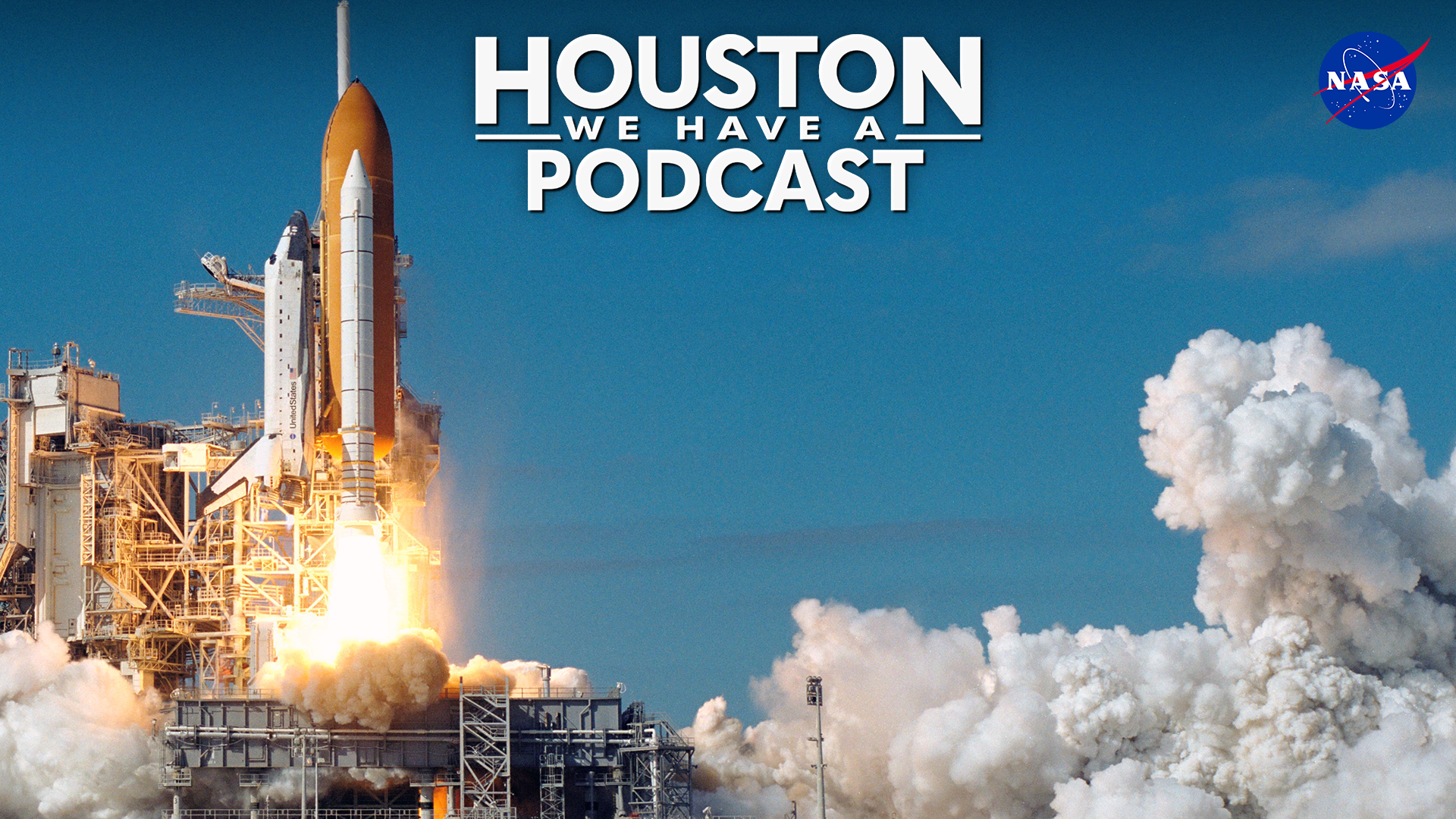
On episode 418, Steven Hirshorn reflects on the Space Shuttle Program, the Space Shuttle Columbia accident, and the lessons learned that continue to shape human spaceflight. This episode was recorded March 13, 2026.
Transcript
Leah Cheshier
Houston We Have a Podcast. Welcome to the official podcast of the NASA Johnson Space Center, Episode 418: Ascension: Looking Back at the Space Shuttle. I’m Leah Cheshier Mustachio, and I’ll be your host today. On this podcast, we bring in the experts, scientists, engineers, and astronauts, all to let you know what’s going on in the world of human spaceflight and more.
The space shuttle is cemented in space flight history and American culture as a symbol of dreaming, teamwork, and achieving what was previously thought impossible. April 12 of this year marks 45 years since its first flight, STS-1. Over 30 years and 135 flights, the shuttle allowed astronauts to conduct science, work on the Hubble telescope, and construct our current home in low Earth orbit, the International Space Station. The Space Shuttle Program was marked by great tragedy and great triumph, ultimately flying hundreds of astronauts before its retirement in 2011.
Steven Hirshorn was an Operations Representative to the Space Shuttle Orbiter project office working with the shuttle program for 16 years. Hirshorn’s book, Ascension, details the two and a half year time period following the loss of space shuttle Columbia and her crew in 2003, and the lessons learned from these events that engineers, managers, and leaders can take forth today. We’ll talk through Steven’s experience, the Columbia tragedy, and the legacy of the shuttle program on this episode of Houston We Have a Podcast.
This episode’s topic was suggested by listener Rebecca via email. If you have suggestions for future episodes, email us at nasa-houstonpodcast@mail.nasa.gov.
Let’s get started.
<Intro Music>
Leah Cheshier
Hi Steven, all the way from Goddard! Thank you so much for coming on Houston We Have a Podcast today.
Steven Hirshorn
Good morning. It’s a pleasure to be here. Thank you very much for inviting me.
Leah Cheshier
So let’s get started by you telling us a little bit about yourself and your background. Tell me where you’re from. Tell me really what sparked your interest in space flight.
Steven Hirshorn
Well, let’s see, I’m 61 years old. I’ve spent 36 years with the agency and counting, not quite done yet. Born and raised in Philadelphia. In years past, I used to enjoy mountain climbing. I’ve written a number of books. I got two books that I wrote that were published by NASA and three others on science fiction, novels that I published, working on a fourth trying to get that released this year. And about 75% through a manuscript of a fifth science fiction novel. That’s what I do for fun now, since I can’t mountain climb.
What sparked my interest in space flight. I’ve thought about that over the years. I’d like to say that there is a seed of passion that, you know, I was born with. It’s always felt that way. But I suspect that there’s probably a couple tangible events. The earliest interest that I can remember was when I was younger than 10, probably seven or eight years old, there was a made for TV movie that came out. This was in probably early 1970s and it was a horrible movie, you know, made for TV. It was low budget, that sort of thing. But the premise of the movie was about a kid, probably, you know, 10, 12 years old or whatever, that stowed away on a Apollo spacecraft just prior to a launch and was launched into space. I haven’t seen that movie since, but, and like I said, it was a made for TV movie, so it was a low budget thing, but that is probably the first time that I can remember having a distinct interest in space flight.
In the early 80s, when I was in college, there was a PBS series called space flight. It was a four part series, and they covered basically the history of the space program at that point in the early 80s, and I videotaped record it, and I can remember watching that PBS series, not quite daily, but almost daily for any number of years. And I just watch it over and over and over. And there was something about it that absolutely fascinated me. I don’t know for a fact, but I like to think that those two events set me on my path.
Leah Cheshier
I love that that’s so cool. I think it’s such a testament to the power of media and popular culture picking up on, you know, space flight and what NASA is doing, and- because I have a similar story of that’s really my interest was from a made for VHS special with talking about a space flight and the space shuttle. So that’s very cool. But what eventually led you to NASA? What did you end up pursuing in college, and how did you land here?
Steven Hirshorn
Let’s see. I got a Bachelor’s Degree in Aeronautical Engineering from Embry Riddle Aeronautical University in Daytona Beach in 1986 and then I got a graduate degree, a master’s degree in aerospace engineering from UT University of Texas at Austin in 1989. In my second year getting my master’s degree- so Austin’s What about a three hour drive or so from, yeah, from JSC, from Houston, and my graduate advisor got me the opportunity to do a summer internship at one of the contractors who supports JSC, at Barrios technologies. And so I spent the summer at Barrios, actually was helping them with some orbital mechanics analysis, working on my master’s thesis, actually. But this was, you know, the Barrios was literally about a mile away from the front gate of JSC. And this was the back in the days before 9-11 when you didn’t need a badge to get on site. I can remember, you know, tourists just walking around on site on campus at JSC.
And so I drove over there one day, and I had already decided that I wanted to be a flight controller- work in, you know, sitting in Mission Control, work in space flights. And I went over and I found where the division of flight controllers were. They were in building 4. And I walked in and found where the division office was, and literally just walked in and say, Hey, I’m a graduate student. Is there anybody here I could talk to about getting a job? At that time, the Division Chief was a gentleman named Steve Bales, and Steve Bales was a flight controller who was on console at the time of the Apollo 11 landings. If you know a bit about that history, during the descent to the moon, the lunar module gave the crew Armstrong and Aldrin a couple of alarms, a 1201 and 1202 alarm, that was not something that was routine in their training. And even the people on Mission Control were confused by the alarms, and this was during the descent. And so Armstrong called down and said, Hey, give me a reading on these alarms. Steve Bales and his back room, a man named Jack Garmin, were the ones who recognized what the alarms were, and basically said, “we’re go for this.” Steve was a division chief at the time. He was just about ready to retire, and so I got to talk with his deputy, a gentleman named Jack Knight, who was also an Apollo flight controller, and we spoke for, I don’t know, an hour or so. And then Jack said, “Come back next week, and I’ll have you talk with the Division Chief,” a gentleman named Rick Fitz, who eventually became the, I’m sorry he was a branch chief Rick was a branch chief, And Rick and I sat and we chatted for a good long time about the job.
I went back to Austin to finish my graduate degree from my last semester, and the memory that I have, and I can’t tell you if it’s actual reality, if it’s truth or not, the memory that I have is that after I got back to Austin, I gave Rick a call about once a week. “Did I get the job?” Persistently, “did I get the job?” Um, and, and eventually, in my memory, you know, it got to the point, after some weeks, or a couple months, he’s, “yeah, yeah, you got the job. Stop, stop giving me a call.” I don’t know if it, if that’s what really happened, that’s, that’s what I remember, but I suspect it probably wasn’t weekly that I was calling him, but that’s how I started as a flight controller. I didn’t you know there was no resume involved. These were the days before USAjobs and things like that. I simply walked in to the building and spoke with people and showed interest. And I think I was fortunate to have them bring me on board.
Leah Cheshier
That’s fantastic. And then eventually you spent, well, you spent your time as a flight controller, and then became the Operations Representative to the Space Shuttle Orbiter Project Office. So what does that role entail?
Steven Hirshorn
The position that I held, the title for the position was technical assistant for shuttle in the division from which the flight controllers came from, the flight controllers responsible for all the shuttle’s hardware and software what was called the Systems Division. So I was in the division office as an assistant to the Division Chief for shuttle. We also had a technical assistant for station at the time. And I had various responsibilities across the division. For example, one of my responsibilities was to put together our COFR package, our certification of flight readiness package for the division based on inputs from all the flight controllers and so forth. One of the duties in that position was to be the Mission Operations Directorate. That’s the larger organization, the Mission Operations Directorate, representative to the orbiter project office. Today, the what we called MOD today. It’s referred to as FOD, Flight Ops Directorate. It’s basically the same organization. So I was the MOD, think FOD, representative to the orbiter project. I was the operations representative. So in that role, you know, the orbiter project office had a configuration control board that met weekly, and we would go through all the decisions that need to be made on hardware and software, if a piece of equipment on the orbiter failed or had to be replaced or was exhibiting a condition, let’s say out of family, all that will be discussed, discussed at This configuration control board.
At this control board, the orbiter project was there. JSC engineering was represented, was represented USA, which was the prime contractor at the time, for shuttle, was represented, and MOD had a seat at the table. So I was that representative at the at the orbiter project office. So when an issue came up pertaining to the hardware that the orbiter project had to make a decision to remove and replace that equipment, or, let’s say, fly as is, on the next shuttle mission, or a variety of different things. I would poll all across mission operations to get our perspective, our vote, if you would, and then bring that to the table when the orbiter Project Office convened their configuration control board.
Leah Cheshier
That’s a big role. So I want to talk about the space shuttle itself. We’re going to dive into some specifics later on, but the space shuttle is iconic, and I want to talk about its history. Why was it created? What was it designed to do?
Steven Hirshorn
Yeah, so my initial answer is it was, it was designed to do everything. And it did, to a large to a lot of respects. But, but go back to the original intent. The idea of a space shuttle came up in their early 1970s while the Apollo program was still going on, all the vehicles, all the spacecraft, all the everything that was designed, constructed and flown prior to that in Mercury, Gemini, and Apollo were essentially one and done. You know, the spacecraft would be built. It’d be tested, it would be launched with a crew, it would fly the mission, it would come back, and then it would become a museum piece. There is no aspect of reusability, which makes sense, because these were our first footsteps into space flight. And as a nation, as a world, as a species, we didn’t have a lot of experience, yet we were building that experience. So there was no such idea of reusability. So every time we flew a mission, that that was it, that was all that we asked of that spacecraft. In the early 1970s it was recognized that that wasn’t necessarily cost effective. Made a lot of sense from an engineering and reliability standpoint. But you know, if you really want to have routine access to space, you want to have a vehicle that can fly a number of missions. That was the genesis of shuttle, to design something that could return to space often. Was not a one and done sort of thing. And reusability was, I would say, the the primary focus of the design that went into shuttle, inevitably to reduce costs for the program, so you didn’t have to have a brand new spacecraft every time that you launched.
The other thing that I think that shuttle was designed to do, and I would conjecture that we achieved, over the 30 years of the program, was to prove that we could work in space, that we could do useful work, research, certainly, but scientific research, things of that nature. But also deploying satellites, retrieving satellites, constructing things in space, like we did with, eventually with station. So that proving that, you know, the early parts of the space program were to prove that humans could survive in space, that that’s what Project Mercury was all about. And Project Gemini was to demonstrate some of the techniques that were required in order to land on the moon, like space walks and rendezvous and docking and things of that nature. Then, of course, Apollo was all about landing a person, landing a human on the moon. And then, of course, the last few Apollo missions were pretty focused on on the science, but it still was a very unproven environment, and there was a lot of risk inherent in these missions. I think shuttle, when it was originally created, was to provide a much more routine access, and to also demonstrate that when- that during our time in space, we could perform useful work, including some of the things that I mentioned.
Leah Cheshier
Yeah, you talked about, I mean, we talked a little bit about reusability and how that makes shuttle just so drastically different from the spacecraft that had flown humans to that point. What do you think are pros and cons of the shuttle design compared to how we had flown humans in capsules at that time, and then, of course, we’ve flown capsules since. So what do you think are some of the pros and cons of shuttle?
Steven Hirshorn
Well, let’s see. The pro is that shuttle, in my mind, was an extraordinarily versatile and multi disciplinary vehicle. It could do many, many things encapsulated in a single package. Obviously, it could transport astronauts, crew, from you know, the surface, to low Earth orbit, and bring them back safely. It could be a platform on which we could perform scientific research, either with laboratories that are embedded in the payload bay, or sometimes we would bring up satellite, deploy it for a period of time for it to do scientific research, and then we would retrieve it and bring it home. So it opened many doors in terms of space based research.
Again, there were elements of the original intent of shuttle was that we would launch satellites from the Orbiter. I think the perception was it would put the launch services industry, you know, expendable launch vehicles, rockets, put that function out of business, because every satellite would be launched on the shuttle, and, you know, potentially the government would even make a little money from the effort. But we could and did deploy satellites from the orbiter, and we also demonstrated that we could retrieve satellites. There were a couple of missions where a satellite had failed but was still within the capability of the orbiter to go up, retrieve it and bring it back home. And we did do that. In those sorts of ways. I think the shuttle and the orbiter were extremely effective in that it could do so many things, all encapsulated in a single vehicle.
Cons for the orbiter, I’d say probably two things. Both were probably, well, the first one certainly was engineering related, but there’s a safety aspect to it also, in that all the vehicles that preceded the shuttle and all the vehicles that have followed the shuttle, the vehicles were designed where the crew was at the top. If you look at, you know, Artemis right now crew’s at the top of the vehicle. There’s a an escape tower that’s used for aborts above them, but everything else is beneath them. On shuttle, there were portions that extended out above the nose of the orbiter. The reason why that’s potentially a bad thing is that then that puts the orbiter and the crew in the path of anything that potentially could come off the vehicle and hit it. And the orbiter was never designed to be hit by anything being, you know, coming off of the external tank or the solid rocket booster. That turned out to be a perpetual issue through the length of the program. Of course, that is the proximate cause of what caused the damage on Columbia, on STS-107, that a piece of debris came off, piece of foam came off of the external tank and struck the leading edge of the left wing and potentially breached it during launch. But that was a design deficiency in the architecture of the shuttle, was that it was not the part that the crew needed, the part that the crew was in and the part that the crew would return to Earth, and was not at the very top. So that was a concession that was made as part of the overall architecture and the design of the vehicle. So that was one shortcoming.
The other thing that I think I’ll mention, there’s a wonderful comparison to a drawing and a photograph. And one of the penultimate engineers that I work with, a gentleman named Bo Bejmuk had this and used to use this comparison in his presentations after the shuttle program the first image is of the perception of what the turn around, what the refurbishment would look like on on the shuttle. So the orbiter, we would launch, the orbiter, it would do its mission, would return to Earth, and then it would be refurbished, and we go and launch it again. The image in that first picture is a an orbiter sitting in a hanger on its landing gear with a single ladder leaning up against it. The reality is the second picture, and the second picture shows an orbiter in where we did the refurbishment in what was called the Orbiter Processing Facility, the OPF, and it is surrounded by scaffolding. So much so that you can’t even see that there’s an orbiter in there. The concept of a quick and easy turn around for the vehicles. You know an orbiter is sitting in an empty hanger with a single ladder leaning up against it never quite met the reality. And so the orbiters were reusable. We flew all the orbiters many, many times. But the extent of what was required to refurbish the vehicles from the previous space flight, make sure that they were in a flyable and ready condition for the next space flight, typically took months and a tremendous amount of work, and, you know, an army of people that would work on it. That was a lesson, certainly, for the agency. But it was much different than, than what was, you know, originally conceptualized. So, again, tremendously versatile vehicle, but there were some shortcomings, I guess, with the design.
Leah Cheshier
Yeah, that’s a great point. I never thought about that turn around time being so much greater. I mean, I knew that it was because there were initially planned to be so many more flights per year, but I had not heard that comparison and contrast between those two photos that’s very interesting.
Steven Hirshorn
The original idea was to fly the shuttle about every two weeks on a cadence of 25, 26 times a year. That was the original idea. We never got anywhere close to, I think the most that we flew was nine times in 1985, which was the year before Challenger. So it was an interesting example of reality not meeting the original concept, idea and perception.
Leah Cheshier
So one more touch back on your career in that space shuttle program. You spent 16 years with the program out of its 30 years of flight. So were there any standout missions or moments? I know Columbia is a big one. We’re going to talk about that one coming up. But did you have anything else that really you just that stands out to you when you think back on it?
Steven Hirshorn
I like to say, for me that it’s, it’s kind of like children. You know, when you have children, there is no favorite, you know, you love them all. That sort of thing every flight has, I have wonderful memories from from all the 55 missions that I worked on console. Having said that, my the very first for me personally, the very first mission that I worked was the flight that launched the Hubble Space Telescope, STS-31 and so that’s cool for me. It’s cool just because of what the mission performed, but it was also the first mission that I worked, STS-49 was mission where we were retrieving a satellite, and the mechanism that we, the astronauts were using did not operate as intended. And typically and throughout the entire program, we would when we would send astronauts outside of the spacecraft to do a spacewalk, it was limited to two astronauts. And for safety reasons, for also reasons concerning the interior volume of the airlock and other things we always- and that remains true for today on station, when we send a crew outside, it’s always two astronauts. On this particular flight. We happen to be flying three spacesuits, EMUs, Extravehicular Mobility Units, so the space suits that the crew uses, and this capture mechanism did not work as designed. It was one of, one of the circumstances where, where Mission Control does the things, and Mission Control is very, very good, and that’s dealing with the unexpected. And so a plan was devised to send three crew members out where they would literally capture the satellite with their with their hands. And they did, and we were able to stow the spacecraft in the orbiter’s payload bay and return it. And the mission was successful, but that was something that was never planned, and that was something that a plan was developed in a very short period of time, including looking through all the safety implications and so forth. Unfortunately for me, I was not working that mission, but I watched the whole thing on TV, especially the spacewalk. And that mission always stands out in my mind.
The other one that I’ll mention was again related to the Hubble Space Telescope, the mission that we sent up after it was noticed that the mirror on the Hubble Space Telescope was improperly ground, was called “spherical aberration,” and we launched a mission to essentially give the telescope eyeglasses and repaired it. That was STS-61 and there were five spacewalks on that mission to install this pair of eyeglasses on the telescope and to remove and replace some critical equipment and so forth. First time that we ever serviced Hubble. There were three, three or four, I think, missions that followed that one, but this was the first. And I did work this mission, also on console during all the space walks. And that had that mission was simply exciting for me, watching the space walks as they as they happen in real time, where you don’t know what the outcome is going to be. And I want to say, and I could be wrong about this, I want to say it was five space walks in five days, which is unusual. Typically, they would plan the mission to have at least a day off between it. And I may not be 100% correct, but that’s, that’s, that’s what I remembered. So there was this during those five days, there was this tremendous cadence and in mission control of doing something literally spectacular. And, you know, I got to watch it on console.
Leah Cheshier
Yeah, that’s such a heroic effort. I can only imagine, even just being in the room, you know, to see something like that come together, that’s incredible. So I’m going to move on and talk a little bit about Columbia. But first I want to touch on Challenger. You know, in 1986 we lost the Challenger crew on ascent, but that was prior to your time here, I think, by just a few years. So did that feel like a large part of the conversation, as you were planning other missions.
Steven Hirshorn
So let’s see. So it was four years before I joined. So having said that, if you recall, I got my undergraduate degree at Embry Riddle in Daytona Beach, and we could watch shuttle launches from Daytona Beach, and we did routinely. The Kennedy Space Center was over the horizon, so it would take 20, 30 seconds or so before from the time of lift off, before we would be able to see it in Daytona Beach. But watching shuttle launches from you know, the campus of Embry Riddle is a pretty routine thing. On that particular launch in January of ‘86 I was in a design class, sitting in front of those old design boards where you draw blueprints and things like that. It was a design class. And I remember that the Secretary of the Aeronautical Engineering Department poked her head into the classroom, and then she backed away, and I thought that was a little unusual. And then a couple minutes later, she poked her head in again, a second time. And, you know, the professor stopped the class, brought her in, you know, “what can we do for you?” And she told us what just happened. And the very first class, I remember the very first question that the students there began to ask is, you know, “what happened to the crew? Did the crew survive? Were they able to make it back to the ground somehow?” Of course, there’s there was no answer at that time.
And I recall that we talked about it for 15 or 20 minutes, and then the professor said, you know that that’s it, Class dismissed. There was no reason going on with a class that day. And I walked out to the parking lot and, and this is one of those images that’s, you know, forever embedded in your memory. When I looked south in the sky, I could see the contrail, the plume, ascending up to maybe about 45 degrees from the horizon. And at that point, and that’s the point where the explosion happened, there was streamers of contrails, white contrails in the form of an umbrella from that point. And of course, so this was, what, 30 minutes after the accident, so. But that image of that single, large plume rising, and then the streamers from the debris raining down into the ocean and so on and so forth. I remember that, and I saw that.
So when I started work four years later, as a flight controller, Challenger was never very far from anybody’s minds. It was a persistent reminder of what happens when we get things wrong. And of course, the building that was in in Building 4 at that time had three stories, and flight controllers were in the first and second story. The astronaut office was on the third story of that building, and so we saw astronauts every day, and got to be friends with, you know, a number of astronauts. And so, again, this all happened before I worked, but just coming into the building and not seeing those seven crew members anymore, I’m sure, affected people on an emotional level. But what I can tell you is, for me personally, the 55 missions that I worked on on console, I worked 10 launches. And you train persistently such that you train so much that when it comes to the real day, if you have to make a call or something like that, it’s just reaction. You don’t have to think about it. But on those 10 launches that I did work, my heart was in my throat the entire time, simply because of the memory of Challenger. And I remember I would talk to, I would talk occasionally. I would call out milestones during the launch. I would ask my back room, my support personnel, how our systems were doing simply to get my jaw to move, because of the memory of Challenger.
Leah Cheshier
Yeah, I can’t imagine. I mean, obviously I’m fortunate enough that I get to work on console and do mission coverage commentary, and so it’s always something in mind that you have to be prepared for anything. But having come in so close to a loss like that, I know it had to be so hard. And then just looking forward to 2003, the space shuttle had its second major tragedy with the Columbia accident. So I would like to hear about what you were doing during that mission. Where were you for launch it, and did you have any concerns mid mission? And then during reentry too? You know. Do you remember what you were doing?
Steven Hirshorn
Sure. Well, so maybe Sure, I’ll say that the first question, where was I during the launch. I honestly don’t remember, and I’ve thought about that, I have no memories of where I was at the time of launch. It was in the morning, and so I suspect that I was at work, if it was, if it was a weekday, if it was I was probably watching on TV, as I tried to do. But I honestly don’t have any distinct memories of where I was during the launch. What was I doing during the mission? This was after I hung up my headset so I was no longer an active flight controller, but as the mission operations rep to the orbiter project office. The orbiter project will get together in Mission Control every day and talk about the previous 24 hours, what we called anomalies, equipment that failed or wasn’t operating properly, all in preparation for that day’s mission management team meeting. And the mission management team is senior shuttle program leadership, that while the flight control team is making the tactical decisions, the mission management team is there to make, let’s say, more strategic decisions. And so the orbiter project would get together every day and to build their PowerPoint charts for that day’s mission management team. And I was there at the table sitting with the orbiter project office as we went through all the anomalies and so on and so forth.
I remember that on the second day of the flight, flight day 2, we reviewed the imagery, the launch imagery that showed the foam being shed from the external tank and striking the somewhere on the left wing, leading edge of the left wing. That imagery became available the previous day, on launch day, you know, it’s processed and so forth. And I remember having discussions about that at the time. From the imagery, you could not tell where the debris struck and the frame rate, that is, how often an image was taken. I think it was, don’t quote me on the number of something like 30 frames per second. Well, that debris was moving about 500 miles an hour relative to the orbiter. And so the on one frame, it was just prior to the debris striking the wing on the next frame, all you saw was the cloud, you know, the where the debris struck, and then the foam broke apart. But there is absolutely no way to know exactly where it struck, on the orbiter. So we talked about it, and we talked about and we discussed it and so forth. And I think it probably came up one or two other times during the mission, but it was one of, I’m picking a number here, 15 or 20 anomalies that that, you know, we worked through. That’s a common number, a common circumstance on all shuttle missions, you know, things fail. So it was that that foam debris in there, or the strike, the foam striking on the orbiter was one of, you know, a dozen or 20 different things that were discussed over the length of the mission. But I do recall that-
Was I concerned? I would say there were probably other people who knew a lot more about the physical properties of the thermal protection system and the structure of the orbiter that were more concerned than I was, but I didn’t sense any, you know, any pervasive sense of calamity or anything like that in the room. It was an anomaly. It was something that we would need to look at and record, and potentially, you know, invoke new procedures or what have you take remedial action. But I don’t recall a sense of dread or impending calamity or anything like that during the mission.
Where was I during re entry? I was asleep. So to give some context for that, I had the- Columbia’s mission was 16 days, so I came into the control center to do this, to assist the orbiter project office every day of the mission. So for two and a half weeks, you know, including weekends. Entry day, there’s no mission management team. There’s no reason for the mission management team to gather, because you’re coming home, you know, that’s it’s on the flight control team at that point. So that was on a, can’t remember if it was a Saturday or Sunday, but it was weekend, and so I had worked straight for two and a half weeks. And you know, that was my weekend, so I was in bed asleep at the time of the accident. It was in the morning, about 8:30 in the morning, Houston time, and but I got a call from my division chief, if you remember when, when I first got hired, and Steve Bales was the division chief, and he was just retiring, and I spoke with his deputy, Jack Knight, and Jack sent me on to a branch chief gentleman named Rick Fitz. Well in 2003 Rick was the division chief, and I was his technical assistant for shuttle in the division office. About 30 minutes after the accident, I got a phone call from from Rick, woke me up, and he essentially told me what happened, and that’s how I found out about the accident.
And I’ll add one other thing to that experience, and I wrote about this in in Ascension in the book, it was a fairly short discussion with Rick. At the time. We only spoke for about 10 minutes. And of course, there were no answers at this time. You know, we knew that Columbia and the crew were lost. But nobody had any idea why or what happened, or what have you. At the end of that conversation, I remember distinctly Rick saying to me, “I sure hope it wasn’t the foam,” referring the foam that was shed from the external tank, which, of course, proved to be what the cause was.
I’ve thought a lot about that. This was 30 minutes after the accident happened. We had no data. We had no information, but we had discussed that as one of the anomalies. We had sat together as a division to do our Certification of Flight Readiness process, or COFR process for the next plan shuttle flight, STS-114 where we review all the previous mission’s anomalies. And that was one of the anomalies that we reviewed, that was while Columbia was in orbit about a week into the mission. I can’t give you a definitive reason, but I’ve always found it fascinating that with no information, there was something, maybe intuition, maybe something else, that made Rick focus almost immediately on the foam. And I found that fascinating, and just from an engineering standpoint, or something else, again, I have no explanation for that, but I’ve always found that interesting.
Leah Cheshier
I mean, I’m definitely not an engineer, and I also find that very fascinating that he picked up on it so soon. So what was your task in the immediate aftermath of the loss of Columbia?
Steven Hirshorn
So I, on the day of the accident, I stayed away from the control center because I knew what was going on. They would lock the control center down. Flight controllers that were there would be collecting data, you know, trying to collect as much information as possible. They were probably not letting people into the control center, so I stayed away that day.
The following day, I think, was a Monday, and I went into work, you know, as per normal. But I ventured over to the control center, and I saw and I went into the building, and I saw a number of people gathering around what was called the Action Center. It’s the room where the mission management team would meet, just off the flight control room. And I was curious why so many people were gathering around there. So I ventured over there, and these were all people that I knew, Senior Program leadership. There were some center directors there. There was people from the orbiter project. I say people that I knew, I would say more correctly, people that I recognized. One of the responsibilities that I had as the mission operations rep to the orbiter Project Office is I would always write up notes from the discussions that we would have on a weekly basis, and then send those notes out across mission operations, just for awareness, so they know, you know, what was discussed, what was what was decided, and so on and so forth. And so some of the familiar people in the orbiter project office were there and so forth. But something was going on, and I didn’t know exactly what, so I took a copy of my flight controller log paper, where we take notes, and I went in, and I sat down. And nobody questioned it. Nobody asked me, you know Hirshorn, what are you doing here? But it was the second meeting of what was called, what eventually became called the Mishap Response Team, and so I took copious notes from the discussion that day. Again, this was a day after the accident, so it’s still very preliminary, but I took literally, like 10 pages of notes, and when the meeting broke, I went back to my office and typed them up and sent them out to my standard distribution list. And the mishap response team met every day at about the same time, including weekends for a number of weeks, and I would show up and take notes and then send it out across the distribution, across, you know, the entire mission operations community, to the division to the leadership of mission operations, to the division chiefs, Flight Director Office and and so forth. What I found interesting as the weeks progressed, and I would continue to do this, people had a tendency to forward those notes out, and which is fine, but it wasn’t until a month or a month and a half into this investigation when I realized the extent of how broadly my notes were distributed. I started getting notes from center directors saying, Hey, these are these are great, you know, thank you for sending this out. I was told by one of the astronauts that my notes were being sent up to station for the station crew to keep them in the loop about that. It, and I think that told me two things. One is it told me you never know where your emails might end up.
Leah Cheshier
That’s so true!
Steven Hirshorn
So you always got to be a little careful as to how you write things. But it also told me something, and I write about this in the book, it told me something about during times like this, people thirst for information, yes, and so that was what I did for the first few months, I would say, during the initial stages of not just the investigation, but recovery operations, where we were collecting the debris that was found on the ground in Texas and Louisiana, bringing it back to the Kennedy Space Center, and all those activities. And of course, we weren’t, we obviously were not launching shuttles during this time, and flight controllers weren’t training for missions. So I occupied myself by generating these, these meeting notes and and by the way, after the fact, when as as I wrote this book for the NASA history office, and it went live, I found all my notes. It was about 150 pages of notes covering maybe six weeks, and I provided it to the NASA history office for historical purposes. So those notes should be available to you know historians that want some insight into into how NASA progressed through the investigation. But the immediate aftermath of the accident, and really, over the next year or so, I was just deeply immersed in the recovery operations and the investigation into the accident.
Leah Cheshier
Wow, that’s such a wealth of like, that’s just a treasure trove all of those notes, having such detailed notes that we can reference even today. And you talked a little bit about Ascension, the book you published through NASA. So I want to touch on that too. You’re outlining in detail this period between Columbia and return to flight. So for everyone that’s interested in this time, when we were standing down from launching the space shuttle, can you summarize what it is you write about in this book and your role and vantage point?
Steven Hirshorn
There are kind of three main phases, I would say, in the two and a half years, between the day of the accident, and in 2003 and the day when we launched the shuttle again on STS-114, two and a half years later, the first phase was what I would call recovery operations. And so it was trying to find any physical evidence, and of course, there’s looking through the telemetry that we got from the spacecraft. But it was, it was basically a forensic sort of exercise. We were able eventually to recover about 40% of the orbiter, and the rest is either still out there or burned up during reentry or what have you. But we were able to recover about 40% of the orbiter. Those that was all and it was all in the piney woods of East Texas and Western Louisiana. And for two or three months, the activities were focused on finding the pieces that we could find. It was almost a wartime footing, I would say, in the resources that were brought to bear with with FEMA and other government organizations, including the military. There are tremendous resources that were brought to bear almost immediately to help us in the task of recovering debris and, of course, recovering the remains of the crew.
And the teams would go out on a daily basis, and they would spread out in a long line, maybe six or eight feet between people, and literally just walk, looking for anything, you know, even a speck of paint or something that can be tiny, little objects. And they had to progress through very difficult terrain. A lot of it was wet and damp, but there were these thickets of prickly bushes, and they would, they would have to go out there with machetes just to clear a path. And I recall that there were firefighters, people that would be like parachute into forest fires and things like that. They helped considerably with this search and recovery operation that went on for two and a half, three months or so.
Once we had all of what we were going to get intact, then probably the next nine months or so was trying to figure out what happened and how and why. You know, the investigation part of it. And that was not quite daily meetings, but certainly weekly meetings with the orbiter project office, when all this was coming in. And it took months. Of course, there was a formal, congressionally authorized board called the Columbia Accident Investigation Board, the CAIB. And so they were the official investigative body. Having said that the CAIB relied on NASA, on us, to basically do a lot of the data collection and the analysis and so on and so forth, and the CAIB was in lockstep as we were moving forward internally with the analysis. But there were weekly meetings. Meetings with the orbiter project office as new information came in. And it took a matter of months, you know, maybe a little bit less than a year, before a fairly clear picture became obvious, or became evident to us as to how the accident happened and why. And of course, all that’s documented in in the CAIB report.
So those two things were pretty much an entire year of activity. We didn’t fly again for two and a half years after the accident. So the the third phase of this was doing all the things that were necessary to get back to flying again. What what internally we called return to flight. And those were the design changes that we had to make to the vehicles, recertification of the orbiter, looking through basically all the components to make sure that, you know, we were safe to fly again. Even understanding what and why, there was still a tremendous amount of work to take that knowledge and then figure out, okay, what do we need to change? And then change it, you know, in the program.
So that two and a half years, those three phases is largely what I tried to outline in the book. And I was, I like to think that I was, I was in the center of gravity for all these activities. I was, you know, at the heart of all these activities. And so I discuss in the book a lot of the meetings that I attended, a lot of as we were progressing through and so forth, some of the discussions, but I also discuss in the book, kind of the personal impact that these whole sequence of events, the accident specifically had on me as an individual. So Columbia, to me, was a tragedy for the nation, and it was a learning event for NASA as an organization, but it also had some very personal implications to me. It, and you know those, I like to call it emotional scarring, but that that is with me today, and definitely changed the way that I think about human space flight and my engineering jobs, even as Chief Engineer for Aeronautics today, that event changed the way that I approach risk and things of that nature. So there’s, there’s a very personal aspect that the that the accident had on me.
Leah Cheshier
It’s powerful. We only have just a few minutes left. And so I wanted to wrap up our conversation with one last question, which is, what are the lessons from the Space Shuttle program that you think are really important today for upcoming generations of scientists and engineers?
Steven Hirshorn
Let’s see. So there are millions of technical lessons about the viability of reusability and about the practicality of being able to do real useful work in space and things of that nature. And there’s, I don’t know, hundreds of books and articles and so forth that have been written about the technical lessons learned and and what we achieved over 30 years that if, if you were to ask me a singular lesson from from the whole events, and I would put it this way: if you look at the three tragedies that the agency has experienced. You know, incumbent in loss of life. There was Apollo one fire in 1967 there was Challenger, as we mentioned, in 1986, and there was Columbia in 2003. All three of those events had very different technical causes you know, there is no relationship in the technical causes between the three, having said that all three had almost exactly the same organizational cause. And there’s been books written about this and so forth, about normalization and deviance, about accepting conditions that are off nominal as just routine, and so forth.
But for me, the biggest thing that I would take away from the shuttle program, is the and I’m trying to think of the best way to phrase this is the threat of hubris. And what I mean by that is, in all three of those accidents, there was a perception that he that these things can’t harm us, or even worse, that, you know, we’ve seen these sorts of failures before, and it hasn’t harmed us yet, and so we’re okay to press forward.
With Apollo 1, it was operating in a high pressure, 100% oxygen environment, which all the previous spacecraft had had done, never was a problem before, until it was on Apollo 1. On Challenger, it was a hot gas blow by of the O rings in the solid rocket boosters, which we had seen on maybe not every shuttle mission prior to Challenger, on on that mission, but many. And then on Columbia, of course, it was foam coming off of the external tank and and the solid rocket boosters striking the orbiter, which, again, there was a fairly long history of that. This aspect of hubris, this aspect of, well, it hasn’t hurt us before, therefore, you know, it’s not going to hurt us in the future. That is something that I think it took a number of emotionally scarring events for the agency to learn.
I would like to think that as an agency, we have finally learned those sorts of lessons and and hopefully we will continue to keep that as part of our, you know, collective DNA, as an agency, and go a lot more than 23 years before something like this happens again.
Leah Cheshier
You’re absolutely right.
What an honor! I’m so grateful we got to talk with you today, and I really appreciate you taking the time to join us on the podcast and share your experiences and share more about Ascension. We really are just appreciative that you stopped to speak with us today. Thank you so much Steve.
Steven Hirshorn
Again, thank you for inviting me. It’s a pleasure to be here.
<Outro Music>
Leah Cheshier
Thanks for sticking around. I hope you learned something new today.
You can check out the latest from around the agency nasa.gov. To find out more about the space shuttle, you can go to nasa.gov/space-shuttle. And if you’d like to check out Steven’s book Ascension. It’s free to download at nasa.gov/history/ascension.
Our full collection of episodes and all the other wonderful NASA Podcasts can be found at nasa.gov/podcasts. On social media we are on the NASA Johnson Space Center pages of Facebook, X, and Instagram.
This episode’s topic was suggested by Rebecca via our email. If you have any questions for us or suggestions for future episodes, email us at nasa-houstonpodcast@mail.nasa.gov.
This interview was recorded on March 13, 2026.
Our producer is Dane Turner. Audio engineers are Will Flato and Daniel Tohill. And our social media is managed by Leah Cheshier and Kelsey Howren. Houston We Have a Podcast was created and is supervised by Gary Jordan. Thanks to Kenna Pell for the groundwork in preparing for this episode. And of course, thanks again to Steven Hirshhorn for taking the time to come on the show.
Give us a rating and feedback on whatever platform you’re listening to us on, and tell us what you think of our podcast.
We’ll be back next week.
3… 2… 1… This is an official NASA podcast.