













Partnering with NASA
NASA Pathways for Partnering and Frequently Asked Questions (FAQs) Support
NASA is committed to partnering with a wide variety of domestic and international partners to successfully accomplish its diverse missions, including the Artemis program and future exploration initiatives to the Moon, Mars, and beyond!
Learn how to partner with NASA and get answers to frequently asked questions regarding NASA’s strategic partnerships with academic, non-profit and industry partners dedicated to advancing the goals of the Agency and world at large.
What is a Space Act Agreement?
Space Act Agreements, or SAAs, are NASA’s primary partnership instrument and provide a flexible framework for collaborating with external organizations. Watch this brief overview to learn how they work and when they are used.
See Examples of SAAsOther Pathways at NASA
Explore Ways to Engage NASA
NASA Front Door (NFD) provides a centralized, streamlined way for industry, academia, and partners to engage and collaborate with NASA.
Designed to guide your submission to the appropriate NASA organizations and ensure your information is reviewed in the right context, the NASA Front Door includes submission areas for Unsolicited Proposals, Real Estate, and Partnership Agreements.
Office of International and Interagency Relations (OIIR)
OIIR serves as the principal Agency liaison with the National Security Council, the Office of Science and Technology Policy, and U.S. departments and agencies.
NASA Technology Transfer (T2) Program
The T2 program ensures that innovations developed for exploration and discovery are broadly available to the public, maximizing the benefit to the Nation.

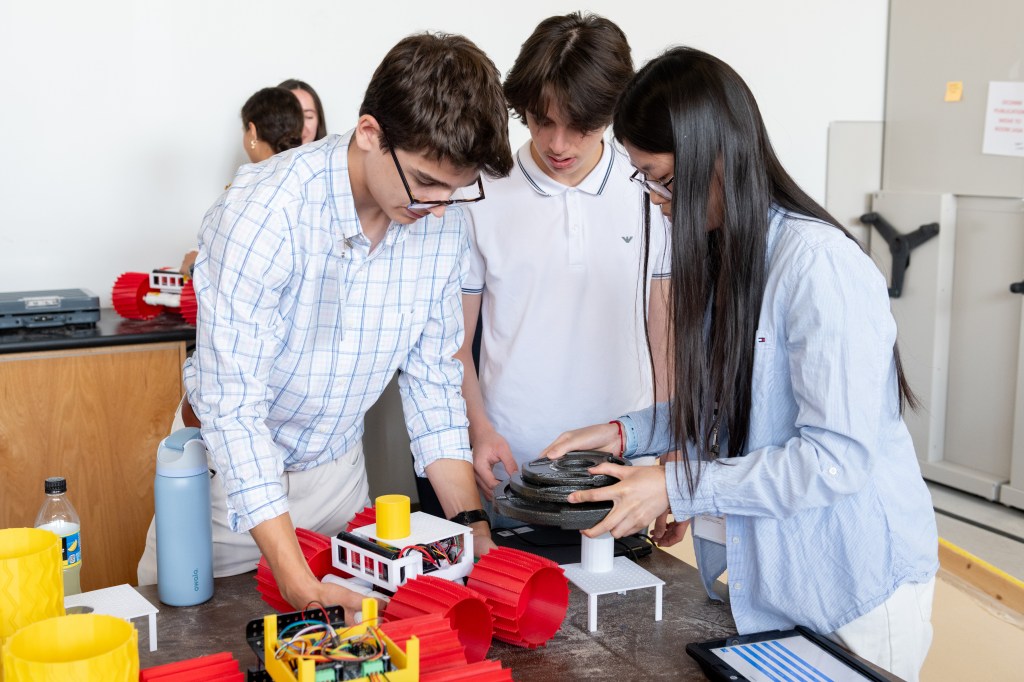
NASA Office of STEM Engagement (OSTEM)
OSTEM collaborates with organizations across the STEM education and workforce ecosystem to create innovative, high‑impact student learning experiences. These collaborations leverage NASA’s mission, people, and facilities to inspire and prepare the next generation STEM and aerospace workforce.
NASA Office of Communications (OCOMM)
OCOMM collaborates with external organizations on a non-exclusive basis on projects that inspire humanity and showcase the value of NASA’s mission, and that have the potential for either significant public engagement or to extend NASA’s reach beyond its traditional audience.
NASA’s publicly available content, including images, 3D models, videos, lessons, and other information on NASA’s public websites, can be used by partners and external organizations without permission or a formal Space Act Agreement (SAA) as long as organizations comply with NASA’s Merchandise & Media Guidelines.
NASA Office of Small Business Programs (OSBP)
The mission of OSBP is to promote and integrate small businesses into the industrial base of contractors and subcontractors that support the future of space exploration, scientific discovery, and aeronautics research.
The NASA Small Business Innovation Research / Small Business Technology Transfer (SBIR/STTR) program is part of America’s Seed Fund, the nation’s largest source of early-stage non-dilutive funding for innovative technologies.
Office of Strategic Infrastructure (OSI)
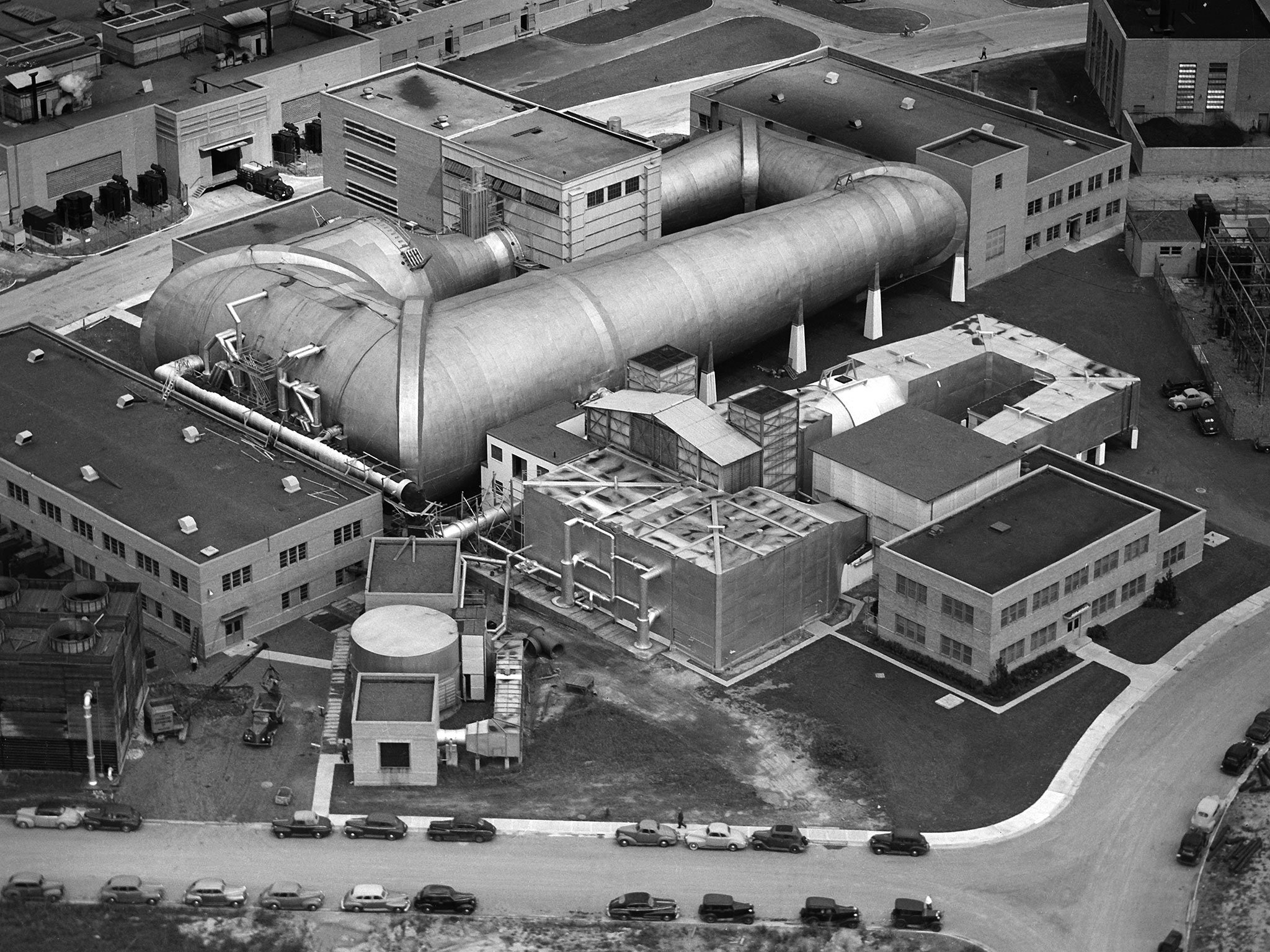
OSI effectively manages NASA’s assets and capabilities including facilities, real estate, supplies, and equipment as well as providing guidance on environmental issues for sustainability and stewardship.
NASA Office of Procurement (OP)
OP oversees the acquisition process to support successful accomplishment of the agency’s current and future missions. It provides policy, oversight, and optimization of procurement resources, and it supports Mission Directorate acquisition strategies to enable more efficient operations for the agency.

Centennial Challenges and the Center of Excellence for Collaborative Innovation (COECI)
CoECI collaborates with innovators across NASA and the Federal Government to generate ideas and solve important problems by working with global communities via the NASA Tournament Lab and internally via NASA Spark. CoECI is part of NASA’s Prizes, Challenges, and Crowdsourcing program.

Public Events and Other Opportunities
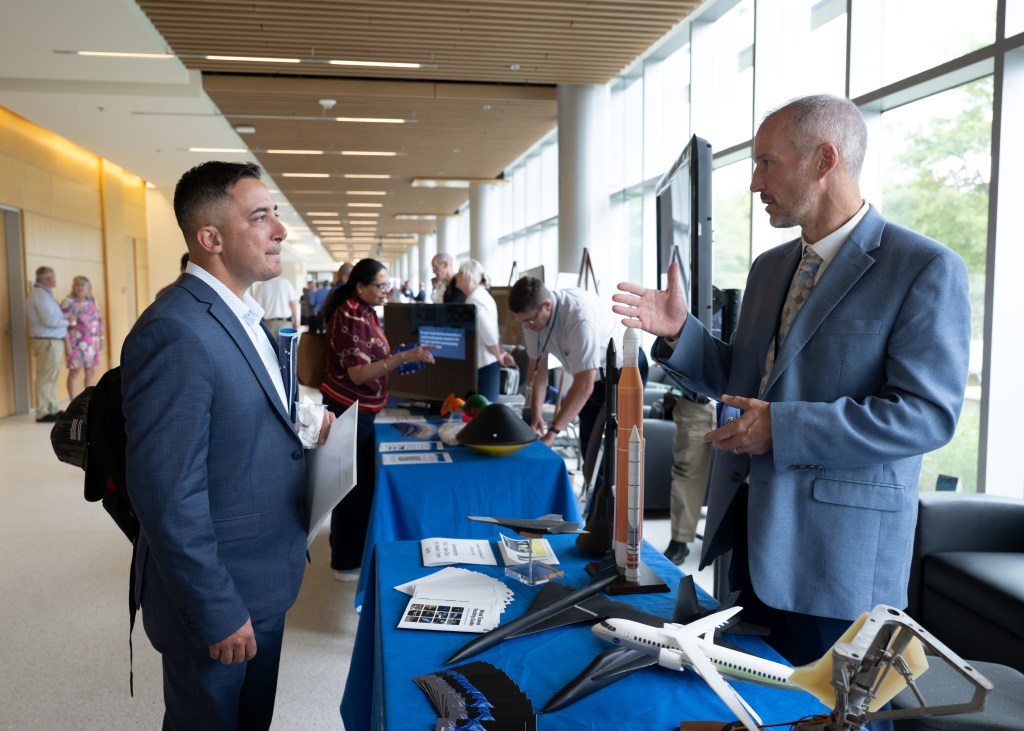
NASA opportunities arise in several ways. Some opportunities are announced through competitive solicitations and public notices. While many other partnerships begin through discussions with NASA directly or public events and conferences.

Partnership Support
Our Frequently Asked Questions (FAQs) are built to answer the questions partners ask most regarding NASA’s strategic partnerships.
A NASA Partnership is a collaborative relationship that advances NASA’s mission and delivers value to both NASA and its partners. Partnerships may involve joint research, technology development, facility access, and more. Unlike procurement contracts, partnerships focus on collaboration and mutual benefit.
The word “partnership” is generally used broadly to describe many types of relationships between organizations. However, for the purpose of NASA partnerships, we refer specifically to a collaborative, non‑procurement business relationship between NASA and an external organization that advances NASA’s mission while providing value to the partner.
These partnership agreements rely on NASA’s “Other Transactions Authority (OTA)” under the National Aeronautics and Space Act (51 U.S.C. § 20113(e)), which allows the Agency to enter into “other transactions” when the objective cannot be met using a contract, grant, or cooperative agreement. NASA also uses other non‑procurement authorities, such as those supporting Cooperative Research and Development Agreements (CRADAs) or the Economy Act.
NASA partners with a wide variety of entities, including:
- U.S. commercial companies of all sizes, including startups.
- Universities, research institutions, and other academic institutions.
- Nonprofit organizations.
- State, local, and Federal government agencies.
- Foreign entities, subject to U.S. law and NASA policy.
NASA partnerships create mutual value by combining NASA’s unique capabilities with the expertise and resources of external organizations.
Partnerships help NASA accomplish its mission by:
- Advancing NASA’s mission objectives.
- Accelerating research, technology development, and exploration.
- Leveraging external innovation and expertise.
- Strengthening the commercial space sector and U.S. space ecosystem.
- Expanding the use of NASA’s unique facilities and technical capabilities.
- Inspiring students and support STEM education and public engagement.
Partnerships help Partners depending on the specific agreement, though Partners may gain access to:
- NASA’s world-class facilities and laboratories.
- Specialized test environments and equipment.
- Technical expertise and engineering capabilities.
- Collaborative research and technology development.
- Mission-relevant demonstrations and validation opportunities.
Partnership agreements operate outside traditional procurement rules. They enable NASA and external organizations to collaborate, share resources, and access NASA’s unique capabilities. Procurement contracts, grants, and cooperative agreements are governed by specific federal regulations and are used when NASA acquires goods or services or provides financial assistance. You can learn more about these types of activities through the NASA Office of Procurement at: https://www.nasa.gov/procurement/.
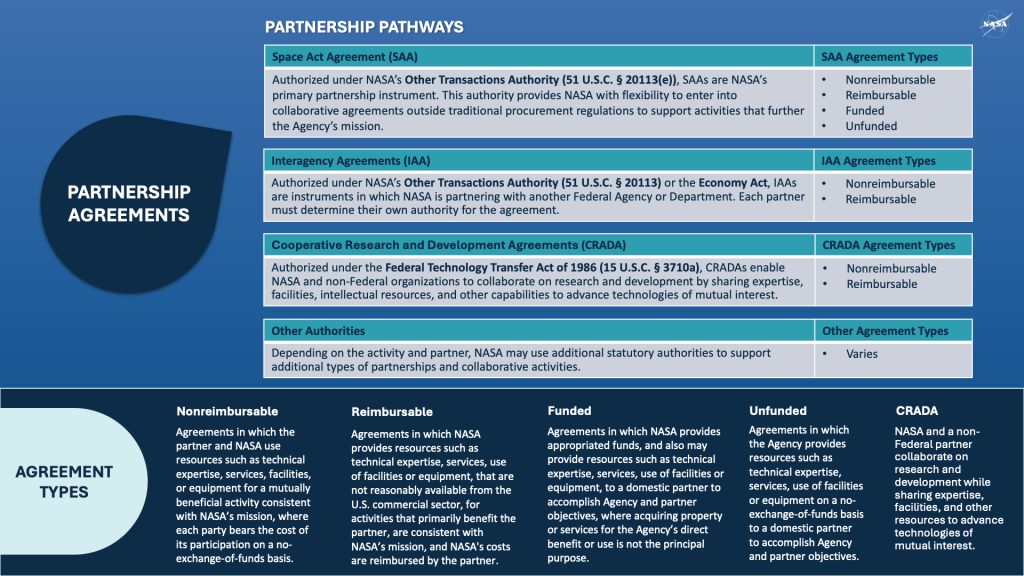
NASA enters into partnerships using several statutory authorities, depending on the purpose of the collaboration.
- Space Act Agreements (SAAs)
Authorized under NASA’s Other Transactions Authority (51 U.S.C. § 20113(e)), Space Act Agreements are NASA’s primary partnership instrument. This authority provides NASA with flexibility to enter into collaborative agreements outside traditional procurement regulations to support activities that further the Agency’s mission. - Interagency Agreements (IAAs)
Authorized under the Economy Act or NASA’s Other Transactions Authority (51 U.S.C. § 20113), IAAs are instruments in which NASA is partnering with another Federal Agency or Department. The structure of these agreements may be reimbursable, nonreimbursable, or include formal statements of understanding based on each partner’s authority. - Cooperative Research and Development Agreements (CRADAs)
Authorized under the Federal Technology Transfer Act of 1986 (15 U.S.C. § 3710a), CRADAs enable NASA and non-Federal organizations to collaborate on research and development by sharing expertise, facilities, intellectual resources, and other capabilities to advance technologies of mutual interest. - Other Authorities
Depending on the activity and partner, NASA may use additional statutory authorities to support additional types of partnerships and collaborative activities.
Space Act Agreements (SAAs) are NASA’s primary partnership instrument, authorized by Congress per NASA’s “Other Transactions Authority (OTA)” under the National Aeronautics and Space Act (51 U.S.C. § 20113(e)). This authority allows NASA to enter into flexible, mission‑supporting agreements outside traditional procurement rules. SAAs enable NASA to work with private and commercial industry, universities and other academic institutions, nonprofit organizations, government agencies, and international entities.
There are different agreement types in SAAs and other Partnership Agreements, and the appropriate type depends on the nature of the activity, the applicable legal authority, and who primarily benefits from the collaboration. SAAs may be nonreimbursable, reimbursable, funded, or unfunded depending on the activity and who benefits.
- Nonreimbursable Agreements – Agreements in which the partner and NASA use resources such as technical expertise, services, facilities, or equipment for a mutually beneficial activity consistent with NASA’s mission, where each party bears the cost of its participation on a no-exchange-of-funds basis.
- Reimbursable Agreements – Agreements in which NASA provides resources such as technical expertise, services, use of facilities or equipment, that are not reasonably available from the U.S. commercial sector, for activities that primarily benefit the partner, are consistent with NASA’s mission, and NASA’s costs are reimbursed by the partner.
- Funded Agreements – Agreements in which NASA provides appropriated funds, and also may provide resources such as technical expertise, services, use of facilities or equipment, to a domestic partner to accomplish Agency and partner objectives, where acquiring property or services for the Agency’s direct benefit or use is not the principal purpose.
- Unfunded Agreements – Agreements in which the Agency provides resources such as technical expertise, services, use of facilities or equipment on a no-exchange-of-funds basis to a domestic partner to accomplish Agency and partner objectives.
NASA focuses on mutual collaborations when supporting various activities through partnerships. NASA can support activities in the following areas and more! Recent examples of NASA partnerships are highlighted here: https://www.nasa.gov/partnerships/current-space-act-agreements/.
- Use of NASA facilities for testing, research, or technology demonstrations.
- Collaborative research and technology development.
- STEM education and outreach activities.
- Access to NASA expertise, capabilities, or specialized test environments.
- Pilot projects, demonstrations, and exploratory studies.
NASA’s funded Space Act Agreements are the mechanism through which NASA provides appropriated funds to a domestic partner. These agreements are typically announced through public solicitations and awarded after full and open competition. To find more public announcements, visit our Opportunities page.
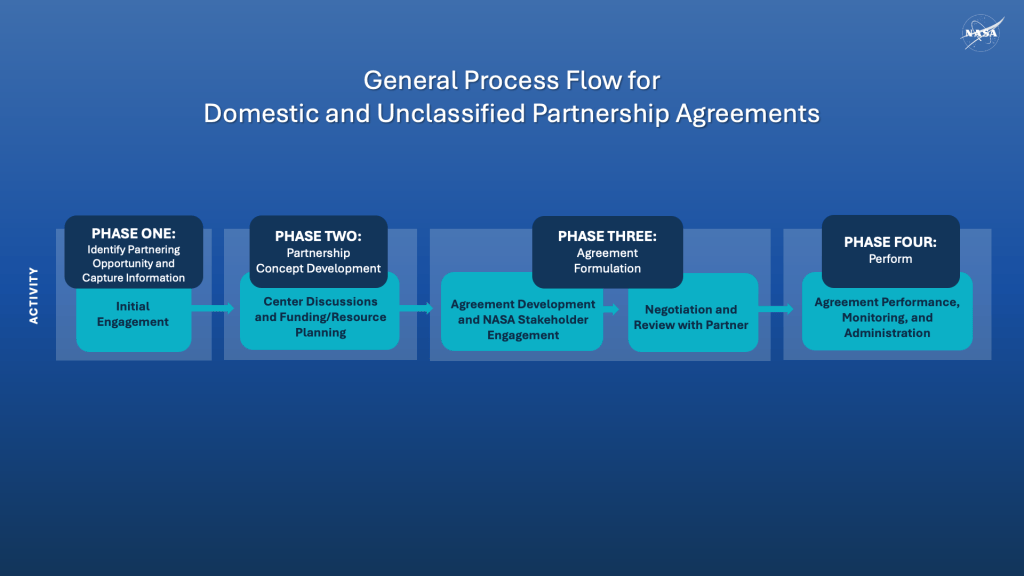
Opportunities to enter into a partnership agreement with NASA are often communicated through public announcements or originated through connections made at public events and directly with NASA Centers. Explore open opportunities, upcoming events and conferences, or make direct connections through the following sites:
Continue the Partnership Journey
NASA uses various types of public announcements to formally advertise partnership opportunities. In addition, NASA partnerships may originate from contacts made at outreach events and direct communication between potential partners and NASA Center.
Dive into our NASA Centers of Excellence to explore what capabilities NASA can offer and see our open or upcoming events and Partnership opportunities.