
















NASA’s X-59 Aircraft Builds Momentum Through 25th Flight
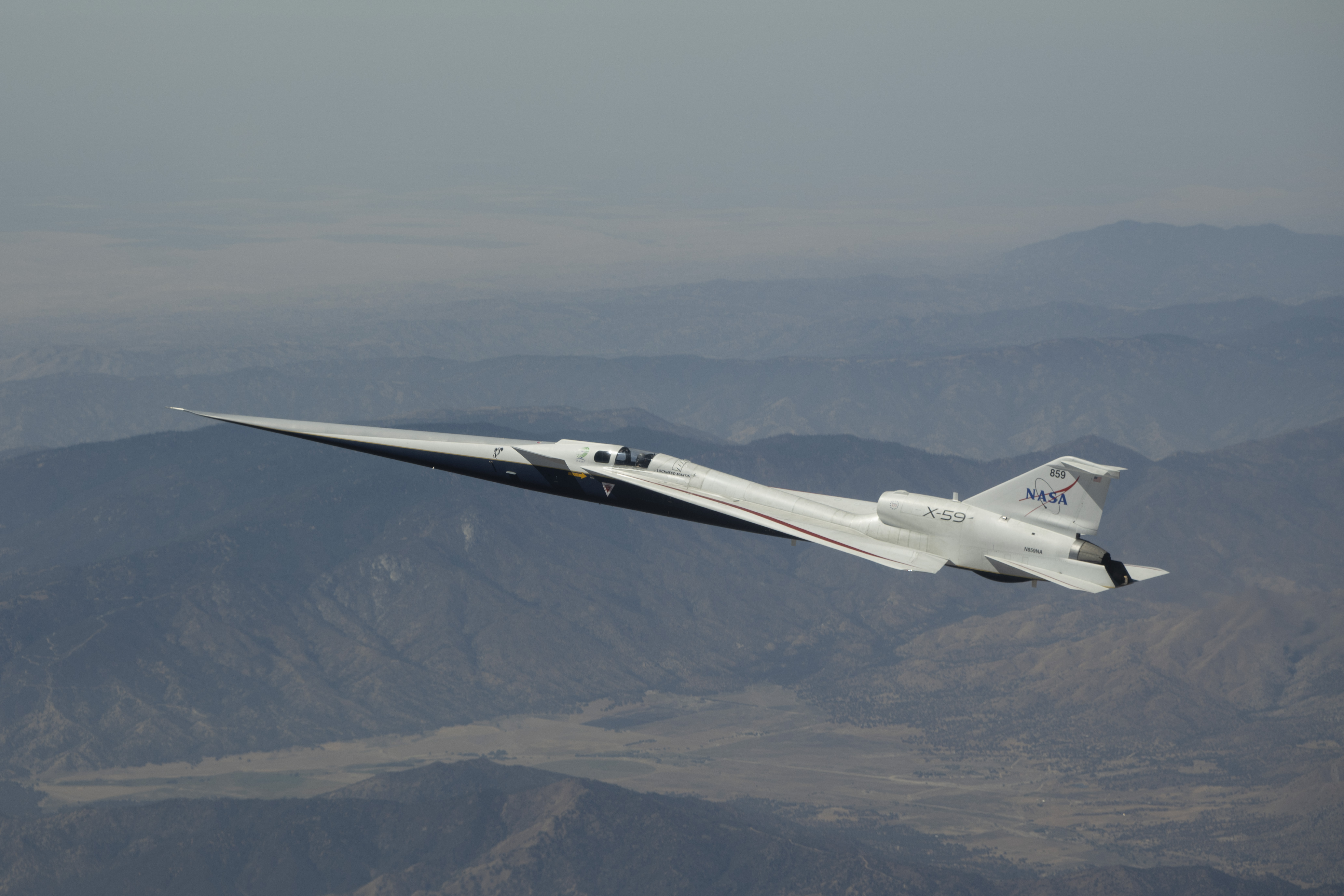
After 25 test flights, NASA’s X-59 quiet supersonic experimental aircraft steadily continues to pass performance marks set by its team. This successful run of tests has the aircraft on a path toward a new phase later this year, where NASA will evaluate the sonic thumps the X-59 is designed to make when flying faster than the speed of sound.
The X-59’s 25th flight took place Aug. 21, from NASA’s Armstrong Flight Research Center in Edwards, California. It lasted a total of 72 minutes with the aircraft reaching Mach 1.2 and approximately 49,000 feet. Like all of its test flights so far, the X-59 was accompanied by a chase plane to monitor it. That chase aircraft’s sonic booms masked any noise from the X-59.
Reaching this point comes after years of design and analysis before the aircraft was built. Now, the X-59 team is seeing the predictions they made using computer models, wind tunnel tests, and other tools confirmed through flight testing.
“Through our ongoing flight tests with the X-59, we’ve gained invaluable insights into both the aircraft’s performance and the unique challenges of the aircraft design,” said Cathy Bahm, project manager for NASA’s Low Boom Flight Demonstrator project. “Each test point has validated our models and predictions, and it has strengthened our confidence in the aircraft’s performance. Every flight brings us closer to transitioning to the next phase where we will demonstrate the X-59’s quiet supersonic flight capabilities.”
The X-59 is a revolutionary design, shaped so that when it flies faster than the speed of sound it will make just a quiet thump instead of a loud sonic boom. That required extensive modeling and design before construction began. Now that the aircraft is undergoing flight testing, one of the tools the X-59 team uses for monitoring progress is a “real-time digital twin,” which compares flight data to simulated predictions.
So far, the X-59’s real-world flight characteristics — how it moves through the air and responds to the forces acting on it — matches simulations closely. Some examples of agreement between flight data and the team’s predictions include:
- Its flying qualities, or controllability
- The stability margin, or how close the aircraft is to becoming unstable under certain conditions
- Flight loads, or the forces and stresses that try to bend and twist an aircraft when it’s flying
The X-59 also has not suffered any unexpected phenomenon, such as instability or excessive vibration, in response to aerodynamic forces. Nils Larson, one of NASA’s test pilots, has described X-59 flights as “exciting but uneventful,” exactly what a test pilot wants.
The aircraft has come a long way from its early test flights with simple objectives, like fly and land safely while demonstrating stability. Since then, it was able to work up to its target cruise speed of Mach 1.4 (924 mph) and altitude of 55,000 feet relatively early in its test schedule. Much of the remaining work has focused on checking performance in all conditions of its flight envelope — the areas and speeds where it should be able to operate safely — including those on the “low and slow” end.
Each flight has built on what was learned during the previous ones, and the test has seen the X-59’s components respond to each challenge. For example, the top-mounted inlet leading to the aircraft’s single GE-F414 engine has performed as expected across a range of maneuvers and conditions.
The 25 flights themselves are only part of the story. Between each test, pilots, engineers and maintenance personnel review aircraft and flight test data, evaluate results and work to make any required refinements. For instance, at various points during the testing they made minor adjustments to the aircraft’s control software and eliminated an issue where its systems were interpreting nuisance alerts as caution warnings.
This is the phase we’ve been working toward. Building and flying a brand-new aircraft is an extraordinary accomplishment, but the next phase is where the real research begins.

Larry Cliatt
Acoustic Validation Technical Lead, Quesst Mission
As the test team continues to unlock more areas in the range of altitudes and speeds required for the Quesst mission, they’re looking forward to learning more. But there are some qualities a simulation can’t quite anticipate. For instance, the aircraft “likes to fly fast,” according to Larson.
That’s good news for the next phase of flight testing as the biggest benchmark for the X-59 — how it will sound at supersonic cruise speeds — will get more focus in the coming months.
“This is the phase we’ve been working toward,” said Larry Cliatt, acoustic validation technical lead for NASA’s Quesst mission. “Building and flying a brand-new aircraft is an extraordinary accomplishment, but the next phase is where the real research begins.”
During the upcoming acoustic validation phase of testing, the team will fly the X-59 while using a variety of ground- and air-based tools to measure and characterize its sonic thumps.
“Acoustic validation will put the tools and methods used to design the X-59 to the test — tools that could ultimately become part of the DNA of every future commercial supersonic aircraft,” Cliatt said. “It will be a complex and demanding flight campaign focused on demonstrating that the X-59 can produce the quiet sonic thump it was designed to achieve.”
The X-59 is the centerpiece of NASA’s Quesst mission to help enable commercial supersonic flight over land. Continue following the X-59’s progress on the Quesst blog and track the aircraft using NASA’s flight tracker.
