


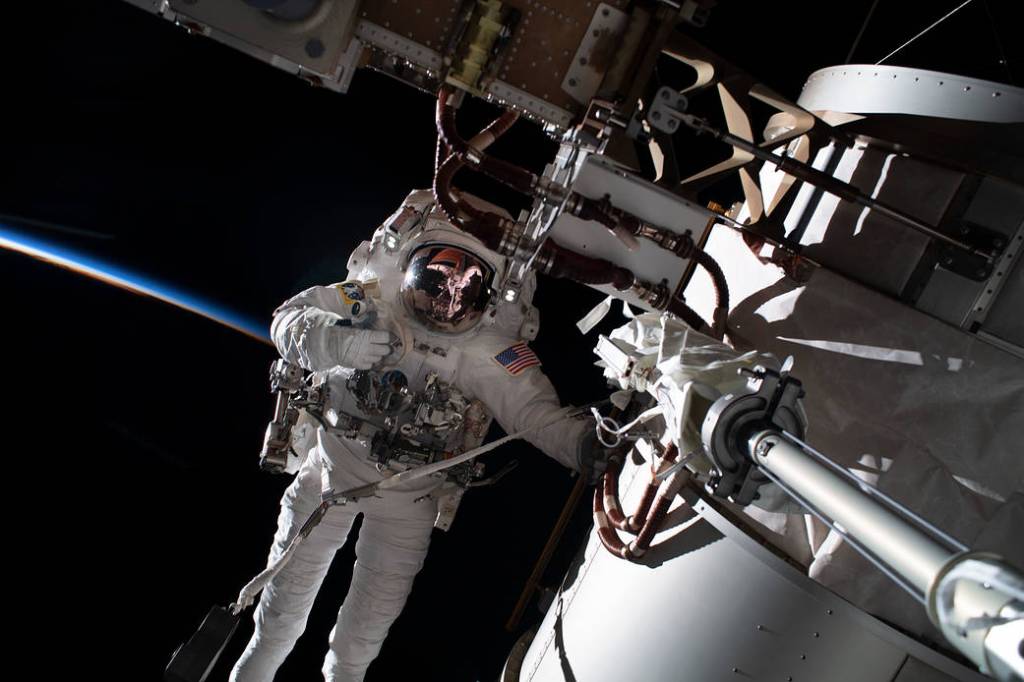















From Earth orbit to the Moon and Mars, explore the world of human spaceflight with NASA each week on the official podcast of the Johnson Space Center in Houston, Texas. Listen to in-depth conversations with the astronauts, scientists and engineers who make it possible.
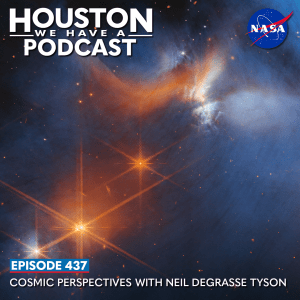
On episode 437, NASA astronaut Chris Williams and astrophysicist Neil deGrasse Tyson explore human spaceflight, astrophysics, and the wonder of the universe. This episode was recorded September 1, 2026.
Transcript
Gary Jordan
Houston We Have a Podcast. Welcome to the official podcast of the NASA Johnson Space Center, episode 437: Cosmic Perspectives. I’m Gary Jordan, and I’ll be your host today. On this podcast, we bring in the experts, scientists, engineers, and astronauts, all to let you know what’s going on in the world of human spaceflight and more.
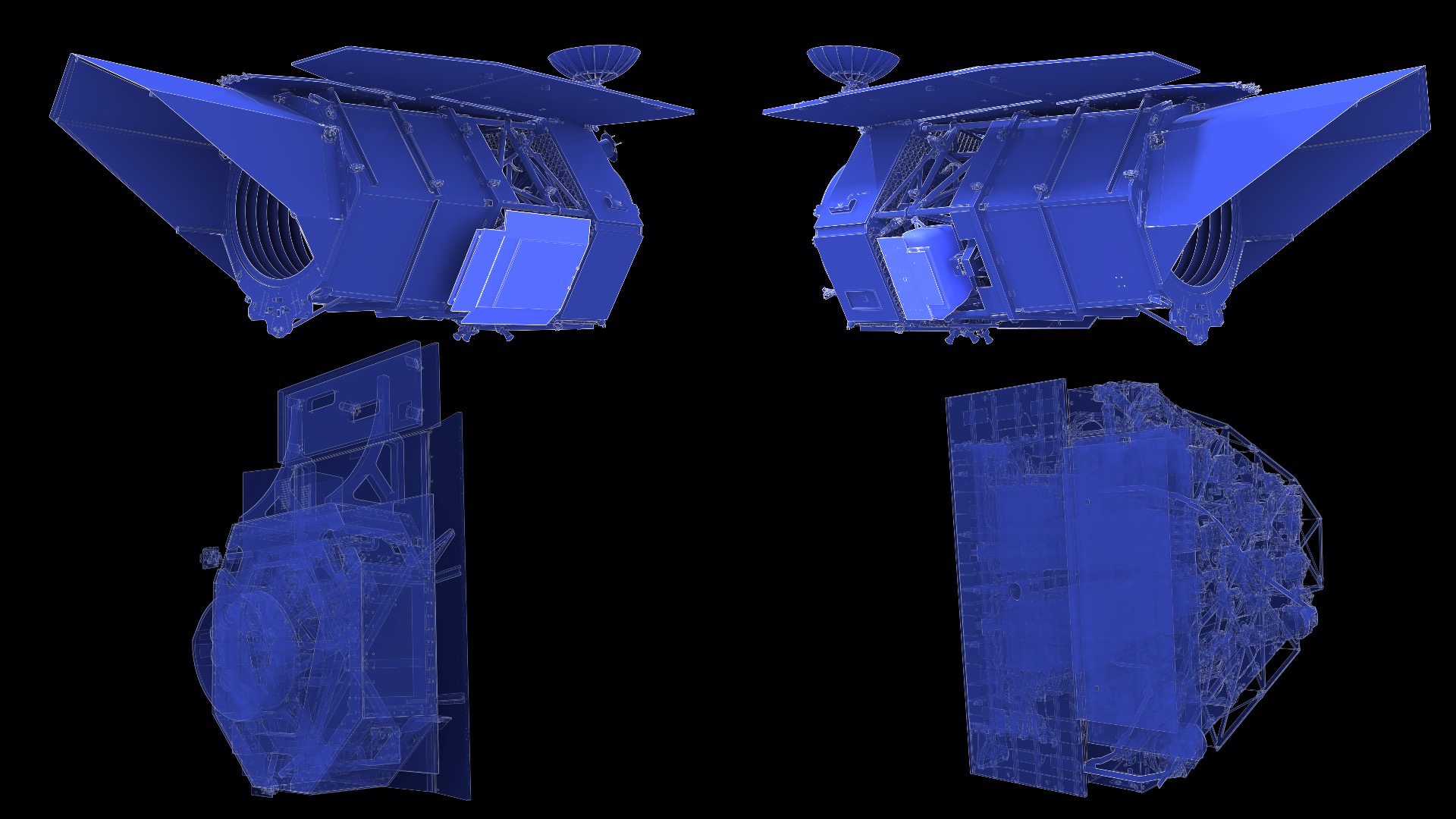
The expansion of human spaceflight against the grandeur of the universe is infinitesimally small. Much of what we know about the observable universe has been thanks to powerful instruments and telescopes that provide different perspectives and new scientific data, which shape our understanding, rewrite textbooks, and pique human curiosity. The new Nancy Grace Roman telescope, for instance, will capture massive cosmic panoramas to map the structure of the universe, and the James Webb Telescope has looked backwards in time and revealed the expansiveness of the universe by showing clusters of galaxies with billions of stars each, peppered against the blackness of space. Telescopes are critical tools to unlock the secrets of the universe.
That’s not to say that human spaceflight is not a powerful contributor to cosmic understanding as well. Much like how each telescope launched into space helps us understand what telescope to send next, each human spaceflight mission contributes knowledge and understanding to help us understand how to go further and faster and longer. More than 25 years of continuous human presence aboard the International Space Station has advanced our understanding of how to live and work in space successfully, and applies directly to designing how we’re going to live and work on the Moon under the Artemis and Moon Base programs. Lunar samples have proven invaluable to our understanding of Earth’s formation, and by proxy, the formation of planets. Future Artemis sample return missions could provide precious insight into furthering our knowledge of moons, planets, and solar systems across the universe.
On this episode, we are bringing in two great minds who have looked out into the vast universe to share their own cosmic perspectives. Chris Williams is a NASA astronaut and board-certified medical physicist. He spent 241 days aboard the International Space Station as part of the Expedition 74 science mission and returned to Earth July of this year. William’s background in physics is extensive. For his doctoral research at MIT, he focused on astrophysics, namely developing radio telescope instrumentation and data processing techniques for cosmology. He then took his astrophysics experience to the medical field, where in Boston his practice and research was in radiation therapy for cancer treatments.
Joining Chris and I for an exciting discussion is Neil deGrasse Tyson, widely recognized as an American astrophysicist, author, and preeminent science communicator. He serves as the director of the Hayden Planetarium at the American Museum of Natural History and host of the popular Star Talk podcast. Throughout his career, Tyson has appeared on television as a host and special guest, and he’s been an advocate for science literacy in his endeavors. In his latest book, Lost in Space: 5000 Facts for Navigating the Universe Tyson discusses human spaceflight and astrophysics. With Williams’ recent return to Earth from space station and astrophysics background, we bring these two together to explore these topics even deeper.
For what it’s worth, it was a fascinating discussion and a mind-blowing experience. So sit back, relax, and enjoy this fascinating conversation with Chris and Neil.
Here we go.
<Intro Music>
Chris Williams, welcome back to Houston We Have a Podcast. It’s great to speak with you again. You recently returned from orbit. Here we are. You’re sitting next to me after being orbiting 250 miles above the Earth. It is a pleasure to have you.
We are here with Dr. Neil deGrasse Tyson. What an honor it is to speak with you today, Dr. Tyson, a longtime fan.
Neil deGrasse Tyson
Neil, please call me Neil. Yes.
Gary Jordan
Neil, of course, yeah, and longtime fan, fan of the podcast as well, and all that you’re doing. What’s nice about this conversation, Chris has a background in astrophysics. You have a background in astrophysics, and I am a silent observer in the corner that just appreciates folks who who can actually understand all of it.
Neil, one of the things I appreciate about you most is how you can condense a lot of this very complicated information into something that’s very understandable, Chris. You did this time and time again on orbit on the many in-flights that you did. You both have this love of astrophysics. I really wanted to start there. There’s got to be a passion.
Neil deGrasse Tyson
But you got Chris, so what do you need me for? I haven’t been in orbit. I got nothing. You know, I got nothing.
Gary Jordan
Maybe not the firsthand experience, but just your observation. I mean, it’s just but and of and how you view the the universe, that cosmic perspective is really what I want to get into. It’s something that maybe not a lot of people share, and you can bring back down to earth in many different ways.
Why don’t we start with that, Chris? If you don’t mind us getting kind of kicked off because there’s a lot of different things that you can pursue in in life and as in in childhood and something maybe early that sparks that interest of looking at the cosmos and the stars and actually think and a lot of people do they look up at the sky but not everybody thinks that’s what I want to do that’s what I want to pursue how do you how do you make your way into an astrophysics world?
Chris Williams
Yeah, thanks, Gary. It’s a great question. I mean, you know, I have been fascinated by space ever since I was a kid. I was born in New York City, and you know, couldn’t see too many stars growing up. But you know, something going back as far as I can remember fascinated me about the idea of exploration. And you know, as far back as I can remember, you know, I remember drawing pictures of the space shuttle as a as a kid in elementary school, and and you know the the one show that my my family all watched together in the evenings was Star Trek, and I think it just kind of got you know instilled in me this idea of exploration and led me towards a path in in science. You know, this fascination with exploration in the universe made me want to want to want to study it to understand it. And you know nobody in my immediate family is a scientist or does anything like that, and so this this curiosity and wonder at the universe, you know, kind of gave me the internal confidence to say, hey, you know, maybe I can study physics. Maybe I can study science. And think by the time I was around 11 years old, as an astronaut, you know, that’s not a real job I could do. But I still really love science, so let me do that. And but you know, never lost the astronaut bug, and and eventually ended up here as well.
Gary Jordan
I hear that time and time again from astronauts just catching that bug and maybe not initially pursuing that astronaut as a dream, but just being passionate about something else, and you kind of veered away from something that maybe was atypical in your family.
Neil, I wonder. I know you’re you’re well known, but just give us a a sense of your early experience that made some kind of early spark that got you to where you are today.
Neil deGrasse Tyson
It was the first visit to the Hayden Planetarium, my local planetarium in New York City, and looking up at the night sky as portrayed on that dome. As duly noted, a New Yorker has no relationship with the night sky. You know, you look up, you see buildings, you see lights, maybe the moon every now and then, but no stars or constellations or anything, and so that was my first encounter with the night- I thought it was a hoax actually, because I’ve seen the night sky from the Bronx, and it has eight stars in it, and that was not eight stars! So I would later learn, yes, that’s the real sky. And to this day, to this day, when I go to mountain tops or the finest observatory sites in the world, and I look up, and I say it’s so beautiful, reminds me of the Hayden Planetarium!
I know it’s it’s a sad fact, sad urban fact, but that’s what got me interested, and that was to show you how old I am, one or two years before we landed on the Moon. So the astronauts that were selected, starting with the Mercury Seven and onward, they did not. That’s not what attracted me to space. It was clear that they were weren’t looking for me. Just let me put it out there, okay? They were looking for some other mold that I did not fit, but that’s not what attracted me. It was the immensity of the universe and how much we did not know.
It was the not knowing that was the force of attraction for me, and I would go on to get a degree in physics and then a PhD in astrophysics, all in the quest to just understand the universe, and to carve your way through what is known, get to that frontier, and then contribute to expanding our understanding of the universe. And that was always my goal. The space! Plus as an astrophysicist, I knew that space to me is like the whole galaxy or the whole universe, not boldly going where hundreds have gone before in orbit. To the Moon? That’s great. That’s a destination. But so today, if you want to send me into space, send me to the Moon, Mars, or beyond. But I have much less interest going into orbit. As fun as that would otherwise be.
Chris Williams
Pretty fun.
Gary Jordan
Yeah! You would know firsthand, right? But I mean, what’s I think what’s good about going into orbit is is the the time and time again we can figure out exactly how to do it right. So when we do have the explorers that ultimately want to go to the moon, we have a lot of you you know we have a lot of practice, a lot of reps in in understanding what it is to live-
Neil deGrasse Tyson
We got, we got the orbit thing- We got the orbit thing down! Low Earth orbit is no longer a frontier of anything.
Gary Jordan
I’m talking the living and working… To explore different things. Oh yeah, go ahead, Chris.
Chris Williams
Yeah, I mean, yeah, I hear your point, but I mean, we are still learning a huge amount about how to. Operate in space on on the space station and things that are going to directly get us back to the Moon and get us further. And I think that that that was one of the things that I didn’t necessarily appreciate before spending time on the on the space station. But how much we’re still continuing to actively learn about how we work in space and how. But-
Neil deGrasse Tyson
I got a question. How how many how long were you in space?
Chris Williams
Ah, 241 days.
Neil deGrasse Tyson
Dang, dude. Okay. So, when is NASA gonna do what every science fiction movie does and have a rotating ring so that you can have artificial gravity? So we don’t have to worry about your bones or the pressure in your eyeballs or whatever the hell goes on biophysically to you in zero-g in orbit, when is NASA going to do that? I want my answer right now.
Chris Williams
That’s a great question. Well, I can say there’s a lot of really interesting things that do happen to you with your body in orbit. You know, we get a lot of time to work out to try to keep our bones as strong as possible, but everybody, most people, lose some bone density. You definitely get some fluid shift where your head feels kind of full those first few days. But then the thing that amazed me is actually how quickly your body gets used to being in zero gravity. How quickly you get used to being a space person. Like your brain, like you know, for the first three weeks is sort of like, what’s going on? You’re flipping upside down. This doesn’t feel great. But then things start to click, and all of a sudden, it’s just like you’re at home in space, which I think is really fascinating. Teaches us ton about how our how our brains work. It’s amazing.
Neil deGrasse Tyson
You see, I think I’m the inadequate stuff rather than the right stuff, because I once went in a centrifuge, really low G centrifuge, and I lost my lunch when I got up, so if I if I think I would lose my lunch the moment I was weightless, and there’s nothing worse than zero-g vomit. I’m pretty sure.
Chris Williams
No comment on that, but yeah.
Gary Jordan
There’s so much that we can learn. You know, I think I wonder if yeah from orbit, Chris, if there was, if you had a different sense of looking out, you know, of course, one of the things we know about the International Space Station is looking down. You got that cupola window, you got the seven bay window. I wonder if there’s a nice angle where you can maybe look a little bit out.
Chris Williams
Oh, absolutely. So you know, we have this iconic cupola window that looks down at Earth, but when I was up there, I flew up on a Soyuz rocket. But there was also a Dragon capsule docked to the Zenith port on space station, and that has windows that kind of looked forward and out. And I spent a lot of time up there because one of the beauties of the International Space Station too is that you know we’re we’re at a 51 degree inclination orbit, and that means that we kind of orbit over the northern hemisphere, the southern hemisphere, and we kind of go far enough north and far enough south that you can see the northern and the southern lights. But also, the center of our galaxy is is a little bit more centered on the southern hemisphere. So, if you ever have the chance to go to a beautiful spot in the night sky, the southern hemisphere, you can really get a great view of the core of our galaxy.
And occasionally, you know, sitting in the Dragon spacecraft, staring out of the windows. I remember a couple times where we had a little bit of an arora on the horizon, and I could just so distinctly see the core of our galaxy rising above the Earth. It was just awe-inspiring and reminded me why I, why I love our universe and just trying to trying to think about it and understand it.
Neil deGrasse Tyson
Yeah, my PhD thesis was on the center, on the core of the Milky Way galaxy, and all the best data on that was obtained in the southern hemisphere in Chile. We were about 30 degrees south, and at that latitude, the center of the galaxy goes directly overhead, so it’s it’s perfectly viewed for rising, crossing the sky, and even setting.
And you didn’t mention it, but as an academic, I feel compelled- Your 51 degree angle is to allow both Russian and American astronauts to dock to the same to the same object, the International Space Station. If we didn’t have Russia as partners, it probably wouldn’t have been launched at that steep angle to the equator. Is that correct?
Chris Williams
Yep, that’s absolutely right. Yeah, the if keeping it at that inclination makes it accessible from from Baikonur basically in Kazakhstan, and so yeah yeah that that’s that’s absolutely correct. But the upside is we get we get a lot of good views over a lot of parts of the Earth from the space station, which yeah can lead to some really nice photographs and views of everyone on our planet.
Neil deGrasse Tyson
Interesting. If you were orbiting just over the equator, that would be the least diverse place to observe the Earth, because you would have no access to the northern or southern hemispheres. So that’s that’s a fascinating fact.
Gary Jordan
I’m gonna I’m gonna botch this, but I think the 51 degree orbit I think it’s like 85 or something percent of the inhabited world that you actually cover, and how you and how you-
Neil deGrasse Tyson
Oh, easily. Yeah.
Chris Williams
I mean, you know, 51.6 degrees south. You know, occasionally on a good weather day, you can see the tip of Antarctica, and when you’re coming full north, you can you can you can really see up into you know sort of northern Canada or Scandinavia. So, I mean, it was, being up there and getting to see all of that of the planet, all of those portions of the planet really gives you a feel for the size of our Earth and just you know how yeah, I don’t know how connected everything is.
Neil deGrasse Tyson
Yeah you know I bet you that number is higher than 85% because probably when I the last time I ran numbers 85% of the world’s population lives north of the equator so if you’re going to be as high as 51 degrees, who lives north of 51 degrees? You have, what do you have? You have northern Canada. You can count the people in one hand there. Northern Siberia. Count the people in one hand there, and so, so yeah, you got everybody.
That means you get to see all the big cities at night. That must be fun.
Chris Williams
Oh, the big cities at night. I mean, that was one of my favorite things to photograph. It’s just absolutely beautiful. You know, it’s one of those things. You know, there’s a there’s a common saying that oh, you can’t see borders from space. But one of the things I found the most fascinating is that yeah, you actually kind of can at night. I mean, you know, being in space gives you this overview effect of where you see the togetherness of everything in the world. But you know, flying over the the border region of North Korea and South Korea at night, like you very clearly see a line of lights that traces out the border. And the the light, the city lights, just you know, they give you some of the feeling of wonder that you get from looking up at the stars. You know, it’s just beautiful.
Neil deGrasse Tyson
Yeah, and generally, if you can notice a border from space, you’re noticing a difference in GDP per capita.
Chris Williams
Yeah, that’s that’s totally fair.
Neil deGrasse Tyson
They have light, and they don’t have light. They have irrigation. They don’t have irrigation.
Chris Williams
Yeah.
Gary Jordan
Energy and technology. You can absolutely witness it. Yeah.
Neil deGrasse Tyson
That’s it.
Gary Jordan
So you so you got that perspective going down. Neil, you mentioned the observatory in in Chile, and I know there’s observatories very strategically placed around the Earth, and I think there’s a variety of factors as to why they choose those locations. You know, limited cloud coverage, limited light pollution. You know, there’s probably these these there’s very strategic places that you can go around the earth to ultimately ultimately observe the universe.
Now, Neil, I think maybe you can help us kind of unravel exactly what is so beneficial about these observatories and and the locations of them that ultimately lead to why we pick these places to build these massive telescopes, radio observatories, whatever it be, to look out into the stars.
Neil deGrasse Tyson
Yeah. So, there are rare reasons why you might put a telescope on the poles. Okay. Antarctica happens to be at very high elevation, and there’s certain observations in microwaves that are otherwise badly contaminated by water vapor in the air, and if you’re at very high elevation, you’d be above a lot of water vapor that would be near the ground level, near sea level. So, but broadly speaking, if you want to access as much of the sky as possible, then, and you want as few clouds as possible, you want to be in the the desert latitudes of the Earth, and that’s there are four such latitudes. But the two ones we all think about is plus 30 and minus 30.
So at the plus 30 around the Earth, you get the Sahara Desert, the Gobi Desert, the Mojave Desert, and I probably left one out. India would be a desert with 30 degrees goes right through that, were it not for the monsoon. That that sort of changes the total waterfall, annual waterfall there.
Neil deGrasse Tyson
So these are there’re these climate cells. They’re cylindrical cells where, over the desert latitudes, the air is primarily falling rather than rising, and when you have falling air, it doesn’t promote cloud formation. So you you can go 300 days a year with no clouds in those deserts. So so clouds will ruin your night if you’re an observer, right? So you want to sort of lean towards desert climates, and- In fact. Is a place in Chile where they put a recent telescope. I think it’s had a half an inch of rain in the last 10 years, something crazy like that.
So anyhow, so there’s that, and you want very stable air. So the observatory in Hawaii, which is not in a desert latitude, it’s closer to the equator, but it’s in an area where the air is very stable over the waters, and that makes for very stable images that you’re that you’re trying to obtain, and that has very high value to the precision of your observations.
And you got to build a road to get there, so you can’t just go. There’s a great mountain. Let me stick an observatory on top. You need a you need a road. You need infrastructure. You need a place where there’s a lab where you can repair things. So- or you can just stick a telescope in space!
Chris Williams
Yeah, we just did that!
Gary Jordan
Yeah, we just did that over the weekend! Just a little weekend activity.
Chris Williams
Yeah, yeah.
Neil deGrasse Tyson
Yeah, yeah. You mean with the Nancy Grace Roman?
Gary Jordan
Yeah, exactly right. Yeah, yeah,
Chris Williams
yeah. No, it makes a lot of sense. One of the projects I had just sort of in my personal time when I was in space was trying to take pictures of some of the observatories that I’d you know been to when I was a grad student, and so it made it really easy because you know most of the time you got pretty good weather when you’re passing over those places. So you know passed over the Magellan telescopes in Chile, and I was like, oh, I can, you know, always clear, easy. Yeah, the hard, the harder places were some of the places I did radio astronomy at because for non optical astronomy, you sometimes have some different constraints. So, you know, I did-
Neil deGrasse Tyson
Oh yeah, so there. I mean, the radio waves get through practically anything. So, you know, long wavelength radio waves. There’s less constraints on that. Where are you going to put that? It often has to do with if it’s an array. Do you have a big plane area where you can put it, like the Very Large Array in New Mexico, famously shown in the movie Contact, And so yeah, so radio telescopes have a whole other flexibility in where you might place them and still get the job done.
Chris Williams
Yeah, when I was in grad school, we were in Western Australia because our main constraint was no people because we were working in radio bands that you know your car radio might pick up on so you needed or your-
Neil deGrasse Tyson
Right or the remote control you have your garage opener door opener, exactly. Yeah you’d be surprised how radio noisy human beings are. In fact this talk of building the next generation radio telescopes on the far side of the Moon.
Chris Williams
Yes!
Neil deGrasse Tyson
You can’t get farther away from humans than that.
Gary Jordan
Yeah this big shield.
Chris Williams
Block out, to block out the Earth. I mean, I think for getting to the, you know, getting beyond the Earth ionosphere, which can block out some of the lowest frequency radio waves, and then getting all the way on the other side to block out all the noise that you know our our civilization creates. It’s a really interesting idea. We could learn some really interesting stuff about the early universe.
Gary Jordan
When you traveled around the world, Chris, I think part of your work was coming up with procedures for radio telescope imaging and things like that. You mind describing that?
Chris Williams
Yeah, I mean, in graduate school, I worked on trying to develop- I was more of a sort of hardware and instrumentation person. So I worked on trying to develop some techniques for looking at some radio signals we think come from hydrogen in the very earliest, very earliest times of the universe-
Neil deGrasse Tyson
Dude. You want to- you want the signals that the aliens send. Forget the hydrogen.
Chris Williams
I mean, those-
Neil deGrasse Tyson
We want to hear the aliens. Fess up here.
Chris Williams
The thing we’d always joke about is our job was to delete the aliens from the signal so that we could actually see the, see the science, right? Like you know, like ah, this is radio noise. Why did this thing keep coming in from this star? That’s really annoying, right? Like, delete that.
Neil deGrasse Tyson
What are these digits of pi coming from the middle of space?
Chris Williams
Exactly. I don’t want that. I want hydrogen.
Neil deGrasse Tyson
That’s funny.
Gary Jordan
Amazing. You know you guys come from this world of of science and observation, right? And there’s probably you know what you’re describing here is is and we’re laughing about it, but the idea of of clean data, of repeatable data, right, is peer reviewed, right? This is the world that you guys come from and and you did a lot both in Chris. You did a lot both in astrophysics and then medical physics as well, which I think there’s a little bit of crossover, which is why you were able to sort of hop over.
Chris Williams
Yeah, yeah. I mean, I did astrophysics for my PhD, but then popped over and applied some of that physics knowledge to med. And cancer research, and I mean, you know, for a variety of reasons. But one of them is that, funnily enough, in in in astrophysics, we often talk about the two-body problem, and that is also something that affects graduate students and their family lives. And you know, so I tried to do something that, but that I still thought was really interesting and could make a positive impact on the world, and you know a lot of the same technologies we use to create images in radio waves from radio telescopes are the same ones we use to create images from MRI machines. And so you know there’s a lot that you know sort of cross pollinates. But I think the biggest-
Neil deGrasse Tyson
Not only the tools but also the software to analyze the images can have great crossover value.
Chris Williams
100% yeah, 100%. But also, you know, the way of thinking as a scientist. You know, how do you take a problem that you’re curious about? How do you break that down and and approach that? Because you know, sometimes these problems can seem sort of large and insurmountable. And I think you know, as a as a as a science student, what you learn is how to how to take something that seems really big and how to break that down and to to approach it.
Neil deGrasse Tyson
If I can add just a perspective here, if two scientists disagree, then they can duke it out, right? And but basically, let’s say they’re at a conference and they’re duking it out… verbally. And, but at the end of the day, what comes of that disagreement is we need either- or both- of more data or better data to distinguish our two ideas to find out which one is correct. Now let’s go have a beer. That’s how scientists end their conversations. Whereas in geopolitics, it usually ends in warfare. Okay, I mean I don’t mean to make light of it, but that’s why you don’t see legions of scientists leading nations into battle, because we would just say “no, we just need more data. No, let’s go have a beer.” So, so this enterprise, when you talk about the integrity of science, it has to do with what is what is ultimately shown to be objectively true is supported by repeatable scientific observations and evidence. And when that happens, we no longer disagree, and we’re on to the next problem.
Gary Jordan
See, that’s perfect. I think I hear from you know I look at both of your backgrounds, Chris and Neil, and just I think a lot of students can look at that people that are kind of interested and have that same aha moment that you both had as a childhood that says wow they’re so I have so many questions about the universe but are otherwise see science as a very intimidating thing, right? Because maybe you know that duking it out can mean a lot of studying and a lot of confidence in what you have studied and observed, and the right mindset to approach and ask the right questions. So, in terms of trying to inspire folks to pursue science and engineering and as a field, you know these things that are otherwise very intimidating at their surface. You know how do you set how do you try to break down those barriers and say, you know this is something that you can do it. You know and here’s how I would here’s how I would approach it.
Chris Williams
Yeah, I mean I think for me, I mean I think you you kind of described it really well, Neil. I mean, like I think as a scientist, the way I kind of approach a problem is that I kind of approach it with the assumption that this is solvable. We just need to figure out how to do it. And for me, the beauty of the universe and the beauty that of physics that you can you know use a few simple rules to describe all of the amazing things that we see around us, from the little scales to the big scales. That, for me, provides a motivation to go through the hard stuff. To say, you know, I know we can solve this, we just got to put in the work. And solving that, you know, like that wonder and that curiosity gives me the motivation to do that hard work to get to that solution, so that’s kind of how I see it.
Neil deGrasse Tyson
Yeah, I’m going to mangle the quote, but there’s a quote from Antoine De Saint-Exupéry, who was an early aviator. In fact, he’s also the author of the charming book, The Little Prince. I think originally in French that was, but he says: if you want people to sail the open ocean, you don’t give them the tools and the wood and give them instructions how to build a ship. No. Instead, you compel them to long for the call of the open ocean. And then they will just figure out how to build the ships themselves. They’ll just do it.
So, if with the efforts of NASA that are so visible to the world, they’re so visible that people think NASA’s budget is 10 times what it actually. Is- so that to consider that fact. So the visibility of NASA’s achievements, the going you know Artemis around the Moon, the launch of the telescopes, the images that come back-that is the draw on what it might be for someone to want to become a scientist. And then you’ll, you’ll put up with anything practically to achieve those goals, and that’s how I look at it. I just get people. I want to compel people to want to do it rather than train them how to do it. When they’re compelled, they’ll train themselves.
Gary Jordan
Neil, can you can you recall a time when you were pursuing your astro you know, an astrophysics degree, where you hit an obstacle that maybe would have otherwise been could have been a turning moment, where you may have been dissuaded from actually continuing to pursue it, but instead that curiosity pushed you to keep going.
Neil deGrasse Tyson
It worked at all points. It was not a turning point ever because my goals were set, and they were very powerful goals. So the the goals were so strong they could override any of these moments that you’re describing, and I don’t say override it. I will I would overcome them. So let me dig to get a simple one. I’m in high school, right? And I’m taking calculus for the first time, and going from algebra to calculus is not the same thing as going from arithmetic to algebra. All right. As hard as it is to say, well, it’s not really a number; it’s just any number, and there’s a letter representing. That’s kind of abstract and weird, but going to calculus is even more abstract and even weirder. So I got the book, and you open up the front and the back pages, and there are these tables of integrals.
Chris Williams
Derivatives.
Neil deGrasse Tyson
Okay, derivatives, and it’s like what? There are all these squiggly lines. And I looked at it and said, “I will never in my life understand any of this.” I remembered saying that to myself the first day of school, opening up the book, and then I said, “But I want to be an astrophysicist, so I’m going to stick with it.”
So, first week goes by, and second week by after a month, this fog began to lift. I say, wait a minute! I could use that equation right there. It’s waiting for me. I pluck it, use it in the problem. Wait a minute! There’s even more. And by mid-semester, all these were my friends, and not this intractable Oz sitting over the horizon beyond the rainbow, and so I don’t know how to rank that among what it is you’re imagining would be an obstacle. But that was as big an obstacle as I can imagine confronting. Thinking to myself, I will never understand this, and then when the day goes by and I say I understand it all. Oh my gosh! There’s confidence for the rest of your life.
Gary Jordan
I mean, that’s the perfect analysis. That’s exactly. I mean, you were laughing. I feel like you had a similar story.
Chris Williams
I mean, I have so many similar stories, right? Like, I mean, I think you you really hit on a a very common theme there. Of, but I think it also you know hints at how powerful like you know curiosity, wonder, and this drive to understand can be.
I mean, I I remember you know my I have a innumerable number of stories, but one you know one that sticks out for me is my qualifying exams in graduate school. So when you’re you’re going for a PhD and advanced degree, you have to take these qualifying exams to you know go on to the next step. And I was at MIT and our physics qualifying exams. You know, had like a 50% failure rate on them, and you know, I- and you get a couple chances at taking them. But I remember failing a couple times and being like, I am never going to get through this. But I really wanted to be an astrophysicist, and I knew that once I just-
Neil deGrasse Tyson
Wait. Just to be clear, the qualifying exam doesn’t get you the PhD. It allows you to step through the door so that you can get the PhD. Yeah, just to be clear.
Chris Williams
Yeah, and the way it worked for us is you had to do general physics qualifying exams to then jump into your astrophysics research and start your dissertation and that sort of thing. And I remember just struggling with you know some of the advanced quantum mechanics and thermodynamics and statistical mechanics and thinking, man, I am never going to get through this. But you know that motivation, that desire of like, I love astrophysics. I love the stars. I love figuring out how this works, and this is how I get there. And then using that as a motivation to really learn it, to really know something, just kind of makes it easy to easy. It gives you that that that drive to get through something that you think is hard and that you might think is insurmountable otherwise.
Gary Jordan
I kind of want to poke at that at the excitement park because you know we’re talking about you’re recalling obstacles and you know I see you smiling over here as you’re going through all these moments in your head that were just- and I know I say obstacles, but I think how you’re thinking of it, and maybe is the right way to think about it, is very difficult challenges that you have to push through to get to that ultimate goal. Neil, you said there was there was a goal, and there was nothing stopping me.
In a similar vein, thinking about a moment where you know you’re pushing through an obstacle, or you get to an exciting revelation as you’re studying, as you’re going through your education, that maybe either reinvigorates, reinforces, whatever you want to call it, that drive that you had in the first place about I really want to be an astrophysicist.
Neil deGrasse Tyson
Well, I mean, there’s there’s your research. That’s the whole point of your research. The research isn’t publishable unless it contributes to our fundamental understanding of the universe, however small that is. If it’s an advance, it’s an advance, and then it gets peer-reviewed. Each one of these is an achievement. Every single one of them. So, you know this old saying: “Oh, I don’t want to go into academia because it’s publish or perish.” Well, let me reword that. “I don’t want to go into academia because I have to work or I’ll get fired.” Okay, publishing is the job. That is the thing. So don’t look at that as the problem. That is the thing. And each of those are are achievements, and they accrue to your self-confidence, to your energy, to your enthusiasm.
Chris Williams
Yeah, absolutely. Yeah, I mean, I have some some you know great recollections of you know working you know our little prototype telescope and you know the first time we got a signal and then you could kind of pull up a map of like the galaxy and the emission from the galaxy and all of a sudden those lines overlay each other and you’re like oh this is actually working! And it’s such a cool thing where you can, where you can connect like what you think should happen, and then it actually does happen. And to me, that’s always a big, beautiful reinforcement.
And you know, in science, that’s you know, you come up with a theory, you think it might work this way, and you know, you take some data, you do some experiments, you do some observations. Sometimes it does, and you know sometimes it doesn’t. A lot of times it doesn’t. That can be interesting too. But the times where you you know you have an idea, you you come up with a plan to test it, and then you do it, and it works like that. Just that really really keeps you going.
Gary Jordan
You know, I think what’s unique about International Space Station astronaut is you know you have these experiences as a researcher wanting to come up with your own research and then apply it. On the space station, you had to be the one applying it on behalf of other researchers, and so maybe you got to see a lot of these in practice from a lot of different perspectives too. You know, you have this experience in astrophysics and and all of this, but you got to do a variety of different kinds of science and work with different scientists around the globe and kind of be witness to you know all the work, hard work that led to that moment. You in space conducting that experiment and being able to you know conduct that on on their behalf, give them the data, and just you know have they now it’s their job to To study it and come up with something interesting.
Chris Williams
I would say that’s one of the hardest things about being an astronaut who’s also a scientist is that you are kind of, you are the hands of other scientists. And everything in my brain is saying, oh, I want to understand you know why are they setting up the experiment this way, why are they doing it this way, what are they getting at, and underlying it. But you know, there’s so many things that you’re trying to do, and really, at times, all you can do is be the hands. And so, but it’s really nice because then you do get to talk to the investigators and learn about the things that they are looking at, why they design their experiments this way, and and really understand it. And it’s great when you can do that because when you understand why they’re doing it and why they’re doing it the certain way, you can you can actually apply your brain and really help out to to even do it better. As we-
Neil deGrasse Tyson
Are, you sure NASA isn’t yapping at you the whole time, saying shut up and do the experiment.
Chris Williams
Well, you have to you have to you have to put put those things down and realize that you know the the beauty of human spaceflight is that we’re putting humans with brains up in up in space to look at situations and say ah you know we thought we were going to do it this way but actually you know I can I can look at the situation I know I know I’ve done something similar in my past and I and I can bridge these two and say like actually let’s do it this way we’re going to learn more we’re going to do it better and and that’s that’s the most fun I think that that that you can have.
Gary Jordan
Neil you mentioned that you know, you know, don’t send me to low Earth orbit. Send me to send me to the Moon, right? If you could, if-
Neil deGrasse Tyson
Mars or beyond, yes.
Gary Jordan
Mars or beyond. If you if you were a scientist and you could be transplanted to this to a location where you can conduct your own science, what is it? What are some of the things that you think that you would? You would want to.
Neil deGrasse Tyson
I wouldn’t do that as a scientist.
Gary Jordan
Okay.
Neil deGrasse Tyson
The science, I would just send a robot. I would do it just for curiosity. I would design a robot that we don’t have to bring back, and yeah, I would send a robot to do the science experiment that I had either on Mars or the Moon or wherever else. Otherwise, it’s just to have a fun trip to see the universe close-up. Those parts of the universe.
Gary Jordan
That would be cool.
Chris Williams
I I think that’s true, but I also think that you know at least for me, right? Like you know, I think the ultimate goal is understanding. And understanding you know, I think understanding encompasses a lot of the things that we can learn from robotic experiments, but I think the human experience of being there and seeing it also, to me, has a tremendous amount of value.
Neil deGrasse Tyson
Of course, yeah, yeah. And they’re not giving, yeah, they’re not giving the ticker tape parade to the robot. They’re giving it to you for having been there.
Chris Williams
Well, and yeah, and and I think that you know you you learn different things. I mean, I think I think that you know you can get very distinct, definitive data that you can come up with an experiment to perform. But you know, sort of communicating the experience of being, being in space, being on the surface of the moon, being on the surface of Mars-that is-that is also knowledge that I think that I think the world needs to needs to know and experience experience as well.
Gary Jordan
You know, there were a lot of, we’ve looked at the moon for a long time, and there’s been a lot of different experiments and wrote and satellites. I know LRO, for example, taken 1000s and 1000s of pictures of the Moon. But when it came to Artemis II, one of the one of the observations that scientists were so excited about, and Kelsey Young was so good at describing this, was the verbal descriptions provided by the Artemis II astronauts that actually had their eyeballs on the surface of the moon that can provide value valuable scientific data that otherwise you know, you like you couldn’t send a rover, or or you can get different data from a rover or a satellite. But there was something specific about, like you’re saying, Chris, about that brain behind the eyes that can adapt real time and try to select the right words to describe exactly what they were seeing. You know, real time, right? You only got one shot as you’re doing this flyby to actually make the observations. So being-
Neil deGrasse Tyson
That’s right, they didn’t go into orbit around the Moon.
Chris Williams
They did a flyby.
Neil deGrasse Tyson
They did a figure eight. Yeah, it was a one one-time chance. Yeah.
Gary Jordan
Yeah, yeah, yeah. Neil, as you’re you know in your in your travels and in your experiences speaking with scientists and engineers and students around the globe. You know, one of the things that we we know at least in our in our field, but I wonder if you observe some of sort of the same things. Is like Chris is saying, and like you said, you know, the ticker tape parade. You know, this idea of an astronaut, a body, a person that serves as a as a force of of inspiration. And in a sense, I think in astrophysics and the scientists themselves, you know, like you as a figure that’s actually able to go out and and try to inspire people, you know, I wonder when you’re when you’re having these conversations, how is it that you try to that that you try to get people to really want to be explorers themselves to really have an appreciation for astrophysics and really maybe inspire them to have that same that same thought to go ahead and pursue something, but really try to digest every everything that you have experienced into something that people can ultimately connect with.
Neil deGrasse Tyson
Yeah, I think you’re overthinking it. Like I said, the fact that we returned to the Moon, that alone inspired millions of people. Just that fact. Without any further explanation. It was it was visible. It was highly covered in the press. And what people don’t talk about is, had we continually been going back and forth to the Moon since 1972, no part of that mission would have even been filmed. So, because it would have just been routine. The fact that it has not been routine, that we haven’t been back in more than 50 years, itself made it a noteworthy, newsworthy headline-making event.
The- during the Apollo era, we didn’t need special programs to get people interested in STEM fields. The Apollo program itself was the driver, and when you’re not doing that, then yeah, how do we get people interested in science? I mean, you know, just by telling them, that’s not going to happen. You have to compel them, like I said earlier.
Gary Jordan
You have to go, and you actually have to do something novel, something amazing, something groundbreaking-
Neil deGrasse Tyson
And visible. Yeah, and visible. It’ll happen. If you build it, they will come.
Gary Jordan
Yeah, absolutely. A lot of what you’re doing on the space station, you know, like and going on maybe maybe an example or two. Of an experiment that’s ultimately you know what what Neil’s talking about is you know to inspire you have to do right so you talk about going around the Moon that in itself was compelling. We’re working towards putting people on its surface again that by itself without any descriptors or or thing or anything behind it is going to be extremely motivating. People are going to be captivated by the fact that just people are walking on the Moon. What’s maybe an example of an experiment on station that’s ultimately going to lend to our understanding to do that successfully?
Chris Williams
Oh, to help us get back to the Moon? There’s a there’s a ton of things that we’re we’re doing. You know, we’ve been we’re hopefully soon going to be testing new spacesuits, hopefully, on the station that we can that we’ll that we’ll eventually be using on the moon to make sure those those work. We’re going to be-
Neil deGrasse Tyson
How about the food? You got a good food plan there?
Chris Williams
We do! We actually, some of the food that we had up on station when I was there was was actually meant for Moon. Moon food. So sort of high high calorie density, actually quite delicious food. Before one of my spacewalks, I was like, “Oh, I’ll try one of these high-calorie, high-energy bars.” And you know, you’re out, you’re in the spacesuit for- You know, they don’t show this in the movies, but you know, in the movies, you just hop in the spacesuit and go out the door. But I mean, it’s like a six-hour process before you, you know, you actually go out the door to to flush all the nitrogen from your-
So, anyway, this high calorie meal bar, you know, for breakfast, and usually we have a snack like while like during the process of getting into our spacesuits. I was like, I am not hungry. And then you know we did a seven plus hour EVA, you know, working really hard. Come back and I’m like, I am still not hungry. So you know, it works.
Neil deGrasse Tyson
Well, just to be clear, EVA is NASA speak for spacewalk.
Chris Williams
Yeah, sorry, jargon. Yes, EVA Extra Vehicular Activity. I got to be better at that. Yes.
Neil deGrasse Tyson
Why you know why use one syllable when you can use 10?
Chris Williams
Exactly, right?
Neil deGrasse Tyson
Ex-tra Ve-hic-u-lar Ac-tiv-i-ty. That’s ten syllables.
Chris Williams
Spacewalk. Spacewalk.
Neil deGrasse Tyson
Spacewalk. Thank you.
Gary Jordan
That’s right. Yeah, yeah. Figuring out exactly what to what to bring, how to preserve it. You know, do you freeze dry it? Do you put it in a thermostabilized condition? You know, how much do you bring? Mass is always an important- Energy consumption. All of that goes into.
Chris Williams
And speaking as an astronaut, how do you make it delicious and something that people want to eat?
Gary Jordan
That’s actually hugely. Yeah, I hear that time and time again. Just how important-
Neil deGrasse Tyson
Wait, wait, wait. I know how that works. The hungrier you are, the better it tastes, no matter what.
Gary Jordan
Neil, I think “starve the astronauts and then give them the food” is not really a good plan.
Neil deGrasse Tyson
Oh, it’s a bad plan. Okay, sorry. I thought I had a genius solution there, but…
Gary Jordan
We, we go back and forth. We iterate, right? Amazing.
Neil, we’re super excited about you know returning to the Moon and and and this this step in exploration and trying to trying to accomplish these goals that would ultimately bring in you know millions of people to to follow along with us and and try to showcase the importance of what it is that we’re doing. When you when you look at the Moon from your from your perspective when you look at you know human spaceflight and exploration from your perspective, you know what are some of the things that when you go out and speak to people whether it be students or or fellow scientists, what are some maybe key facts key observations-you know, some some things that you like to pull out that you think are particularly interesting and might be a motivational factor to to maybe spark a curiosity for someone to take and continue to investigate?
Neil deGrasse Tyson
Well, I think there’s so many moons of the solar system more interesting than our moon that it’s hard for me to defend the Moon, other than its proximity to Earth.
Chris Williams
It’s ours!
Neil deGrasse Tyson
The Moon is like is is it’s a dead place. There’s no life, you know. Maybe there’s water in the poles. That would be good. Figure out a way to extract it and possibly load it up as rocket fuel to return. But when I think of moons like Europa and Enceladus and and even other planets like like Mars and Venus and Saturn’s moon Titan, which has a thick atmosphere and liquid methane on its surface. So so I think the Moon is is not really competitive in that realm.
Gary Jordan
Scientifically. Yeah, why should I should next time we do this, Neil? If we do this again, I’m gonna put I’m gonna put Juliana Gross, I’m gonna put Kelsey Young, I’m gonna put some of the lunar scientists right here, and talk about some of the valuable sciences.
Chris Williams
Yeah, I mean, some some of the cool stuff about lunar is because it’s is because it’s it doesn’t have plate tectonics, right? It gives us a history view of our planet that we can’t get because you know these plate tectonics that we have on our Earth that that will kind of continually mix and refresh our planet’s surface erase, so it has some some some interesting things we can still learn, I think.
Gary Jordan
No other moon in our solar system is named Moon. You know they all have-
Neil deGrasse Tyson
No, no, the Moon has a name. No, the Moon has a name.
Gary Jordan
What’s the Moon? What’s the Moon’s name?
Neil deGrasse Tyson
It’s called Luna.
Gary Jordan
Luna is that the name of Luna?
Neil deGrasse Tyson
And Earth is Terra.
Gary Jordan
Okay.
Neil deGrasse Tyson
If you want to stay with the Roman names, we’re Terra, and the Moon is Luna, and the sun is Sol. S-O-L. So if you look at old maps, like Copernicus names all the planets in his new solar system, we’re Terra. Terra and Luna. So we do have. So yeah, Earth and Moon. We have names. Don’t be upset for them.
Gary Jordan
I’m living my dream right now. I’m on a conversation, and Neil deGrasse Tyson is schooling me. This is awesome. This is really really cool.
Neil deGrasse Tyson
Stupid extra facts about the world that not everyone knows. Yeah.
Gary Jordan
With when it comes to some of the other moons in our solar system, you you pulled on a couple. You pulled on Enceladus. I don’t know if you mentioned Titan. There’s a lot of really cool moons.
Neil deGrasse Tyson
I did mention Titan.
Gary Jordan
You did mention Titan. Yeah. What are like you know what is what is particularly interesting about some of these places that you that you call them out specifically
Neil deGrasse Tyson
Stuff is happening!
Gary Jordan
Stuff is happening.
Neil deGrasse Tyson
Titan has lakes of liquid methane lakes and tributaries feeding those lakes. Moon Io that is the most active volcanoes in the solar system, and Mars there might be aquifers beneath the surface, and if it’s kept in a liquid state, maybe there’s microbial life. None of those questions work on the Moon. I’m sorry, I just can’t get excited about the Moon.
Gary Jordan
We got to practice on the Moon first to get there.
Chris Williams
I mean, that’s how we you know we we got to take our steps to learn how we do it. Yes, I think I think the Moon’s a great place to do that.
Gary Jordan
Yeah, and we still and no, you know, not to dismiss any of the-
Neil deGrasse Tyson
Well, there’s that saying: if God wanted a space program, He would have given us a moon. So we have a moon. So… And what’s good about the moon is that you get there in one news cycle, right? You get there in like three days, and you can come back. All that happens within a week. So yeah, you can test things.
If you’re on your way to Mars and it takes nine months or more, people just forget about you. You know? They’re not going to show pictures of you every day for 10 months. That’s not going to happen. You’ll be preempted with some sitcom or something.
Chris Williams
That’s totally fair. And if you’re going on a on a nine-month trip to Mars, you can’t you can’t easily turn around and be like, this quite right. We need a little bit. We need to we need to to make the system a little bit better, we need a little…
Gary Jordan
Turn around, try again. Yeah, exactly.
Neil deGrasse Tyson
Do over.
Chris Williams
Yeah, no do overs.
Gary Jordan
Well, cool. We’ll go ahead and and wrap up here. Chris Williams, Neil deGrasse Tyson. This was this was truly fascinating. I’m- I got I got schooled. It’s exactly what I wanted to do. I definitely learned a lot, and I appreciate having both brilliant minds here to to have and facilitate a really interesting conversation.
Thank you so much for your time, Neil, and for sitting down. You too, Chris. Very much appreciate the time.
Neil deGrasse Tyson
Thanks for having me.
Chris Williams
Yeah, thanks, Neil. Thanks, Gary. It’s great to great to get a chance to talk to you both.
Gary Jordan
Hey, thanks for sticking around. I hope you enjoyed this conversation as much as I did,
Our full collection of episodes and all the other wonderful NASA podcasts can be found at nasa.gov/podcasts.
On social media we’re on the NASA Johnson Space Center pages of Facebook, X, and Instagram. If you have any questions for us or suggestions for future episodes, email us at nasa-houstonpodcast@mail.nasa.gov.
This interview was recorded on September 1, 2026.
Our producer is Dane Turner. Audio engineers are Will Flato and Daniel Tohill. And our social media is managed by Leah Cheshier and Kelsey Howren. Houston We Have a Podcast was created and is supervised by me, Gary Jordan. Thanks to Tatiana Rodriguez, Mary Pfister, and Joseph Zakrzewski for their help in bringing this episode together. And of course, thanks again to Chris Williams and Neil deGrasse Tyson for taking the time to come on the show.
Give us a rating and feedback on whatever platform you’re listening to us on, and tell us what you think of our podcast.
We’ll be back next week.
3… 2… 1… This is an official NASA podcast.