











FLIGHT OPPORTUNITIES COMMUNITY OF PRACTICE WEBINAR
Sensor-Fusion Flight Test: A Case Study with Exploration Potential
Jan. 7, 2026
Speakers
- Louis Nguyen, Research Computer Engineer, NASA’s Langley Research Center
- John Dykema, Ph.D., Project Scientist, Harvard University
- Amanda Cook, Ph.D., Instrument Scientist and Project Engineer, NASA’s Ames Research Center
- Joshua Frock, Program Manager, Aerostar
- Anh Nguyen, Ph.D., Program Portfolio Integrator, NASA’s Flight Opportunities program
Abstract
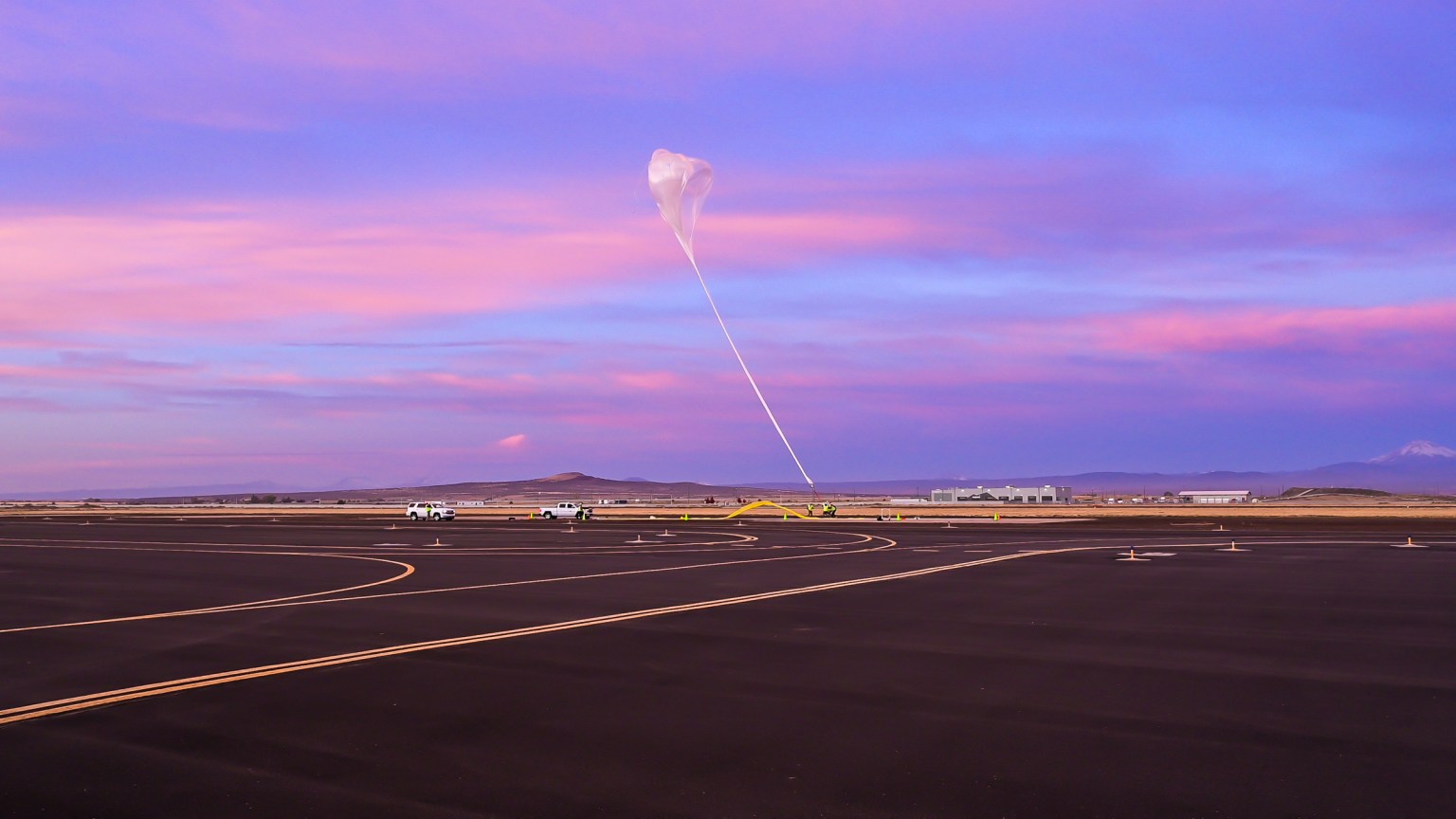
This session will explore the unique aspects of testing a suite of Earth observation sensors as well as how these technologies might be leveraged for planetary exploration. On April 23, 2025, a payload comprising three technologies designed to autonomously detect wildland fires from the stratosphere flew aboard an Aerostar International high-altitude balloon for eight hours over several contained and controlled burns.
Designed to fuse the observations of multiple sensors simultaneously, the payload combined:
- A sensor developed by Harvard University that measures the quantity of smoke by particle size
- The Xiomas-developed multi-band thermal imager called TBIRD (Three Band Infrared Detector) that quantifies burning intensity and estimates the fire’s smoke-producing emissions
- The ASI (Atmospheric Structure Investigation) from NASA’s Ames Research Center, which includes the NephEx sensor to measure the smoke’s optical density in addition to a pressure probe, accelerometer, and other components designed to be used on a descent probe for future planetary studies
In this webinar moderated by Flight Opportunities personnel, researchers will discuss how they fused the data from the three balloon-based sensing technologies along with data from a drone-based sensor to obtain a comprehensive understanding of fires on the ground. The session will cover the opportunities and lessons learned in collaborating across sectors — from academia to industry and small business to the government — as well as what’s next for the technologies.
Speaker Bios:
Louis Nguyen began his professional career in 1992 and has 25 years of experience working in the field of atmospheric science research. Louis is a research computer engineer at NASA Langley Research Center’s Science Directorate. He conducts and enables atmospheric science research for NASA’s Science Mission Directorate and the broader Earth science community with the goal of improving scientific understanding of the Earth’s atmosphere system. Louis is the operations lead and systems engineer for the Satellite Cloud Observations and Radiative Property Retrieval System (SatCORPS) group, which supports NASA’s Clouds in the Earth’s Radiant Energy System (CERES) mission and Radiation Budget Science Program. Louis is a computer scientist with extensive experience in developing real-time low latency satellite applications on cloud platforms. He is responsible for proposing and conducting research and development activities for the purpose of improving scientific and public understanding of Earth radiation budget, weather forecasting, and aviation safety.
John Dykema, Ph.D., project scientist in the School of Engineering and Applied Sciences at Harvard University, is an applied physicist focused on research at the intersection of atmospheric chemistry and atmospheric radiation. He brings a background in semiconductor technology to the development of innovative observing systems for radiometry, aerosol measurements, and atmospheric profiling. Dykema is a member of the Dynamics and Chemistry of the Summer Stratosphere (DCOTSS) mission, working to extract observational constraints to update the radiative properties of upper troposphere–lower stratosphere aerosols. This investigation revisits the climate impact of stratospheric aerosols, taking account of new discoveries regarding the aerosols’ complex morphology and composition. He has led the design of laser-based calibration technology to link satellite measurements of climate quantities to fundamental physics. To enhance the scientific value of novel instrumentation, he has studied new approaches to data analysis. These methods include linear stochastic modeling, optimal detection/fingerprinting, and adaptive signal processing. He has applied these methods to remotely sensed observations and climate model output to infer climate sensitivity, quantify radiative processes, and estimate climate impacts. His advisory and advocacy activities include membership in NASA and international measurement teams dedicated to advancing physically rigorous calibration of climate measurements.
Amanda Cook, Ph.D., is a scientist and engineer at NASA’s Ames Research Center in Silicon Valley. Most recently, Cook has served as the integration, testing, and payload operations lead for the Near-infrared Volatiles Spectrometer System (NIRVSS) on the VIPER rover mission to the lunar south pole. Cook is a founding member and technical lead for Ames’ Flight Instrument Group (FIG), a team of instrument developers who push measurement prototypes through to spaceflight-qualified hardware. FIG develops instruments ranging from 2D and 3D imagers and spectrometers, to anemometers, cloud sensors, and more. FIG has utilized the Flight Opportunities program and other strategic pathways to mature several instruments in preparation for future spaceflight and mission proposals.
Joshua Frock has served as a program manager and mission services engineer at Aerostar since November 2022. He completes high-altitude balloon campaign flights through NASA’s Flight Opportunities program, commercial companies, as well as Department of Defense national and international exercises. Previous roles include digital and programs manager for the City of Sioux Falls, South Dakota where he provided oversight of innovation and technology programs, and significant military experience with the South Dakota Air National Guard, culminating in roles such as telecommunications senior enlisted advisor and senior telecommunications supervisor. Frock holds a bachelor’s degree in multimedia graphic design and several associate degrees from the Community College of the Air Force.
Anh Nguyen, Ph.D., is currently the program portfolio integrator for NASA’s Small Spacecraft Technology and Flight Opportunities programs and the campaign manager for the Flight Opportunities program’s hosted orbital and high-altitude balloon flights. Nguyen has worked on a variety of CubeSat and suborbital flight tests during her career at NASA over the past 10 years. She has a Ph.D. in aerospace engineering from the University of Florida’s Precision Space Systems Laboratory, with a focus on dynamic systems and controls, and she is passionate about rapidly demonstrating new space technologies.