

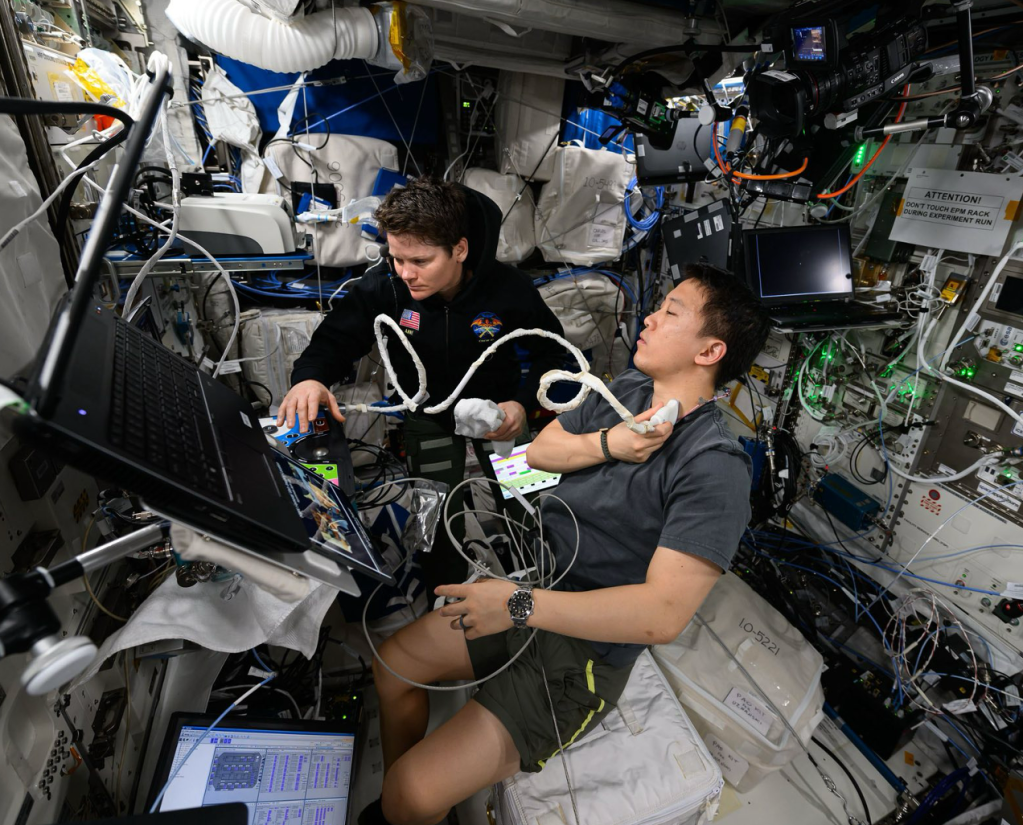
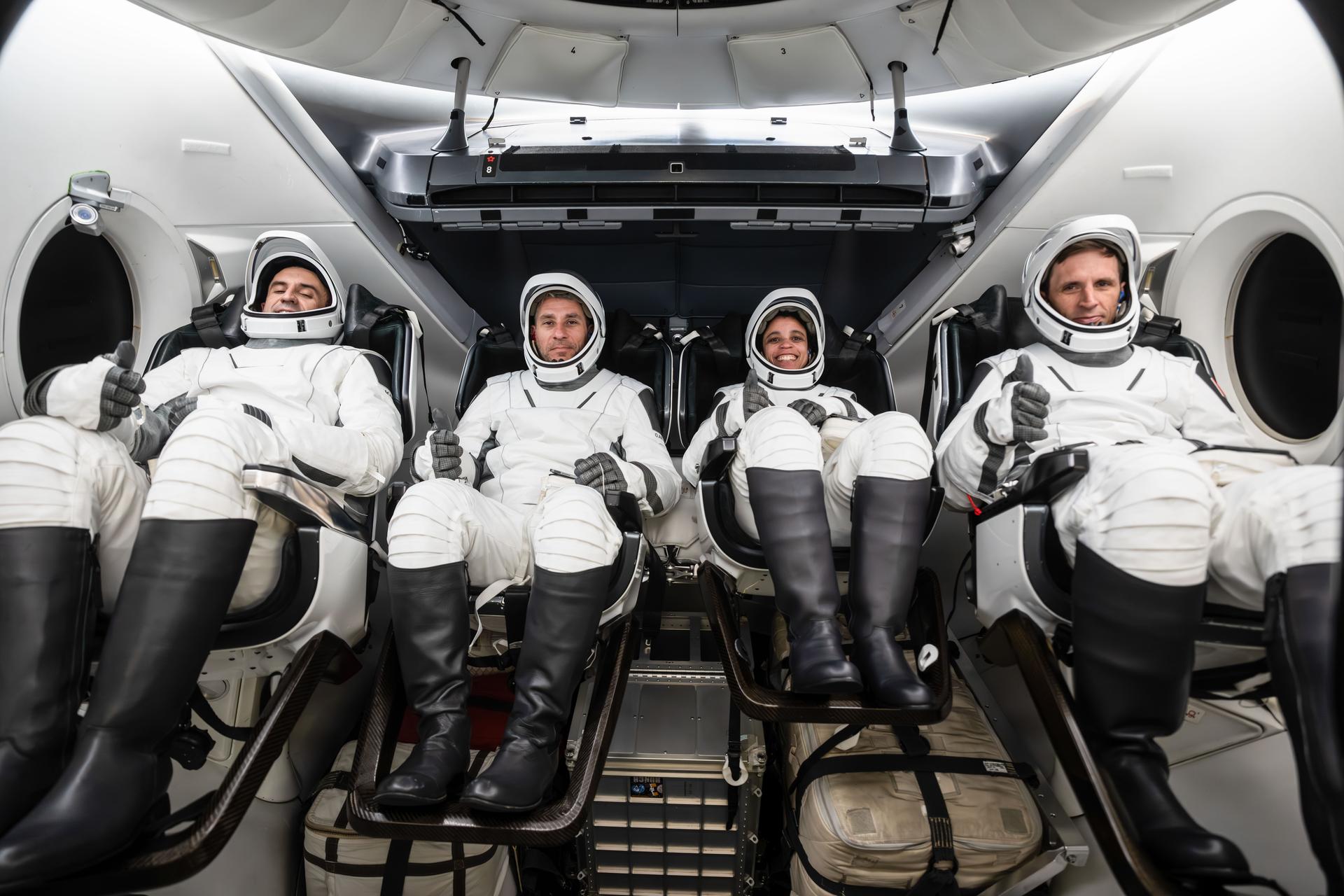














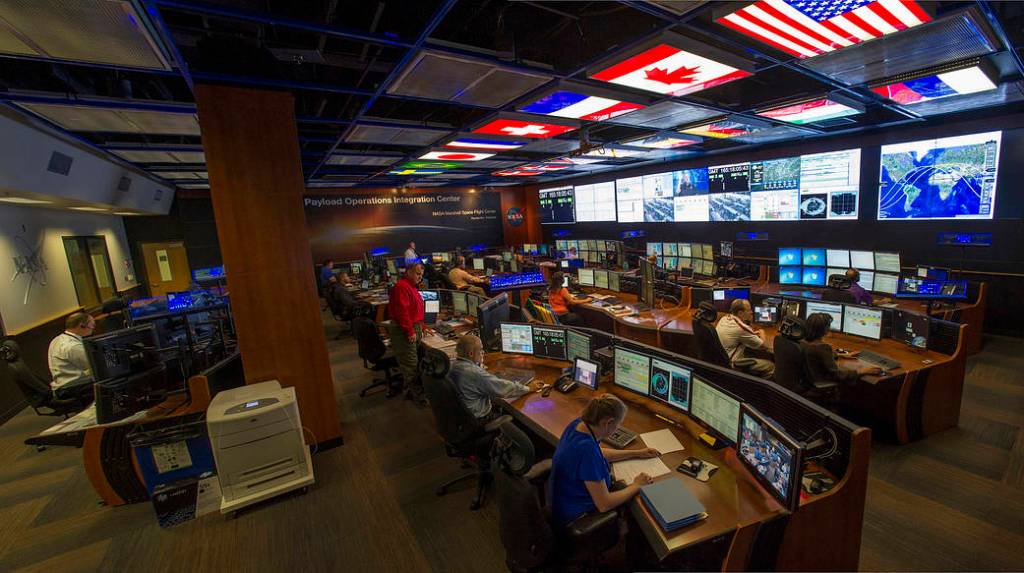
Host Andres Almeida: Every experiment and scientific investigation aboard the International Space Station depends on more than the astronauts performing it. On the ground, teams at space agencies across the globe are coordinating schedules, solving problems in real time, and making sure the crew has all the information they need to keep research moving. Last year alone, 750 investigations were performed aboard the orbiting laboratory.
For 24 hours a day, seven days a week, alternating teams at the Payload Operations Integration Center at Marshall Space Flight Center in Huntsville, Alabama, help manage that effort.
In this episode of Small Steps, Giant Leaps, we’re joined by Kassandra Stephens, a payload communications manager for the International Space Station.
She talks about serving as the voice between the crew and the ground team, coordinating with control centers around the world, and why some of the most important skills in mission operations aren’t just technical — they’re people skills, too.
Let’s get into it.
[Intro music]
Welcome to Small Steps, Giant Leaps, the podcast from APPEL’s Academy of Program/Project & Engineering Leadership, or APPEL. I’m your host, Andres Almeida.
Kassandra joins us from Marshall Space Flight Center today.
Hey, Kassandra, how are you doing today?
Stephens: Hey, Andres, I’m doing great.
Host: Great. Well, I’m really glad you’re here because you have a very interesting role, and I’d love for you to tell us more about it. What is the Payload Operations Integration Center, and what do you do there?
Stephens: So, the Payload Operations Integration Center, or POIC, is a control center, but really just a large group of people here in Huntsville, Alabama, that handle the payload operations and all the fixings and everything that’s involved with that for space station.
We’re also getting set up to support payload operations for Artemis.
Specifically, right now, my role is as a payload communications manager or a PAYCOM for the ISS. So, we are the voice from the control room for payloads here at Huntsville. We’re like the bridge between the crew on board and our counterparts here in the room. We work together with the crew to get science done on station.
Host: What does communication look like with crew during a typical shift, if there is a typical shift?
Stephens: I would say there isn’t a typical shift, but just ’cause ops can be so varied between day to day. You could have a nice quiet shift where you may not have a lot of crew [communications] you may not have a lot of activities, but that’ll be the day stage.
And it’s like, hey, here’s this random thing you weren’t expecting, and you have to work together with your team and the crew to figure out how to fix it.
But typically, in a shift, you know, at the beginning of the day, there’s something called the daily planning conference. So, the crew have two a day: one in the morning, one in the evening.
So, usually, that’s kind of like the bracket that starts and ends their day with chatting with different centers, like, “Oh, hey, we might have a little extra information to help you with your day,” or maybe we have a question or something like that.
So, at the beginning of the day, we get that out, and at the end of the day, it’s kind of like the wrap-up, like, “Oh, hey, we didn’t get this information for you, so before, you know, you head off for your evening, can you pass us the serial number?” or something like that.
Host: And does Mission Control in Houston get involved too? Is there a lot of coordination at the same time?
Stephens: Absolutely, yeah. So, we have to not only work with the crew but with MCCH [Mission Control Center Houston] in Houston, with Moscow, with SSIPC [Space Station Integration and Promotion Center] in JAXA [Japan Aerospace Exploration Agency] or Japan, and with Munich, or our friends over in Europe.
The crew on any given day will have activities from all of us. So, we all have to coordinate, like, because sometimes, you know, things don’t go as planned.
So, if your activity’s running long, you might be like, “Hey, we’re approaching, say, Houston’s activity. We might have to coordinate with using some of their time,” or, “Hey, can we work around you, or you know, vice versa?” So, we have counterparts not only in our room but in all the other centers that we coordinate with there as well.
Host: And it’s 24/7.
Stephens: Absolutely, yeah. So, one of my favorite shifts to work—not everybody’s favorite—but I love the midnight shift.
So, that’s for us from 11 or 12 local to 7 or 8 a.m. local. For the crew, they run on GMT, so their day starts when most people here are going to bed (for us, at least).
But yeah, 24/7. We’ve been running payload ops for station for I want to say 25 years now, continuously. No breaks.
Host: Right.
Stephens: Weekends, holidays. There’s always someone here working it. We’re all working to that science goal.
Host: There’s got to be some camaraderie, right? Everybody has their part, no matter what shift. But there’s got to be something special about those odd hours.
Stephens: For me, personally, I like it because it’s like quieter. There’s no traffic when you’re coming in. You’re not getting hit with emails or Teams messages, and you can kind of really like focus on what you’re working on.
It might be like, “Hey, I gotta go put another pot of coffee on because we’re all up at 3 a.m.”
Host: How do you help manage so many different investigations happening all at once?
Stephens: We have planners not just here in Huntsville, but around the world that have to work together to put the crew’s schedule together and make sure we’re not stepping on each other’s toes, or you know, trying to schedule three crew to work in the same spot at the same time.
I know, for example, with our, one of our glove boxes, we have all these investigations that need to be completed in this time frame. And who needs to go in here and there, and here and there?
Host: Can you think of any moments in your work that have really stood out to you? Something memorable?
Stephens: There’s been a couple of different, like, the crew will crack a joke or you’ll crack a joke and then we’ll have a running joke all day.
Something that’s really memorable is in training. One of my very first daily planning conferences where I had to speak, it was Talk Like a Pirate Day so I had to speak like a pirate for my very first planning conference.
And it was, it was just, you know, one of those things that you’re not coming into the shift planning for, but you’re like, ”You know what? I’m gonna roll with it. Ahoy maties!” and go with it.”
Host: Or else you walk the plank.
Stephens: Exactly! And it’s just fun to bring those little human elements, you know? Because sometimes working station it can be very business, strict.
But it’s also, it’s fun to crack a joke with the crew. So, it’s like, “Hey, bud, we see you, you see us.” We’ll keep it soft around the edges sometimes and provide the crew with those human elements because sometimes they only hear a couple different voices every day, and it’s the communicators from the centers, so they might not hear other people.
Host: Right. They’re working six, sometimes seven days a week.
Stephens: Absolutely. So, you want to give them grace, but also really help them through that time by giving them those human elements.
Host: Yeah. Speaking of human elements, I imagine there can be times when they’re carrying out an investigation and experiment, and frustration sets in. How do you manage that? How does your team manage that when a crew member expresses maybe they need a little bit more troubleshooting, some support?
Stephens: So, that’s one thing, like, specifically for my position, that we look out for.
So, you know there could be like subtle signs or something like, ”Oh, hm, this crew member might be tired today because of X, Y, Z.” Maybe they had a sleep shift or stayed up late last night.
Or, “Hey, we’ve been working at this for three, four hours now. Do you think we could let them have a break?” Let them go to the bathroom. Let them, you know, take a breather right quick, especially if we’re working on something difficult, just because everybody needs a break every once in a while.
So, part of our job is to look out for that and communicate to our team, like, “Hey, I know we need to get this done, but we also need to factor in that they are human beings and we need to take care of them as well.”
Host: Yeah, that’s important. How do you handle unexpected issues or changes during operations?
Stephens: You can only be trained so much on how to handle anomalies during training.
We have things we call simulations or sims where we train, go through like, take a timeline for a day and go through different scenarios like, “Oh, how would you react to this happening or that happening?”
But there have been so many times on console where it’s like things nobody would have expected. Or one thing we have to keep in mind on the science side is some of these payloads are brand spanking new, brand-new hardware, brand new payload developers. Sometimes things happen that nobody was expecting.
So, it’s working with your team, working with your payload developer, whoever, to be like, “Okay, here’s what’s happened. Here’s what we think is the cause. Let’s work through, think it through, and figure out how to go forward with this activity.”
We also have, like, safety teams that have pre-looked at things to make sure it’s as safe as possible for the crew, not gonna cause any damage to the station. But, you know, if we have to, we’ll call them up and be like, “Hey, this is what happened. Is it safe to proceed in X-Y-Z direction? Do you have suggestions on what we should do?” Stuff like that.
Host: It sounds very dynamic. And for someone interested in this kind of work, what skills or experiences do you think are most important?
Stephens: Two things come to mind right off the bat.
One would be being able to work with a team. And not just a team of a bunch of people that you automatically like or people that you easily get along with.
Being able to work with a variety of personalities, of communication styles just because, you know, you never know who you’re going to end up on console with, and you need to be able to communicate and work with them, regardless of your feelings.
And then the other one I was thinking is critical thinking because, again, you can run into a scenario that no one’s thought of or thought possible.
So, being able to think through and work through the problem, but also just thinking through and being like, “Okay, this happened. What could have caused it? How do I think it could be fixed? What other factors might have contributed to this issue happening?”
Host: I like that you gave those two qualities because those aren’t technical qualities, right? They’re more skills that you can certainly develop them, but it’s like you got to be in the trenches to really mature and grow.
Stephens: Absolutely, and sometimes there’s not as big a focus on those. People call them soft skills, but really it’s just like not that technical skill, that “how to work with others” that also needs sometimes an equivalent focus to actual like, technical “how to do CAD drawings” and stuff.
Host: Yeah. What was your giant leap?
Stephens: My giant leap careerwise would have been the jump from being an engineer working a three-degree-of-freedom trajectory design to swapping (like almost a 180) and becoming a PAYCOM.
Because you know there’s the stereotypical engineer: you stay in your lane, you check your boxes. PAYCOM is like a completely different side of my brain. Yes, I still use, like, that critical thinking aspect, but it’s in a different way.
This job has more of those people elements, or like, you know, reading body language or even being able to come up with the right combination of words to say is something completely different than when I was engineering.
So, I’d say my big leap was jumping from one side of my brain (that engineering/technical) to that other side of my brain, while still pulling on things I’d learned from the engineering side, you know what I mean?
Host: I do, yeah. And you were a NASA Pathways intern.
Stephens: Yes. That’s how I got my start.
Host: Ah, great program. And for anybody else interested, nasa.gov/internships lists all the opportunities for interning at NASA.
And that’s when I met you. I think you had just graduated or were you in Pathways in 2013?
Stephens: I was either, I might have just graduated, actually, because I did graduate in 2013 from undergrad, and you know, just getting that start in Pathways really just opened up my career.
But also, it introduced me to other career paths because I didn’t even know roles like PAYCOM, or I didn’t even know we did space station ops here at Marshall until I was in Pathways and met other Pathways interns, and I was like, “Oh, that’s so cool. I didn’t know that existed!”
The only other thought I have for anyone is one of my mottos or mantras (or whatever you want to call it) from my career has been to not give up.
When I went to undergrad and decided I wanted to be an aerospace engineer, I knew I wanted to work for NASA. So, my freshman year, I was applying for Pathways internships immediately just, you know, left and right.
And it wasn’t until my junior year that I even got an opportunity to come out here to NASA, but I knew where I wanted to be. I kept applying.
So, I’d say never give up. You never know! And then sometimes that opportunity might come through a window versus the door you’re expecting.
Host: Hm. We all need that reminder. I like that.
Stephens: Yeah.
Host: Thank you, Kassandra, for your time and your insights. We appreciate it.
Stephens: Absolutely. Thank you for inviting me, Andres.
[Outro music]
Host: That’s it for this episode of Small Steps, Giant Leaps. For a transcript and for all other episodes, visit nasa.gov/podcasts. While you’re there, check out our other podcasts like Houston, We Have a Podcast, Curious Universe, and Universo curioso de la NASA. As always, thanks for listening.
Outro: Three. Two. One. This is an official NASA podcast.