























Host Andres Almeida: Astronauts aboard the International Space Station depend on life support systems that provide clean air, drinkable water, and a safe, livable environment. These systems are what make long-duration spaceflight not only possible, but comfortable.
Today, some of these space station technologies have been adapted for Artemis – specifically, aboard the Orion crew capsule that takes humans farther into deep space than ever before.
In this episode of Small Steps, Giant Leaps, we’re joined by Paul Boehm, Orion Crew Support and Thermal Systems manager at Johnson Space Center in Houston. He’ll tell us how lessons from Apollo, the space shuttle, and the space station are preparing NASA for long-duration missions to the Moon and beyond.
This is Small Steps, Giant Leaps.
[Intro music]
Welcome to Small Steps, Giant Leaps, the podcast from NASA’s Academy of Program/Project & Engineering Leadership. I’m your host, Andres Almeida.
So, what space station-derived technology does the Orion spacecraft have? Let’s talk with today’s guest.
Paul thanks for joining us.
Paul Boehm: Hey, thank you for having me. I really appreciate it.
Host: You’ve worked on several human spaceflight programs. What are you working on now?
Boehm: Yeah, I was what we call the functional area manager for the life support system, the suits, the crew systems, flight crew equipment – everything the crew uses on Orion every day in a mission. And so, I pretty much managed that hardware.
So, almost 15 years. That’s been a long time coming, and I was really excited when Artemis II finally flew. That was my big goal of my career, was to see the crew get back to the Moon. So, I’m almost there.
Host: How does Orion adapt lessons from the International Space Station?
Boehm: I had the privilege of being a flight controller in my previous life, working in the Mission Operations Directorate back then for many years as an EVA [extravehicular activity] flight controller working for all through the station assembly.
But when I moved over into Orion, one of the things that we try to do is when we’re developing new hardware, we want to take advantage.
Obviously, if there’s things that we believe could be influenced by microgravity for the conditions that station would have, that we would try to use the station as a testbed for that type of hardware.
And so, we did have several pieces of hardware early on we flew to ISS to be able to go ahead and use it as a testbed to develop hardware.
Also, hardware that the space station had developed that we could then use and apply to Orion. We also looked at that as well.
So, we kind of did those parallel paths with new development hardware using ISS as a testbed, but also hardware that ISS had that we knew we could apply to Orion.
Host: Can you share examples of hardware now in use aboard Orion?
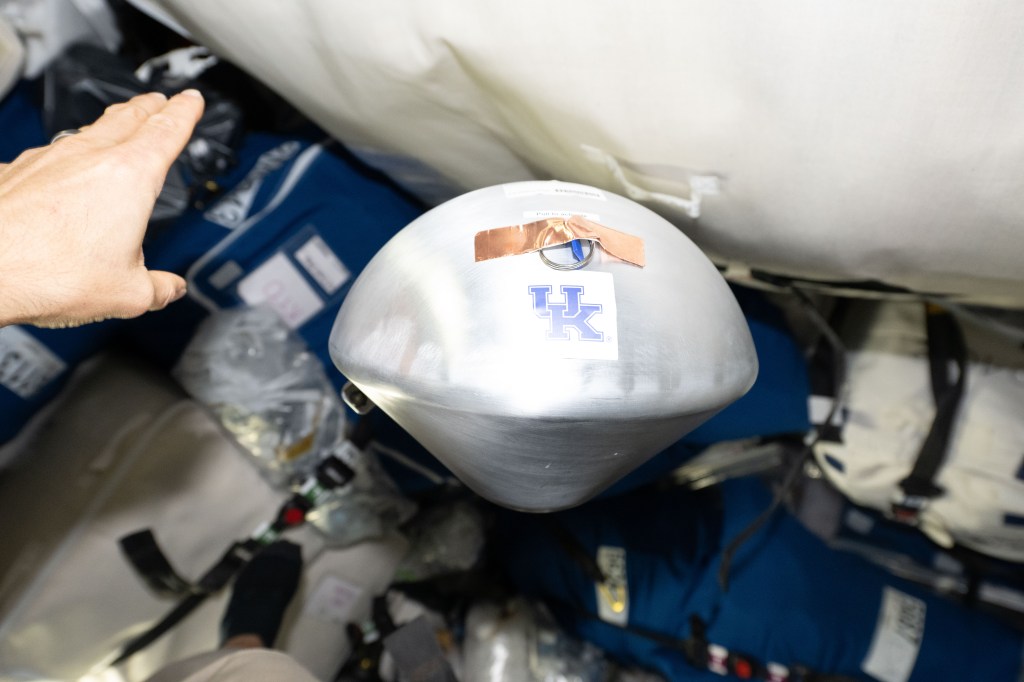
Boehm: We had a couple of items. Two of the most prominent ones are early on. We actually had a detailed test objective payload type experiment that we flew to ISS that was related to what we call phase change material.
Essentially, it’s a thermal system that uses a wax material that you melt to absorb heat in a thermal system, and then the wax can be frozen again, and that allows you to essentially have some supplemental heat rejection and absorption capability within the system.
One of the things we didn’t know at the time was exactly how the pressures and that buildup in that wax as it freezes and thaws. You can imagine that with water, obviously, everybody knows you put water in a bottle and freeze it. You can start blowing up bottles and breaking them.
So, we wanted to understand the wax situation, and so the experiment that we flew to ISS measured those pressures in the different segments of the wax module. We built it a couple layers very close to what we were going to plan for Orion.
And so, we use that data to actually influence the design of the phase change module material units that we actually have on Orion today.
Host: That’s interesting.
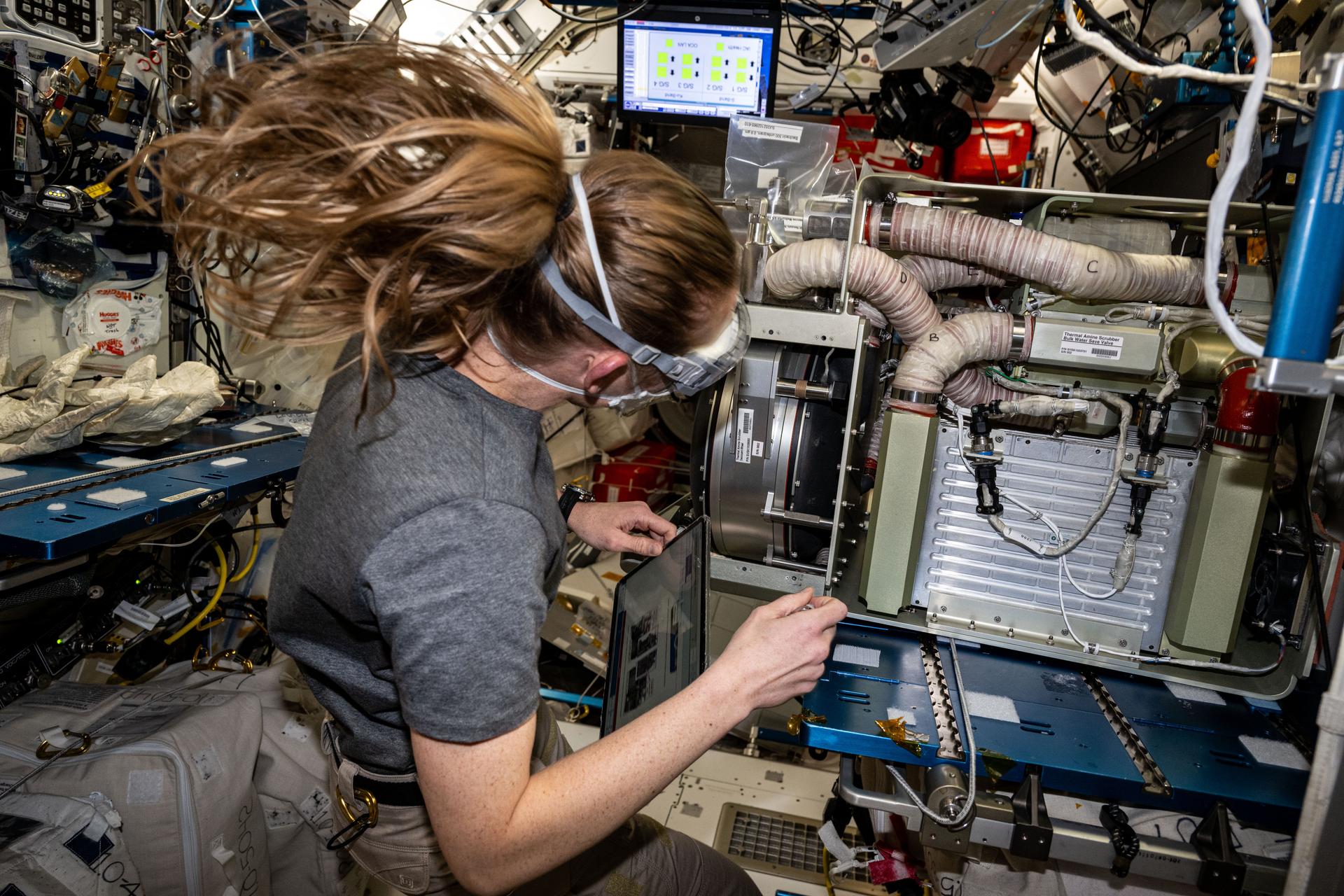
Boehm: We had another experiment that was flown to ISS based on what we were looking at originally for exploration missions. We call it amine system.
Basically, it’s a chemical that absorbs CO2, and then you can actually regenerate it by exposing it either to heat or to vacuum.
In our Orion case, we got plenty of vacuum, so we just expose it to our overboard vacuum and are able to remove the CO2 from the chemical, dump it overboard. And so, we wanted to test that type of system.
We did a lot of ground testing with it, but we also flew, they also flew a payload experiment to ISS to actually demonstrate that on ISS, and it did actually run for many, many days on ISS. And they still used it for a while to actually supplement the CO2 removal system on ISS because it was working pretty well for doing that.
And then on Artemis II, we had great experience with those systems controlling CO2, so it did prove out itself on ISS and the ground testing that we did.
Host: And does it all function the same despite Orion having a significantly smaller volume than space station?
Boehm: Yeah, the material and the basic design of the system is very similar. It really depends on number of crew members and their metabolic rates. And how much CO2 they’re producing is really the driver, and then the volume is really controlled by your cabin airflow and how well you do with that ventilation system.
Host: And metabolic rates vary from person to person. How challenging is it to design around that?
Boehm: Yeah, that’s a big challenge for the ECLS system. Usually, as you know, you have all your standard hardware items like valves and fluids and liquids and things like that, and you can pretty easily design that. Then you throw in the human into it, and now you got a bit of variable because, yeah, everybody is different.
Host: What about safety systems aboard Orion? I know the space station has fire extinguishers aboard. For Orion, are they any different?
Boehm: Yeah, that was one of those devices that we saw on ISS, and we said, “Hey, we can maybe just go use that.” And so, the ISS had actually two different types of fire extinguishers.
One of them is a water-based extinguisher. You tend to want to use that because you can’t really use a standard, like, CO2 or gaseous halon-type device, because of the concerns with our small cabin, and also affecting our ECLS system and things like that.
So, we basically went with a water-based system. We were going to use the ISS. We did start with that, but then we actually modified it for Orion because we needed a smaller version. We needed something that we can take up less mass and volume to do exploration missions out to the Moon and back.
You really have to pay attention to mass and volume, and so every piece of hardware that we look at, even if we were borrowing things from ISS, we went ahead and and had to really look at it from a mass and volume perspective of what do we need for Orion specifically.
So, we did use a water-based fire extinguisher like they did, but we sized it down specifically for our contingencies for Orion.
Host: And in your work, every ounce counts!
Boehm: Definitely. I’ve worked shuttle, I’ve worked space station. Yes.
Mass, obviously, for launch is a big deal, but I will tell you going into Orion and the lunar missions, and then researching a lot also about what the Apollo guys went through:
I had the very lucky chance to talk with a gentleman named Jerry Goodman, who was the crew systems lead for Apollo.
And back in the mid-2010s, he actually gave me a cartoon that he drew up back in 1965 that essentially showed the last straw on the camel’s back as they were going to march for stowage and the thing breaking the camel’s back.
And he said Apollo went through the exact same thing to where they looked at every single ounce that went on the vehicle to try to minimize what was flying to the Moon because of the constraints with mass and volume on the Apollo program.
And yeah, Orion went into the same thing where we did lots of mass scrubs to pull mass out of the vehicle and all the crew systems that we have to support. So that’s a constant challenge that we have going to the Moon for, especially for the translunar injection burn. Things like that that we got to do.
Host: Learning from Apollo must be a major advantage.
Boehm: So, definitely we are taking advantage of the fact that we have folks like myself that got the benefit of working the three different programs. But we also have a lot of folks that have come in that have started working ISS. And then now they’re coming over to work on Orion.
And so, we’re taking advantage of the fact that we have that experience from folks from ISS and and being able to share that with Orion.
And I think it is a challenge from our perspective, too, on the Orion side. It’s a bit different with Orion for doing these exploration missions.
Some of the things that I know I used to do when I was an ISS flight controller and and used to [do] ISS operations, I know I can’t do those on Orion. It’s just not practical anymore.
I kind of term it as a camping trip. That’s the way you got to think of it.
We sometimes got spoiled with shuttle and station with the large volumes and the large capability we have with those vehicles. Orion just is not quite that way right now.
And so, we need to be, you know, conscious of every piece of hardware that we try to take with us.
Host: Back to the engineering technology how does the Orion spacesuit play into all this?
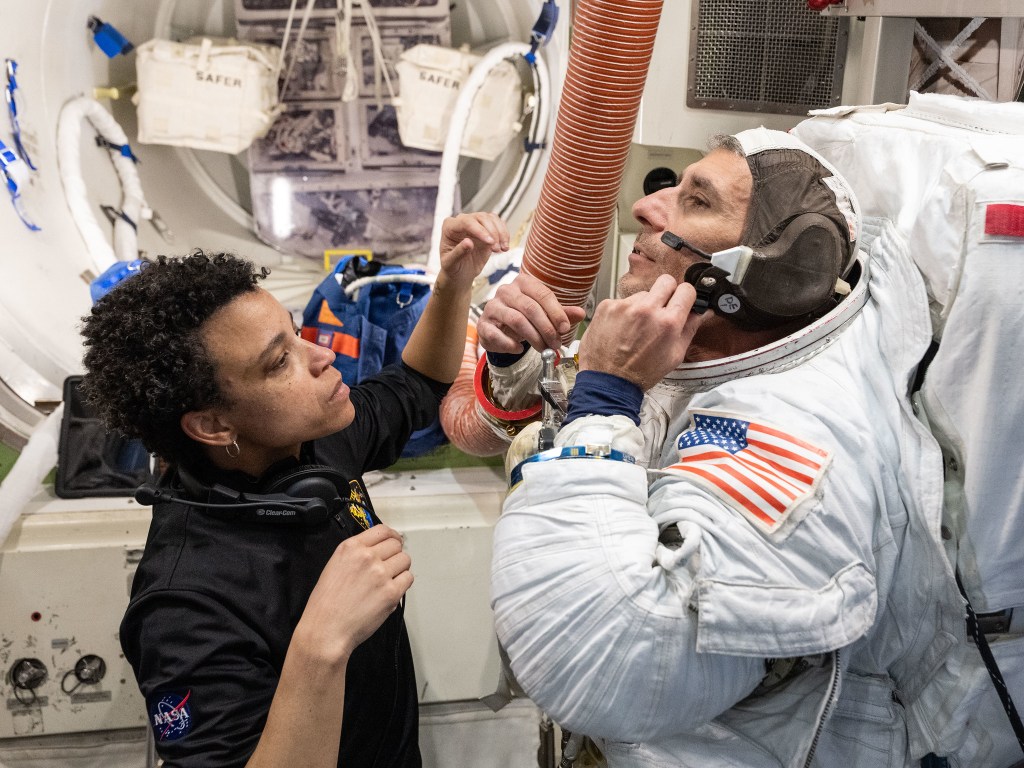
Boehm: Yeah, we actually don’t have a whole lot that we actually need to do with that suit, the space station suit, the EVA suits that you’re used to seeing going out EVA. They have a hard upper torso, and you tend to be more restricted.
What we see is the spine growth during missions. And so, typically from your head to your feet, you get a bit taller. And so, with the EMU [extravehicular mobility unit] that we have on space station, we used to put about an inch into that waist of that suit to account for that growth for crews, so that their shoulders wouldn’t get pushed into that hard upper torso by the legs, your feet being where they’re at, and then your shoulders having to go up.
So, with Orion we have a soft suit. The whole suit is soft, and so you have a little more flexibility with that particular suit. We do size it for the crew members specifically. We do leave a little bit of extra in there just to make sure they got comfort and ability.
But the feedback we had from the Artemis II crew on orbit – granted, it was only a 10-day mission – but we actually didn’t have any issues with that particular topic, with spinal growth and that with our particular suit. So, we think it worked out pretty well with the soft suits that we have.
Host: That’s great. And those suits aren’t purposefully designed for eight-hour spacewalks anyway.
Boehm: Not really, but we actually do size the suits and everything.
Our main contingency for the suits is if you have a cabin depress on the way to the Moon.
We have tried to design the suits and the system of the vehicle to support the crew for up to six days in the suit, which is not something you want to do. But to be able to get the crew home, crew survival capability – that’s what we have on Orion.
Host: Wow. On a personal level and career level, what was your giant leap?
Boehm: Oh, I think it was what we just did with Artemis II.
You know I’ve been at JSC for 37 years and been through a couple programs that said we were going to get back to the Moon and this is absolutely the closest I’ve ever been in my entire career. So, I think this is the big leap.
We’ve got the capability now to get crew back to the Moon. We’ve got to be able to obviously build more of the vehicles, which we’re doing.
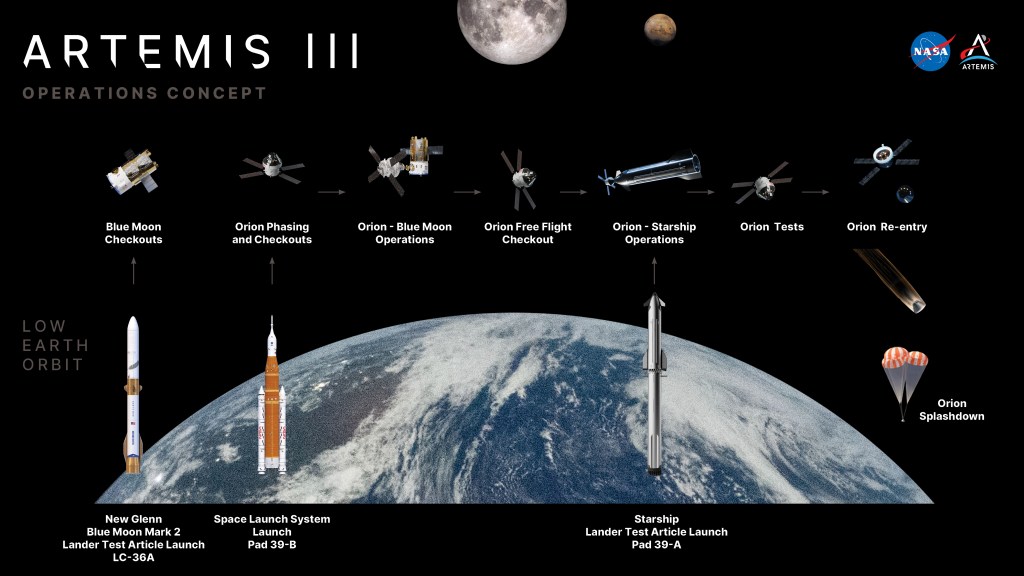
We’ve got Artemis III being built right now, going to fly next year.
We’ve got Artemis IV going.
We’ve got Artemis V going.
And so, you know we’ve got that cadence that’s starting to happen. Never had that before in my career. So, to me, that’s the huge leap that we’re doing.
You know, I thoroughly enjoyed doing all the development and build of space station through the years. That was a huge thing. But I think this is the big leap that we can do for exploration, which is to me what I was really hoping to have when I came to NASA.
Host: That’s excellent. And how did it feel having the public following every step of Artemis II? Everybody got to see the inside of Orion.
Boehm: Yeah, I worked the mission, and I was in the control center the whole mission, and I really didn’t get to watch much of the external video and everything. And so, I had my family kind of telling me what was going on when I when I go home, go to sleep.
But yeah, I was I was amazed to see that excitement again that everybody had across the world because you see all the old newsreels and things like that with Apollo and how people got excited back then.
To me, that was what this is all about: was to have that goal of a country going back to the Moon, and then also the world, you know, joining us to do this. That was just awesome seeing that.
And I wish I could have got to see more of it during the mission, but I did watch some of the stuff afterwards, and it was really cool seeing it.
Host: I’m sure there’s more to come. Paul, that’s our time for today. Thanks for talking with us.
Boehm: Oh, thank you very much for having me. Appreciate it.
Host: That’s it for this episode of Small Steps, Giant Leaps. For a transcript, and to catch all other episodes, visit nasa.gov/podcasts. While you’re there, check out our other podcasts like Houston, We Have a Podcast, Curious Universe, and Universo curioso de la NASA. As always, thanks for listening.
Outro: Three. Two. One. This is an official NASA podcast.