



















From Earth orbit to the Moon and Mars, explore the world of human spaceflight with NASA each week on the official podcast of the Johnson Space Center in Houston, Texas. Listen to in-depth conversations with the astronauts, scientists and engineers who make it possible.
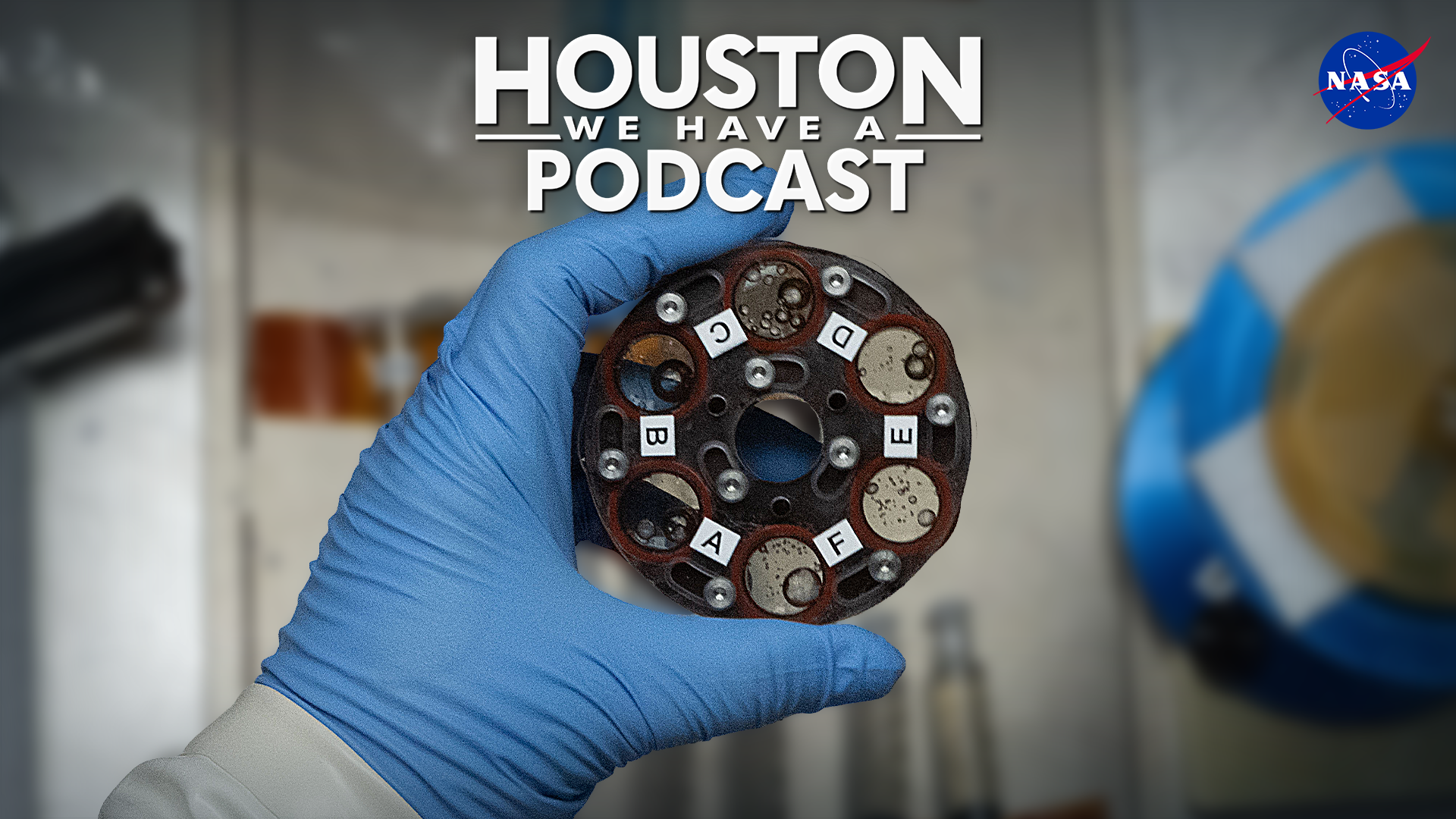
On episode 432, Dr. Abba Zubair discusses how stem cell research aboard the International Space Station is advancing regenerative medicine and what scientists learned from a recently published study. This episode was recorded June 25, 2026.
Transcript
Gary Jordan
Houston We Have a Podcast. Welcome to the official podcast of the NASA Johnson Space Center, episode 432: ISS Results: Stem Cells in Space. I’m Gary Jordan, and I’ll be your host today. On this podcast, we bring in the experts, scientists, engineers, and astronauts, all to let you know what’s going on in the world of human spaceflight and more.
If you’re an avid listener of this podcast, you’re likely familiar with science aboard the International Space Station. More than 25 years of continuous human presence and hundreds of investigations. Sure, there are laboratories all over the globe, and many have unique capabilities that draw researchers in to submit proposals and advance humanity’s understanding of an endless number of subjects. The International Space Station offers the unique capabilities of microgravity and the harsh environment of space, and a number of facilities on board support experiments in biology, Earth science, space science, physics-you name it.
For stem cell research, this microgravity environment has welcomed some fascinating experiments. A particular investigation called microgravity expanded stem cells was conducted on station from 2016 to 2017. The study looked at whether the unique space environment could expand human stem cells, which is a needed process for them to be used in various medical therapies. But in space, how does the expansion process change? The principal investigator of this study, Dr. Abba Zubair, co-authored a recently published research paper about the findings of this study.
On this episode, we get a chance to speak with the principal investigator about these exciting results. Dr. Zubair chats with us from Jacksonville, Florida, where he is posted as the Medical Director for Transfusion Medicine and Stem Cell Therapy at Mayo Clinic’s Florida campus. His focus within this field is on regenerative medicine and immunotherapy applications that involve stem cells and other types of cells. In the meantime, let’s get to our conversation with Dr. Abba Zubair about his research and the results that have stemmed from the microgravity environment (pun totally intended).
Enjoy.
Gary Jordan
Doctor Abba Zubair, thank you so much for coming on Houston We Have a Podcast today.
Abba Zubair
Thank you.
Gary Jordan
It’s great to have you. I know we’ve been kind of back and forth trying to make this work. You know, I think we’re all busy, but you certainly you do a lot at the university that you’re at. A lot of research, and you’re still practicing. You have you have to work with your patients. And so the fact that we’re talking right now, this is this is certainly very special to us.
Take us through who is Dr. Abba Zubair, if you don’t mind, maybe starting very briefly with you know where you grew up, and then how you got to the profession of where you are today, including perhaps maybe inspiration for pursuing medical degrees and getting your you know pursuing stem cell research.
Abba Zubair
Absolutely. So thank you again. It’s really an honor to be on this show and talking to your audience, which I’m sure they cut across the nation and maybe abroad.
So you can tell from my accent, I’m not from New Jersey, but I grew up. I grew up in Nigeria. This is a country in West Africa. You know, went to high school, medical school in Nigeria. But I have been fascinated by space. You know, in in developing world, electricity is not always available, so that could be some kind of limitation. But at night, the sky becomes alive. You know, the stars are more visible. You look up, you kind of wonder, and I’m sure many of your audience like that, whether you are in Nigeria or in in Florida, wherever you are, some of us are curious. For as far as I can remember, I’m always fascinated by space and what is out there, and I wanted to be an astronaut, and and obviously being in Nigeria, that chances are very limited. And my career advisor in high school said, “Look, Abba, you can do anything, but you know, being an astronaut may not be in your lifetime. So you better rethink and do something, you know more realistic.” So I look around at me. I see a lot of diseases, a lot of people suffering, and I said, “Well, I I really want to make a difference in that arena. So that’s how I end up going to medical school, and and in medical school, really, it’s really fascinating. And we we we had a lot of experience expatriate from around the world. We had medical students from U.S. also coming to our medical school. So I get exposed to foreign medical students, and we share ideas.
I also become really fascinated by just knowledge and what is out there that I can do. So, I at the moment after medical school, I really want to explore. I want to make a difference. So that journey took me through England, where I did a PhD in cancer immunology, and then right after a PhD, I got a green card through the lottery. So I never thought I would be in the U.S. but I just came with a green card. Never had a regular U.S. visa, but being in the U.S. started at the University of Pennsylvania, working as a researcher.
But really, my heart is in the care of patients. So, in as much I like the science, I wanted to really also see patient and interact. So, I did all the exams, and then I was lucky, an opening came, became available in the same institution at the University of Pennsylvania. Went into lab medicine and pathology because I’ve done a lot of lab work, and I figured that would be a field that would bridge my basic research experience and patient care. But then I end up really loving transfusion medicine, which is really the part of lab medicine that is very clinical. We see patient, we do procedures and stuff like that. So that really attracted me, and one of my clinical role is to collect stem cell for bone marrow transplants. We collect it by apheresis a device that is specialized for doing that, we also process the stem cell in our lab either from bone marrow aspirate in the O.R. or by apheresis, we also receive cord blood. So I I see the value of stem cell and how it is helping people recover after they have blood cancer. But I have seen patients also that don’t have enough stem cell either to donate them for themselves because of their disease. I also see that some patients don’t have the luxury of having siblings that can donate for them. So I became very fascinated of finding ways to expand stem cells.
But the stem cell is like a seed. They limit their numbers. If you have too much seed, then it becomes like cancer. So when you try to grow stem cell, they always keep their number intact. So I then start thinking out of the box and link my dream of space and say, well, how about if we take out gravity, maybe it will, you know, affect the biology of stem cell and make them to grow. And so that’s how I end up, you know, studying stem cell in space.
Gary Jordan
Beautiful story, Doctor Zubair, because this is exactly what we’re going to be talking about in detail is going through. Of course, the research that you did in space and and what is exciting is I know you worked with colleagues to to publish a paper on some of the research that you have done, and I certainly wanna I certainly wanna get to that to sort of ease our audience into into this subject and and and selfishly to ease me into the subject, it’s certainly complicated, right? Is stem cell therapy one of the things you talked about is the clinical aspect of it is this transfusion medicine and something that may be maybe a little bit foreign to certainly myself, but our but our audience as well? You know, take us through exactly what this is and what the benefits are, you know, what what sorts of patients would you treat with transfusion medicine?
Abba Zubair
Yeah, so transfusion medicine, I can tell you, it’s one of those, obscured field that not many, even people in healthcare, may not know it as a specialty, because again, we are hidden in the lab medicine, which is traditionally not a place where patient care is involved. What is known about transfusion medicine is blood bank. So we, the the transfusion medicine specialists, specialize in transfusion, blood transfusion. We oversee blood bank. We make sure that you know the blood that comes out the blood bank is compatible, is safe, and we also specialize in managing reaction after blood transfusion. So we work with our colleagues that are more in the front line with the patient when things happen, then they get to call us.
The other aspect of transfusion medicine is what we call apheresis. is a procedural using machine that looks like a dialysis machine, but it’s a procedural that we can collect different blood components either separately or together. So we can select just red cell and take it out. We can take out plasma. We can take out granulocyte and all that. These are all components of blood.
In addition to that, we can take out stem cell. So the way it works is that patients get treated with a growth factor that stimulates the stem cell to come out. They grow and then come out into circulation. Then we use the apheresis machine to collect it. So we we not only collection we do therapy. So patients that have let’s say leukemia and they have a lot of cells that even their blood is so thick it doesn’t flow well. While we are the ones that come with our machine and take out those super excess number of white cells. The same thing, also, we treat a patient with sickle cell disease. These are patients that have abnormal red cells, and under stress, the red cell become sickles and clog their blood vessels, so we can take that out.
And then there are a number of conditions that involves antibodies that either mostly the patient develop antibodies to to self, you know. So autoimmune conditions, you know, like lupus, or after transplant, patient may start rejecting their organs, so like kidney or heart, so we can wash out the antibodies that are circulating in the blood to reduce the the burden on the organ, so to prevent the rejection.
There are other treatments also we do, which some people may not know. We can actually wash out cholesterol. So there are patients that you know medication cannot doesn’t work for them, or they have side effects. So there is a special machine that we can just collect the cholesterol, the bad cholesterol, the LDL, and spare the good cholesterol, the HDL. So I mean, we do also what we call photopheresis. It’s a light treatment that helps patients with some kind of blood cancer or when they have rejection after bone marrow transplant, what we call graft-versus-host disease.
So there are a lot of conditions that we treat, but generally our role is supporting role. So either hematology or neurology call us treat specific conditions that are known to respond to the kind of treatment we give, so that’s why a lot of people don’t know what we do because we tend to be more a supporter role rather than the primary care team.
Gary Jordan
Yes, doing the actual transfusion, but it sounds like a lot of you know what what I’m hearing is this: there are so many applications to this, right? Somebody, there. You have patients with this, with an issue, and how can trans- You’re thinking, how can transfusion medicine help this, right? And especially with your work with stem cells, this is this is where you’re thinking. How can I? How can I make these stem cells into something that is effective for the patients? And I think that’s what’s unique about stem cells. Let’s let’s back it up to that, right? What is like you’re using stem cells, this is what we’re going to talk about today: is stem cell and stem cell research on station, but just overview, right? So, in terms of the transfusion, you’re you’re using stem cells. What are they? Where do they come from? How do you source them for the transfusion medicine? Let’s talk about stem cells.
Abba Zubair
Yeah, so so stem cell they are everywhere in every organ. There are some stem cell they are there to participate in tissue repair, regeneration of damaged tissue and so on. However, stem cell that I use clinically, mainly they are used in bone marrow transplant in patient with blood cancer like leukemia, lymphoma, and those stem cells are collected either from the bone marrow, you know, inside the bone, that’s the marrow. That’s where they live, and they they produce blood cells, so so our role is to collect that cells and prepare it for treatment to give it back to patients. So there are multiple ways of doing that, you know. So it could be we just collect the cells by the apheresis that I was mentioning, or it might be in the OR where we collect it from the the posterior iliac crest, so around the hip bone, we do multiple aspirate and collect the cells, and then we come to the lab and prepare it, and then different ways of preparing that.
And that stem cell can be given right after, let’s say, a conditioning chemotherapy to the patient, or it can be stored till when the patient is ready to get that. Another important thing for stem cell therapy is really the the whole field of regenerative medicine. These days stem cell had been used to regenerate muscle or heart muscle or regenerate nerve after spinal cord injury with very limited success. But it’s a field that is growing rapidly, finding new application of stem cell in regenerative medicine. A lot of it is still experimental, but we are very much involved in it.
And the bigger question is: so if you don’t have enough stem cell. What are your options? You know. And for many the options are very limited. They don’t have enough. They don’t have a relative that can donate because that relative has to be a match to the patient. Or we can it will search for unrelated donors, and that also is very limited for some, especially minorities, because unrelated donor registry is is not as inclusive because again minorities are not represented, so the chance of finding somebody who is, you know, a match to a minority patient also is relatively smaller because the registry is not large enough and also doesn’t have equal representation of those minorities.
Gary Jordan
Yeah, yeah, and so so certainly, you know, getting more patients, getting more diverse patients, you know, certainly would help with the with the options that you have, right? You you mentioned even you know if you don’t have enough stem cells, so so there’s a certain quantity aspect to the application of the medicine that you’re looking at, and I wonder if that you know, and and hopefully I’m characterizing this correctly- You can guide me in the right direction, but I wonder if this this question, you know, how do we get more stem cells? You know, I wonder if this was the question that sort of led you to bridge, you know, solving for new applications. You know how can we best use stem cells to help our patients? I wonder if that question right there- how do we get more stem cells? If that was the one that led to your space station research?
Abba Zubair
Yes, absolutely. So I I began experimenting. So okay, I want to grow stem cell in the lab. So if you have a very limited number of cells, can we take your stem cell and grow it in the lab? And that’s where the challenge starts. I mean, we have some ideas. We use cocktail of growth factors and cytokine to grow the cells, but the growth is very limited because the stem cell are inherently designed to keep their numbers. So when they divide the two cells, one daughter cell becomes identical to the parent, so kind of stay a stem cell. The other daughter cells start to differentiate, meaning mature and proliferate. So at every given time, you end up having about the same number of stem cells. Now there are some tricks we can play to increase the number of the stem cell, but it’s still very challenging, and that’s why I said can space environment allow us to do that, you know. to do that, you know.
Gary Jordan
And so, maybe did you have maybe some understanding of how the microgravity environment could potentially help in this aspect, and maybe you can start research there. Was there some was there something that that helped you to, to even consider that this this this maybe had some potential.
Abba Zubair
Yeah. No. So you know, the key thing about space is limited or absence of gravity. There is gravity everywhere, but in space you get what we call microgravity. On Earth, everywhere, everything we we do is influenced by gravity. How we look, we wouldn’t have been an erect humans like we do standing on our two feet if we maybe evolved on Jupiter, which has a lot lot more gravity rather than on Earth, it just the mechanics wouldn’t work. We might look more like a lizard on Jupiter than somebody because again, the the pressure, the the gravity, the weight of the body would be so much to be erect. So that is a good understanding that gravity play a role in our our physiology, how we look, but it does also affect how our genes turn on or off. So, and that that’s why the the impact of gravity has gone beyond just you know the looks or the physics of it, but it does affect gene expression as well. And there’s some hints before our research saying that maybe gravity simulated gravity may affect how cells grow and proliferate. So building on that, we said, “Well, can we really evaluate stem cell expansion at the International Space Station, not using simulated microgravity, but using real microgravity environment offered at the ISS?” So that that was the trigger, really, and we went with this very simple question: Can stem cell grow faster in in space at the International Space Station compared to growing them in our lab? So, and that’s really the main question. Yeah.
Gary Jordan
Yeah, and I see, and I think this is the study: Microgravity Expanded Stem Cells. Is this the this is the study that you’re talking about?
Abba Zubair
Yes.
Gary Jordan
And that’s what and that’s that’s how you can clarify maybe what you know. I was going to ask what is microgravity expansion. I think it’s maybe maybe the growth of the stem cells, right? Maybe I don’t know if it’s growing bigger or in larger quantities, but is that, uh…?
Abba Zubair
It’s, it’s number. It’s number. We’re interested in the number, so we wanted to see if if absence of gravity can allow the stem cell to proliferate, to grow without what we call differentiation. You know, so stem cells are very primitive cells. Their main function is to self-renew and give rise to matured cells or differentiated cells. So we wanted to see whether the cells can grow without differentiating, you know, becoming specialized cells in a microgravity environment. So that, that was the mission to see can we expand the stem cell without them being differentiated, which is the problem on Earth. You stimulate them, they grow, but they differentiate. So you end up having a lot of cells, but they are not stem cell; they are matured cells. So that that was a question that we wanted to see in that project, and yeah.
Gary Jordan
That had to be very exciting, right? You thinking about that childhood dream in Nigeria, looking up at the sky, having that wonder of space, pursuing stem cells because unfortunately you were not directed to pursue being an astronaut, but of course, it sounds like you found something you were certainly passionate about. Now you can connect the dots. I wonder if you could take us through that those those early moments of starting to work, you know, with with NASA, with the space station program, U.S. National Lab, to take this idea, this concept- I wonder if you know these stem cells can grow in larger quantities on the space station. And working through the process of experiment design, flying it up to the space station, and then executing and working with some of the payload flight controllers to see it through.
Abba Zubair
Yes, absolutely. I can tell you a lot of things happens because of people, and I just want to give a shout out. There’s one person who I I say he’s a catalyst to my involvement with space research and and down to the cases for the national lab and and NASA, Larry Harvey is maybe one of your audiences. He is not a biologist; he’s a physicist and very passionate about space. And he reached out to somebody he knew within Mayo and asking if there are researchers that would be interested to do research in space. So I mean that person he reached out to send out email to all investigators. Maybe there are 500,000 of us, and apparently I’m the only one who responded because of my childhood dream. I I like space, and I see this as an opportunity to bridge my practice. You know, my work about stem cell and all the research we were doing. Actually, at the time, we are testing out a type of stem cell in it as a way to to have recovery after stroke. So I said, “Well, let’s. This is great opportunity. So I link up with with Larry. Larry Harvey, he really introduced me to NASA, to the to the system and how things work, and the rest of it is history.
So it’s always about connection and networking, you know. And then obviously you have to have the passion and interest in that arena, you know. So and and doing research in space is a team science. You cannot do it alone. Why? Because you have to reinvent a lot of things. You need people with engineering background because the hardware that you would use would not be typical hardware that you find in the lab, and whatever you would be doing has to be space compatible. So one of the requirement actually for the first project is we have to have what is called implementation partner, and BioServe, which is really more engineering hardware space entity is is an affiliated with University of Colorado, and they have a lot of experience supporting research in at the International Space Station. So we team up with them, and they they develop hardware, the the bio reactor, the chamber that would we would use to grow the cells because you cannot, you know things float around, so you can’t use just regular hardware that you use in the lab. The other thing, just simple feeding the cells. You know, in the lab we do what we call media exchange. Media exchange in space is is very different from media exchange in the lab. Because of the absence of the gravity, when you mix fluid, they don’t mix; they just stay side by side with with them. So it’s not like you add liquid, then they all mix. No, they don’t mix very well. So you have to have a mechanism of mixing, removing old media, and replacing, mixing it with fresh media to feed the cells. Just as an example of how everything is different when you do- so things that you take for granted on us, especially if you have a lab, you’re doing research, and everything would be different.
The other thing you have to design the experiment in such a way that the astronaut would be able to do it. So I mean, I wish I could go up there and do it myself. But you have to train astronauts, and you have to make your protocol so straightforward, such that it can be performed. If you make your experiment so complex, your scoring will go down because again, the astronauts they are so dedicated and they have tons of projects. So you you know it’s it’s not that easy to do to do that. So again, the you know the project was cases the or the first one or the one that we got directly from NASA. I think NASA has been really remarkable because they don’t not only just give you money; they also assign a project manager, and they you know they help you with logistics and stuff like that, together with the implementation partner, which really play a key role. And they are the conduit also between our team and the astronauts that are doing the experiment. They they actually train the astronaut. We are not the one doing the training, and they also collect our samples when they return and send it back to us. So they are the implementation partners. They are the intermediary between us, the investigation team, and the astronaut that perform the experiment. So it’s really remarkable experience.
Another great thing is that a lot of the actual experiment, when they are being conducted, that the we can watch the astronaut doing the experiment in real time, and that’s to me is so wonderful to see your experiment being conducted, and you are watching it, and and actually we are able to provide feedback and or you know in real time. So this is remarkable, you know. So, and then we have another set of experiment exactly identical to the one that is being conducted at the space station in our lab, so that we replicate exactly what they have done, and that is our control group. And the publication we had is based on comparing the result from our lab and the result of samples we analyzed from space to see, you know, do they grow differently? What are the characteristic and so on?
Gary Jordan
Unbelievable! Yeah, you’re right. It absolutely takes a team. There’s so many disciplines, right? And it sounds like really the the idea there is you have an idea of of what you want to accomplish in space, and this team of people is is there to help you be successful. Think about those things that perhaps is is not typically common in a lab on Earth for the specific research you do, and help to solve the problem because ultimately, at the end of the day, you want good research. You want effective research. You want to make sure that what the the data that you’re collecting is reliable and is going to ultimately tell a good story for you to do the research that you need to do. I think it’s fair to say because one of the things we’re going to talk about here is your paper that you published with colleagues, of course, right? You said it takes a team. Microgravity Expanded Stem Cells. I think it’s fair to say that all the work that you put into the experiment on the space station. At the end of the day, it sounds like it was it was it was pretty successful.
Abba Zubair
Yes, absolutely. Yeah. So the paper is, we already published them, and there’s still more data. You know, just on the day we received the samples back, a friend of mine was just asking. “So, what is the result?” I said, “well, the result would come, and it may take years to get the final result.” Why? Because what the astronaut can do is very limited. So they just can feed the media. They can do simple counting. They can take samples, and the the real analysis is when the samples get back to our lab. Then we can do a lot of studies at you know looking at gene expression, looking at what they secrete in the in the in the media in the environment that they grow. So we we did statican analysis and and growth factor. We also wanted to see if the cells have grown well and are they safe? If, because the whole idea of this is using them to treat patients, we are not just doing it for just the the heck of it or the curiosity, it is application to patient. And so the first thing is to even see was there any microbial contamination. So, can the experiment be conducted in a sterile, safe way? And as you may, this may sound trivial, but it is complicated as experiment with multiple people and even astronauts that are not part of the the research lab, so so there are many opportunities of contamination by bacteria or so or viruses and all that. So one of the first thing we did is to evaluate, you know, how sterile the samples when they come back and all that.
The second part is really somebody asked me, so what did you grow? Did you grow aliens by the you know in the tube? I said, yeah, there’s one cell with ten eyes. I said no, I’m just kidding, you know, but but but truly, we are we we look at the safety of the cells in terms of whether they become cancerous. So have they changed? Have they transformed to become tumors? Because you don’t want to grow a cell that behaving like cancer, right? So there are tests we can do to evaluate the safety of the cells in terms of how they transform to be malignant. So this is just broad evaluation of feasibility and application of cells. Not so much more to look at their numbers and biology, and that’s the other part. So simply, we wanted to look at: Have they grown more than the others? That compared to the control, the control are identical to to the ones that we send to the space. So we look at the cell count and see: Are there more stem cell from the space sample compared to the sample we have from our lab, and then we also look at the chromosomes. Then we also look at genes and what genes are expressed or downregulated. So, you know genes can be up or down. So so all of that is to see how safe and what is the effect of the absence of gravity on the biology of the cells.
The other thing we are worried- So, so, so there are three things in space, right, that make this environment so unique. One is the absence or little gravity, so what we call microgravity, right. The second is vacuum. You know, space is a vacuum. Of course, the International Space Station is pressurized, so it is just like one atmosphere. So that that aspect we couldn’t, we could not assess because there was no vacuum. The cells are not in a vacuum. But the third thing, which is the elephant in the in the environment, is radiation, right? So, and one of our interest is see was there any impact on the DNA? Was there a damage of of the DNA from radiation? You know. So those are all broad things, and some of it we are still studying. Some is what you find in in the paper, the paper that you you are referring to. The key thing about all of this is is you should never forget the mission. The mission is to see can we expand stem cell for human application, right? So that is the key. And so the first paper really focused on that. There isn’t much discussion about gene expression, how it affects the biology of the cell. Where we were just looking at safety, sterility, and any risk of transformation. And that that was the paper that you have.
The other thing is, we didn’t only send one type of stem cell. We send actually three different types of cells. Two are known to have stem cell properties. The other one is a leukemia cell line. So we we we we’ve studied hematopoietic stem cell. We have studied mesenchymal stem cell or mesenchymal stromal cells, and then studied leukemia stem cell. So the paper we published focuses more on the mesenchymal stromal cells because. The motivation for the project was to see if we can use this kind of cells to treat patients with stroke, because we have an existing clinical trial using the mesenchymal stem cell grown in our lab to treat patient with stroke. So we wanted to evaluate whether cells grown in space can be used in the same condition. So we focus on that at the beginning, and the first paper was really like I said, we’re looking at safety, sterility, and any evidence of transformation.
So in terms of the results, we found yes, we can expand mesenchymal stem cell that we call them MSCs in a sterile way. So it is feasible to really grow them. The second thing is, can we increase the number? Do they grow faster in space compared to Earth? The answer was no. We didn’t see significant growth of the cells in space compared to Earth. You know, this is research. We wanted to see increase, but we didn’t see it, and that’s what it is. However, however, this is the interesting part. We found the cells, these MSCs, which are primarily used as immunosuppressive agents. So we use it in stroke to control inflammation because after a stroke, actually, what killed the patient- you know, a stroke is a bleed in the head, and you know the skull is a limited space. So when you get inflammation and swelling and the bleeding, it really put pressure and can kill patients. So we wanted to see whether we can suppress the inflammation, and that was a clinical study we were doing in our hospital here at Mayo. So, yeah, the ability of the MSC to suppress inflammation is very interesting to us. And what we found is that the cells that are grown in space are more immunosuppressive compared to the cells that have grown in our lab. So we end up not getting more cells in space, but we get more potent cells. So and that’s really the key. You know, you start with one question, you are thinking you want more numbers, but you may get even same number or less number. But the the biology or the the physiology of the cell can be enhanced in the direction that you want them to, you you hope the cell to be. So basically, we find the cells are much more immunosuppressive. Therefore, for the same number of cells, you may get better effects. You know, better control of inflammation.
We also did not see any evidence that the cells have transformed. So, because again, you know, when the cells are grown in space, they’re back, and you want to treat patient, you don’t want to give them give the cells that are already transformed to be malignant and cause cancer. So that was really helpful. We also see that the the shielding around the space station prevent any cosmic radiation to damage the DNA of the cell. So we didn’t see any evidence of significant DNA damage. So, so those are the main findings of that first paper. You know, we we had subsequently have more papers. One that focus on what genes are actually affected, you know what are up or down, and so so again we still have samples.
We’re still looking at different thing. The study evolved into looking at bone and bone formation or bone loss, because astronauts have this problem. The longer they stay in space, the more their their bone become brittle. So, so they lose bone mass almost at the rate of like 1% a month. So, the longer they stay, it is quite significant. So, so you know, you start with one question. You have multiple questions. The first space flight we did was only one donor. The next, we have had multiple projects and flights. We we have more donors. So, and we also study difference between males and females, and we look at aging as well. You know, so there are multiple questions that evolve out of that first first study that we did.
Gary Jordan
And it sounds you know, there’s there’s so many different perspectives that you could have on just what what is seemingly from the outside someone who’s perhaps not a researcher like myself, you know, you just look at stem cells and see what happens. But you have to ask the right questions, right? And what’s exciting is how promising you said it was, right? Though they’re they’re more immunosuppressant, they’re more potent, right? So there’s something maybe not in the in the larger numbers that we were talking about, but more potent.
And I love that you were describing how all along the way, you know, you want to see what happens, of course, but you’re always thinking, is this something that we can that we can actually apply to you know when we were very when at the very beginning of our talk when we were first talking, you know, transfusion medicine. Ultimately, you want to help the patients, right? How pristine are the samples that you’re getting from the space station? Are the are the astronauts handling it correctly? Is the radiation affecting it and perhaps making it not you know could potentially harm it in a way that would make it not effective? But but your goal, you’re trying to see, hey, you know, maybe there’s a way to make to that, this could be beneficial in the medical field, and that is so incredibly exciting. I guess exciting enough for you to continue your research, right? And to look at it from all of these other perspectives. I think you’re. I think it sounds like you’re a fan of the International Space Station, and you’re going to use it. You’re going to use it all along the way until until its retirement, of course.
Abba Zubair
As you know, it might soon be retiring, but we hope it will be replaced by a bigger, more capable station. Yeah.
Gary Jordan
And so it sounds like you know, yeah, it’s and that’s of of course something that we are looking at, and but what we’re hearing from researchers like yourself is the microgravity environment is highly beneficial, right? There’s something that’s happening in microgravity that’s good for research that can help us to to ask some questions and then eventually unlock new questions, like you said, just by doing the research, right? So, so it sounds like you’re finding the continuation of research in space, you know, highly valuable. You’re looking at what’s next, and it sounds like you want to be a part of it.
Abba Zubair
Yeah, absolutely. Couldn’t be more excited. I get engaged with from high schoolers to college students to get them excited about space because it’s a new frontier. You know, and the good news, we have more access to space because you can see with SpaceX and these other, you know, entities, Axiom and Blue Origin, Virgin Atlantic, that a lot more options now. You know, so so this is really exciting time. I really could not imagine because for the first space flight it took us two years to get on the rocket to get there. So so now they have a flight almost every month. So I mean it’s crazy. So which is really great. Yeah, much more options now.
Gary Jordan
That’s, yeah. It’s there’s there’s more options. There’s more opportunity, and I think that also means it’s more promising for you know your ultimate goal of using space as a platform to perhaps generate more potent stem cells for application to to medicines that could be applied to patients, you know that goal, that end goal in mind is certainly very exciting. Using space as a as a platform like that, and the application is there’s there’s nothing really more noble than that, right? Is helping people. It’s what you set out to do back when you were in Nigeria, and you said it says “sorry sorry doctor or sorry Abba Zubair, you cannot be an astronaut.” But you said, “Well, how can I help people? And and this is fantastic what you’re doing. I hope you you know it’s it’s just it’s awesome and it’s such a noble pursuit. It’s it’s really really cool.
Abba Zubair
Well, thank you, thank you for an opportunity. Thank you for giving your platform to educate the public for what we are doing, and we want more people to be engaged, you know, to support us, and more people to get into the field as well. So, couldn’t say it more, you know.
Gary Jordan
You’re very good at explaining things in a way that these are complicated subjects. I tried. I tried reading your your results page, and my goodness, it goes right over your head. But for you, hearing it from you, you’re able to to present it in such a very understandable way, and that goes such a long way. I really do hope folks are listening to this and and perhaps thinking, you know, how can I get involved? You just got to pursue what your passionate in and find whatever it is. For you, for you, Doctor Zubair. It’s it’s helping people, right? With this regenerative medicine, with transfusion medicine, with stem cell research, right? You’re thinking of you’re you’re attacking the problem from a variety of different ways. People are going to get involved and continue to work wherever whatever happens in low Earth orbit.
You know what’s exciting is is here at the agency. We’re going even further than that, right? We’re going to where we have we have efforts to go to the moon, and of course, all along the way, we’re collecting research. I don’t know if you thought that far ahead. You know, you you talked about the benefits of microgravity in low Earth orbit. One of them being the shielding against radiation. Radiation environment maybe is a little bit more harsh on the moon, but you know, I’m certainly you know researchers, perhaps in the medical field, maybe yourself. You know, that’s there’s other opportunities there because we’re you know talk about expanding opportunities not only in low Earth orbit, you know, we’re trying to get to the moon too, and hopefully that provides a yet another perspective for researchers to look at this problem from.
Abba Zubair
Absolutely, I mean, the moon would have its own challenges. It doesn’t have an atmosphere. You know, the the radiation would be definitely more the Van Allen Belt that magnetic field that protect us go out to the moon is not as much. So the farther away we go, the more radiation becomes an issue, and we need to find a way. And we are already doing that in in our lab, looking at land from cancer to find ways to be to develop cells that are radiation resistant. In the end, is how can human be more resistant to radiation? You know, without so we we looking at tools that we can reengineer ourselves to kind of make them more radiation resistant. So and that can play a role in in treatment or you know if you are on the moon, there is a big solar flare. You can you can take some medication to kind of be, you know, more prepared. You know, so we we’re looking at all of that. It’s really exciting time.
Gary Jordan
The application to humans, but what you’re describing sounds like science fiction. It’s it’s crazy what you guys are doing. That is that is really really important stuff, and and Dr. Zubair, that’s where I wanted to wrap up. Is just is that idea and thinking about the the the exciting future that’s that’s ahead when it comes to the the these kinds of research activities in space, including yours. Thank you for all you’ve done on the space station and continue to do, and thanks for taking the time to connect with us and describe the results and and the applications and everything you’re doing. It was an absolute pleasure talking with you, Dr. Zubair. Thank you.
Abba Zubair
Thank you. Thank you so much. Thank you. Appreciate it.
Gary Jordan
Hey! Thanks for sticking around. I hope you learned something today.
Dr. Zubair and his colleagues’ published works is just one of nearly 5,000 publications that have been screened and archived since the station began operations. Go to nasa.gov/stationresults to check out more that have stemmed from the International Space Station research. I’m sorry, I can’t help myself.
Our full collection of episodes and all the other wonderful NASA podcasts can be found at nasa.gov/podcasts. On social media we are on the NASA Johnson Space Center pages of Facebook, X, and Instagram. If you have any questions for us or suggestions for future episodes, email us at nasa-houstonpodcast@mail.nasa.gov.
This interview was recorded on June 25, 2026.
Our producer is Dane Turner. Audio engineers are Will Flato and Daniel Tohill. And our social media is managed by Leah Cheshier and Kelsey Howren. Houston We Have a Podcast was created and is supervised by me, Gary Jordan. Thanks to Nicole Rose, Destiny Duran, and Christine Giraldo for their help in bringing this episode together, and of course, thanks again to Dr. Abba Zubair for taking the time to come on the show.
Give us a rating and feedback on whatever platform you’re listening to us on, and tell us what you think of our podcast. We’ll be back next week.
3… 2… 1… This is an official NASA podcast.