













Episode description:
NASA’s Artemis II astronauts are back home. Hear reactions from the Artemis II crew—Reid Wiseman, Victor Glover, Christina Koch, and Jeremy Hansen—as they returned to Earth.
For more information about Artemis II, visit nasa.gov/artemis-ii.

[Music: Supercluster by Sergey Azbel]
HOST JACOB PINTER: You’re listening to NASA’s Curious Universe. I’m Jacob Pinter. The astronauts of NASA’s Artemis II mission—Reid Wiseman, Victor Glover, Christina Koch, and Jeremy Hansen—are back home.
REID WISEMAN: Victor, Christina and Jeremy. We are we are bonded forever, and no one down here is ever going to know what the four of us just went through. And it was the most special thing that will ever happen in my life.
JACOB: In this special update episode: how Artemis II ended. We’ll listen in to the moments the astronauts returned to Earth and splashed down safely in the Pacific Ocean, and we’ll hear the astronauts recap their journey in their own words.
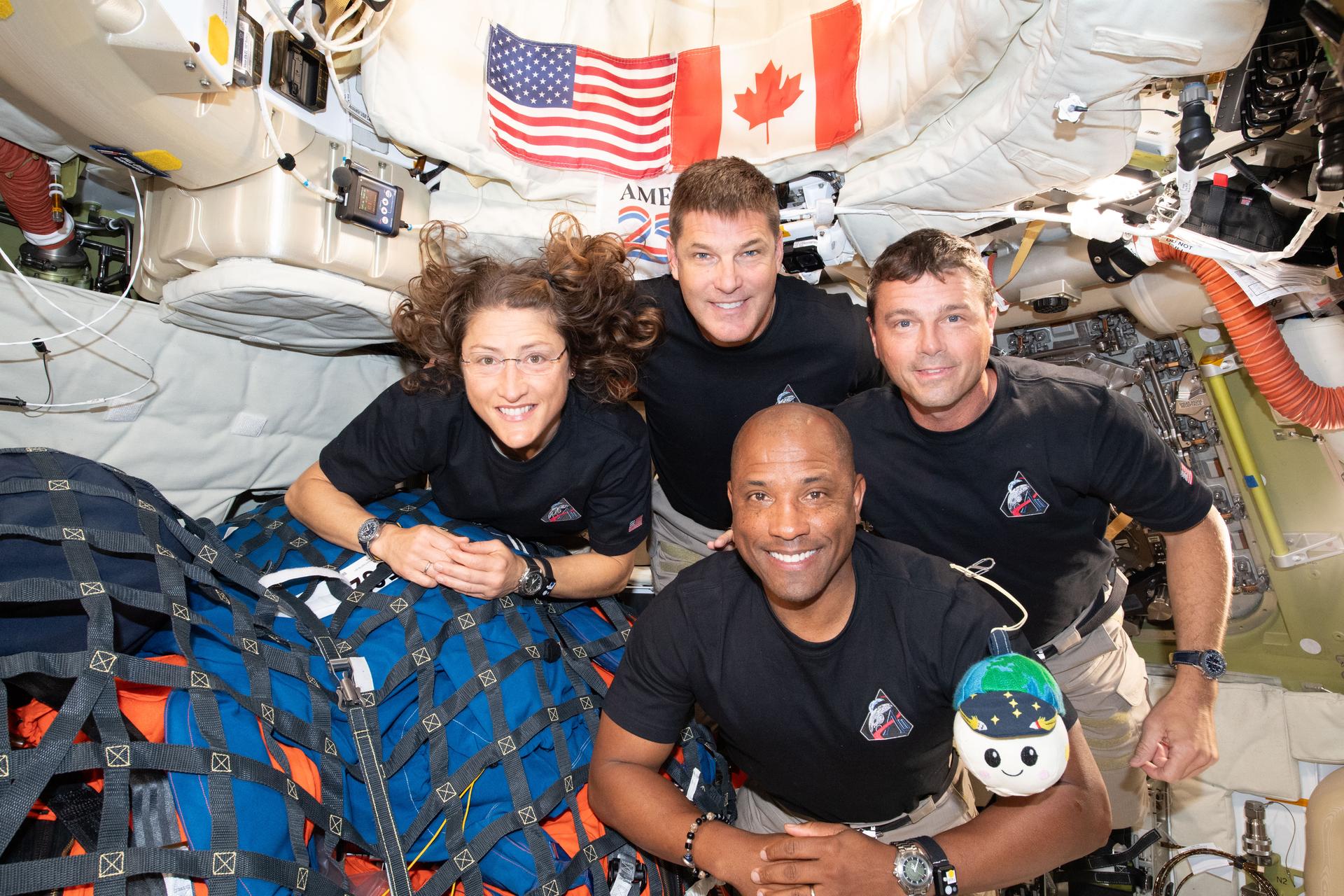
The Artemis II astronauts flew their Orion spacecraft, which is named Integrity, farther from Earth than any other human has ever traveled. This was a test flight and a crucial step to eventually return humans to the Moon’s surface through the Artemis program.
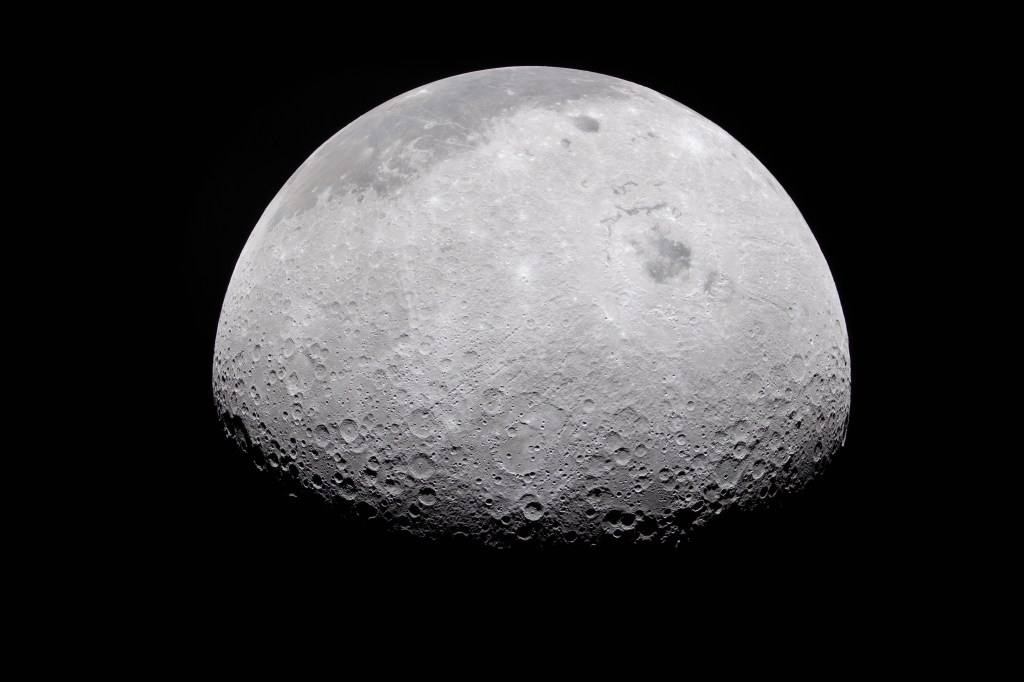
On day six of the mission the astronauts flew around the Moon, seeing parts of it that no other unaided human eyes have ever seen. They relayed details to NASA scientists in the moment, and they brought back pictures, videos, and voice notes that will keep scientists busy for a long time. Then the astronauts spent several days traveling back home, and on day 10 they returned.
The final total on Integrity’s odometer: 694,481 miles or just a shade over 1.1 million kilometers. In the final hours of NASA’s livestream of Artemis II, on April 10, 2026, we watched as a partially lit Earth grew larger and larger. Integrity was almost home. Commander Reid Wiseman kept in touch with mission control.
REID: And we have a great view of the Moon out window two. Looks a little smaller than yesterday.
MISSION CONTROL: Guess we’ll have to go back.
[Music: Natural Motion by Paul Richard O’Brien]
JACOB: In another episode of Curious Universe, we go into detail about NASA’s preparations to recover the astronauts once they landed and the intense conditions Integrity faced in the final minutes of the mission.
Here’s a quick recap. As Integrity entered the atmosphere, it traveled about 35 times the speed of sound. As the spacecraft fell, it compressed the atmosphere, creating temperatures of several thousand degrees Fahrenheit, and superheated plasma built up around the spacecraft. NASA engineers knew that because of those extreme conditions, it would be impossible to communicate with Integrity for about six minutes.
ROB NAVIAS, NASA Communications: And we have crossed the threshold now entering the Earth’s atmosphere. We’re at 400,000 feet, traveling 34,800 feet per second. And as predicted, we’ve entered our communications blackout.
JACOB: During the six-minute blackout, NASA engineers could only wait. There were no data about the condition of the spacecraft. There was no word from the crew. Mission control stayed ready until the moment when they expected to reestablish contact.
MISSION CONTROL: Integrity, Houston. Comm check post blackout.
REID: Houston, Integrity. We have you loud and clear.
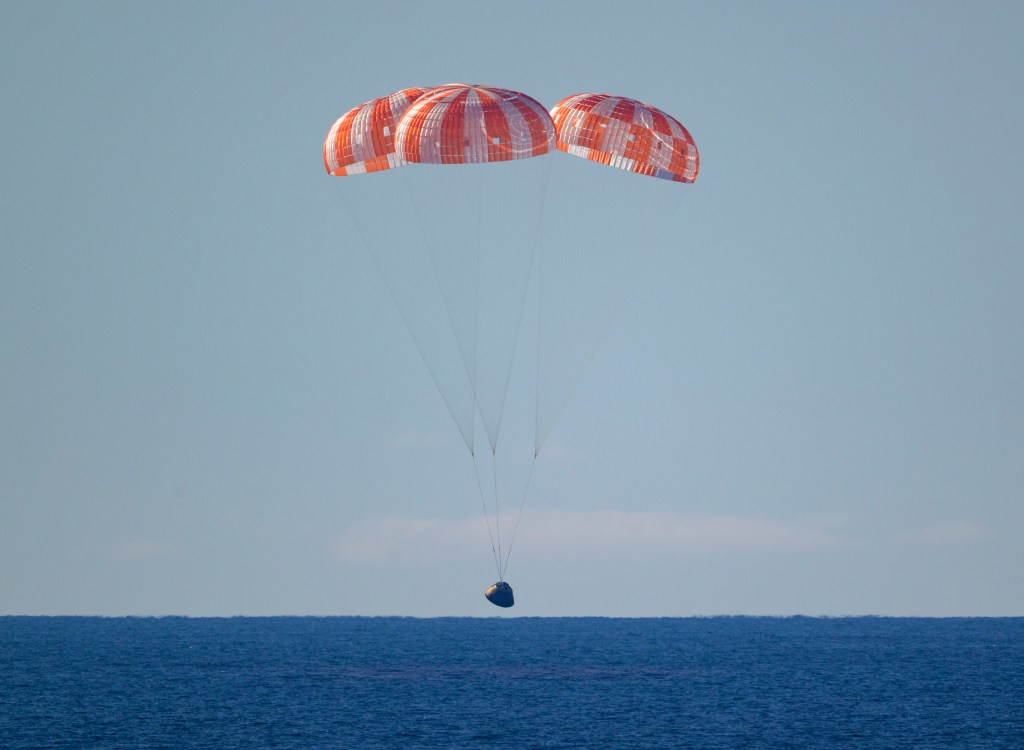
JACOB: On the livestream, cameras captured Integrity’s parachutes deploying as the capsule descended. Finally, just minutes after reentering the atmosphere, Integrity landed in the ocean with three orange-and-white parachutes billowing above it.
REID: Houston, Integrity. Splashdown. Sending post landing command now.

JACOB: The recovery team kicked into gear. And, again, we have much more detail about the recovery of Artemis II in another episode in this podcast feed. As the astronauts waited to be let out of their spacecraft, they radioed mission control that they were feeling green. Not “green” like their complexion—green as in go. They were feeling good.
REID: Houston, we have you loud and clear on VLDR. How us?
MISSION CONTROL: We have you the same. We’ll meet you over in post landing.
ROB NAVIAS, NASA Communications: Perfect communications established.
REID: What a journey. We are stable one. Four green crew members.
MISSION CONTROL: Houston copies all.
JACOB: Integrity bobbed in the water with the astronauts still sealed inside. Until …
[Sound of hatch opening]
DIVER: Yes.
[Sound of cheering]
DIVER: Let’s go!
JACOB: A team of Navy divers opened the hatch, found four smiling astronauts, and gave them their first fist bumps back on Earth.
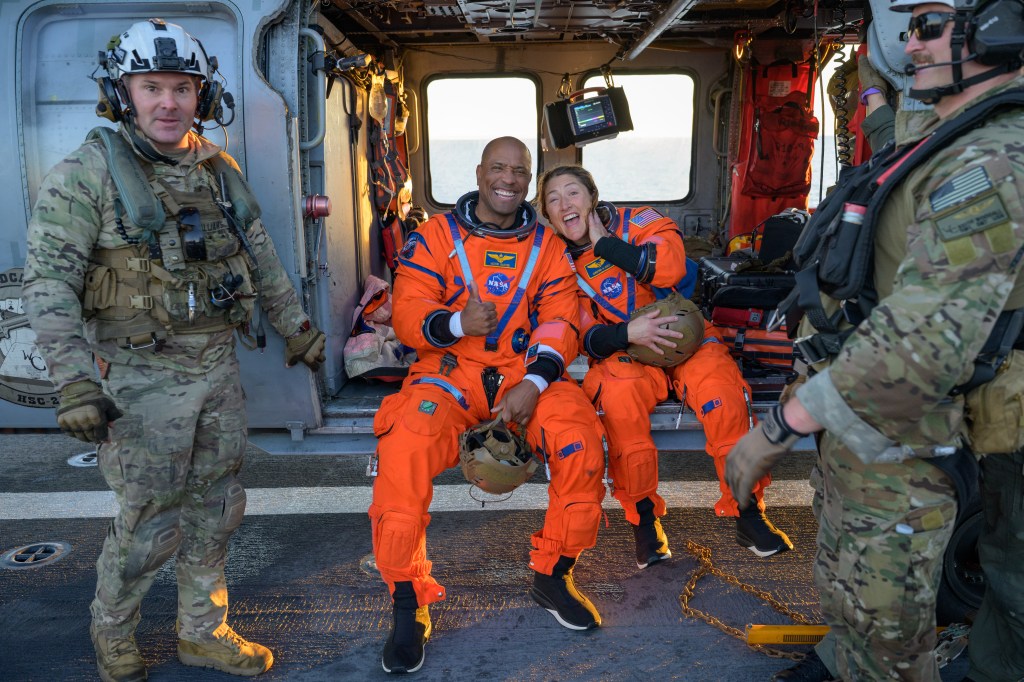
DIVER: Four green! Ike, welcome home. Christina, welcome home. Yes. Jeremy. Absolutely. Welcome home brother. There it is. Reid! What’s up? Welcome home brother …
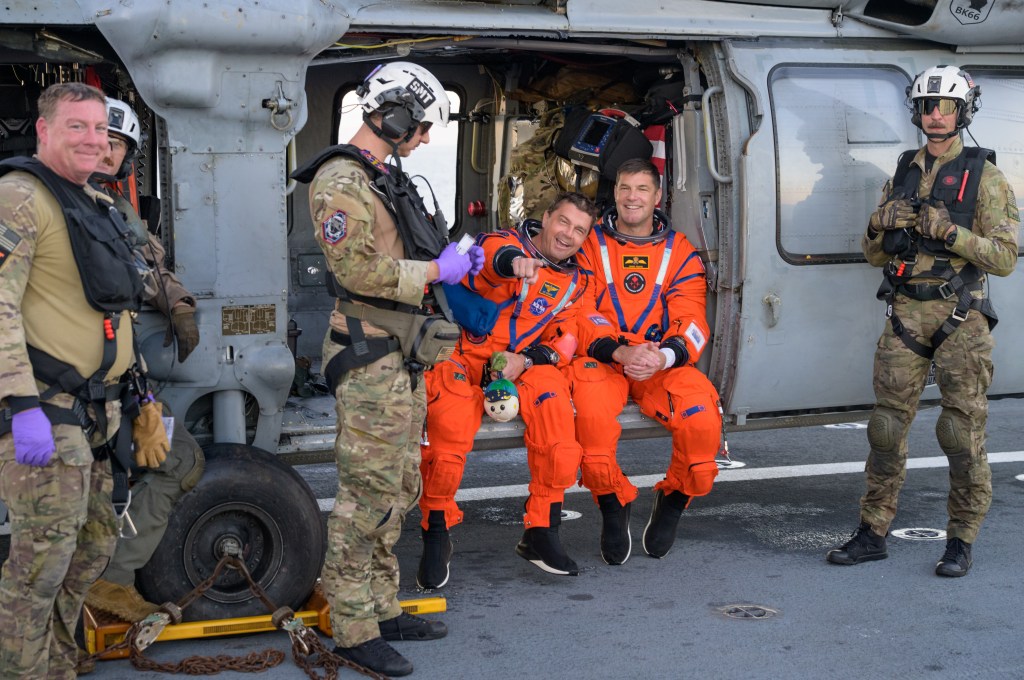
JACOB: After the recovery team retrieved the astronauts, they brought them to a ship waiting nearby. The astronauts went through medical evaluations, and the next day they made it back home to Houston, Texas. A crowd was waiting for the astronauts, including their families, colleagues in the astronaut corps, and other NASA employees. NASA Administrator Jared Isaacman welcomed the crew on-stage.
JARED ISAACMAN: Commander Wiseman—Reid—you said in an interview back in February that you hoped this mission would be forgotten, overshadowed by all that was to come after, but I’m very sorry to disappoint you all. Artemis II will always be remembered.
JACOB: Then it was time for the astronauts to speak. One by one, they took the mic. Commander Reid Wiseman went first.
REID: I have absolutely no idea what to say. This is—24 hours ago, the Earth was that big out the window, and we were doing Mach 39 and here we are back at Ellington, at home.
JACOB: If you’ve ever taken a vacation and then needed a couple of days to decompress and process your trip before you get back to real life, it seemed like the astronauts were going through a version of that. Fresh off an experience of a lifetime, they occasionally struggled to put into words exactly what they were feeling.
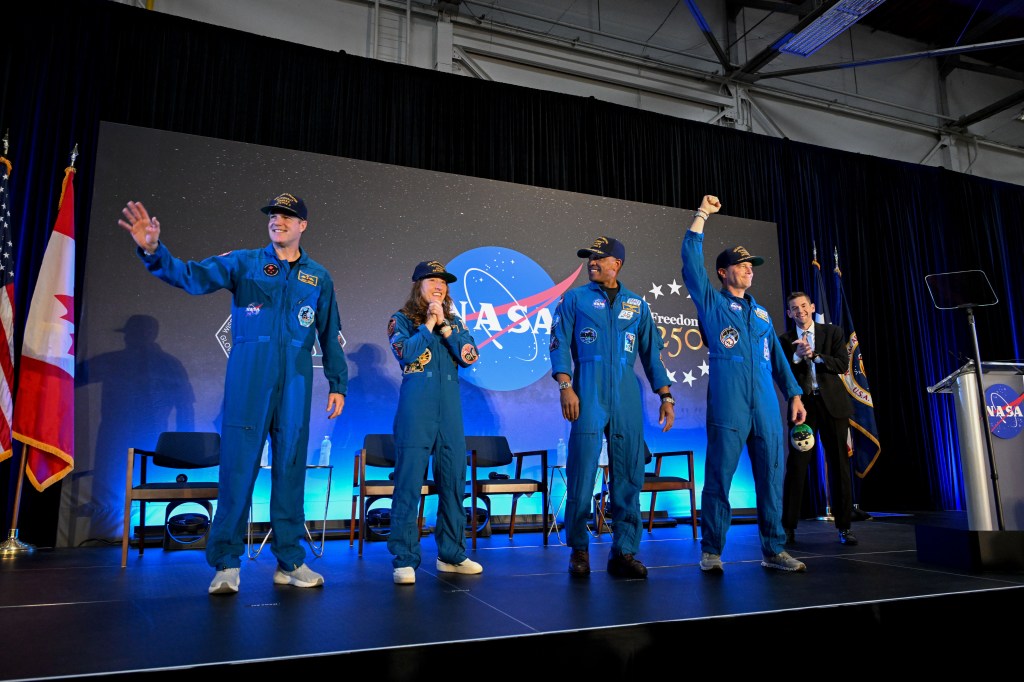
REID: No one knows what the families went through, man. This was not easy. Being 200,000-plus miles away from home—like before you launch, it feels like it’s the greatest dream on Earth. And when you’re out there, you just want to get back to your families and your friends. It’s a special thing to be a human, and it’s a special thing to be on planet Earth. Thank you.
JACOB: When Reid was done, Pilot Victor Glover took the mic.
VICTOR: I’m going to keep it brief, because I don’t—I’m afraid to start talking. I have not processed what we just did, and I’m afraid to start even trying. When this started on April 3, I wanted to thank God in public, and I want to thank God again, because even. Bigger than my challenge trying to describe what we went through, the gratitude of seeing what we saw, doing what we did, and being with who I was with—it’s too big to just be in one body.
JACOB: Next was Mission Specialist Christina Koch. She spent a little bit of time teasing out the word “crew” and what makes a crew different from a team. A crew, according to Christina, is a group of people with the same needs working together and willing to sacrifice when they need to and to give grace when they need to.
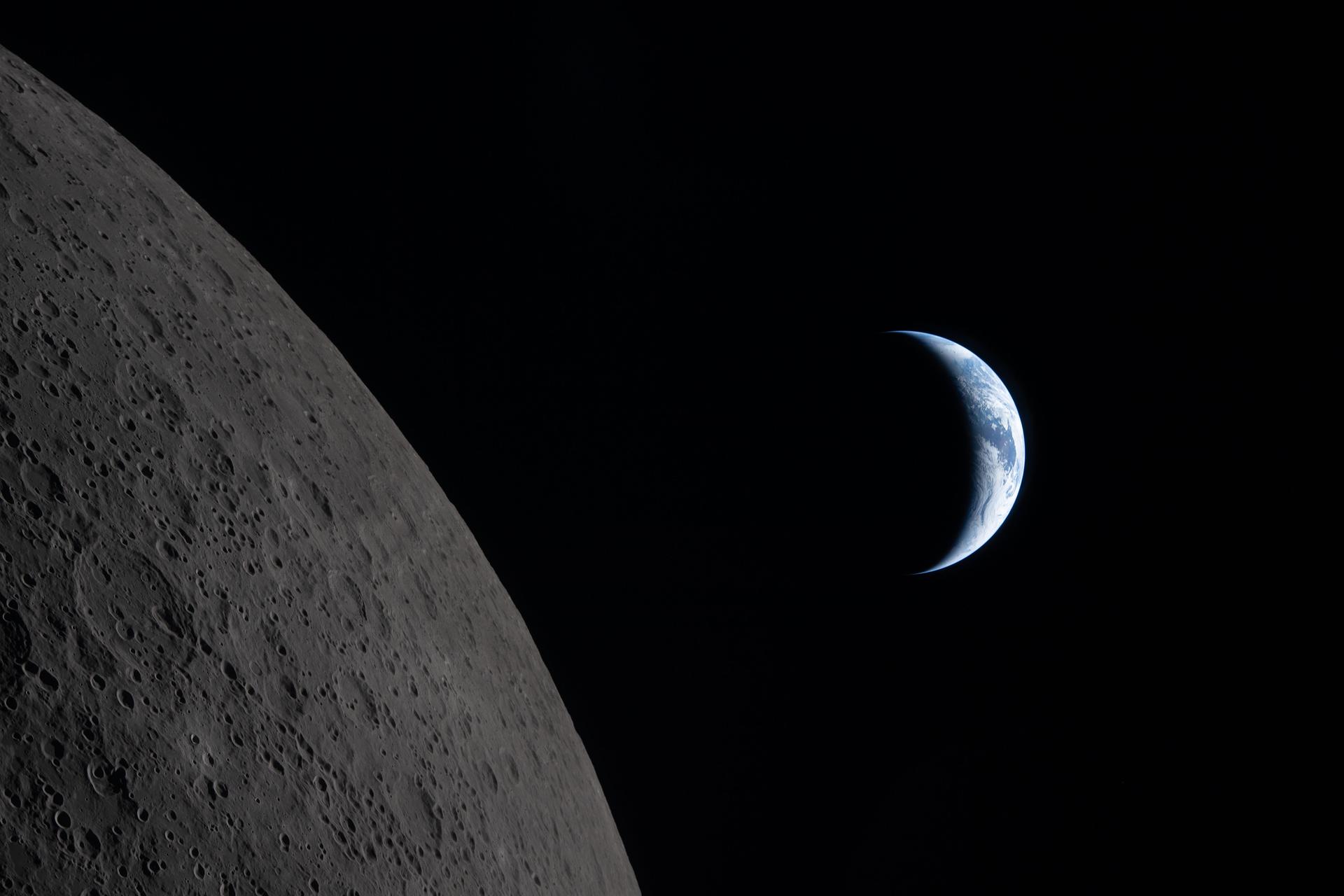
CHRISTINA KOCH: When we saw tiny Earth, people asked our crew what impressions we had and honestly what struck me wasn’t necessarily just Earth. It was all the blackness around it. Earth was just this lifeboat hanging undisturbingly in the universe.
JACOB: Christina started to get choked up at this part.
CHRISTINA: Uh oh. [Laughter] I may have not learned—I know I haven’t learned everything that this journey has yet to teach me, but there’s one new thing I know, and that is: planet Earth, you are a crew.
JACOB: Rounding out the Artemis II crew was Mission Specialist Jeremy Hansen with the Canadian Space Agency. He said he felt gratitude for his family and the people he works with. Then he asked his crewmates to stand up and join him. They stood linked, with their arms around each other’s shoulders, as Jeremy said the four astronauts were united by love.
JEREMY HANSEN: What you saw was a group of people who loved contributing, having meaningful contribution, and extracting joy out of that, and what we’ve been hearing is that was something special for you to witness. And the reason I had them form up here with me is because I would suggest to you that when you look up here, you’re not looking at us. We are a mirror reflecting you. And if you like what you see, then just look a little deeper. This is you.
JACOB: There were more toasts to the crew. There was—as one NASA official put it —a big Texas round of applause. And after a few more speeches celebrating the success of Artemis II, Reid Wiseman looked directly at other NASA astronauts in the audience. There was a crowd of them, wearing royal blue flight suits. He said it’s their turn to keep exploring.
REID: We would be remiss if the four of us didn’t look right there and say it is time to go, and be ready, because it takes courage. It takes determination. And you all are freaking going, and we are going to be standing there supporting you every single step of the way in every possible way possible. Thank you. [Applause]
JACOB: On that note, I want to leave you with one more parting thought, because as huge of an accomplishment as Artemis II is, it is not the end of an era. It’s the beginning. As the Artemis II astronauts put it, they are carrying a relay baton, and now they hand it off to the next crew to continue pushing humanity further.
Shortly after splashdown, Amit Kshatriya, NASA’s associate administrator, put the focus on the teams of experts at NASA and its partners—the ones who fought all kinds of challenges to make this mission succeed.
[Music: Hope Horizons by Cliff Haywood]
AMIT KSHATRIYA: We talk a lot about what gets in our way. The impediment to action is where we find the way to get to action. What stands in the way becomes the way. This program faced every obstacle an institution could face. The team met each one with work, and tonight is the proof that that work needs to continue. The path to the lunar surface is open, but the work ahead is greater than the work behind us. It always will be. Fifty-three years ago, humanity left the Moon. This time we return to stay. Let us finish what they started. Let us focus on what was left undone. Let us not go to plant flags and leave, but to stay with firmness in our purpose, with gratitude for the hands who built the machines, and with love for the ones that we carry with us. Welcome home, Integrity.
JACOB: This is NASA’s Curious Universe, an official NASA podcast. You can find our whole Artemis II series at nasa.gov/artemispodcast. Again: nasa.gov/artemispodcast.
Our Artemis II series was written and produced by Christian Elliott and Jacob Pinter.
Our executive producer is Katie Konans. Wes Buchanan designed the show art for this series. Music for the series comes from Universal Production Music.
We had support throughout this series from Rachel Kraft, Lisa Allen, Lora Bleacher, Brandi Dean, Courtney Beasley, Amber Jacobson, and Thalia Patrinos. For this episode we had extra help from James Gannon.
You can find transcripts for every episode of Curious Universe and explore NASA’s other podcasts at nasa.gov/podcasts.
If you enjoyed this episode of NASA’s Curious Universe, let us know. Leave us a review wherever you’re listening right now. Maybe send a link to one of your friends. And you can follow NASA’s Curious Universe in your favorite podcast app to get a notification each time we post a new episode.