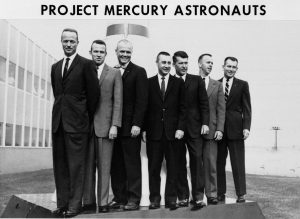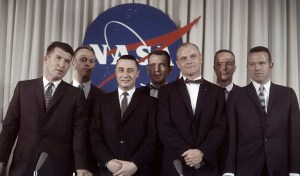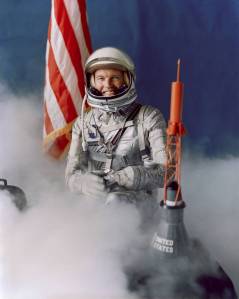












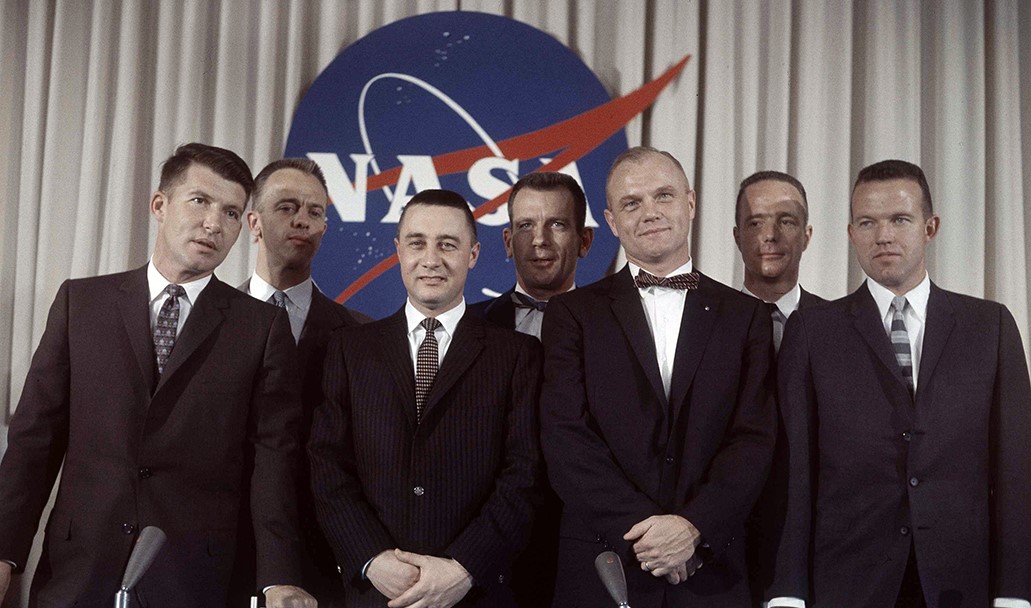
Mercury, America’s first human space flight program, introduced the nation to its first astronauts. There were six total flights with six astronauts flown. Total flight time for these missions was 53 hours, 55 minutes and 27 seconds.
Mercury-Redstone 3
Spacecraft: FREEDOM 7
Mission Date: May 5, 1961
Astronaut: Alan B. Shepard, Jr.
Flight Summary: 15 minutes, 28 seconds
Suborbital flight that successfully put the first American in space.
Mercury-Redstone 4
Spacecraft: LIBERTY BELL 7
Mission Date: July 21, 1961
Astronaut: Virgil I. Grissom
Flight Summary: 15 minutes, 37 seconds
Suborbital flight, successful flight but the spacecraft sank shortly after splashdown.
Mercury-Atlas 6
Spacecraft: FRIENDSHIP 7
Mission Date: February 20, 1962
Astronaut: John H. Glenn, Jr.
Flight Summary: 4 hours, 55 minutes, 23 seconds
Three-orbit flight that placed the first American into orbit.
Mercury-Atlas 7
Spacecraft: AURORA 7
Mission Date: May 24, 1962
Astronaut: M. Scott Carpenter
Flight Summary: 4 hours, 56 minutes, 5 seconds
Confirmed the success of the Mercury-Atlas 6 by duplicating the flight.
Mercury-Atlas 8
Spacecraft: SIGMA 7
Mission Date: October 3, 1962
Astronaut: Walter M. Schirra
Flight Summary: 9 hours, 13 minutes, 11 seconds
Six-orbit engineering test flight.
Mercury-Atlas 9
Spacecraft: FAITH 7
Mission Date: May 15-16, 1963
Astronaut: L. Gordon Cooper, Jr.
Flight Summary: 34 hours, 19 minutes, 49 seconds
The last Mercury mission; completed 22 orbits to evaluate effects of one day in space.