



















Space Reactor-1 Freedom
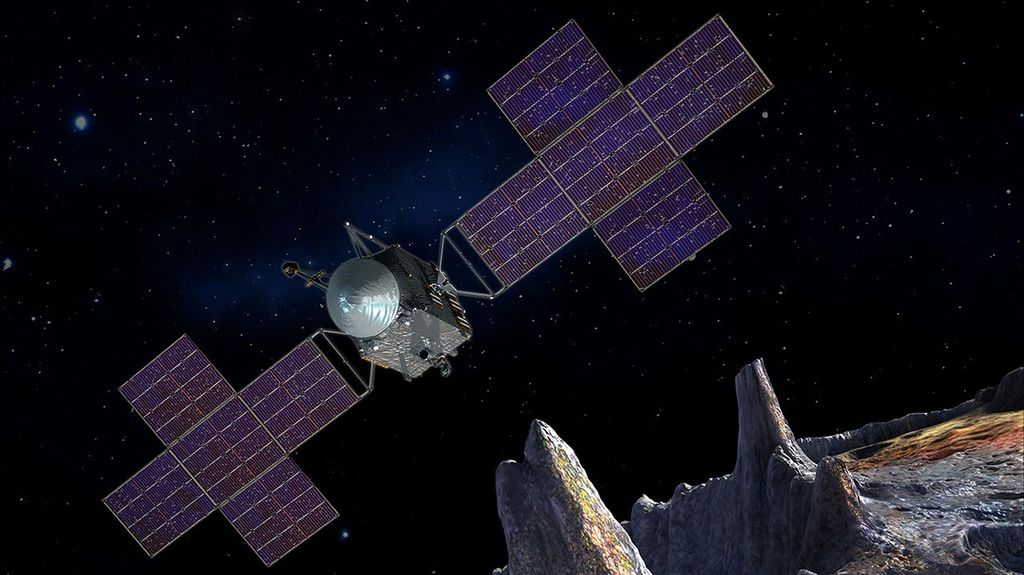
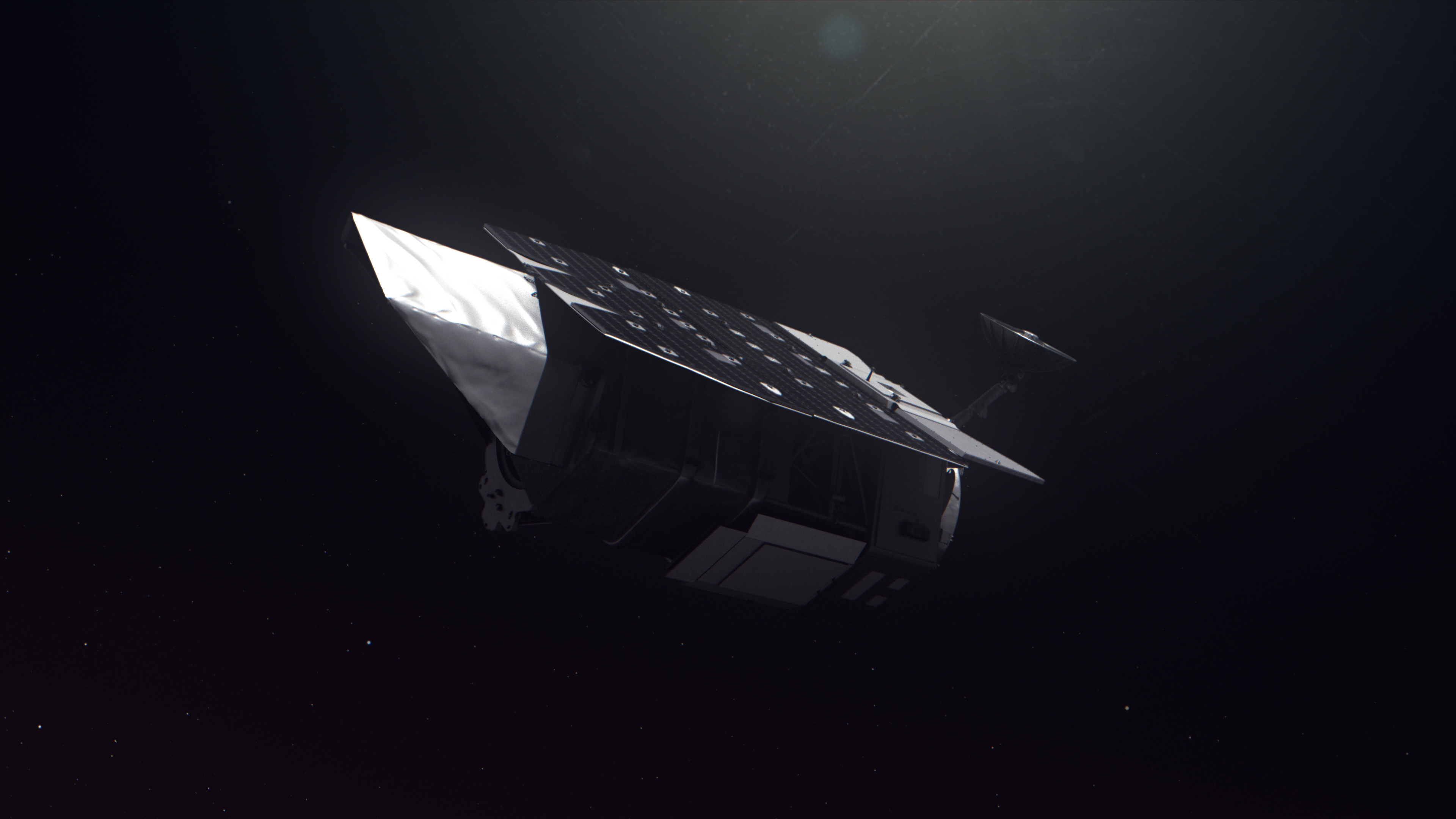
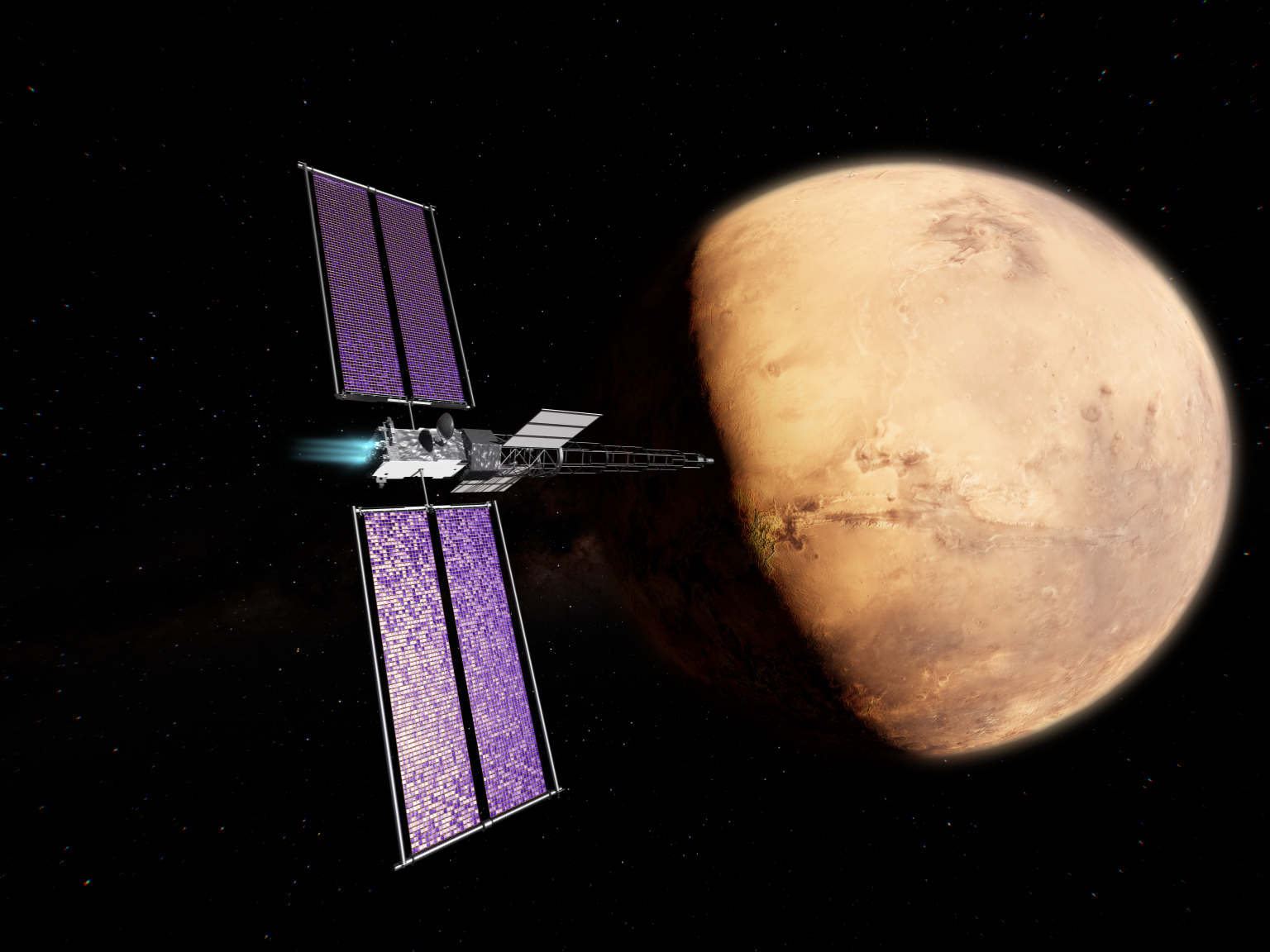
Destined for Mars, Space Reactor 1 Freedom is the first fission powered spacecraft to travel beyond Earth’s orbit, demonstrating nuclear electric propulsion and delivering the SkyFall payload.
Golden age of space exploration
space nuclear propulsion
science Payload
A Trailblazing Voyage
NASA will launch Space Reactor-1 Freedom, humanity’s first fission-powered interplanetary spacecraft.
Targeting launch in late 2028, the mission will showcase American nuclear power operations in space, prove fission surface power technology for NASA’s Moon Base, and help enable future fuel-efficient spacecraft that will be capable of supporting ambitious science and human exploration missions to Mars and deep space.
The Space Reactor-1 Freedom spacecraft will demonstrate nuclear electric propulsion and deliver SkyFall to the Red Planet. SkyFall will deploy three Mars helicopters, evolved from NASA’s heritage Ingenuity Mars Helicopters design, to collect scientific data, demonstrate exploration zones, and identify potential water sources.

Paving The Way
Space Reactor-1 Freedom will pave the way for space nuclear hardware development, set regulatory and launch precedent, and activate the industrial base for future fission power and propulsion systems.
Explore the mission’s objectives:
1. Operate a nuclear-electric propulsion system in space
2. Launch on Earth escape trajectory
3. Utilize the 2028 Mars launch window
4. Leverage existing technology and flight hardware to the maximum extent possible
5. Deliver Skyfall to Mars Intercept
6. Reactor Extended Performance
Powering SR-1 Freedom
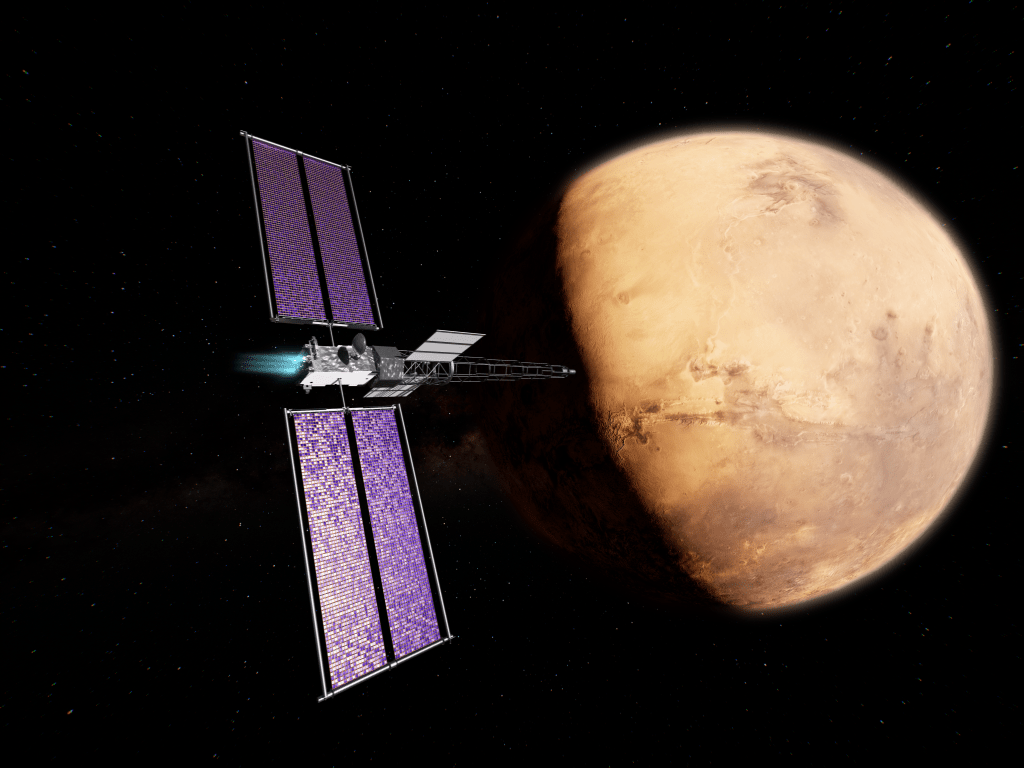
Space Reactor-1 Freedom will demonstrate nuclear electric propulsion for the first time.
Explore features of the vehicle:
Weight: About 26,455 pounds (12,000 kilograms)
Fuel: High-Assay Low-Enriched Uranium (HALEU)
Power: 20 kilowatts electric closed Brayton cycle power conversion system
Spacecraft Bus: Power and Propulsion Element generating 48 kilowatts of electrical power
Thrusters: Advanced Electric Propulsion System, 12-kilowatt Hall thruster
Communications: X-band communications with NASA’s Deep Space Network
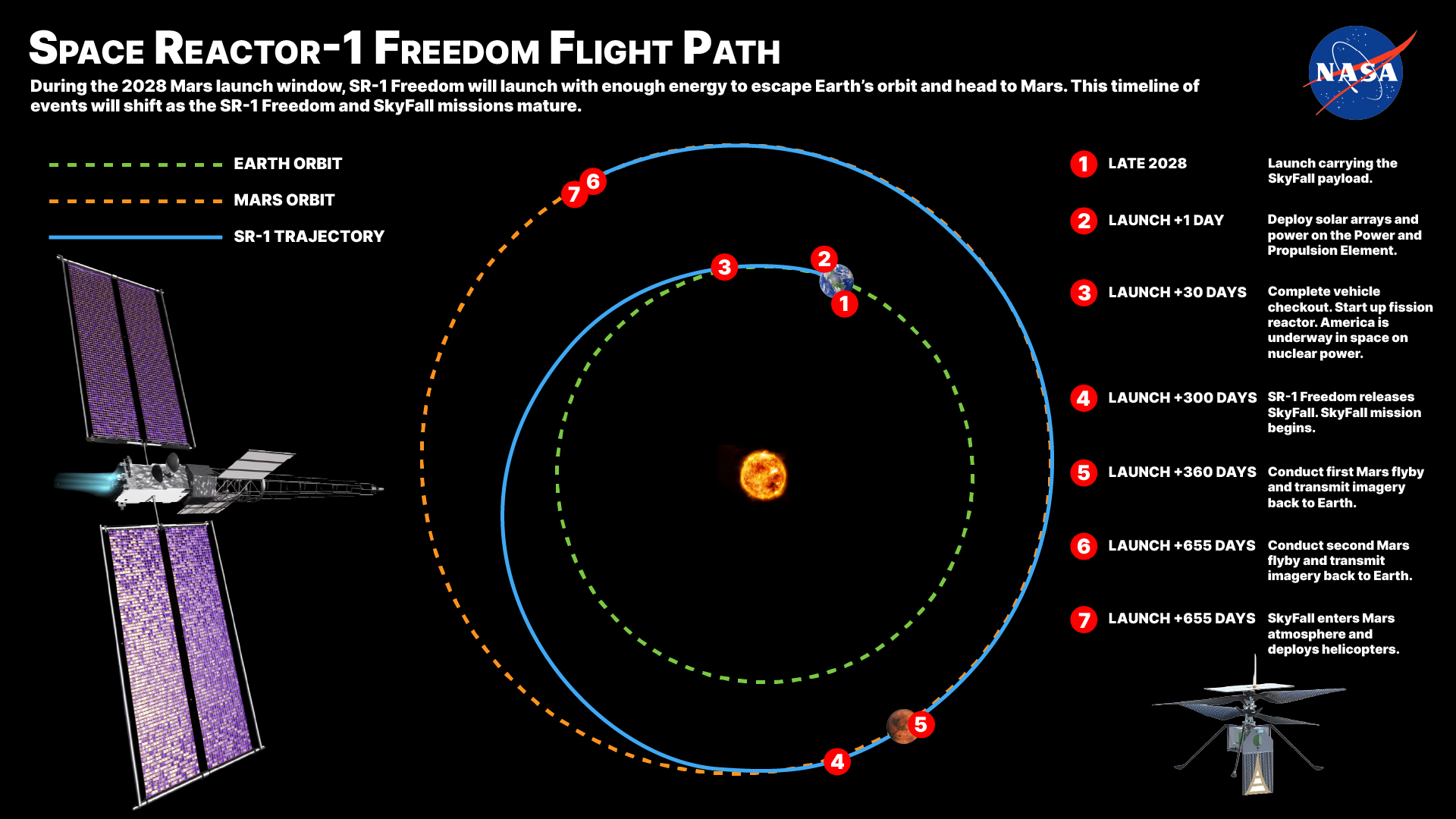
SR-1 Freedom Flight Path
This mission is the first step in a deliberate sequence. It will inform and enable Lunar Reactor-1 (LR-1), a fission surface power system designed to keep NASA’s Moon Base operating through periods of darkness and in locations where solar power alone is not sufficient. By flying a reactor first — without the added complexity of a lunar landing — SR-1 reduces nuclear flight risk, stimulates and qualifies the supply chain, and builds the workforce necessary for future space nuclear missions.
Together, SR-1 and LR-1 are the beginnings of a domestic nuclear-space industrial base that scales to power permanent lunar outposts and secures American leadership in space for decades to come.
NASA’s SkyFall Mission
NASA’s SkyFall mission will build on the success of the Ingenuity Mars Helicopter, which achieved the first powered, controlled flight on another planet. Using a mid-air deployment, SkyFall will deliver three Mars helicopters, evolved from the heritage Ingenuity design, to collect scientific data, demonstrate exploration zones, and identify potential water ice sources.
The three SkyFall helicopters will carry an advanced instrument package featuring ground-penetrating radar and imagers, and will be capable of measuring air temperature, wind speed, and direction. The radar will collect data about subsurface features that can be combined with data from the imagers, which could help map the terrain and characterize environments on Mars that are different from those we have explored before. If subsurface ice is detected, these measurements may help determine its extent and depth, which could help scientists understand potential formation mechanisms.
Measurements of wind speed, direction, and temperature at different elevations could provide a meteorological dataset that is different from what other spacecraft at the surface have previously been able to collect. These meteorological data combined with imaging could also provide insight into regional dust transport. Overall, this exploration and mapping from aerial vehicles could demonstrate how future missions to potential landing sites could serve as precursors to human-scale exploration.
The science payload will include an advanced instrument package that aims to:
- Use ground penetrating radar to find ice deposits
- Measure air temperature, wind speed, and direction
- Demonstrate usefulness and feasibility of potential exploration zone scouting methods using aerial mobility
NASA is planning a landing site selection process to determine the best possible landing sites for SkyFall to maximize the scientific return of the helicopters and their payloads, keeping within the capabilities of the Entry, Descent, and Landing system. To best support safe landing for human exploration on Mars, NASA is also targeting flat, low-elevation areas that are free of many geological obstacles. The helicopters could last months, and potentially years.
While the significantly lower gravity on Mars (one-third of Earth’s) makes flight on Mars slightly easier, this is offset by difficulties associated with flying in the Red Planet’s extremely thin atmosphere (only 1% of the air pressure at the surface compared to Earth), which means there are relatively fewer air molecules with which the helicopters’ two 4-foot-wide (1.4 meter) rotor blades can interact to achieve flight.
Media Information
-
01
Media Contacts
Jacqueline Minerd, Lead Communications Integrator, SR-1 Freedom: jacqueline.minerd@nasa.gov
Jan Wittry, Public Affairs Officer, Space Reactors Division: jan.m.wittry-1@nasa.gov
Alana Johnson, Mars Exploration Program Communications Lead, SkyFall: alana.r.johnson@nasa.gov
DC Agle, JPL Media Lead, SkyFall: david.c.agle@jpl.nasa.gov