
















Apollo Mission Control Center Restoration

History Overview
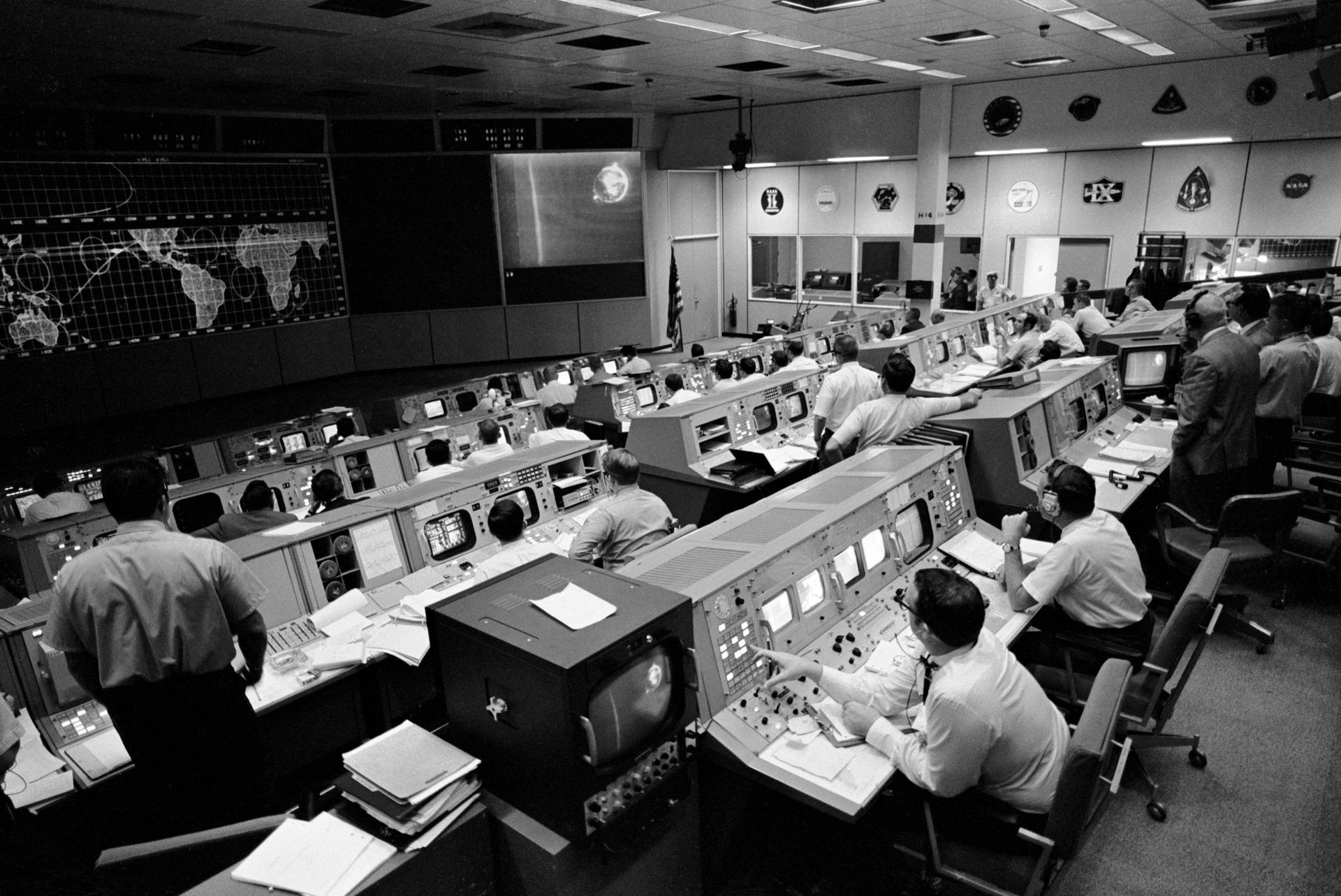
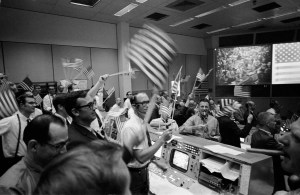
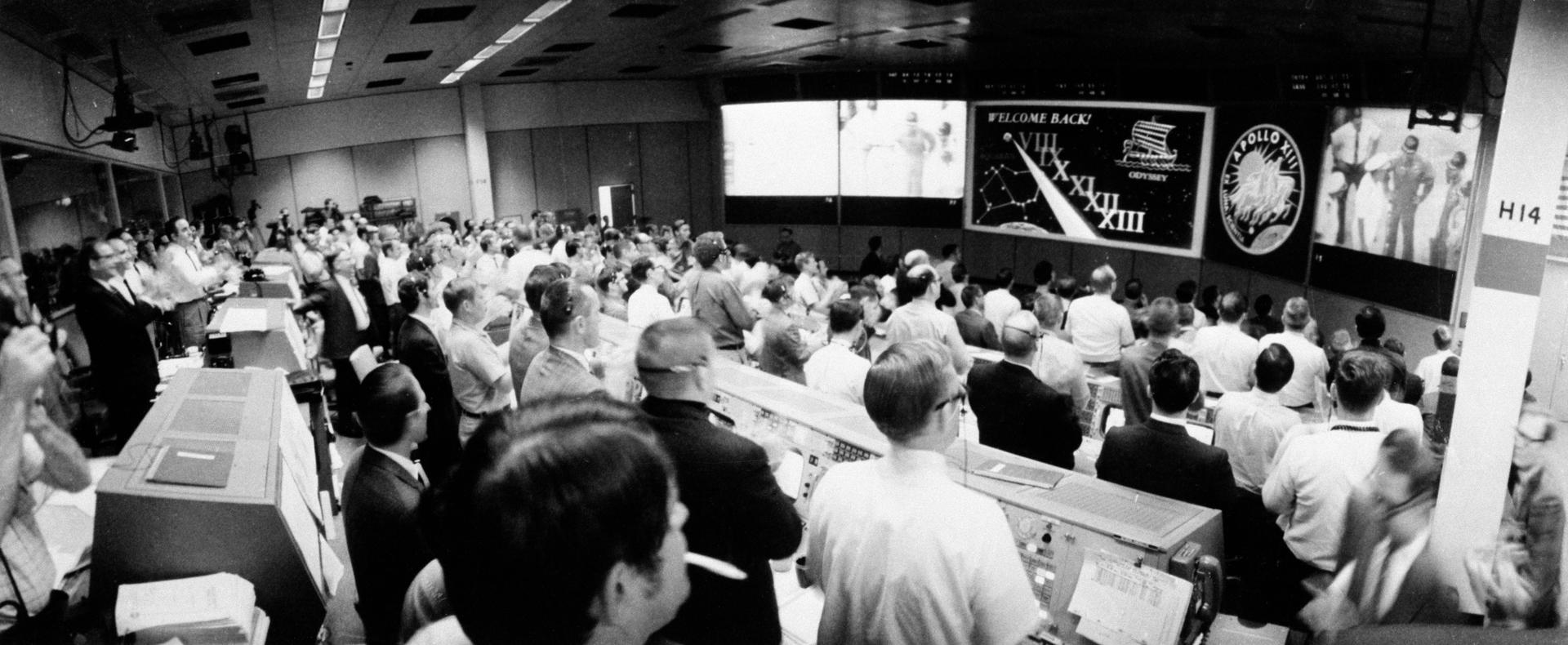
While history often recognizes the astronauts who became the first humans to walk on the Moon, equally noteworthy are the people of Mission Control, without whom the missions would not have been possible. With less computing power than a present-day cell phone at their disposal, Apollo-era flight controllers in Houston were able to safely launch humans into space, and even land them on our nearest celestial neighbor. The Historic Mission Control Center at NASA’s Johnson Space Center (JSC) was home to the planning, monitoring and command controls that were essential to America’s early human spaceflight program. It housed the people responsible for the success of early manned spaceflight missions, including the Gemini, Mercury, Apollo, and Soyuz missions in the 1960s and 1970s, as well as Shuttle-era missions in the early 1990s.
National Historic Landmark Status
Due to its impactfulness and criticality to human spaceflight in America, Building 30– The Christopher C. Kraft, Jr. Mission Control Center– became a National Historic Landmark (NHL) in 1985. The historic Apollo Mission Control was decommissioned in the 1990s, after the Space Shuttle Discovery spent seven days in space during the STS-53 mission in 1992. In 2015, the NHL received “threatened” status after its condition declined from years of use and increased foot traffic. When the National Park Service made this determination, JSC was already in the process of restoring the Apollo Mission Control Center.
Restoration Process
The restoration project, which was conceived in 2013, began in November 2018 and was completed in July 2019. It restored the Historic Mission Control to its Apollo-Era condition, and features the authentic consoles used to monitor nine Gemini missions, all Apollo Moon missions, and 21 space shuttle missions. This includes the Apollo 11 flight that first landed men on the moon, the Apollo 13 mission that famously experienced an in-flight emergency, and 40 other space missions. The $5 million endeavor was funded with a generous $3.1 million donation from the City of Webster, TX, and an additional $400,000 matching of the Kickstarter Campaign run by Space Center Houston. The Kickstarter raised $525k in donations, and JSC added the remaining $1 million to complete the project.
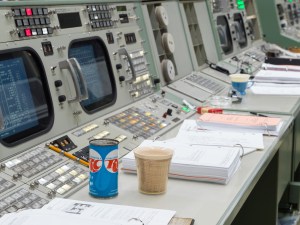
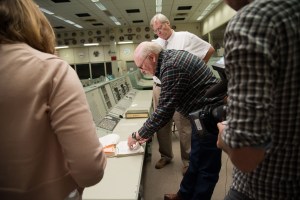
The project restored original furniture and finishes in order to return the MOCR to its classic appearance during a pivotal time in American history. The MOCR is complete with authentic consoles, mission medallions, upholstery, seats, wallpaper, and carpet, that were all either cleaned and restored to their original condition or recreated using original samples. Digitized 16-mm film taken during the Apollo 11 mission allowed restoration experts to identify otherwise unknown artifacts and colors as they were experienced in the control room during that time. This includes the original column markings, paint colors, and even coffee mugs at flight controllers’ consoles.
For the restoration, JSC consulted with the State Historic Preservation Officer, the Advisory Council on Historic Preservation, the National Park Service, and other interested parties in accordance with the National Historic Preservation Act. The contractor team included a variety of qualified professionals, restoration specialists, and conservators.
Control Room
Consoles
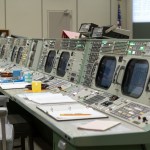
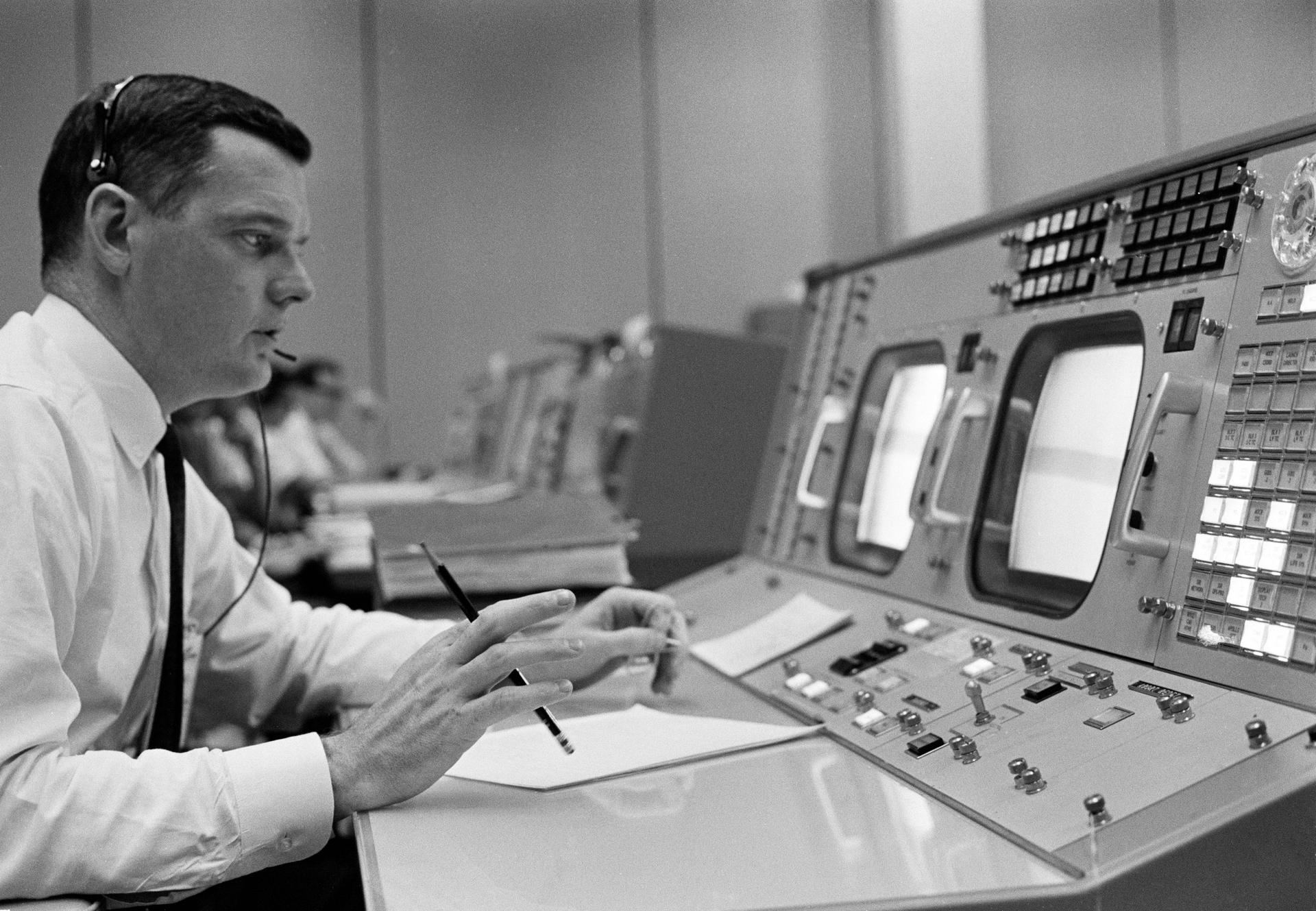
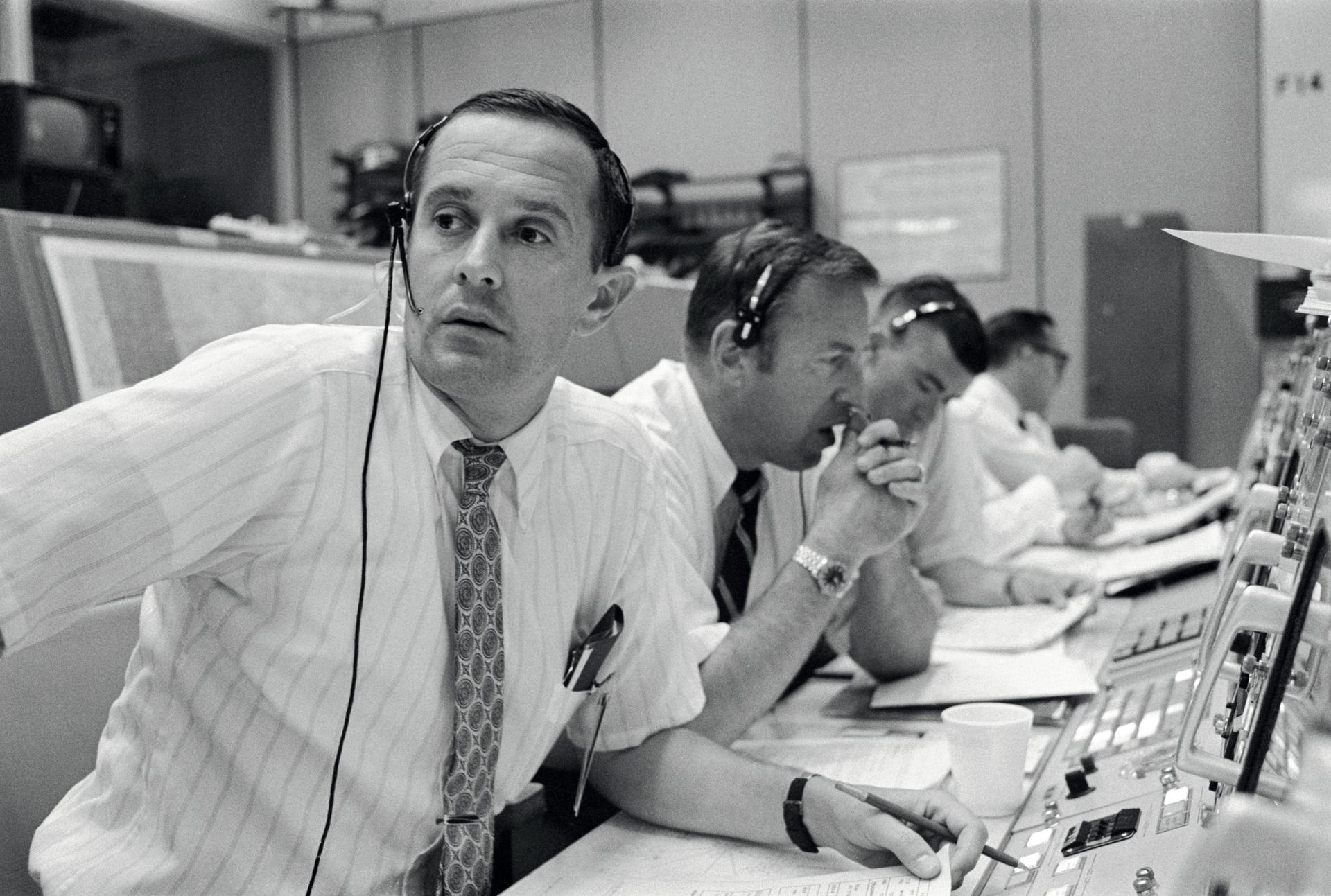
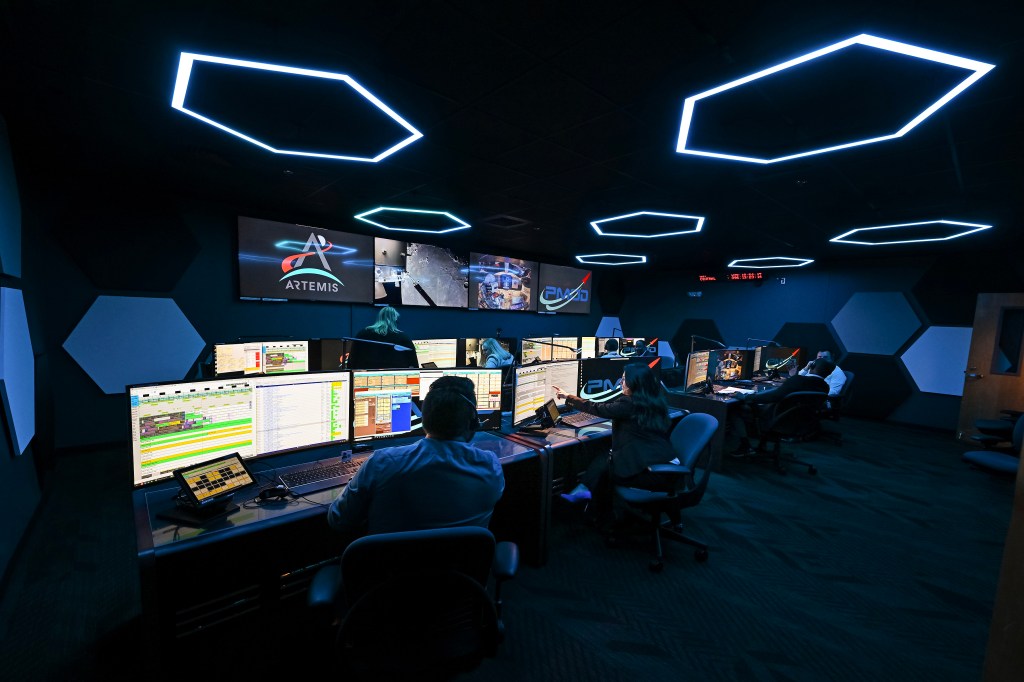
Integral to the Mission Control Room are the consoles used by the flight directors to monitor different aspects of spaceflight missions. Each console is roughly 1,200 pounds and used cathode ray tube (CRT) technology to process and display information. A system of pneumatic tubes (vacuum tubes with cylindrical containers) were used alongside the consoles to help mission control team members communicate with one another. During restoration, each of the original consoles was carefully removed from the MOCR, professionally restored to its original condition, and returned to JSC in November 2018. The control consoles were restored to the Apollo 11 mission, but the technology displayed on the screens is actually that of the Apollo 15 mission. Because the National Park Service oversees historic preservation efforts, every single element removed from the consoles—from wiring to pennies and cigarette butts—was archived and saved as an artifact. If necessary, every step to return the consoles to their Apollo-era greatness could be undone and they could be reassembled to the condition in which they arrived by qualified professionals.
In order to preserve the original design of the MOCR, careful steps were taken to identify original materials, clean and restore them, or replace them with nearly identical matches. Sheetrock walls were repainted to match original paint colors, and any original paint sections found were also cleaned and restored. In one instance, a piece of original wallpaper was uncovered around a thermostat. The same company that printed the original wallpaper in the 1960s was located; they found the original wallpaper print roll, and reprinted the classic wallpaper specifically for the restoration. Any other original wallpaper pieces found remaining on the walls were cleaned and left in place. In a number of instances, additional pieces of history were unearthed. For example, when restoring the paint on the columns in the MOCR, an original column number was uncovered, revealing new insights into the paint colors and text. Furthermore, during the removal of the consoles from the control room, the restoration team discovered a piece of original carpeting, which was then used to reproduce the carpeting for the rest of the room.
Personal and Utilitarian Artifacts
Personal and utilitarian artifacts were placed in the Control Room to recreate the historic scene during active Apollo Missions. These artifacts (chairs, clothing, coffee cups, ash trays, manuals, headsets, books, pencils, pencil sharpeners, clocks, tape dispensers, maps, charts, etc.) are original period pieces that were either found on-site at JSC or produced elsewhere. Original documents were copied for display.
Simulation and Recovery Control Rooms
Adjacent to the Mission Operations Control Room are two key support rooms: the Simulation Control Room, often referred to as the “Sim Room,” where staff conducted simulations to prepare for flight missions, and the Recovery Operations Control Room, where staff and U.S. Navy officials coordinated recovery efforts after splash down. The consoles in the simulation room were restored and reconfigured to their original organization. The last remaining “Selectomatic Transitube” (p-tube) station was also restored. The location of this room is being used today for mission operations. A photo of what the room once looked like was placed where the window into the room is located.
Visitors Viewing Area
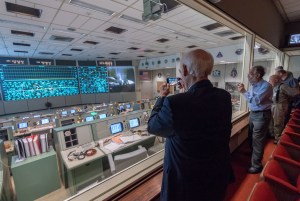
At the back of the Mission Operations Control Room (behind the mission controllers) is a wall with large windows that separate the MOCR from the Visitors Viewing Area, where dignitaries, guests, and the press could observe the activities of the mission controllers without causing disturbances or disruptions. After the historic MOCR was decommissioned, the theater-style seating where visitors would sit during missions later became open to the public during tours of Mission Control. This naturally led to wear and tear from years of public access. During the restoration, the Visitors Viewing Area was returned to its historic appearance: all seating and carpet remains original but was repaired and cleaned. Each of the armchairs in the Visitor Viewing room was removed, allowing the restoration team to replace the internal cushioning, as well as deep-clean or replace the rooms’ carpeting. Additionally, the original phone booths were fully restored, including the perforated metal acoustical wall covering and black rotary-dial phones.
Summary Display Projection Room “Bat Cave”
At the front of the MOCR are large group display screens; behind these screens is the Summary Display Projection Room (SDPR), sometimes referred to as the “Bat Cave.” Here, maps and images were projected onto the screens, many with illuminated, electromechanical plotter overlays. The main group of rear-projection screens spans the entire room and presented large-scale TV broadcasts and data graphics in real time to the Apollo Flight Controllers. The large screens were illuminated by mechanical slide projectors and early video-based cinema projectors. These devices projected imagery onto the rear of the screens from the Bat Cave.
Inside the SDPR, the original steel equipment platforms and most projection mirrors are still in place. However, the two original graphic slide projectors and three video projectors that were located in the SDPR have been removed. One of the graphic slide projectors is in storage at JSC and the three video projectors, called Eidophors, were obtained by Cosmosphere when the equipment was decommissioned. The original Eidophor Projection system was a product of the later 1940s’ attempt to develop a video projector powerful enough to replace or augment the film projection systems in movie theaters. This system uses the same type of illumination used in film projectors and was used by the military and airline industry in flight simulators. This was the primary technology to put video feeds onto the large screen in the MOCR.
Located above the five main viewing screens in the MOCR, nine rectangular screens presented clocks, timers, and various numerical data projected from behind the screens. The screens were illuminated by mechanical numbering and data systems that no longer exist, nor have any documentation of their original manufacture or illustrations been uncovered. From interviews with retired NASA workers, the original mechanisms projected a display of time and data using mechanical light through a stencil system.