















Daniel Drew
University of Hawaii, Honolulu, HI
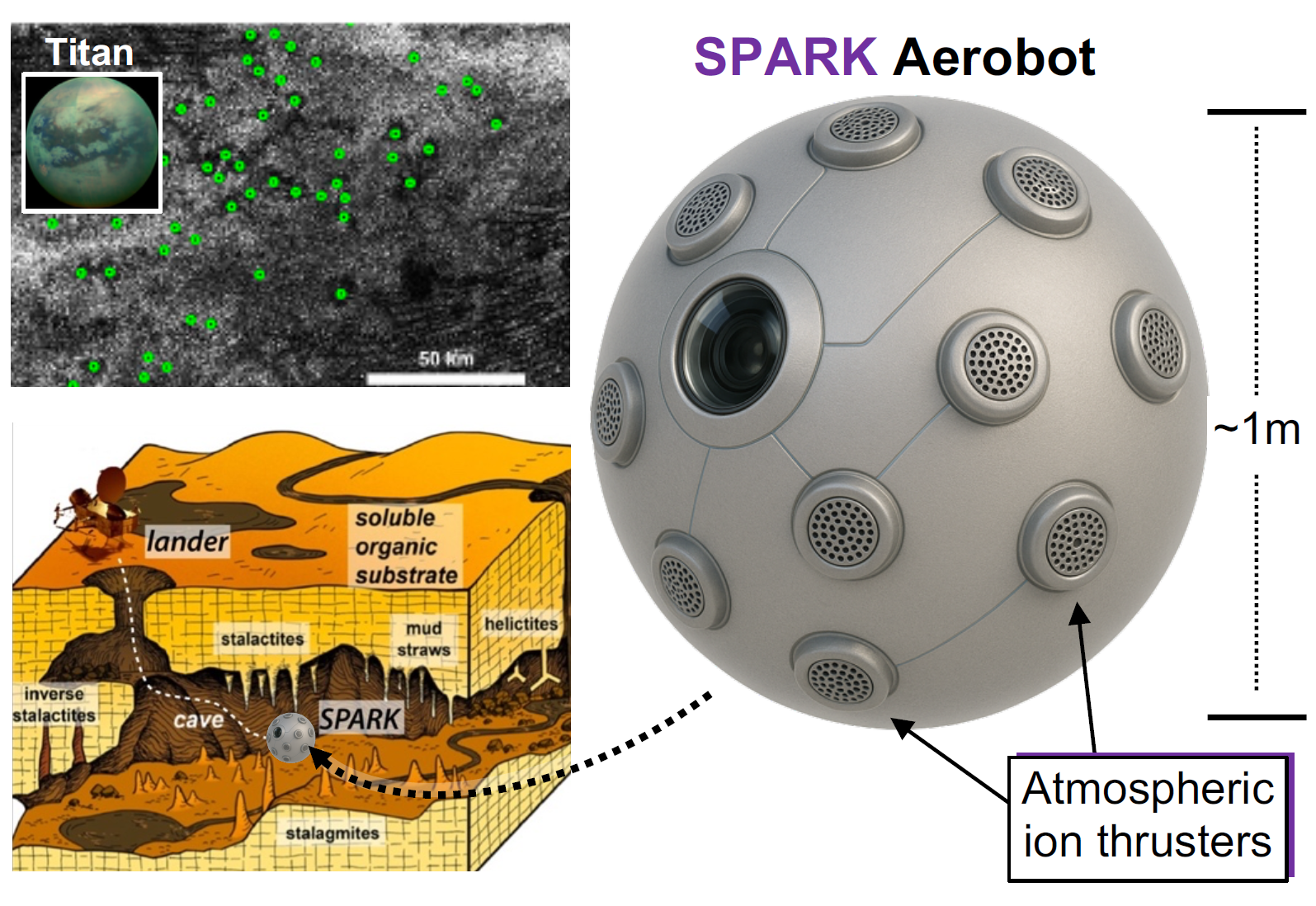
While karst terrain and subsurface caves are sites of immense scientific value on bodies like Titan, they are difficult or impossible to safely explore using current methods. In this proposal, we seek to develop small lighter-than-air vehicles (“aerobots”) that can be deployed as-needed by a larger spacecraft for entering and navigating caves. To provide omnidirectional maneuverability and minimize downwash, we propose distributed electrohydrodynamic propulsors (“atmospheric ion thrusters”), which are both completely solid-state and virtually silent. Electrohydrodynamic thrust is not ideal for power-autonomous flight on Earth. In favorable atmospheric conditions like those on Titan, however, we expect power savings of over 100x, at least twice the benefit received by rotorcraft. Favorable plasma inception conditions should also decrease the payload mass required for high voltage conversion compared to Earth, and there is no need for in-situ heating to prevent actuator failure at cryogenic temperatures as with rotors. In addition to independent aerobots, we envision small-scale EHD thrusters as a complementary technology for other applications, like long-term high-altitude observer station-keeping or propulsive hopper trajectory adjustment, whenever atmospheric conditions are favorable (e.g., on Venus). In Phase 1, we plan to conduct initial feasibility experiments and construct numerical models showing the performance of EHD in Titan-like conditions, explore EHD thrusters for balloon station-keeping with tethered power, and conduct focused engineering design space studies (Science Traceability Matrix, Vehicle Subsystem Trade Study) culminating in a viable point-design for a Phase II prototype.