













Artur Davoyan
University of California, Los Angeles
The goal of the proposed program is to enable the next generation of solar sails featuring very high characteristic acceleration–potentially up to 2 mm/s²–and large effective areas exceeding 10,000 m², to support future ultra–high delta-V missions. These advanced solar sails would significantly transform space exploration and utilization, making possible a range of missions currently beyond the capabilities of conventional chemical and electric propulsion. Examples include Earth and Venus pole-sitter spacecraft, solar polar imagers, and low-cost, fast-transit probes to the outer planets and interstellar medium. Achieving high characteristic accelerations (>0.3 mm/s²) has long been a central goal of solar sailing. However, this objective remains elusive, largely due to challenges associated with scaling up sail size. As sail area increases, so do the mass and complexity of deployment mechanisms. In particular, unfolding large sail membranes during deployment remains a key technical hurdle.
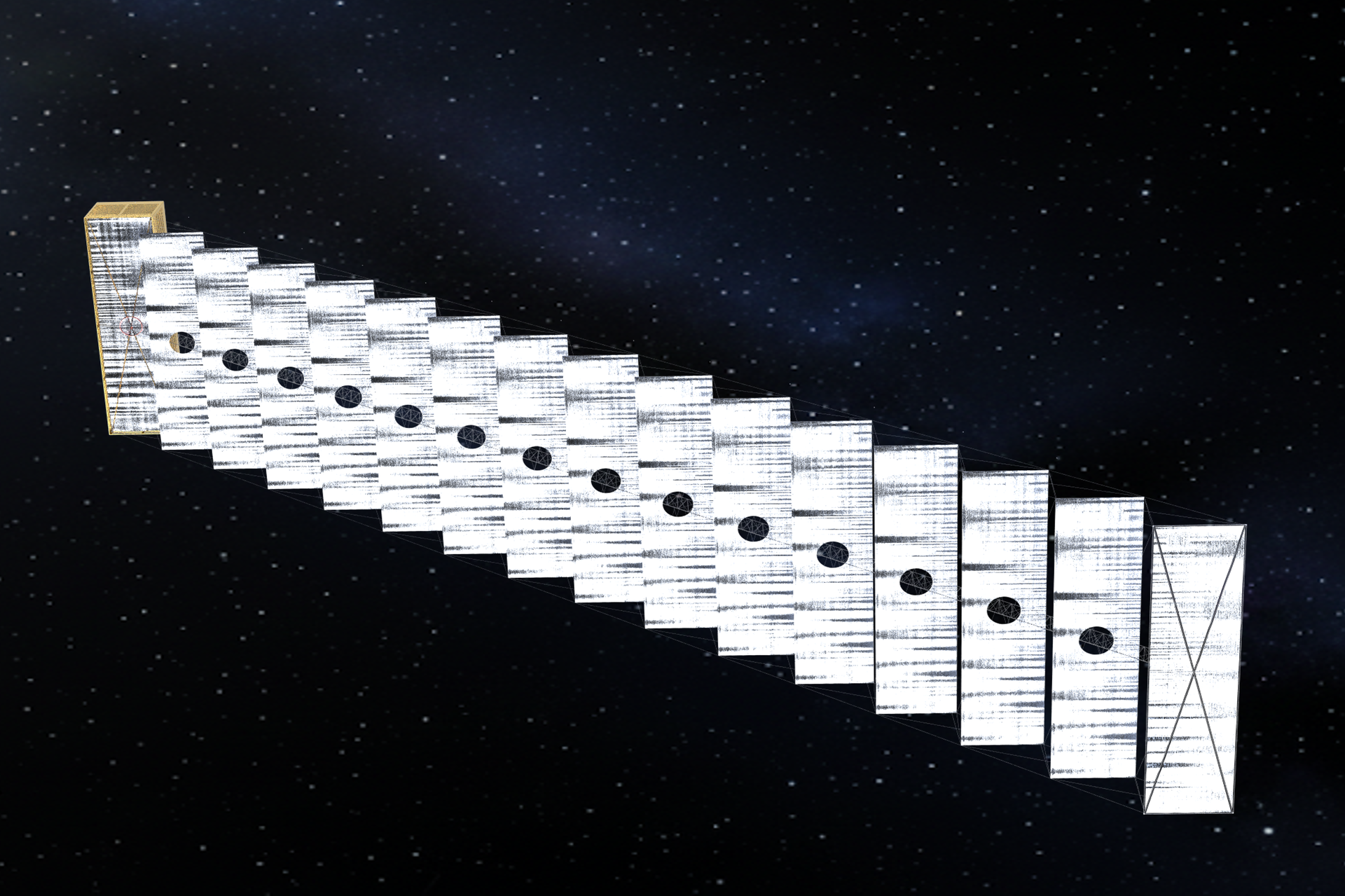
To overcome these challenges, we propose a fundamentally new solar sail architecture that eliminates the need for membrane unfolding and simplifies deployment. Our concept integrates two core technologies: (i) A lightweight, coilable truss structure that deploys a stack of sail membranes, each with an area between 50–150 m² (limited by the rocket fairing), and (ii) Tensegrity engineering to maintain the structural integrity and shape of the deployed system.
In the deployed configuration, the sail membranes form a “staircase” structure supported by a central coilable truss that passes through the center of each frameless sail. The overall assembly behaves as a tensegrity structure, maintaining its shape without traditional rigid frames. In the stowed configuration, each sail remains unfolded and is stored as part of a stacked assembly inside a guide container–or “mothercraft”–which also facilitates controlled deployment. In Phase I, we will design and test deployment prototypes and conduct numerical studies of the stacked sail system. These high-acceleration stacked sails are intended for solar-stationary observation missions, including probes placed into halo orbits at 0.4 AU perihelion and 60° solar latitude.