















Lunar Time
As NASA and its partners establish a long-term presence on the Moon, missions will need more than communications and navigation. NASA is leading U.S. government and international efforts to establish Coordinated Lunar Time (LTC), a time standard for the Moon that will be convertible to Earth’s Coordinated Universal Time (UTC) and extended to other destinations in our solar system.
A Time Standard for the Moon
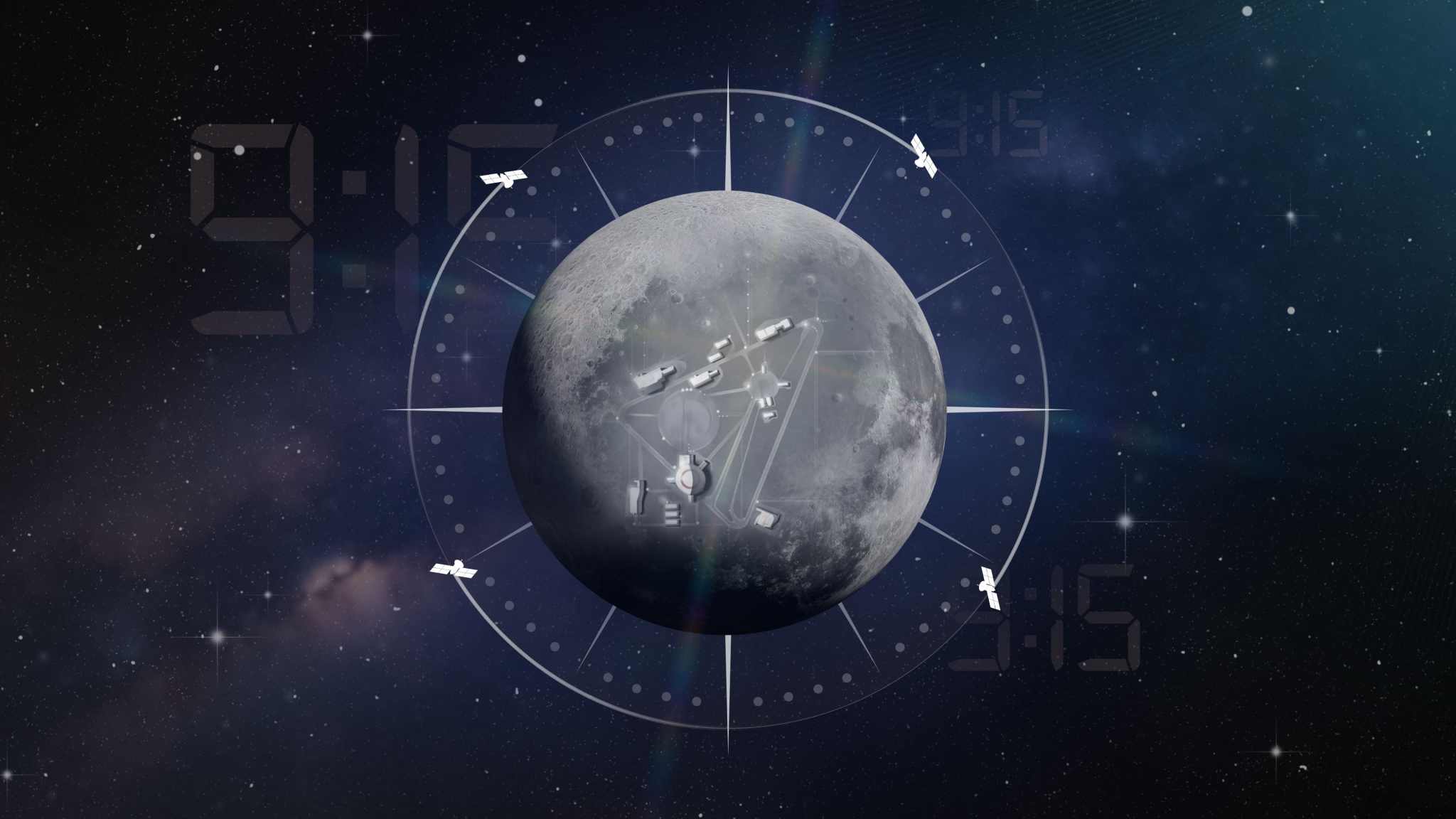
Led by NASA’s SCaN (Space Communications and Navigation) Division, the agency is coordinating with U.S. government stakeholders, partner space agencies, and international standards organizations to establish Coordinated Lunar Time (LTC). Like Coordinated Universal Time (UTC) on Earth, LTC will be determined by an ensemble of clocks working together at the Moon. NASA and its partners are researching which mathematical model will best establish lunar time.
Lunar Time
The Challenge of Relativity
Why does the Moon need its own time?
Due to the physics of relativity, clocks appear to move at different rates depending on where they are located and how quickly they are moving. To an observer on the Moon, a clock on Earth will appear to lose an average of 58.7 microseconds per Earth day. Over lunar distances, timing offsets of that size could cause navigation errors of roughly 10.5 miles. A fully coordinated, lunar-specific time scale, convertible to UTC, solves this problem.
Why Time Matters
Synchronized Clocks for Lunar Missions
Just as GPS depends on clocks synched to a single agreed-upon time on Earth, precision lunar navigation will require synchronized clocks at the Moon. Close maneuvers between spacecraft, such as docking, depend on precisely synchronized clocks, and even small errors can be dangerous. Precision science often combines measurements collected at different locations, where the smallest timing disagreements can grow into errors in the data. A common time will also help missions track activity around the Moon, known as space situational awareness, by precisely time-stamping imagery and science observations. As Artemis missions continue and more spacecraft travel to the Moon, unified timekeeping will be essential.
Establishing LTC
Atomic Clocks at the Moon
NASA proposes establishing LTC through an ensemble of atomic clocks at the Moon, similar to how scientists combine readings from many atomic clocks worldwide to calculate Earth’s UTC. Deploying clocks across the lunar surface and in orbit would keep all lunar users synchronized. While LTC will operate independently, it will remain traceable to UTC, allowing seamless conversion between lunar time and Earth time. Because scientists often define a body’s reference time at its center, where calculations are cleanest, establishing LTC also means determining how time at the Moon’s center relates to time kept on the lunar surface.

Beyond the Moon
A Scalable Standard
How NASA establishes LTC will set a precedent for how time is established at other celestial bodies. SCaN is designing LTC to be scalable, so that the same standard applied at the Moon can be extended to Mars and beyond, supporting coordinated exploration throughout our solar system.
Working with Partners
A Global Timekeeping Effort
In 2024, the White House Office of Science and Technology Policy directed NASA to lead U.S. government efforts to establish a time standard for the Moon. NASA is working with international scientific bodies that each oversee a piece of lunar timekeeping. The International Astronomical Union (IAU) defined the Moon’s official reference time, called the Lunar Coordinate Time (TCL). The Bureau International des Poids et Mesures (BIPM), the organization that maintains time standards on Earth, is developing the method that will keep lunar time convertible to UTC, and the International Association of Geodesy (IAG) is determining how that will reference time translates to clocks on the lunar surface. NASA is also coordinating with partner space agencies to ensure interoperability and broad adoption. The White House Policy on Celestial Time Standardization calls for LTC to be adopted across signatories of the Artemis Accords.