
























Brain Research, Heart Health Wrap Up Work Week Aboard Station
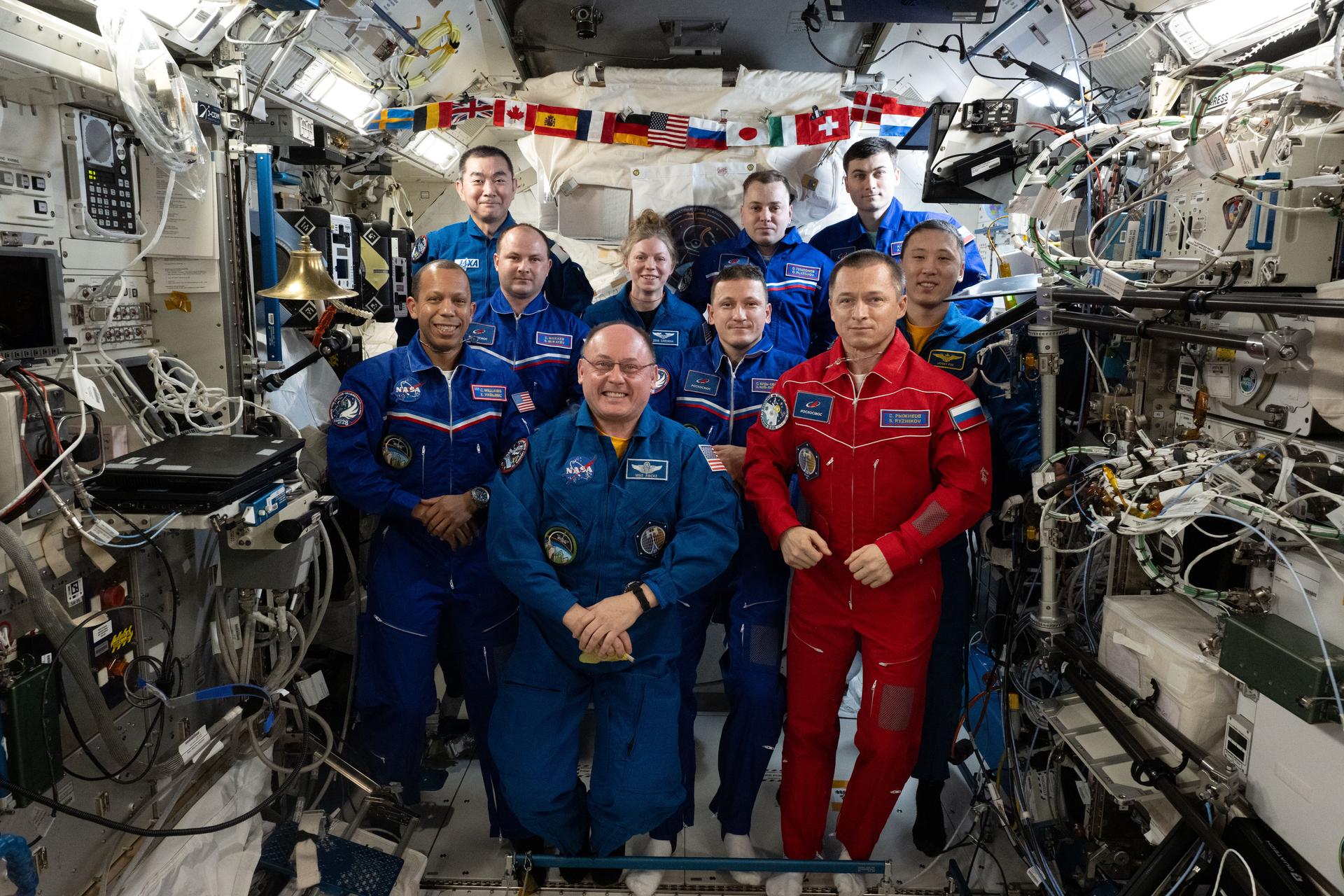
The Expedition 74 crew explored how living in space affects the brain and blood circulation on Friday to ensure crews stay healthy and ensure long-term mission success. The International Space Station residents also focused on spacewalking tools and science hardware maintenance wrapping up the week.
NASA Flight Engineer Chris Williams began his shift on Friday collecting his blood and urine samples for analysis then stowing them in a science freezer. Afterward, Williams participated in a pair of tests to document potential space-caused changes to brain structure and performance for the long-running CIPHER investigation. The first test measured his spatial cognition, or ability to orient himself in weightlessness, while the second test recorded his reactions as he practiced Canadarm2 robotic arm maneuvers during a computer simulation to capture a cargo spacecraft. Doctors will use the results to evaluate cognitive performance and develop tools to monitor and protect the brain in microgravity.
Station Commander Mike Fincke of NASA and Flight Engineer Kimiya Yui of JAXA (Japan Aerospace Exploration Agency) took turns studying how blood flows from the brain to the heart to understand cerebral and cardiac efficiency in space. The duo wore electrodes and sensors on their neck, collarbone, and ribs measuring blood flow and volume changes that may lead to space-related cardiac issues such as blood clots or arterial stiffness.
Roscosmos cosmonauts Sergey Kud-Sverchkov and Sergei Mikaev also explored vascular health wearing chest electrodes and blood pressure cuffs on the arms, wrists, and fingers for their space agency’s Endothelium human research experiment. They were studying how the inner lining of blood vessels works to keep blood flowing smoothly, regulate pressure, and prevent clots in crew members. Doctors are monitoring how weightlessness and space radiation affect a cosmonaut’s arteries, blood pressure, and heart during a spaceflight.
NASA Flight Engineer Zena Cardman was back inside the Quest airlock on Friday organizing spacewalking tools and wearing virtual reality goggles training how to operate a spacesuit emergency jetpack. The jet pack, officially called Simplified Aid For EVA Rescue, or SAFER, enables a spacewalker to maneuver safely back to the orbital outpost in the unlikely event they become untethered.
Roscosmos Flight Engineer Oleg Platonov finalized an overnight photography session that automatically photographed Earth landmarks in near-ultraviolet wavelengths during the crew’s sleep shift. Next, Platonov replaced a vacuum pump and transferred liquids during standard orbital plumbing maintenance. Finally, the first-time space flyer checked video recording gear and formatted video memory cards wrapping up his work week aboard the orbiting lab. The Expedition 74 crew members will call down to family members, share gifts and meals, and celebrate Christmas and New Year’s Eve in orbit.
Pending further mission updates in December this will be the last International Space Station blog post of 2025. The next regular blog update is planned for Monday, Jan. 5, 2026. You can also visit nasa.gov/station on the web or @space_station on X, ISS Facebook, and ISS Instagram on social media for the latest mission information.
Get the latest from NASA delivered every week. Subscribe here.
