


















By Eric Lindstrom How do you spell physical oceanography? I know my answer for that question! It’s easy: CTD. For about the last 40 years, the mainstay of physical oceanography has been profiling the ocean with sensors for Conductivity, Temperature, and Depth (CTD). The SPURS cruise is no exception. These are key properties to derive […]
Hello, Knorr? It’s The International Space Station Calling
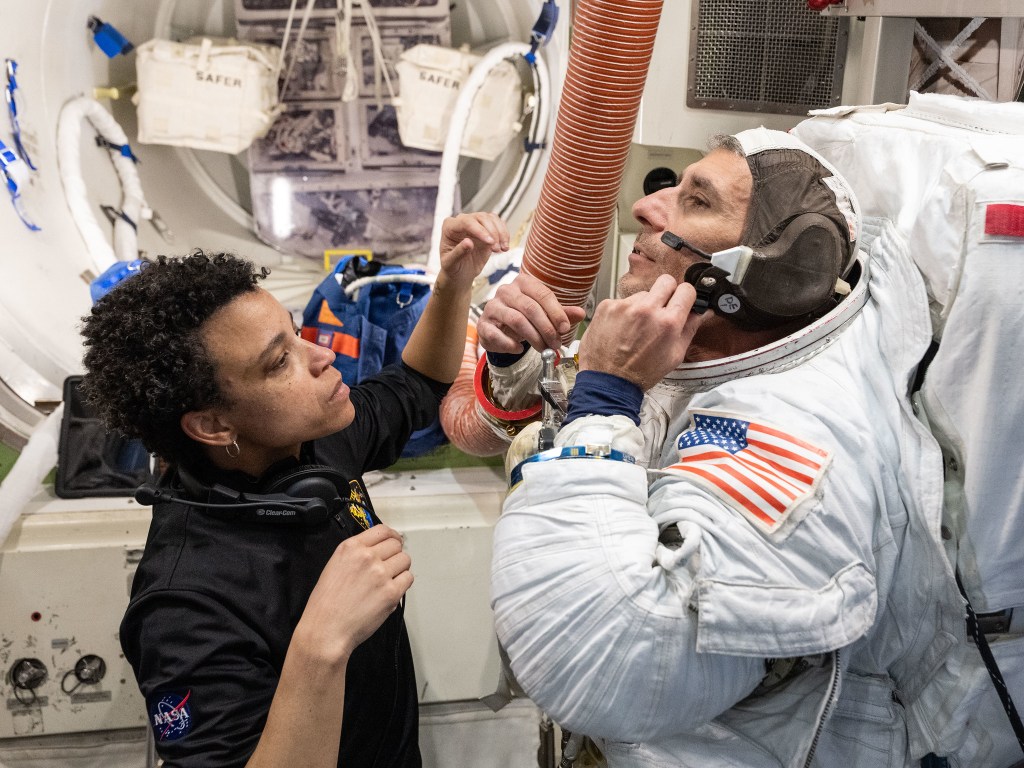
By Eric Lindstrom Friday, 5 October 2012 — We got a call today from the Commander of the International Space Station (ISS), Sunita “Suni” Williams. Suni, who was calling while the ISS was passing over Eastern Russia, wanted to congratulate us on our SPURS expedition. We had 30 minutes of wide-ranging conversation about life at […]
October Puzzler
Every month, NASA Earth Observatory will offer up a puzzling satellite image here on Earth Matters. The fifth puzzler is above. Your challenge is to use the comments section below to tell us what part of the world we’re looking at, when the image was acquired, and what’s happening in the scene. How to answer. […]
Measurements by long-term autonomous platforms in SPURS
By Eric Lindstrom A team of scientists from University of Washington is focusing on long-term observations in SPURS region with autonomous instruments: Argo floats (Drs. Stephen C. Riser, Jeffrey Nystuen, and student Jessica Anderson), Seagliders (Drs. Craig Lee, Charlie Eriksen, and Luc Rainville), and Lagrangian floats (Drs. Eric D’Asaro and Andrey Shcherbina). Their sentinel instruments […]
September Puzzler Answer
Congratulations to Carl Schardt, Conan Witzel, and David Haycock for being some of our first readers to work out that the September puzzler showed part of Queensland’s Channel Country. Carl quickly recognized it was the Simpson Desert, but it took Conan and David a few days to pinpoint the exact area shown. If you missed […]
Prawlers, Engineers, and the Future of Oceanography at Sea
By Eric Lindstrom A number of the instruments deployed during SPURS are “works in progress.” They work well, but need exercise in new or more challenging environments to perfect them. The whole of SPURS is an experiment, taking salinity measurement in the ocean to an entirely new level. Extended deployment of sensor webs in hostile […]
What is ocean microstructure and why study it?
By Eric Lindstrom “The techniques I developed for studying turbulence, like weather, also apply to the stock market.” Benoit Mandelbrot If Mandelbrot’s statement is true, maybe oceanographers studying ocean microstructure (caused by turbulence), besides writing journal articles about mixing in the ocean also work on padding their retirement accounts with stunning stock market acumen? Jokes […]
The Bridge Of The Knorr
By Eric Lindstrom Almost everyone can imagine the bridge of a ship – from the movies, a tour of a ship, or maybe you are the master of your own vessel. It is the place where control of all ship operations is commanded. On the bridge of the Knorr, an officer and a seaman are […]
Managing SPURS Data
By Eric Lindstrom The complex job of managing the data from SPURS is daunting because of the number of different platforms and data streams that need to be logged and cross-calibrated. Overall, by NASA standards, we are dealing with relatively small quantities of data (Gigabytes) but there are many,many different sensors and platforms involved. The […]
Modeling And The Dry Side of SPURS
By Eric Lindstrom Yi Chao is one of the “spiritual leaders” of our “dry” team in SPURS (those people who help from land). He is an ocean modeler in California who has been involved with Aquarius and SPURS for many years. He long ago decided to be on the dry team because of the seasickness […]