
























The launch team picked up the count to today’s launch again at the T-2 hour mark after a planned hold. The next step is to begin loading cryogenic – or super-cold – propellants into the Atlas V first stage and Centaur upper stage. Liquid oxygen with a temperature of minus-297 degrees will be pumped into …
Launch Teams Ready for Cryogenic Propellants Loading
The countdown is on schedule to day to resume at 11:18 a.m. EST after launch teams confirmed they are ready to begin filling the Atlas V booster and Centaur upper stage with cryogenic – super-cold – propellants.
Blogular Feeds Available, Too
BTW, you can get automatic updates from NASA’s MAVEN Launch Blog by subscribing to our feed at blogs.nasa.gov/maven/feed
NASA Launch Team Ready for Cryo Loading
Omar Baez, the NASA Launch Manager, received a “go” from his launch team to load the cryogenic propellants. The United Launch Alliance will next poll the Atlas V team. Everything remains on schedule to launch at 1:28 p.m. EST.
MAVEN, Atlas V Countdown Coverage Starts Now!
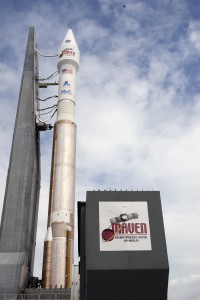
Good morning from Cape Canaveral Air Force Station in Florida where the weather is warm, the sky is blue with some thin cloud streaks and MAVEN stands atop an Atlas V rocket poised to head to Mars! The launch teams here report everything is on track for a liftoff at 1:28 p.m. EST. If some …
Planned Countdown Hold Begins
At T-2 hours, the countdown clocks have paused for 30 minutes. Everything remains on schedule for launch at 1:28 p.m. EST. The countdown will resume at 11:18 EST and the launch team will begin the steps to load cryogenic propellants into the Atlas V first stage and Centaur upper stage.
The Launch Pad This Morning
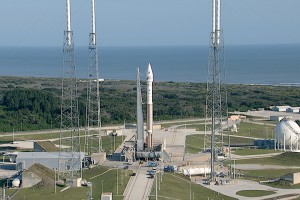
Here’s a look at the Space Launch Complex-41 at Cape Canaveral Air Force Station in Florida this morning where the Atlas V with MAVEN aboard is going through launch preparations. Our continuous coverage here on the NASA Launch Blog and NASA TV’s coverage of the countdown will begin at 11 a.m.
Saturday’s Rollout (Video)
Take a look at the rollout of the Atlas V rocket carrying MAVEN from the Vertical Integration Facility to the launch pad at Space Launch Complex-41 at Cape Canaveral Air Force Station in Florida.
Countdown Under Way For MAVEN
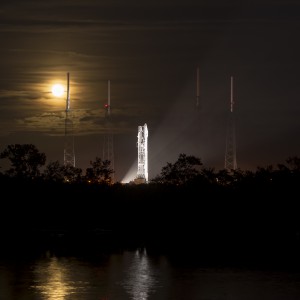
MAVEN’s launch team began today’s countdown on schedule at 6:28 a.m. Managers from NASA and United Launch Alliance are overseeing today’s preparations and launch of the MAVEN spacecraft to Mars atop an Atlas V-401 and Centaur upper stage. Liftoff remains on schedule for 1:28 p.m. EST, the start of a 2-hour launch window. Our continuous countdown …
ISS Daily Summary Report – 11/15/13
Diapason Experiment: Flight Engineer (FE)-5 Mastracchio set up and powered on the Diapason instrument for the final test run. This experiment studies nano-particle migration and capture achieved by very small thermal gradients. The particle size range allows the monitoring of combustion-generated pollution and the identification of atmospheric contaminants on-board ISS. Ocular Health (OH) Measurements: FE-6 …