



















What’s a Chase Plane and Why Does the X-59 Have One?
You may have noticed that NASA’s X-59 has a shadow – another aircraft trailing it from a safe distance. That sidekick is known as a “chase plane,” and it has an important role in NASA’s Quesst mission.
Chase planes are commonly used during the flight testing of major experimental aircraft, providing an extra layer of observation and support for test pilots.
The X-59’s chase is either an F-15 or F/A-18, piloted by another test pilot, often with a photographer or videographer in the second seat. The chase plane’s primary role is to help with communication between the two pilots and control room and monitor the X-59 while it hits different test objectives, such as reaching a range of speeds and altitudes while the team collects data. In later phases of the Quesst mission, the X-59 will fly solo more frequently but require a safety chase plane for some flights.
Watch the latest 59 seconds on NASA’s X-59 with lead X-59 test pilot Nils Larson to learn more about the job of the chase plane and see them in action.
X-59 in 59
Welcome to 59 seconds on X-59! In this series, test pilot Nils Larson takes you on a behind-the-scenes look at what it takes to fly the X-59.
View 59 in 59 on YouTube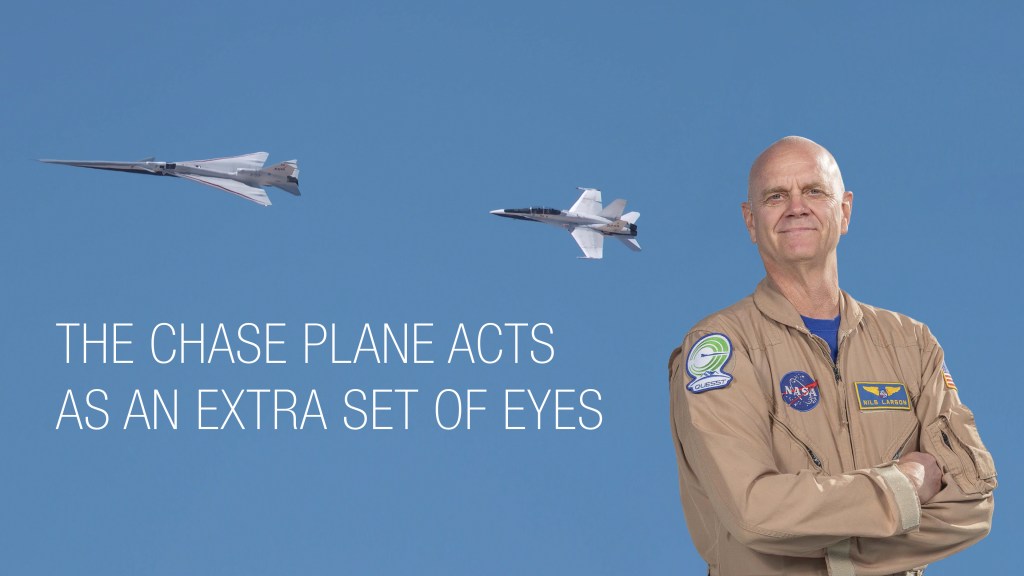
More X-59 to Explore

Read more on the Quesst mission page.
