









A.C. Charania
Zeno Power Systems, Inc.
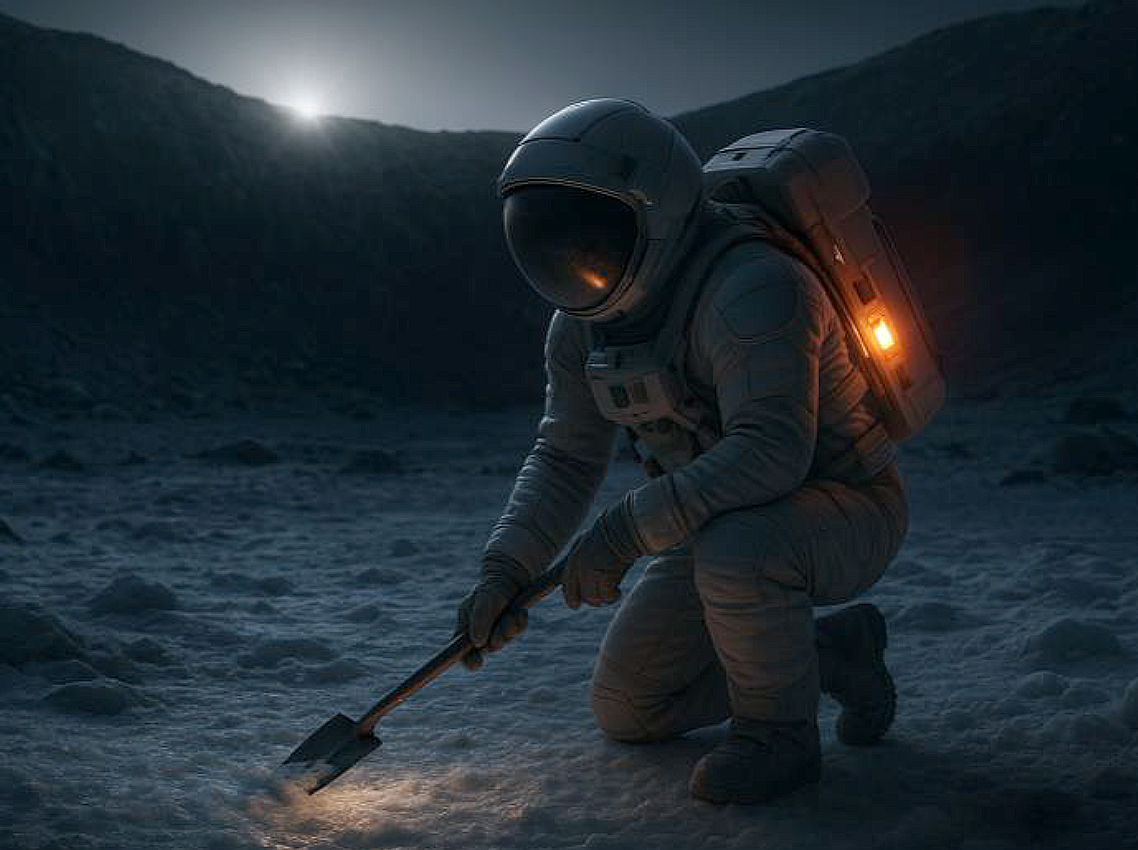
EARENDIL addresses a critical barrier to sustained human operations on the lunar surface: the extreme cold of permanently shadowed regions (PSRs) and the two-week lunar night. These environments impose severe thermal constraints on astronauts, limiting mission flexibility, endangering safety during contingencies, and curtailing scientific access to volatile-rich, cryogenic terrains. The central objective of this proposal is to assess the feasibility of integrating compact americium-241 (Am-241) radioisotope heat sources into extravehicular activity (EVA) suits to provide astronauts with continuous, passive warmth during extended surface operations in these extreme environments.
EARENDIL proposes a fundamentally novel application of space nuclear technology: wearable radioisotope thermal systems for direct astronaut life support. Unlike traditional radioisotope power systems (RPS) used for spacecraft, EARENDIL integrates heat sources within the astronaut spacesuit itself, providing distributed, reliable heat to maintain operational body temperature independent of external power or habitat support. This Phase I study will employ a multidisciplinary approach combining thermal modeling, health physics assessment, and systems integration analysis to evaluate the technical and safety feasibility of this concept. Specifically, it will address key unknowns related to heating requirements, mission dose rates, human factors, and compatibility with existing EVA suit architectures.
The significance of this work is tightly aligned with NASA’s Space Technology Mission Directorate and Exploration Systems Development Mission Directorate priorities, directly addressing the #1/#2 identified technology gap: enabling operations and survival through the lunar night. By extending the operational range and duration of EVAs into PSRs and nighttime environments, EARENDIL enhances crew safety during habitat power failures, reduces reliance on heavy battery systems, and unlocks new opportunities for science and resource utilization in previously inaccessible regions. This capability is critical for the Artemis program’s long-term objectives at the lunar south pole and directly supports NASA’s broader ambitions for sustainable exploration architectures on the Moon and Mars.
If feasible, EARENDIL would redefine the thermal management paradigm for human spaceflight, offering a mass- and power-efficient solution to one of the harshest constraints on lunar exploration. Beyond immediate mission applications, this concept advances the broader understanding of integrating nuclear technologies into astronaut systems, informing future designs for resilience, redundancy, and human survival in extreme extraterrestrial environments.