












Gilly Elor
Stone Aerospace, Inc.
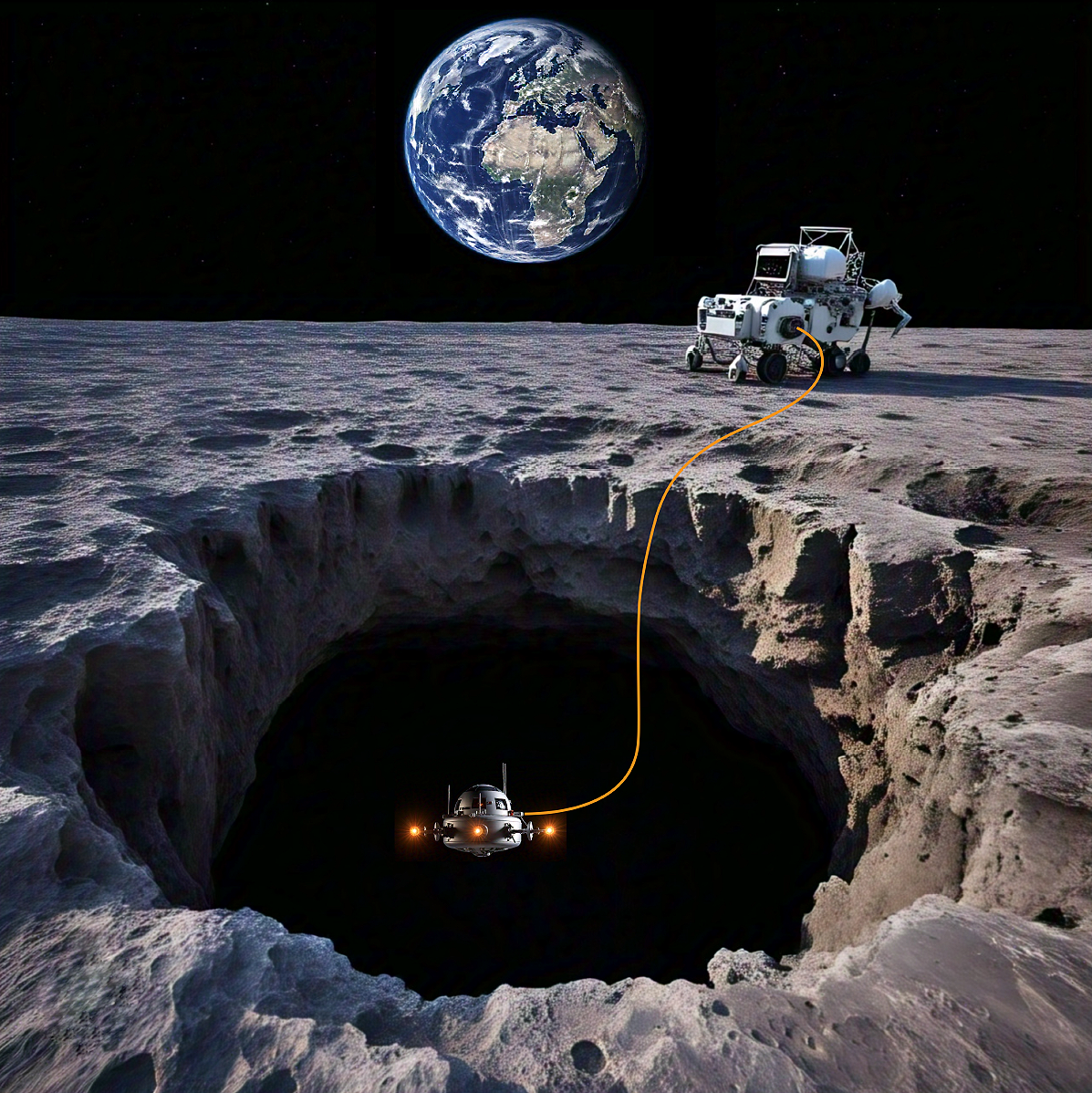
Lava tubes are one of the most interesting and entirely uncharted targets for lunar science and exploration. The Mare Tranquillitatis lunar skylight measures approximately 100m by 88m across and is 133m deep. Lunar Reconnaissance Orbiter data indicates the pit leads to an extensive subsurface lava tube that may continue for kilometers. The Lunar Underground eXplorer (LUX) mission seeks to explore and map these tunnels to assess their merits as sheltered sites for crewed lunar bases (naturally protected from cosmic radiation), and address scientific questions that could lead to discoveries in planetary geology and astrobiology. There are serious challenges with such exploration. It requires vertical entry; the morphology will be complex; there is no possibility of wireless data transmission to the lander; it will be energetically demanding (due to complete darkness); exploration and navigation within completely un-mapped 3D overhead environments is energy intensive and there is no GPS navigation aiding; critically, the system must be non-polluting so as to not affect sensor measurements of the pristine environment.
We propose transmitting laser power-over-fiber (PoF) to enable a hovering robotic lunar lava tube exploration and scientific mission. As one or more LUX vehicles descends down the Mare Tranquillitatis pit (and into the tunnels beyond) a thin, light, robust, optical waveguide (fiber) is spooled out from an on-vehicle spooler. A lander or rover carries a laser (and its power source) which delivers PoF to a LUX exploration vehicle. A vehicle-deployed fiber waveguide will enable three novel capabilities: assured high speed non-line-of-sight data transmission; onboard electrical power generation; and laser enhanced specific impulse (Isp) for a non-polluting cold-gas propulsion system. Taken together we posit that these will significantly enhance the range, duration, and quality of science and exploration for subsurface lunar (and eventually Martian) exploration. While other lunar lava tube mission proposals exist, none have the unique combinations of enabling elements of our concept.
The proposed NIAC work will be a feasibility study to demonstrate that PoF technology could enhance range and duration sufficiently to enable the LUX mission. Our prior work shows that vehicle-deployed fiber is highly effective for data transfer and extending mission duration, even with a small board-level (1-2 kW) laser. The key unknown is the potential Isp (and therefore range) improvement from PoF laser-heated propulsion. This will be assessed through a full end-to-end SWaP-optimized system design, focusing on laser heating effectiveness for a given propellant and thruster design. We will consider various heat transfer strategies to maximize Isp for a fixed propellant mass. Design choices will balance LUX’s size, mass, payload, and propellant with the laser power needed to achieve substantial penetrations in the lava tube. A LUX mission CONOPs will evaluate the ability to meet science goals within mass and duration constraints, accounting for mission uncertainties and mitigation strategies. Our Mission CONOPS team blends a unique combination of expertise in terrestrial analog cave exploration with planetary mission planning. By addressing risks tied to the cave’s unknown nature, our Phase I final report will also serve as a guide for any future lunar cave mission planning. Phase II would involve sub-scale laboratory tests to quantifiably measure increased Isp using a 1070nm fiber laser transmitted over a kilometer of fiber-optic waveguide.
The proposed study could enable the first off-world cave exploration. This could also advance other planetary exploration applications requiring non-line-of-sight power delivery to remote locations. Additionally, our technology has broad dual-use potential for terrestrial applications, enabling long-range continuous optical power transmission to mobile platforms on land, in air, or underwater.