



















Space Tech Industry Partnerships
The Space Technology Mission Directorate (STMD) uses partnerships to expand important space technologies and capabilities. These opportunities encourage collaborations with the commercial space sector that leverage emerging markets and capabilities to meet NASA’s strategic goals and industry needs. NASA’s investments in industry partnerships can reduce development costs and accelerate the infusion of emerging space system capabilities. While developing technology to enable NASA’s next generation of science and human exploration missions, the agency will help grow the economy and strengthen the nation’s economic competitiveness.
Selection Announcements
| Advanced Cooling Technologies, Inc. 3D-printed Loop Heat Pipe with Deployable Radiator Panel and Thermal Control Valve Flight Test Lancaster, PA | Lockheed Martin Space Such Great Heights – Advancing Vertical Solar Array Technology Capabilities for Surface Application Littleton, CO |
| Advanced Space LLC Distributed Small Spacecraft Autonomy in Cislunar Space Westminster, CO | Lunar Outpost Inc. Distributed Autonomy for Scalable Intelligent Fleets Arvada, CO |
| Advanced Space LLC Integration of Onboard Autonomy for Flight Demonstrations Westminster, CO | Made in Space, Inc. Advanced Regolith Sintering for Thermal Management on the Lunar Surface Jacksonville, FL |
| Aerojet Rocketdyne of DE, Inc. Actuated High Temperature Fluid Coupling for Liquid Metal Coolant System Canoga Park, CA | Max Space, Inc. Advancement Toward Human Certification of Statically Determinate Ultra-Lightweight Inflatable Pressure Vessel Miami Shores, FL |
| Aerojet Rocketdyne of DE, Inc. Advanced Electric Propulsion system Hall Current Thruster Affordability Improvements Redmond, WA | Mission Space U.S. Corp. Development of a Small-Sized Lunar Dust Monitoring Unit Miami Beach, FL |
| Apech Labs LLC Launch Hardened Deploy and Docking Mechanism Deploy and Docking Verification Testing Buffalo, NY | Moonprint Solutions, LLC Evaluation of Dust Mitigation Covers for Rovers and Robotics on the Moon and Mars Dover, DE |
| Astrobotic Technology, Inc. Advancing Scalable Spacerless Multi-Layer Insulation Enclosures Toward Flight Readiness Pittsburgh, PA | Motiv Space Systems, Inc. Risk Reduction for the Commercialization of Future ISAM Missions Leveraging the Fly Foundational Robots Platform Pasadena, CA |
| Axiom Space, LLC Multiscale Modeling of Microgravity Effects on Aluminum Nitride Crystal Growth via Physical Vapor Deposition Houston, TX | Opterus Research and Development, Inc. Opterus Solar Sail Boom Testing Loveland, CO |
| Blue Origin, LLC Space to Surface Deceleration Capabilities Assessment Renton, WA | Orbital Composites, Inc. 3D-Printed Composite Nozzles for Next Generation Solid and Liquid Rocket Engines Campbell, CA |
| Busek Co. Inc. Duration Test of Low Power Krypton Hall Effect Thruster Natick, MA | Psionic, LLC Demonstrating Terrain Contour Map and Expanding the Operational Envelope of Psionic NDL-based Navigation Suite Charlottesville, VA |
| Canopy Aerospace Inc. Proving Performance of Alternative Carbon Ablators to Unlock In-Space Manufacturing Littleton, CO | Quadrus Corporation Advancing the Readiness of the Additively Manufactured, Dexterous, Leak-Proof Interface (ADLI) Huntsville, AL |
| Chase Supply Inc. Development and Environmental Testing of Digital Electronics for Flight Coriolis Flow Meter Application Hampton, VA | Rogue Space Systems Corporation Orbot™ Simulation, Testing, and Validation for Rendezvous, Proximity Operations, and Capture/Docking Laconia, NH |
| Dcubed USA LLC Advancement and Flight Test of Hybrid Carbon Fiber – Photopolymer In-Space Manufactured Booms Berthoud, CO | Starcloud Inc. Flight Demonstration of High-Performance Computing for In-Orbit Autonomy and Exploration Redmond, WA |
| Elementum 3D, Inc. Reactive Additive Manufacturing Permeable Integrated Structures (RAMPIS) Erie, CO | Starpath Robotics Inc. HELION: High-speed Exploration using LIDAR for Intelligent Onboard Navigation Hawthorne, CA |
| Enduralock, LLC OneLink Satellite Docking System and Robotic End-Effector for ISAM Portland, OR | STOKE Space Technologies Advancing Nova Stage 2 Entry, Descent, and Landing Kent, WA |
| General Galactic Technologies Corporation Advancing Critical Subsystems of Genesis, a Water-based, Dual-Mode Propulsion System El Segundo, CA | Teledyne Energy Systems, Inc. Space-rated Hydrogen Electric Power System (SHEPS) Hunt Valley, MD |
| Hebi Robotics, Inc. Modular Robots for Low Cost, Rapid Implementation of ISAM Systems (MORRIS) Pittsburgh, PA | Ten One Aerospace LLC Advancing Autonomous Rendezvous, Proximity Operations, and Docking Annapolis, MD |
| Hyperion Transport Systems Inc. Development Test Campaign for an Applied-Field Magnetoplasmadynamic Thruster with Superconducting Magnet Allendale, MI | Varda Space Industries, Inc. Heating Augmentation Tips for In-Flight Testing of Advanced Thermal Protection Systems El Segundo, CA |
| Kall Morris Incorporated Asteria: Payload Attachment for On-Orbit Servicing Marquette, MI | Venturi Astrolab, Inc. High-Power Dust-Tolerant Actuators for Lunar Environment Applications Hawthorne, CA |
| Lockheed Martin Inc. Space Technologies for Robotic-Assembly, Acceptance Testing, and Outfitting of Space-Infrastructure (STRATOS) Emerald Hills, CA | Zeno Power Systems, Inc. Irradiation Testing of Sunpower Robust Stirling Convertor Organics Washington DC |
| Lockheed Martin Inc. Beaming Over Lunar Surfaces Testing New Orleans, LA |
Tipping Point
Through the Tipping Point Announcement for Partnership proposals, NASA seeks industry-developed space technologies that can foster the development of commercial space capabilities and benefit future NASA missions. A technology is considered at a tipping point if an investment in a demonstration will significantly mature the technology, increase the likelihood of infusion into a commercial space application, and bring the technology to market for both government and commercial applications. The partnerships established through Tipping Point selections combine NASA resources with an industry contribution of at least 25% of the total project resources (10% minimum for companies with 500 or fewer employees), shepherding the development of critical space technologies/capabilities to stimulate commercial space economy while also saving the agency, and American taxpayers, money.
Beginning in 2022, selected Tipping Point proposals will be awarded as funded Space Act Agreements.
Announcement of Collaboration Opportunity (ACO)
Through the Announcement of Collaboration Opportunity (ACO), NASA helps reduce the development cost of space technologies and accelerate the infusion of emerging commercial capabilities into future missions. Resulting in unfunded Space Act Agreements, NASA centers partner with selected companies to provide expertise, facilities, hardware and software at no cost.
Current Opportunities for Proposals
There are no open opportunities at this time. To see what other STMD opportunities might be best suited for you, visit TechPort:
Go to TechPort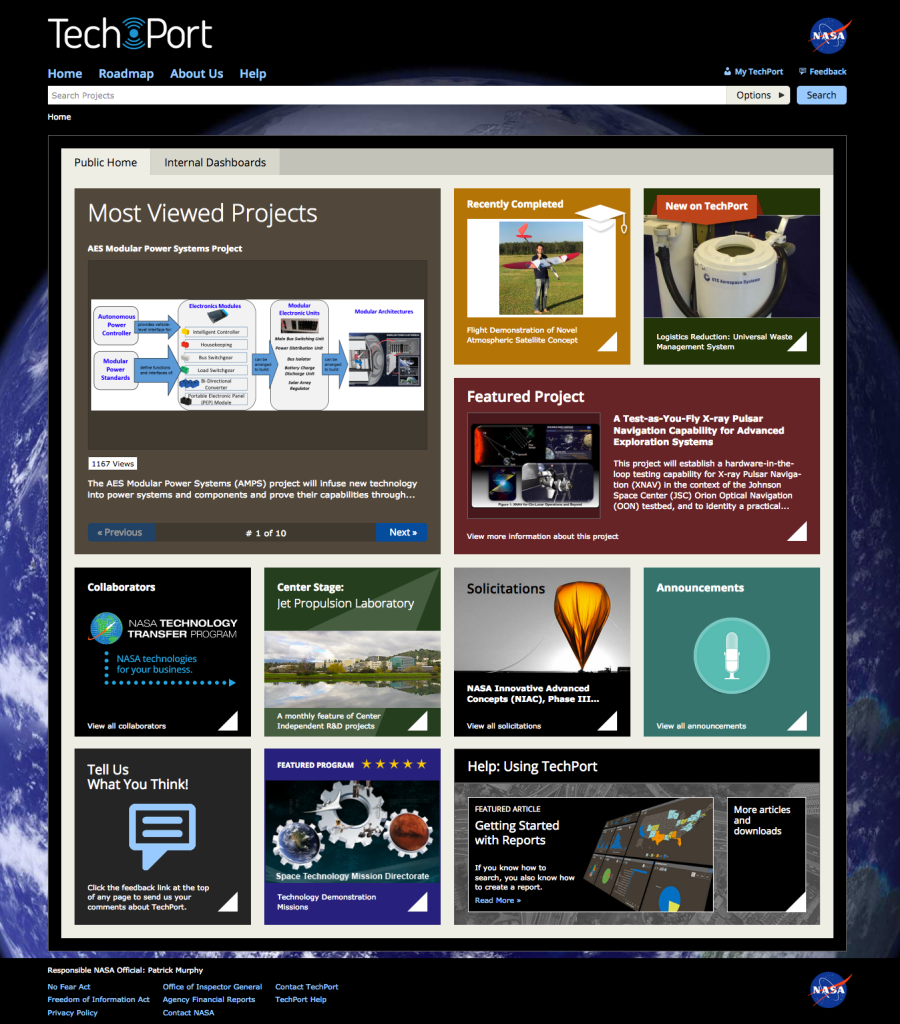
Past Opportunities
February 2022 Tipping Point Solicitation:
Announcement for Partnership Proposals to Advance Tipping Point Technologies
July 2023 Tipping Point Selection Release:
https://www.nasa.gov/press-release/nasa-partners-with-american-companies-on-key-moon-exploration-tech
https://www.nasa.gov/directorates/spacetech/solicitations/tipping_points/2023_selections
February 2022 ACO Solicitation:
Space Technology Announcement of Collaboration Opportunity (ACO)
April 2023 ACO Selection Release:
NASA Selects 12 Companies to Collaborate on Key Technology Development
January 2020 Tipping Point Solicitation:
Utilizing Public-Private Partnerships to Advance Tipping Point Technologies
October 2020 Tipping Point Selection Release:
NASA Announces Partners to Advance ‘Tipping Point’ Technologies for the Moon, Mars
More information about the 2020 Tipping Point Selections
January 2020 ACO Solicitation:
Announcement of Collaboration Opportunity (ACO)
November 2020 ACO Selection Release:
New NASA Partnerships to Mature Commercial Space Technologies, Capabilities
More information about the 2020 ACO Selections
February 2019 Tipping Point Solicitation:
Utilizing Public-Private Partnerships to Advance Tipping Point Technologies
September 2019 Tipping Point Selection Release:
NASA Announces New Tipping Point Partnerships for Moon and Mars Technologies
October 2018 ACO Solicitation:
ACO 2018: Space Technology Announcement of Collaboration Opportunity
July 2019 ACO Selection Release:
NASA Announces US Industry Partnerships to Advance Moon, Mars Technology
November 2017 Tipping Point Solicitation:
Tipping Point 2017: Utilizing Public-Private Partnerships to Advance Tipping Point Technologies
August 2018 Tipping Point Selection Release:
NASA Announces New Partnerships to Develop Space Exploration Technologies
August 2016 Tipping Point Solicitation:
Utilizing Public-Private Partnerships to Advance Tipping Point Technologies
February 2017 Tipping Point Selection Release:
NASA Establishes New Public-Private Partnerships to Advance U.S. Commercial Space Capabilities
May 2015 ACO Solicitation:
Utilizing Public-Private Partnerships To Advance Emerging Space Technology System Capabilities
May 2015 Tipping Point Solicitation:
Utilizing Public-Private Partnerships to Advance Tipping Point Technologies
November 2015 Combined Tipping Point and ACO Selection Release:
NASA Announces New Public-Private Partnerships to Advance ‘Tipping Point,’ Emerging Space Capabilities