















From Earth orbit to the Moon and Mars, explore the world of human spaceflight with NASA each week on the official podcast of the Johnson Space Center in Houston, Texas. Listen to in-depth conversations with the astronauts, scientists and engineers who make it possible.
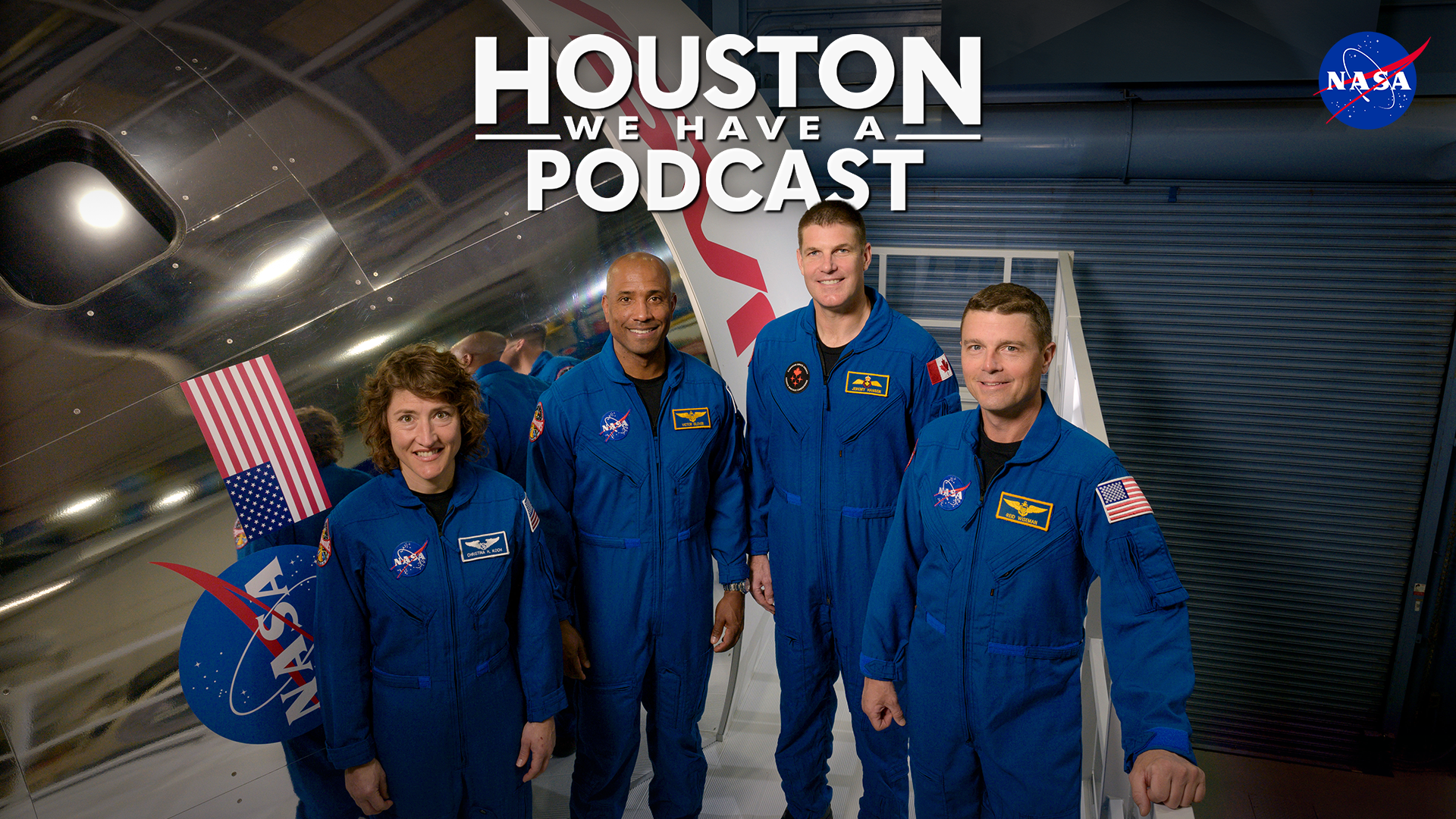
On episode 417, the Artemis II crew share how they got to where they are today and reflect on what it means to prepare for humanity’s return to the Moon. This episode features a special collaboration between Houston We Have a Podcast and NASA’s Curious Universe. This episode was recorded October 23, 2025.

Transcript
Nilufar Ramji
Houston We Have a Podcast. Welcome to the official podcast of the NASA Johnson Space Center. Episode 417: Artemis II: The Crew. I’m Nilufar Ramji, and I’ll be one of your hosts today. On this podcast, we bring in the experts, scientists, engineers and astronauts all to let you know what’s going on in the world of human spaceflight and more.
I mentioned that I’m only one of your hosts, because for the first time in the eight years that Houston We Have a Podcast has been running, we are teaming up with our sister-show, Curious Universe. Joining me as my co-host today is Jacob Pinter.
Jacob, welcome.
Jacob Pinter
Hey, Nilufar. It’s great to be here.
I work on NASA’s podcast, Curious Universe. On Curious Universe, we explore the cosmos with NASA experts from our home planet, all the way across this wild and wonderful universe that we all share.
Nilufar Ramji
Well, thanks so much for being here Jacob.
In November of 2022 the Space Launch System rocket launched from Kennedy Space Center in Florida with the Orion capsule atop for a 25 day uncrewed test flight around the moon. It was a great success, and just months after its return, NASA announced the crew of the next mission going to the moon, Artemis II.
Jacob Pinter
Artemis II will take four astronauts on a 10 day mission around the moon. They are NASA astronauts, Commander Reid Wiseman, pilot Victor Glover and Mission Specialist Christina Koch and Canadian Space Agency astronaut Jeremy Hansen, they’ll test the Orion spacecraft and all of its systems in preparation for later Artemis missions, where crew members will be landing on the moon.
Nilufar Ramji
Jacob and I got to speak to the crew last fall ahead of their mission, to talk about how they got to where they are and what going to the moon means to them.
Ready for lift off!
<Intro Music>
Nilufar Ramji
Welcome back to Houston We Have a Podcast. We’re so happy to have you here and we wanted to jump right in to get to know all of you as much as possible. So y’all have some deep roots with each other going back to the selection as astronaut candidates. Reid and Jeremy, y’all were in the Astronaut Group 20, AKA The Chumps in 2009. And Victor and Christina, you were both in Astronaut Group 21, the 8-Balls in 2013. So first off, tell us a little bit about what your first impressions were of each other. I’ll open it up.
Reid Wiseman
Well, Jeremy asked me to move in with him when I was looking for a place to live when we first got here, and I was like, there is no way I’m moving in with that guy. Like, we’ll never graduate from our astronaut candidate, period. So I said no, and I rented a little apartment down by Kemah, Texas for our transition here with my family. And I look back and really regret that. I think we would have had a lot of fun if I said yes to that request.
Jeremy Hansen
Yeah, you should regret that life choice.
Nilufar Ramji
Anything to counter that, Jeremy?
Jeremy Hansen
Not really. No. I’ll leave it at that. You got enough from that. That snippet.
Christina Koch
I think, for me, first impression, was coming off of a very long road trip from Montana to be here in the heat of summer where my air conditioner on my car broke, I remember meeting Victor and his family and his four daughters, who were very young at the time, and them just being so gracious and kind. But my biggest memory of Victor from our astronaut- from Ike, of our astronaut candidate years, was something he said to our entire class to start us out on the right foot and set the stage for what I think was a really successful training period. And he said our goal as a class is to cross the finish line together, and I will never forget that. It set the bit for what an amazing human you are. And I think about that all the time.
Victor Glover
Wow. I’m gonna need a minute.
Jacob Pinter
You looked really concerned.
Victor Glover
I said a lot during that time.
You know it’s you were asking about first impressions. And I cannot remember a first but I have several, like significant impressions from, from Christina in that time, for example, you’ll hear me say Nana Notes, referring to the best notes ever. She took the best notes, and really made sure that all of us knew the same thing, so we would all graduate together. And it just became a term for writing the right things down.
But my the biggest, the single biggest impression that Christina made on me during astronaut candidate training, we were having a conversation about what it was like to transition here from our previous lives. And I just remember a moment in this conversation where I felt like, Oh, you think this place is like the military, it’s not. And she’s like, wait, you think this place is like the civilian world, it’s not. And so, I just remember feeling like, Okay, that’s cool. We’re both in a culture that’s new to us, and that was, that was a that was a very important part of my transition to NASA.
Nilufar Ramji
Seems like it was a big bond forming experience. So tell me how that’s carried into being the Artemis II crew.
Jeremy Hansen
Well, I feel a bit guilty for not giving an impression on Reid, so maybe please go ahead first. Yeah, but I think it ties into this question as well, something that just carried forward. And I think people probably pick up on this from Reid themselves very quickly, but it’s just very easy and natural to have a friendship with someone like Reid, and that just just translated through our entire time here at NASA as part of this crew. It’s just easy, and you never feel like you have to be someone else. And I think that’s just a really important and genuine person.
Nilufar Ramji
I love that. So now let’s talk about this bond as the Artemis II crew, how does how is that experience from meeting each other in your first classes carried over to today and into the mission.
Reid Wiseman
Honestly, I’d say it’s, it’s a lot of work when you when you take four professionals, we’re all very senior astronauts here, at NASA and with the Canadian Space Agency, and it definitely takes a lot of work. So we have really committed to getting to know one another, not just on a topical level, like really digging in, what makes each one of us tick, what kind of sets us off, what gets us motivated, how we respond to emergencies, but also just how we respond to group living. It has been a tremendous amount of work, but the cool thing for this crew is just how much effort we have been willing to put into it, and that is going to serve us really well when we got to spend 10 days together in the Integrity spacecraft going around the moon.
Jacob Pinter
Do you remember one moment when you realized, like, we have fused into one unit, one team, one something…
Christina Koch
I have one we did a National Outdoor Leadership School, kind of training. It’s also called NOLS, something that the Astronaut Office has used for many years to train expeditionary behavior skills. We did sort of a mini version of it. And we did a two day backpacking trip, just us crew and our NOLS, our crew, our prime crew, and our backup crew. So six of us and our NOLS instructor, and there was a moment since we were alone that whole time when we came back, and they actually had a drone fly in over us to film our return from the back country into the front country and coming back to the wider group that we were with. It was a geology trip, so a huge group of instructors and things like that. And I think that transition taught us the real stark difference between the six of us when we’re gelling together as a crew and when we’re on the outside of that which often in our role, we’re performing training in front of other people. And that contrast, for me, sealed the idea of us as a crew of six.
Reid Wiseman
Love that story, and I remember that moment very well. I think we all do.
Victor Glover
Vividly.
Nilufar Ramji
So the four of your names were announced to the world in early 2023. I want to know a little bit about how you were told and how you were feeling in that exact moment.
Reid Wiseman
Everybody always asks this question.
Nilufar Ramji
I know. The world always wants to know. I actually don’t know the answer to that question.
Reid Wiseman
First, we’d have had to have shown up to the meeting on time.
Christina Koch
We were all late.
Victor Glover
We’ll never forget March 7, 2023. A date that will live in infamy.
Christina Koch
We really demonstrated to our leadership that they chose the right crew. None of us were on time.
Reid Wiseman
I missed it all together.
Christina Koch
You had to video chat in.
Reid Wiseman
Oh, yeah, I did.
Christina Koch
Yeah, we were late because I had the wrong impression that it was a virtual meeting, which I took from a different NASA site here. And yeah, I guess I know my impression was when I finally did make it, which about 15 minutes late, walked into the room, saw my boss and my boss’s boss and you. And thought, were you? You weren’t, yeah, just Victor, and those, those other two. And I thought, Oh, wow, we’re in for something here. And sat down and got the question.
Reid Wiseman
Joe Acaba put a meeting on my calendar that was about some Soyuz related thing. And I just, I completely ignored it. And then at some point he texted me, and was like, Are you going to join the meeting? And I said, I just thought this was like, arbitrary type of thing. And so I teamed in from the lobby of a doctor’s office, and I saw those two sitting there with our Big Boss, Norm Knight, the director of flight operations, and then Joe Acaba, the chief astronaut. And I was like, oh boy, I picked the wrong meeting to miss.
Victor Glover
Yeah, so they tried to set it up so that we wouldn’t have any idea what was happening. And I think that that backfired a little bit. You know, it was as much of a joke for them as it was for us. But I think we got there, and I can’t remember the exact words I should, because it was a very powerful moment. You know, they were kind of keeping up the ruse, talking about whatever the subject the, you know, the surreptitious subject was, the pretense. And then Norm says something to the effect of, and he had a folder full of the assignment papers that they sign, but he says, How would you like to fly Artemis II? I believe that was what he said. And I’ll tell you, I’m not going to go into it, but there was a whole lot. There were a lot of feelings, a lot of feelings. And it was a, it was a very profound moment for me. Definitely. There was a lot going on, and it was just a- it was a big moment.
Reid Wiseman
I think most people think you get told that, and you run out like jumping for joy. And I just that is not the that is not the typical reaction to that moment. The typical reaction to that moment is you just, you’re thinking about this whole astronaut office, and there’s very few people that are going to get to go do this. And then you also think about the tremendous workload that’s coming. Who are you going to go fly with? What is now going to be on your shoulders? And so there’s, there’s more of like, I guess maybe it’s because we’re operators. We’re astronauts. We’re always operating. As soon as you find out one piece of information, now it’s on to the next, the next part of this journey. And that, it just kind of felt surreal. But also it was, it was pretty heavy. It was not like, it was not like you just won the lottery and you’re running out and jumping for joy. It was not that feeling at all.
Jacob Pinter
You’re thinking about the to do list, not the accomplishment.
Reid Wiseman
It’s a lot. It’s just a lot of things.
Victor Glover
A lot of things. You know, he said one of them that was really heavy for me at the time, I was the assigned crew Branch Chief, so the the office that is responsible for getting astronauts prepared directly for their missions, supporting them while they’re in flight, and then transitioning them, transitioning them back when they get home. And that Job was really meaningful, and we are also trying to change some things and to really make that time in that branch what it ought to be for the crew members and their families. And I was not even a year, I was 11 months into that job, and I was really hoping to do it for two years. And so one of the first thoughts you touched on this, too, in a different way, is the impact that that assignment will have on the rest of the office. And I will tell you that I don’t talk about it much, but I felt like I was letting that group down. And so it was, it was hard for me to just be happy, because it felt selfish.
That’s and then also, and then there’s this other thing that, and this is a part of what I think Reid was getting at a second ago too, is there’s only a handful of these assignments ever, and these four people in this office, full of folks who have flown shuttle a little bit, which we don’t do anymore, that are flying ISS. And so we had a meeting, so that at least spawned some really good and intentional things. We decided to sit down and write out what was important to us, and one of them was to not divide the office, to not have an us versus them mindset, or to even let that creep in. And so I think we did some good things with with all those feelings. Eventually.
Nilufar Ramji
And how were, how did your families react when you told them?
Christina Koch
My husband was very excited. I actually, we live at the beach, and so we took a bike ride at night out to the end of a jetty when the moon rose, and that’s when I told him. He was very excited and happy for me.
Nilufar Ramji
That’s really romantic! I like that.
Christina Koch
It was actually too foggy to see the moon,
Jeremy Hansen
But it was there.
Victor Glover
You had one job!
Jeremy Hansen
I also was really pleased by their action of my children and my wife. They they were just really excited for me. And even though there’s, you know, there’s a risk aspect to this, they knew it was something that that I was interested in pursuing, and I it just felt really good that they were as excited, genuinely, as excited as they were, which was, felt very supported.
Jacob Pinter
What, um, what’s the biggest lesson that you’ve learned from your crewmates? Either an individual crewmate or just the process of of all being together?
Reid Wiseman
We don’t have enough time.
Victor Glover
Oh, man.
Christina Koch
Overall, I would say I have learned how awesome it can be to have the opportunity, as like an adult, to have a new family, to have people in your life that you can have conflict with, because, of course, you’re literally together almost all day, every day, and to come back together and love each other just as much, and that’s a rare thing outside of your actual immediate family, and we have that with each other, I would say. And learning how awesome of a privilege that is, is what these guys have taught me.
Jeremy Hansen
Yeah, I think that’s a really good point, because in a lot of relationships in your life there, you know, there’s this opportunity where, if something frustrates you, sort of just brush it off, or you walk away from it, or your distance yourself from it. And but in this relationship, it’s not like that. In this relationship, we we lean into it and come out stronger. And that’s, that’s pretty special thing. I’ve also learned, you know, in the my military training, I did a lot of, like, very kind of reacting to situations quickly. And it’s not just this, this mission, but also just being here and the space program, the the value of slowing down. You know, sometimes you still need those instinctual reactions and and how you deal with emergency situations, but in these development programs and these testing programs, there’s just a lot of value in slowing down and and building that skill set to, you know, think through all of the possible things that could be coming before you, you choose an option. And that’s just, that’s a muscle that I’ve had to build. And I think I’ve learned a lot from that perspective.
Victor Glover
The- there’s this belief that, you know, astronauts get along great, and they have to get along great because they live in ISS or some capsule for a long period of time. And I think that’s a part of it. What we do, and what we try to do with NOLS and other of other expeditionary behavior development opportunities, is to make it so that we can combine almost anyone in the office into a crew, and now you’re this smaller team that’s a part of this big team. But I also think I have learned something lately, since since March 7 of 2023 with this group specifically, and I trained with a group of four for a previous, five with our backup, for a previous mission. But with this group, we put some some thought into getting help from professional psychologists psychiatrists, and helping us with performance and and optimizing the human in the human system. And I think the idea that we we still disagree, but I think we disagree pretty well, pretty effectively. We and I just, you don’t hear it like that, you get along great, yeah, but we disagree pretty great too. And I think that’s an important facet, like, and, you know, people hearing some of that messy stuff is, I think, important not to make it rose colored, like we just always show up, smiled, prepared, and things just go well for us. We have some hard things to get through, and we and we do, and it’s not always pretty, but, but we we get back to the mission and and we come out better for it.
Reid Wiseman
Can we go back to talking to our families? Because Victor and I didn’t get to answer, and I don’t know if you want to answer, but I do. I just want to talk about it real quick, because I’m an only parent with two daughters, and it was hard for me to go home and tell them, but I, I’ll just keep this short, but I once I told them, they like, they turned it around in their head to an extremely positive thing. And the next morning, I woke up and my older daughter had made Moon cupcakes for the family, like, and she was the one that was, I think, most against this for her life. And so I just, I thought that was amazing. Like here these two kids, I thought were gonna pull me, but there were pushing me, and I that was, I will never forget that. Like that is exactly the way you want to feel as a parent. It was such a cool moment for me,
Nilufar Ramji
Definitely a proud dad moment.
Victor Glover
Thanks for going back to that. It was so we found out on March 7, the public announcement was April 3. Well, in the month of March, we happened to have an opportunity I had at the time. I had two children away in college, and they’re in California, and so we happened to go out there to visit them. So we were all together in a hotel room. And again, all that stuff is still pretty fresh for me, and it was a heavy conversation, and knowing that, you know, it is this thing, what’s coming there’s the estate planning and all of these other things, and it’s dangerous. You know Dad’s job is dangerous. And I told them, and one of my kids just yelled out, “let’s go!” And it was and that said that it was just contagious, like it caught fire. And Deonna, my wife, already knew, but even her reaction was just different. And I needed that. I need it very similar, like it just was so nourishing to my soul. It was like, okay, yep, we can celebrate. And that’s actually when I started to really feel the celebration. And that day in that hotel room with them made April 3rd a lot easier.
Reid Wiseman
And if you look at Orion as it’s moved from place to place, down at Kennedy Space area, there’s a huge, “Let’s go!” banner on the front of that that’s been signed by the whole team. Like that not only caught fire in your family, but that just thread and weaved itself through the entire team. It’s so great.
Jacob Pinter
And so these conversations you’re talking about, these were more than two years ago, and so now you know these people in your life have seen you going through the training that date on the calendar is getting closer and closer. What are the conversations like now that you’re having with the people you’re close to.
Christina Koch
Well, I will say it got real for my husband when he saw the rocket. We you know, we talk about it a lot, but until that gigantic, 300 foot rocket was in front of him, I don’t think it had really sent sunk in. I don’t think it can, and I don’t think it really ever can fully. But I can say our conversations change that day, and they just feel a lot more real. And I think that internalizing what we’re doing together has has become real.
Jeremy Hansen
I had an experience standing on the roof of the Launch Control Center at Kennedy Space Center with my family on the tour, Reid and I did it together with both our families at the same time, just having to work out, and we were standing up there, and that’s where they’re going to watch the launch from. And that that I could just tell that was a moment for them where they’re like, oh, there’s going to be some emotions on that day. You know, we have to lean into one another and, you know, support mom. And there are just a lot of comments like that. And that was a very real moment for us thinking about those things. And then people ask them. They get asked that a lot is like, what do you think about your dad going on this risky mission around the moon? And I think that definitely, well, I know it has made them contemplate those things, which is good, because you have to think about those realities. We have to have those honest conversations, because the most likely outcome, and this is how I truly feel about it, is that we’ll be fine and we’ll make it back. That is the most likely outcome, but it’s not the only outcome, and we do have to prepare for that as well.
Reid Wiseman
I think when I talk to my kids about that, that’s what was starting to it actually liberated them. I don’t think it scared them. I think it liberated them that we just looked at it head on, and I talked to them if I if I don’t come back, here is here’s where you’ll go, and here’s the estate plan, and here is exactly what I have built this foundation for the both of you. And it’s incredible. It was hard for me to have that conversation, but then it was, it was also very freeing, I think for all of us.
Victor Glover
Yeah, that that is a fact. That’s what just keeps running through my mind, is that there’s a lot of logistics. There’s, you know, and we, we’ve been through a pretty similar circumstance. I launched on Launch Pad 39 A. This time I’ll be on 39B and so some of it is familiar, but my kids were, like, all living at home at the time. Now, two are away and two are home. And so we’ve been talking about the logistics, and some of which is not fun to discuss. But the thing that I have appreciated the most at the end of it, I just sit there and meditate about it, or write about it, pray about it, and I’ve written in my journal several times how this conversation was quick, this one was long, but I’m glad they feel they have the space to say what they think.
The last time around, I thought, you know, training for my first mission. It is my job to put as much effort as NASA puts into preparing me, preparing my family. But it actually is my family’s job to prepare my family. And my kids are all average age adults now, and it’s just really cool to see their contribution. They bring up things and talk about things, the two that are in college, you know they’re not going to come home to quarantine. But when I brought that up, you know that, hey, there’s an option, they were like, no, we’ll come home. If we got to withdraw from school for a semester or a quarter, we’ll come home. And I’m like, Oh, they can make that choice if they want to. I hope they don’t. But they can. I want them to finish school, you know? But it’s been cool just to think about it afterward. Like, wow, all these adults have in this discussion.
Nilufar Ramji
Have you found that your family bonds have strengthened ever since this announcement happened, and since you’ve been training and preparing?
Reid Wiseman
I do think when you have something acute coming in your life, it gives you a chance to pause and think about what is the richness that you’re seeking in life, and it does give you a chance to spend a little more deliberate energy on that. So that’s my perception of it is that, I mean, everything that people do in a daily life can be dangerous, but we have this acute thing on the horizon, and it gives us a milestone that we can kind of plan around, and it does make you far more deliberate on a free weekend. What do we want to do? What valuable time can we spend together? Because the families, let’s face it, we are working hard. We are traveling a lot. We don’t have a we don’t have a tremendous amount of time together. So if we can have those shorter, but much more valuable moments, this acute thing on the horizon, this launch of Artemis II, it gives us that ability to really hone in on that. And I do see every member of the crew doing that.
Victor Glover
I’ve, I’ve really appreciated when I could bring family members along to different events, and that’s been from the very beginning, but especially this time around. You know, there are some unique aspects to this. And I think when they get done and to listen to them reflect on, you know, we took a bunch of our families on some of the public relations events in the very beginning, which were like, kind of all we were doing or in the early time, and and we all went to New York, and I think a lot of our families took part in that trip. And we went to Ottawa, Canada, and we, we took a bunch of family, family members on that. And it’s just neat to listen to them reflect on, wow, that’s like that you had to deal with all of this. And I’m thinking, Man, that’s just Tuesday. So it’s been cool to you know, open the door a little bit more for them. They’ve definitely learned a lot.
Nilufar Ramji
So what’s something about your job that all. All of you understand, but nobody else understands. Specifically related to the Artemis II mission. What’s something that all four of you all get, and everyone else walks in and they’re like, What? What are they talking about? Or why are they doing that?
Jeremy Hansen
Well, just one thing people probably wouldn’t know is, like, just before we came out here to record this and do some filming. We were in a spacesuit, completely covered in sweat, doing emergency egresses from the capsule in Building 9, and then where you completely put on a different hat and come over here and do this. And I just think it’s something people would not expect.
Jacob Pinter
And you look great.
Reid Wiseman
The other thing is neat as a crew member, for good or bad, this mission has been under, you know, under development for a long time, and it is, it is fascinating. As a crew member, the four of us, we are the people that truly see it all together, the way the human is going to operate it. And it, it is neat to watch and see, like you can see a few misses here and there where just people with the best of intentions designed the system the best possible way, but they didn’t see these interactions across even though we have great systems engineering, great integrators, looking at all of this, it’s still when you put a human and this crazy brain and these eyes together, we just see things differently, and that’s been a neat thing. But I think that is something that people don’t expect, is that we still see, we see plenty of areas where we need to dig in a little bit deeper questions that we need to ask systems that aren’t working quite the way the designers thought they were going to work. So that’s been cool, I think, as a Navy Test Pilot, but now as an astronaut, that’s like one of the neatest things that you can possibly do as an astronaut.
Victor Glover
There’s a lot I thought when you brought up Building 9 Jeremy, that you were going to talk about how often we have to pay we have to pee on ourselves. You know, sleeping and using the bathroom in uncomfortable positions and places is actually a very important part of this job, and it can be very challenging to do both. So that’s one I think most people don’t know, but actually I would, I was thinking about something else. You made me think, you put that there.
Reid Wiseman
I’m so glad you went there, Ike! Thank you.
Victor Glover
It’s a reality. I’m not kidding, sleeping and using the bathroom, and it can be a challenge. But, but I don’t I, because I we try very hard not to speak for the crew, for each other, when, when it’s not appropriate. I’m going to take a little bit of liberty here and speak for the crew. We understand why so many people focus on our names, why our pictures hang all over the center, but that we we are happy for humanity sending people to the moon, even though a lot of humanity is happy for the four of us going to the moon. And that little nuance, like it’s not about us, we try very hard to make it not about us. It’s about landing on the moon and eventually landing on Mars, and it’s about the next thing. And I think people hear us say it a lot, but but really that, that that that’s truly our focus.
Jacob Pinter
Jeremy, I have a question for you. Artemis II will be your first trip to space. What is the best advice that you’ve gotten from these three?
Jeremy Hansen
Lots of advice on just how things are different in microgravity and how, I mean, they were just telling me the other day to sim, I was simulating, kind of throwing something across Integrity to one of them, and they’re like, Hey, you’re gonna throw that too hard in space. I’m just telling you right now, you just you got to take some time to get used to it and go slow. So some things like that. You know how we deal with those first few days, from a medical perspective, a lot of advice conversation around that, which is really helpful, trying to figure out the best strategy to do that. And then I also see them carving out time mentally. You know, when we’re doing sims that, hey, let’s just make sure that you take a few moments in these early hours in space to really take it in, like sneak over the window and have a look at the Earth when it’s zipping by. I mean, because even in the sim, the view is just unreal. The things you see in the first few hours when we’re zipping out to 1200 nautical miles, and then back to 100 and then accelerating to 39 times the speed of sound, and just some really cool and amazing views.
Nilufar Ramji
So you have a special patch for this mission as well. Can you tell us a little bit about kind of how it came about?
Jeremy Hansen
So Canada has a very small space program, of course, and we don’t fly very many humans in space. And so we’ve always had a tradition that we have a patch that is created for the Canadian Space Agency for each flight to represent each one of those flights. And so that was sort of a tradition that we’ve long held. And I knew it was coming, but it really just fell into place. It ended up being a gift, really. It was really quite a remarkable story. From my perspective, I developed this relationship with a place called the Turtle Lodge, and that is a center in Manitoba, Canada, where they built this place to bring indigenous perspectives together from across all of North America. Not just Canada, but all of North America. And I went there for some ceremonies. I learned a little bit about some ancient wisdom and how they prepare people to go on journeys traditionally. And I also met this artist. There was lots of artwork on the wall, and so in conversation with the elder at the Turtle Lodge and this artist, we we realized there was an opportunity here to use the mission to just share one indigenous perspective. And there’s a lot to the patch, but in the patch, the most prominent thing are the seven animals that are around the outside, and they represent what’s some call the Seven Sacred Laws, and so each animal so the buffalo is respect, the eagle represents love, the bear is courage, the sabe or the Sasquatch is honesty, the beaver is wisdom, the wolf is humility, and the turtle is truth. And there is very simple things that every human knows that if you strive to live in these ways with these attributes, it’s going to enrich not only your life, but the lives of others.
Jacob Pinter
And it’s a beautiful patch, and it’s already sewn onto your flight suit. You were pointing at it.
Jeremy Hansen
Yeah, no, it’s, you know, it’s really touching for me. It’s quite emotional. The whole story about how it happened and just the way it was, it came together, and it was gifted. And it’s really just a beautiful story. And it’s people are interested. It’s on the Canadian Space Agency website, and there’s some neat video of of the elder, Sabe, and the artist, Henry, and they, they explain some of what went into the patch. It’s really quite special.
Jacob Pinter
So you get to be the first crew to fly Orion to the moon, and you named your spacecraft Integrity, which you’ve name dropped a few times. Can you say more about why you chose integrity and why that in particular stood tall against whatever else was on the list?
Reid Wiseman
We had quite a few names on a list, and we had been, I’ll say kicking the can down the road for far, far, far too long. And then we decided it was time to just get together. And we had our backup crew members, Andre Douglas from NASA and Jenni Gibbons from the Canadian Space Agency, and we went over to the astronaut quarantine facility here at Johnson Space Center. And we spent a few hours just looking through this list, and, if I recall correctly, and I’m starting the story, so I’m recalling it correctly. When we first started going through this, Integrity was not on the list of names, and we kind of had, we had turned through it a little bit, and then I think Christina added integrity to the list, or someone did. And then we went through it a few more times, and Integrity just kept coming up again and again and again. And then we started to look through our own core values as a crew, because we spent a lot of time and intentionality on that. And we have a little saying in the crew that you we could either be in integrity or out of integrity. We use it all the time. If you show up to class prepared and early and ready to go, you’re in integrity. If you show up five minutes late because you had to go grab a coffee or you didn’t plan properly, you’re out of integrity. So we give each other a lot of grace. You know, you’re not always perfect and you’re not always wrong. So you can come in and out of this mindset. And once we kind of got there on integrity, we started thinking more about that name. You know, it’s the integration of all these different parts coming together, all these people’s hands have touched this spacecraft around the world. We really want to inspire the world. So integrating the entire planet during this mission. It works great. And then the core values of NASA, Canadian Space Agency, and the astronaut office, integrity is one of those core values across all three of those elements. So everywhere we looked this name, Integrity just kept coming up to the forefront. So at the end of the day, it was once Integrity crept its way up to the top of the list. It was quick and finished. Anybody want to adjust the accuracy of my made up story?
Jacob Pinter
Christina, he mentioned that you were the one who added it to the list? Does that sound right?
Christina Koch
I don’t exactly remember. I think I was just the one running the list. And so I don’t remember if it was me that put it on or someone else. But the big, important thing there is we’re a values-based kind of crew. We love thinking about that and starting there. And so many values resonate with us, but this one just kept rising to the top, I think, because of its multi-faceted meanings, the fact that it has that idea of bringing things together and integrating one mission that sort of made it stand out in a lot of ways.
Jacob Pinter
You guys are going to have a really busy schedule when you are in space for those 10 days. But Jeremy, like you mentioned that some of the advice you’ve gotten is to stop and look around a little bit. I am really curious. How are you guys going to find time, or are you going to be able to find time to just appreciate what you’re doing and seeing?
Reid Wiseman
Day one is hard. This is going to probably be the most dynamic first day of a mission. I think NASA, at least in NASA’s recent history, for sure. So day one is highly orchestrated. We’ve practiced the first 48 hours a lot. And when I say day one, I really mean probably the first 36 hours in space. And we’re getting up eight hours before that. It’s a long day with a with a four hour nap in there. I think that period is it’s so highly orchestrated, and we have trained it so many times, that is going to be the the most difficult part, getting that one down. And even in that there are moments, as Jeremy said, where we’re like, whoa. Like, look at all of Canada, there. All of Greenland. Oh, there’s the entire earth the size of a basketball out the window now. And so you still take these little, tiny, acute human moments in this huge, choreographed plan of day one and day two.
And then the mission sort of slows down as we head out towards the moon that we do have a little bit of time to regroup. There’s a lot of testing, there’s a lot of science that we’re going to do. And then again, as we go around the far side of the moon, we get into this very choreographed structure for about eight hours of our trip, and then we’re coming back. So there, I think there will be some time to appreciate a touch of downtime, but those first two days, for sure is it’s just all go.
Christina Koch
I think it’s going to be neat to just be spending time as a crew together, and we won’t always be at the windows, because there won’t necessarily be a view at all times of either Earth or the moon or the Milky Way. There will sometimes, but I think there’s gonna be times when we just bust out a show and watch a movie together, or all put on our headphones and sit in separate corners and read something off of our tablet. So I think there’ll be a lot of human, and that’s- I’m excited for that.
Jacob Pinter
You need that too. Yep, for sure,
Nilufar Ramji
A lot of human and a lot of science as well. So you’ll be scientists and test subjects during the mission with groundbreaking human health experiments as well as the geological observations that you’re going to be conducting at the moon. So how are you feeling about being our scientific ambassadors to the moon?
Speechless…
Reid Wiseman
I love that. I have never heard that phrase before.
Jeremy Hansen
It’s a bit lofty. There’s from my perspective, we’re proxy scientists, so we’re in a we’re definitely enabling science, and it’s definitely important to every single one of us that we we leverage science. Science is what got us here, this ability to be able to send humans off of our planet. And so to the point that we can enable science, we definitely are all in for that. However, it’s really like we’re on the shoulders of giants. We do very little. We just do what they tell us to do. And then other people behind the scenes, like everything, the unsung heroes of the space program, they use their genius to glean what we can from it.
Nilufar Ramji
Can you tell us a little bit about what you’ll be doing on Orion to advance Lunar Science.
Christina Koch
Yeah, the main thing we’ll be doing is observing. You know, we’re obviously not landing, but our goal is to do as much as we can for the future crews that will be landing, in terms of our observations, but then also just the raw science of human eyes seeing some parts of the moon, in some cases, potentially, parts that have never seen before from human eyes. Anytime you put something real that you’re taking a picture through, you know, picture of through the digitization of remote sensing, it’s not the same as seeing it with human eyes, and that’s something that I never realized. But the geologists who are working with us are super pumped about it, and so they’ve gotten us excited. Earlier you asked, what’s something that no one else knows? No one knows how bad I was at geology. Okay, I was horrible. Except these guys, they know. And somehow, through years of training, I have finally it clicked, and lunar geology is making more sense to me, and I am ready to be an observer and hopefully contribute to answering some of these questions that really the moon is one of the few places we can answer them. The moon is a witness plate for all of our solar systems formation, and there are things that we can know only because we are doing this mission.
Nilufar Ramji
Thank you for sharing that one of my questions was going to be, does geology training come easy to you? So thank you for answering.
Christina Koch
Absolutely not!
Reid Wiseman
It is just like foreign language training. I mean, it just takes a lot of time to get that that vocabulary down and that way of thinking down. But I also think geology training, for me in some way, it like broke open my brain in the best of ways. Standing at 7000 feet at the top of a mountain, and the geologist saying, look, look down and pick up a rock and tell me what you see. And I picked up this rock and I saw what looked like, almost like a snail shell in the rock. And they’re like, yep, this used to be the bottom of the ocean, and that’s a sea creature that’s fossilized in that rock. I’m like, Well, how could that be where the top of a mountain? They’re like, yep, because it used to be at the bottom of the ocean, and it has risen up over time in the western part of the United States, and that was where it- like, it’s such a simple concept, but I was, it was so neat to be there and have that moment. So I have geology plays a huge I got a huge interest in that.
Victor Glover
You know, Reid compared it to foreign language training. And our foreign language training is challenging as well. Trying to get to, you know, something equivalent to a student who studies it for four years in college and spends a semester abroad. That’s our requirement, to be able to fly on the International Space Station. And like foreign language training, we have fantastic instructors. And just thinking about, you know, there’s this concept synclines and inclines that they took a clay model and made these, almost like a jaw breaker, different colored layers in this sphere, and then took string and spoons and knives and just cut into it. And then you could see the way layers would form and the different shapes that it would create. But then you look up at a real like the wall of the Grand Canyon, and you go, okay, that’s one of these processes. And they just, they use all the different things. If you’re a hands on learner, if you’re, you know, auditory, if you need to write it down or draw it. We’ve just had, you know, I’ve been here for 12 years, 12 years of amazing instructors.
Christina Koch
Definitely.
Jacob Pinter
Can you guys say more about the field training you’ve done? Because I think they’re going to be a lot of people who turn on the TV when you’re on the launch pad, and they’re going to see that part of it, but they’re not going to see the part where you have, like, really spent the time, and spent time with these excellent trainers as well, like in the western US and in Iceland, and really, like doing the work, so that when you do see that stuff on the moon, you’ve got a lot of help. But, you know, your stuff also.
Christina Koch
Yeah, we’ve done a lot of amazing geology trips, and a lot of that is to flesh out the training for the future astronauts that will walk on the moon and do that in situ geology. And we have, like you said, Iceland, we went to northern Canada, and you’re right. They might see us on this mission, on the rocket. They don’t see us with the head nets over our heads for two weeks straight while the biting flies are trying to get at you and lugging your tent across the tundra, but they were phenomenal opportunities, and you’re exactly right going into the field, being asked to do observations, day in and day out, doing location- We’ve ran complete simulations of surface Moon walks, essentially, including Mission Control and making real time calls about where we sample what we’re seeing. So it’s been phenomenal. And it really it took me several trips, like I said, before it finally sunk in, but it’s been an amazing experience. And of course, with all those trips comes the extra bonus training of the expeditionary skills and the bonding with your greater team of geologists that are going to be supporting those missions.
Jacob Pinter
Do you have a- Do you have a bucket list? Isn’t quite the right word, but is there something that you just really want to see when you are at the moon?
Reid Wiseman
I know, I know – Far side. I love that. I love that question. Because I think all of us had a bit of an epiphany when our geology training team was showing us a picture of the far side of the moon, and they had overlaid these like lighter areas and darker areas. And I was wondering what that was like. A significant part of the far side of the Moon was in this darker shading, and they said the light areas were visible during Apollo, and the dark areas have never been seen by human eyes, aside from reconnaissance satellites. And it was well over half, I’d say approaching like 60 to 70% of the far side has never been seen by human eyes because Apollo was landing during day, and a lot of times, they always landed on the near side of the Moon, the Earth side of the moon, so the far side was generally in eclipse. And so I really, from my from my past flying in Russia, from my first mission, I really wanted to see two Russian landmarks on the far side: Tsiolkovsky and Moscoviense, which are on the the left or the western side of the far side. But as we’ve gone through this training, I realize Orientale has never been seen by human eyes, and it is the textbook crater for the entire solar system. So if this crew gets to look down on Orientale and explain it in our headsets, on our microphone, and get that data back to the geology team, the way we see it, the colors we see, the shading we see, the formations that we see with our eyes like that. It’s actually making the hair on my arm stand up. Like that would be amazing.
Victor Glover
Pretty unreal. That, that same day, or at least one of those days where we were having those discussions and those moments, and they showed us that that chart, we had a simulation in the one of the new science rooms, and they’ve got this great video wall, and they had the moon up there, and it was moving. Believe it was real time. And so we’re, you know, going past the moon, practicing the setup, and making these observations, and working together, and and then, Earth rise happened. The Earth- Earth peaked out from behind the moon and all, I mean, it’s a sim like this is imagery up on a wall. And all of us were like, wow, look at I mean, it was just, it was a neat moment that, you know, we live on this big rock, but you don’t see it from that far away. And even in the sim, it was pretty, pretty amazing.
Reid Wiseman
Let me ask the crew this. When we were in that sim and we saw Earth rise, we knew when it was coming. And even, even so. I was, I was shocked how small the Earth looked coming up on the left or the West Side of the Moon. It was tiny and and crystal clear. So that was as a human that was just inspiring right there.
Christina Koch
Yeah, the moon will be about the size of a basketball held at arm’s length from our perspective, and I would say the Earth would be smaller than a golf ball held at arm’s length, if I’m just roughly estimating that. Sounds about maybe a marble.
Jacob Pinter
Like I said, I think there are going to be a lot of people tuning in when you guys are at the launch pad, and they’re not going to see the two, almost three years worth of training that has gotten you there. How would you describe the journey that you have been through individually, the journey that you have all have been through together? Kind of from that first missed meeting when you were selected, to that point.
Christina Koch
We’re still full of antics. I know that!
Jeremy Hansen
The three T’s, like the three T’s.
Victor Glover
You know, we, we the training has been talking, testing, and training. And in the beginning, there was a lot of emphasis on the talking. We were doing this a lot, you know, in front of cameras and microphones and the testing, the developmental nature of this requires us to do a lot of testing, but the training was also being developed. And so now we are spending a lot of time- I mean, tomorrow we have a SIM we were in a sim Tuesday, and these sims are they’re getting really, really good and really complex, and some of the problems that we’re trying to solve with the flight control team, but I think every debrief, we learn something. And it’s like, and I there’s a lot of studying happening, a lot of technical knowledge, but we’re learning something every time we we jump into one of these Sims. And so we’re doing, we’re still doing the three T’s, but, like, there’s a lot, lot more emphasis on the last two T’s. Which, which I think is, is a really good place to be 16 weeks prior to launch.
Reid Wiseman
I want to make a comment as well, which is, you know, we are pretty senior crew. Ike’s got a half a year in space and a couple space walks. I got a half year in space and a couple less than him, but a couple space walks. And Christina has almost a year in space with a lot of space walks. And I think I came into this mission thinking we were ready. We’re good enough, like we can go execute this mission. But what it is showing me over the last two years. It is. It has been daily, constant improvement. Out of all four of us and out of the team, there is zero stagnation. We’ve all learned from each other. I’ve taken so much from Christina, Victor, and Jeremy. Like every day, I’m pulling little bits from them that are making me, hopefully better, and it’s definitely making this crew better. So there is just just the constant improvement has been a really pleasant surprise for me.
Christina Koch
Something I realized just probably a month ago was we always talk about how bonded you get during your astronaut candidate years. So going back to that, those questions you were talking about earlier, we’ve been training as a crew and doing as much or way more travel, even than you do as candidates, for longer than even our astronaut candidate years. And something about that made me realize, these are the days. This actually is the mission. If we’re not soaking up every single day of our lives at this point, working together, then we’re missing, we’re missing it, and that’s really what our training has turned into. Because it can seem like a grind. It is extremely busy. I’m eating in the elevator most days on my way between things, and hardly finding time for anything in the middle of the day. But these are the days, and that’s been the important thing for me to take away at this point, after three years.
Nilufar Ramji
And you’ve talked a lot about training, so I wanted to take a moment if you would all welcome it, if you, if there is anyone you’d like to recognize over the course of your training, any teams, any people, any anyone you’d like to give A shout out to, anything that memorable, that sticks out, I’m sure that the teams are waiting to hear from you, just like the world is walking watching all these folks that have trained you to prepare over the last two years are also watching you and are proud.
Reid Wiseman
We are proud to be a part of this team. We have said many times that we joined this team on April 3, when we got announced, and I think that’s the right mindset, and I’m not gonna I would love to single people out. I’m not gonna single anyone out, but I will say this as we have traveled around the entire world, and we’ve seen these people that are building this vehicle and are learning how to operate this vehicle, with the launch control team at Kennedy with the mission control team here in Houston, and our science team that’s kind of assembled from across NASA centers, but will be located here in Houston. The commitment, I think, to excellence that we have seen from the start is incredible, and we have, we have stood places and watched people that are doing a critical lift turn around and tell. To quiet down because we were kind of giggling a little during this critical lift, and no noise was supposed to be occurring. And to just for someone to have the courage to be able to turn around and say, Hey, hang on. We have a critical lift going on. We have to pay attention to this. Like those are the moments, and those are the people that you just you just know you, you have the best people on planet Earth putting this vehicle together and training us and then operating the spacecraft to go fly. The entire team is top notch.
Jacob Pinter
I was curious about that because, you know, other countries can go to space. There are private companies that can send people and machines to space, but still, only NASA can send people around the moon. What is it that makes this agency special?
Christina Koch
Well, like Jeremy says, everyone’s using their gifts. We are a group of people that has come together a big team, and everyone is here because they found what fulfills them. They found something that they can do and work hard at and be passionate about, because they care about something bigger than themselves. And I think people aren’t afraid to really dig in here and be selfless. That’s, that’s what I see.
Victor Glover
NASA’s mission is to explore the unknown in air and space. To innovate for the benefit of humanity and to inspire the world through discovery. And I, I really believe, even if people can’t rattle that off, they come to work to do that, and that’s what makes us special. I mean, it’s unfortunate there a lot of people out there just phoning it in, just showing up because it’s a paycheck, or it’s something else, some other incentive. But, you know, we’re, we’re all federal workers or military, and I think the mission, we all believe in this. And at every level, I don’t mean the human space flight piece. You know, one of the things this place is that Juno, if you know, the NASA Juno mission and New Horizons like, because the picture that they took that heart shaped ice field. It got transmitted back. No, no. It was taken on the day we graduated astronaut candidacy. So I will never forget that picture. It just symbolizes so many things. And you know, the human space flight is kind of like the face of it. We get to be the ambassadors of all of these amazing things NASA does. But NASA does so many more amazing things, besides sending humans to space, and I think people show up because of that.
Nilufar Ramji
So let’s talk a little bit about your legacy that you’re going to leave. So I want to know a little bit about what you hope your legacy is, not just as an astronaut, not not just as someone who flew around the moon, but just as you as individuals, as people?
Jeremy Hansen
For me, and you kind of hit on it when you were talking about the team that makes this possible. And, you know, asking if there are people we could highlight, and it’s just so amazing how complex it is, and how many people have to come together to do this? And like I have lived and breathed space for so long, you know, as a child, growing up, and I couldn’t, I’m still shocked at how much interest intricacy is involved in actually making this happen, and how many people are grinding it out to actually send the four of us around the moon. Like it just, it still blows me away, and so we’re all just doing the exact same thing. We’re all just showing up and using our energy every single day for something that’s bigger than ourselves, like Victor was talking about, and just investing in the future of humanity. That’s not my legacy, but that is a great legacy for any human being, to just simply, just use your energy for good. You can’t fix all the problems of the world. Artemis II isn’t going to fix it all, but one thing we all can do is we can get up every morning say, I’m just going to try and make sure the energy that I have today adds a little bit of value to this world.
Reid Wiseman
Nobody’s going to speak after that. It was perfect.
Jacob Pinter
Do, uh, do you guys have any advice for the astronauts of Artemis III? You know when the time comes, if they call you and say, Hey, Reid, Christina, Victor, Jeremy, what do you got for me? Would you tell them?
Reid Wiseman
Never stop for the paparazzi!
Victor Glover
We may hand them a report, maybe an encyclopedia. An encyclopedia. We’ve taken a lot of notes, copious notes.
Christina Koch
I feel like they’re gonna get sick of us giving them advice.
Reid Wiseman
They are, Artemis III is gonna have a tremendous amount of risk on their shoulders. They are the ultimate integrators, and if they don’t like what they see, they must speak up, and they must work the system, and they must make corrections and make them as early as they can. Alongside doing that, they are going to be in the public spotlight, in the political spotlight, in the family spotlight, and balancing all those things and just putting our arms around that crew and hugging that crew as much as we possibly can to get this job done. I think that is going to be an enormous thing.
Victor Glover
I’m not a big fan of giving advice. I really expected my crewmates to laugh out loud.
Christina Koch
I’m looking at you. I’m giving you the look.
Victor Glover
I do. I do love to discuss things, and I will, I speak like I have a very strong opinion about a lot of things, but I do love to give the facts. And you can take this case study and do what you will with it, and I think we will. I hope we have the chance to discuss some things with the Artemis III crew. But what I really would offer them is not advice is, hey, there are going to be things that you can say to us, and we’ll be like, yep, that everybody else will be like, Oh, that’s interesting. They just won’t, they won’t understand it like we will. And so call us wherever we are. I think we can be an ear that’s not like any other ear, even in the astronaut office.
Reid Wiseman
I think that’s exactly what I said. Just put our arms around them and just and hug them, because there is going, they’re going to be in a different world, and is going to take a lot a lot of support to get that mission successfully completed on every on every element.
Christina Koch
I might tell them, like the best place in the spacecraft to hide when you just need a little time away from your friends. Best spot to hang your sleeping bag…
Jacob Pinter
Put those headphones on, read on your tablet.
Nilufar Ramji
Okay, take us home. I know that a lot of people are when they look up at the moon, they’re like, I am looking at the moon differently now, now that I’m going on this mission, now that I’ve flown, now that I’ve been part of a lunar mission, when I look up at the sky, it’s a whole different ball game for me. So what does the moon and this mission mean to you?
Reid Wiseman
I do love looking up at the moon. Especially when I was younger, I would look at the moon when my brother was away at college, and we had a pretty close relationship, and just knowing he’s looking at that same moon, we’re pretty far apart from each other. But when I’m looking at the moon, he’s looking at the moon, he’s looking at the moon. Like I think the moon, for so many humans, is an anchor. It is a calendar. It is a spiritual symbol. The moon can be so many things, but it is just that. Concept is the one thing that we all look up at, and it is the same, and we have very similar dreams across the entire planet. And to me, when I look at the moon, it is connection to civilization on planet Earth. That is what I think about.
Christina Koch
My dad told me a story once, when he was young, that him and his mom were looking at the moon, and it was maybe around when the human space flight program was starting, and there was some maybe talk of sending humans there, and she looked at the moon and she said, Don’t worry, Ronnie, we’ll never get there. And fast forwarding 70 years now, his daughter is going there, her granddaughter. And I think that’s why I would say it just means possibility, and it means it means to me, reaching for something, no matter how impossible it might seem like it is in the time.
Jeremy Hansen
I could reflect back to the patch in the patch that was gifted to the space agency for this mission. The moon is represented by a grandmother moon, and that is just comes from one culture, the Anishinaabe culture, where the grandmothers are responsible for the water and they oversee and guide women through the reproductive cycle and and they’ve come to that conclusion in the culture, because that’s what the moon does with with Mother Earth. And it, it takes moves the waters around the planet, and it, you know, it is, it’s on that that reproductive, the same reproductive cycle. And I just think it’s really neat, something that I didn’t never heard really before. But when that was explained to me, I was like, oh, that’s that makes a lot of sense how that culture looks at at the moon and with such admiration and respect, like everybody I mean, you respect your grandmothers, and they really respect the moon. It’s really special.
Victor Glover
When we first got assigned to this mission, my dad asked me if I see the moon differently, and I was pretty quick to say, no. No I don’t. I mean, I’ve always looked up at it and you know, it’s cool that I see that rabbit in the rocking chair, and I still do, but somewhere in the middle of this training, during the Lunar geology training, specifically, it changed. And I wrote a note to my family, and my dad included, to say that it’s it. It is a different thing, and it’s kind of like the gravity. It’s the center of this mission. Now it’s the center of our patch. And I hope, if folks are tuned in, the opportunity for it to become something more, even though it’s been like a piece of the background of all of our lives, it could just feel like that thing hanging on the wall, but to just think about the complex situation, the synchronization of its orbit and its rotation, to make it look the same way to all of us, so that we all see the same thing. If you know what that means, it can become so much more to all of us, and just to feel that through this training flow, and it surprised me, I hope people open themselves to the possibility of seeing it differently.
Jacob Pinter
I was really struck by the way a couple of you talked about your family seeing the SLS rocket, or seeing the spot where you’ll launch from, and where they’ll be, and that really making it real for them. And of course, you guys have seen all those things too. Do you expect that you know what you’ll be feeling on launch day. And do you have a like, a strategy to kind of get your mind right if you need it? You know, I always think of like athletes in the locker room with their headphones on, just like getting in their own little world. Do you have like a process or a mantra or something like that?
Reid Wiseman
Game day.
Jeremy Hansen
We have a nap strategy.
Jacob Pinter
A nap strategy?!
Christina Koch
Napping and food. Revolves around those two things.
Reid Wiseman
This is gonna sound really weird, but I think we have the easiest job on launch day. We have a scripted schedule. We have people that are there to support us. We know exactly what we have to go do our families. They have the hardest job on launch day, watching their loved ones go do this and watching from afar, that is very, very difficult. So it’s just the way I think of it, like our job that day is crystal clear, and it’s it is easy.
Jeremy Hansen
I think more about the day before, you know, saying goodbye to family, giving them that last hug. And I think that’ll be the tough day and but like Reid said, day of it’s going to be go time.
Victor Glover
I do appreciate that you’ve opened the door to this, though, and I won’t even go deep into it, just crack the lid on. There are lots of emotions swirling around on that day. And even having been through something like it before three of us have sat on top of a rocket and gone to space and been a fireball coming back to Earth. But it doesn’t make doing that the next time easier, especially now on a new system that humans haven’t sat atop. And so there is a lot it, just like we don’t talk about it enough that this job is dangerous. It’s also quite emotional and just so the ability to focus and work through that, and a big part of that is being together. I mean, we make time intentionally. NASA brings our families to Kennedy Space Center, because that’s an important part of processing it all. And it is not, it’s not an afterthought. I mean, there’s a lot to process, but it is. It’s when you go into quarantine. Life gets a little bit simpler. It’s nice training is done.
Nilufar Ramji
Well, Reid, Christina, Victor, Jeremy, we are rooting for you. Congratulations, and we wish you all the best on this mission. Thanks for joining us on the podcast.
Christina Koch
Thank you, Nilufar.
Victor Glover
Thank you.
Jeremy Hansen
Thank you.
Reid Wiseman
Let’s go.
<Outro Music>
Nilufar Ramji
Thanks for sticking around. I hope you learned something new today.
We last spoke to the Artemis II crew just after their announcement on episode 283.
Jacob Pinter
You can check out the latest from around the agency at nasa.gov. And you can find out more about the Artemis program at nasa.gov/artemis.
Also, if you like this episode, you should definitely check out NASA’s Curious Universe. You can find Curious Universe and all of NASA’s podcasts at nasa.gov/podcasts.
Nilufar Ramji
On social media we are on the NASA Johnson Space Center pages of Facebook, X, and Instagram. If you have any questions for us or suggestions for future episodes, email us at nasa-houstonpodcast@mail.nasa.gov.
Jacob Pinter
This interview was recorded on October 23, 2025.
Nilufar Ramji
Our producer is Dane Turner. Audio engineers are Will Flato and Daniel Tohill. And our social media is managed by Kelcie Howren. Houston We Have a Podcast was created and is supervised by Gary Jordan.
Jacob Pinter
Special thanks to Courtney Beasley, Jennifer James, and Katie Konans for helping to plan and set up this interview. And of course, a huge thanks to Reid Wiseman, Victor Glover, Christina Koch, and Jeremy Hansen for taking the time to come on the show.
Nilufar Ramji
Give us a rating and feedback on whatever platform you’re listening to us on, and tell us what you think about our podcast.
Jacob Pinter
3… 2… 1… This is an official NASA podcast.