


























Episode description:
NASA’s Nancy Grace Roman Space Telescope is on a quest to discover planets outside our solar system. NASA scientists Bertrand Mennesson and Vanessa Bailey explain how Roman’s wide view will spot as many as 100,000 new exoplanets in a galactic census that will change how we understand planetary system formation. And we’ll learn about an experimental camera that will allow scientists to take direct pictures of Jupiter-sized exoplanets around Sun-like stars – and analyze their atmospheres.
[Music: Curiosity by SYSTEM Sounds]
HOST JACOB PINTER: This is NASA’s Curious Universe. I’m Jacob Pinter.
NASA is launching a new space telescope that will change the way we see the universe.
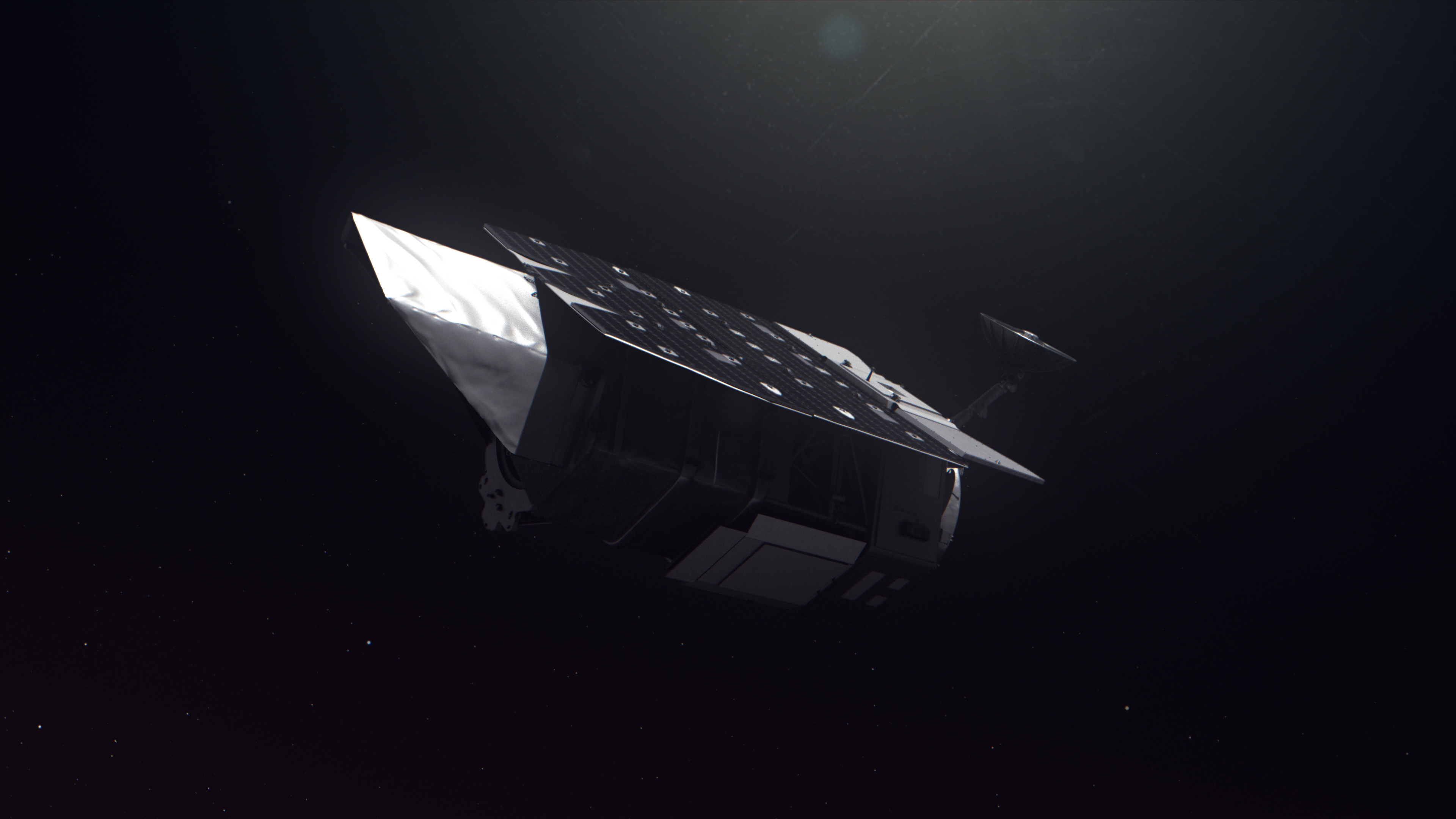
It’s called the Nancy Grace Roman Space Telescope.
Roman will study some of the biggest mysteries out there.
Answering questions about how the universe has changed over time … what’s driving its expansion … and the worlds that exist beyond our solar system.
Roman has a unique ability to survey vast areas of space with incredible speed and detail.
It will collect huge amounts of data, including more than a billion galaxies … and help discover thousands of planets orbiting distant stars.
Roman will join other space telescopes … including Hubble and Webb.
It builds on NASA’s technology and know-how that have shaped our view of the cosmos for decades.
[Music: Social Progress by Brice Davoli]
JACOB: In this episode … how Roman will discover and study new worlds outside of our solar system… exoplanets.
We’ll learn how Roman will conduct a galactic census… staring into the center of our Milky Way galaxy and adding as many as 100,000 new exoplanets to our catalog of known worlds.
With each new exoplanet detection, we’ll learn a little more about how planets form… and how our own solar system came to be.
We’ll also peek inside an experimental instrument flying aboard this space telescope… which will let scientists zoom in on Jupiter-sized exoplanets in detail for the very first time.
All that will pave the way for a new era of exoplanet science … and get us a few steps closer to eventually finding small, rocky exoplanets like our own. Exo-Earths.
[SFX: Crickets chirping, campfire crackling]
JACOB: If you look up on a clear night, in a place without much light pollution, you can typically see a couple thousand stars.
[Music: Scientific Progress by Thomas Gallicani]
JACOB: We now know that on average, each one of those stars has at least one exoplanet orbiting it.
So far, we’ve detected more than 6,000 of them.
And we’ve learned that exoplanets and planetary systems come in a wide variety of shapes and sizes.
We can still only guess at what those exoplanets are like… but our best guesses would make the most creative sci-fi authors blush.
We’ve discovered planets where it rains glass… planets entirely covered by lava oceans… planets with… and I know this sounds like an oxymoron… hot ice.
[SFX: Raindrops, boiling water, sizzling]
JACOB: Now, this is a brand-new field. We’re still at the very beginning… coming up with new methods and technologies to detect exoplanets and learn the most basic things about them.
In fact, about 30 years ago we didn’t know for sure if exoplanets even existed.
And right there at the start was a young French scientist named Bertrand Mennesson.
BERTRAND MENNESSON: when I was 23 I went to an internship fair. There were a number of topics. One that was very futuristic at the time was about exoplanets.
JACOB: Today, Bertrand is the Deputy Project Scientist for the Roman Space Telescope at NASA’s Jet Propulsion Laboratory… he’s one of the people leading Roman’s exoplanet science.
But at that internship fair, 30 years ago, exoplanet science barely existed… it was a totally theoretical field.
BERTRAND: Nobody had ever detected an exoplanet yet found what its atmosphere was made of, but I thought it was a really interesting topic, so a bit of a bet involved in getting into a field where there’s been no detection yet, but it captured my imagination, I think.
JACOB: That bet on a new field paid off. In 1995, while Bertrand was in graduate school, it happened.
Two Swiss scientists discovered the first exoplanet.
BERTRAND: One of the reviewers for the original paper was a guy that worked with us, and so he told us, “Don’t tell this to anyone else, but we might have detected the first exoplanet.” And the rest is history.
JACOB: That planet was 51 Peg B … nicknamed “Dimidium.”
The researchers found it by looking at the planet’s parent star and noticing that it wobbled a little bit…
BERTRAND: Basically, if a planet is orbiting a star, the star is going to react to that motion by wobbling itself either along the line of sight or perpendicular to the line of sight.
JACOB: Years later, those two scientists would win the Nobel Prize in Physics for that discovery.
BERTRAND: It was very exciting, because nobody expected this type of planet. What you kind of discover first are what we would call the freaks of nature.
[Music: New Development by Frederic Sans]
JACOB: Now, 51 Peg B is definitely a freak. For one thing, it’s huge… a gas giant bigger than Jupiter. And it orbits way closer to its star than Jupiter does in our own solar system.
That made scientists go, “huh.”
Maybe we have to rethink what we think we know about how planetary systems work.
VANESSA BAILEY: So the very first exoplanets that were discovered were totally unlike anything in our own solar system. They were Jupiter-sized things in orbits tighter than Mercury’s, and right away you know that the planet formation model that produced our solar system is not the only type of planet formation that happens in our galaxy.
JACOB: In other words…
VANESSA BAILEY: Our solar system is not the universal blueprint.
JACOB: That’s Vanessa Bailey. She’s an instrument scientist on the Roman telescope team.
She says, picture that map that shows the planets in our solar system in a line out from the Sun…
You know… Mercury, Venus, Earth, Mars… then the big gas giants, Jupiter, Saturn, Uranus, Neptune… and maybe Pluto… depending on when you went to school.
VANESSA: I grew up with, and, you did too, with, with this idea that, okay, all of the small rocky planets are in the interior of the planetary system. All the big giant planets are on the exterior, and astronomers had built up, and planetary scientists had built up a model for how you can form a planetary system to produce rocky planets on the inside and big gas giants on the outside.
JACOB: Exoplanetary systems that we’ve discovered are just… not like that. They have those giants like 51 Peg B… and even stranger things.
VANESSA: So, we’ve seen many of these hot Jupiters, we’ve discovered these things called super Earths, or mini Neptunes, totally unlike anything in our own solar system. And as the name kind of implies, we don’t know, are they scaled-up rocky planets, like a bigger version of Earth, are they super Earths? Or are they scaled-down versions of Neptune with a big hydrogen atmosphere? Mini Neptunes? These are known to be now, in fact, some of the most common type of planets in exoplanetary systems. So, you know, we see just an incredibly diverse array of exoplanets everywhere we look, there’s, there’s something new and interesting.
[Music: Dots and Dashes by Jan Telegra]
JACOB: Scientists think the reason we keep finding these weirdos comes down to the ways we’re looking.
There’s that wobble method…
[SFX: Oscillating woosh]
JACOB: and then another method, where astronomers carefully measure the brightness of stars.
[SFX: Ticking sound]
JACOB: When a star’s brightness dips a little, that’s a sign that an orbiting planet might be passing in front of it.
Vanessa says both of these methods…
VANESSA: It turns out they’re the best at detecting very large planets orbiting very close to their stars.
With both of these methods, you’re looking at a star and inferring things about the planets that orbit it.
VANESSA: Unlike planetary science in our own solar system, where we can send a rover or send a probe, the only tools we have touse as astronomers studying exoplanets are light.
JACOB: Scientists call these techniques “indirect methods.”
VANESSA: Both of these use the look for a signature in the way a planet can affect the light of the star, you don’t see the planet itself, but you see the way it changes the light of the star, and you can infer that a planet is there, and that’s how the vast, vast majority of the more than 6,000 confirmed exoplanets have been discovered, is through one of these indirect methods.
JACOB: But since they’re biased towards a certain type of planet, we know our picture of the universe is incomplete.
VANESSA: What we don’t know yet is how common are solar systems like ours, and that’s simply because planets like ours are very hard to detect.
JACOB: To really understand the scope of possible planetary systems… and to understand how our solar system formed and why it has the planets it does… we need methods that can find smaller planets much further out from their stars.
Like, the distance Earth is away from our Sun.
And we need to find a lot more than 6,000 of them.
That’s where Roman comes in.
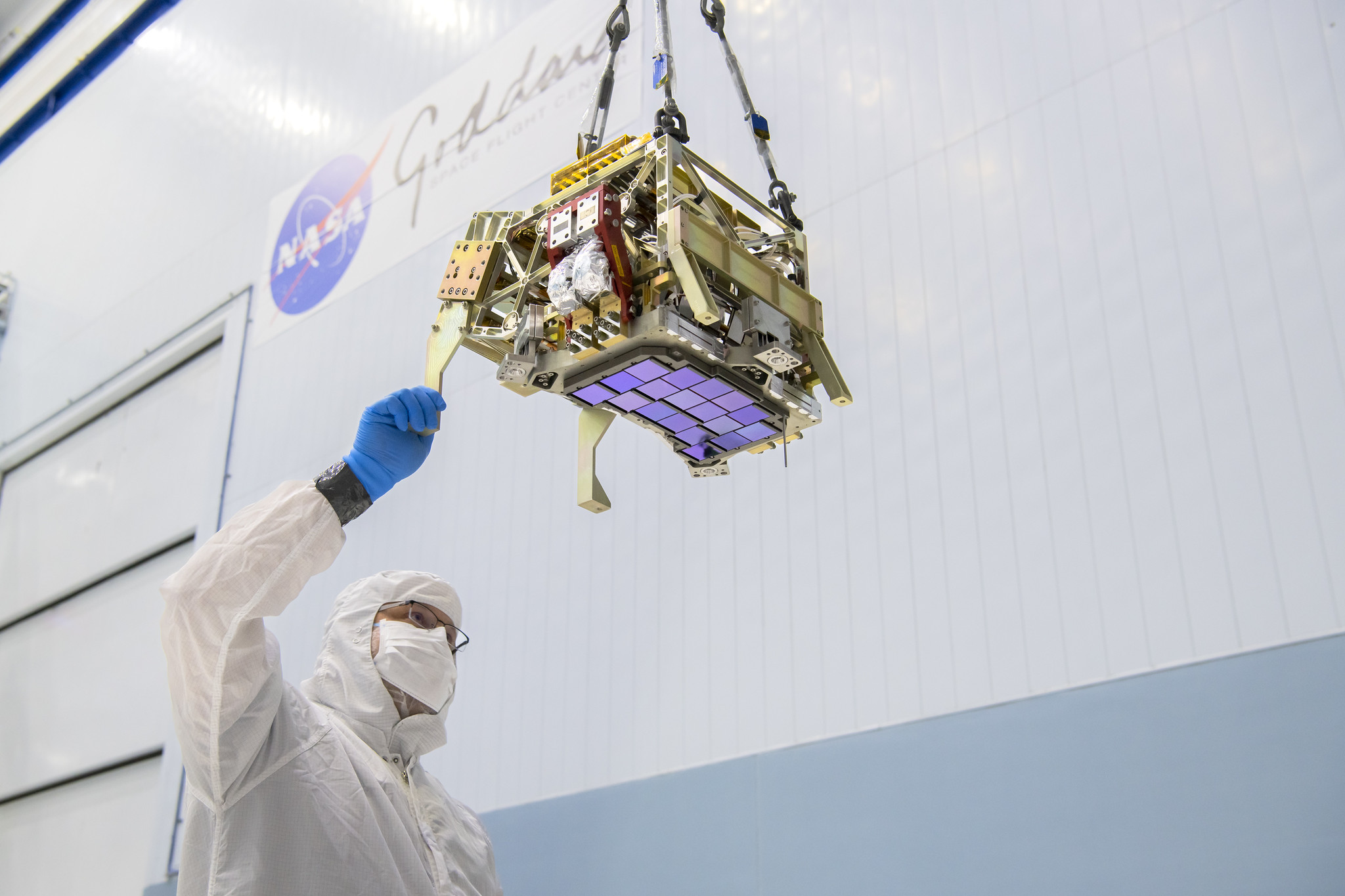
Roman’s main instrument is the Wide Field Instrument.
It’s a 300-megapixel camera with a field of view 100 times bigger than Hubble’s. And Roman will use that instrument to look for exoplanets up to 26,000 lightyears away from Earth.
Roman will look for signs of big exoplanets transiting close in front of their stars.
But it’ll also use a newer method for detecting exoplanets: gravitational microlensing.
This one’s a little complicated… but basically it uses stars as magnifying glasses…
The huge gravity of some stars stretches spacetime, making it easier to spot exoplanets orbiting far from their stars.
This doesn’t happen everywhere, but since Roman can see so much of the sky at once, it’ll be able to spot the places where it doeshappen.
VANESSA: And I’m quite excited, because the Nancy Grace Roman mission, one of the two cameras on board the Wide Field instrument, will use the microlensing method to get the most complete census to date of smaller planets orbiting at distances more like Earth, Mars, Jupiter, a real part of parameter space we’ve never been able to access before, and that’s what’s going to tell us, is our solar system common or rare, at least go a long way to answering that question.
JACOB: This new method compliments the older ones well.
VANESSA: The transit method is best at discovering planets orbiting close to their stars, whereas the microlensing method is better at discovering planets orbiting farther from their stars.
JACOB: Once Roman launches, the science team is going to turn the Wide Field Instrument towards the core of the Milky Way galaxy and scan for exoplanets.
VANESSA: The wide field instrument is going to stare towards the center of our galaxy, where it can see literally hundreds of thousands of stars in a single image at once, and it can use one of these two indirect detection methods, the transit method or the microlensing method, to search for planets around hundreds of thousands of stars at once. We know that most stars have planets, and so it’s probably no surprise then that that with these surveys, the Wide Field Instrument will detect perhaps 100,000 planets.
JACOB: That’s more than 16 times as many exoplanets as we know about today.
This project has a cool name… the galactic bulge time domain survey.
It’s like a galactic census. From this, we’ll get a fuller picture of the demographics of planets in our galaxy… and a better understanding of how common our solar system is.
But for a given patch of sky with exoplanets…
BERTRAND: We’re going to see them once and we’re going to be able to tell how far they are from their star and what their mass is, but we’re not going to be able to have a lot of details on them or observe them ever again.
JACOB: That’s Bertrand again.
He says, that means from Roman’s Wide Field Instrument, we’ll learn more about how our solar system formed, and how planetary systems form in general.
But we won’t get much insight from those methods into the other big question in exoplanet science, the one that drives him… could other planets support life?
[Music: Tentative Surge by Jan Telegra]
BERTRAND: so this is not really looking for aliens, which I will talk to my son and nephews about, because they are less than 10 years old, but you know, eventually this is what we are after the search for, for life in the universe like trying to answer these basic questions by actually observing stars and whether they have planets, whether these planets are habitable, whether these habitable planets have life, what kind of life.
JACOB: The biggest quest in exoplanet science is discovering an exo-Earth… a small, rocky planet like ours, that could potentially support life.
To learn about these exoplanets in detail, to figure out what their atmospheres are made of, whether they have oceans of liquid water, whether they could host life… you need to zoom in and take a long, close look.
Roman is advancing key technologies that may someday let us do just that.
For a planet to potentially host life, it has to be in a star’s habitable zone.
We sometimes call that the goldilocks zone… too close to a star, and the planet gets bombarded with radiation.
[SFX: Geiger counter buzzing]
JACOB: Too far away, and it’s too cold for liquid water to exist.
[SFX: Whooshing wind]
JACOB: The planet’s orbit has to be juuuuust right.
But being in the goldilocks zone isn’t a guarantee that a planet is a pleasant place to visit.
Earth and Venus are both within our Sun’s goldilocks zone.
[SFX: Wooshing, sizzling]
JACOB: But one has surface temperatures of almost 900 degrees Fahrenheit… and atmospheric pressure that’s crushed every probe we’ve sent so far. And one is, well, Earth.
[SFX: Birds singing]
JACOB: That’s because Venus’ atmosphere is almost entirely carbon dioxide. Earth’s has oxygen… which life as we know it needs to exist.
So, to really know if a planet is habitable, you need to know what its atmosphere is made of.
And you can’t do that with the indirect methods we’ve been talking about so far.
That’s where the newest, most cutting-edge exoplanet research method comes in… taking pictures of planets directly.
BERTRAND: It’s really you see directly the planet itself and its light, so you’re able to analyze the light of the planet and not merely saying that there’s probably a planet in orbit around that star, because you see the star move. In that case, you really see the planet itself.
JACOB: What you’re seeing is either light the planet is reflecting from its star…
Or light the planet’s emitting itself, if it’s so young that it’s still glowing from the heat of its formation.
Now, the pictures we’re talking about taking… they are not beautiful, clear photos.
VANESSA: Yeah, where maybe some people have in mind that we are taking sharp images where you can see the cloud bands like you could see on Jupiter. It’s nothing like that, right? These systems are light years away. So, we are getting one little smudge, we’lltake an image in several different colors of light, study the relative brightness in those different colors to try to tease out what the atmosphere might be made of.
JACOB: But from that tiny smudge… that pinprick of light, you can actually learn a ton.
You can break that light into its colors with a prism… to study the atmosphere’s spectrum…
That is, how bright the planet is in different colors of light.
Each molecule in a planet’s atmosphere vibrates at a different frequency… imagine a xylophone.
Imagine carbon dioxide sounds like this…
[SFX: Carbon dioxide xylophone note]
JACOB: Nitrogen sounds like this…
[SFX: Nitrogen xylophone note]
JACOB: And Oxygen sounds like this…
[SFX: Oxygen xylophone note]
JACOB: Put them together, and the frequency of Venus would sound like this…
[SFX: Venus xylophone chord with nitrogen and carbon dioxide notes]
JACOB: On the other hand, Earth would sound like this…
[SFX: Earth xylophone chord with nitrogen, carbon dioxide and oxygen notes]
JACOB: From those frequencies of light, we can begin to understand what an exoplanet is like.
That’s where Roman’s second camera comes in.
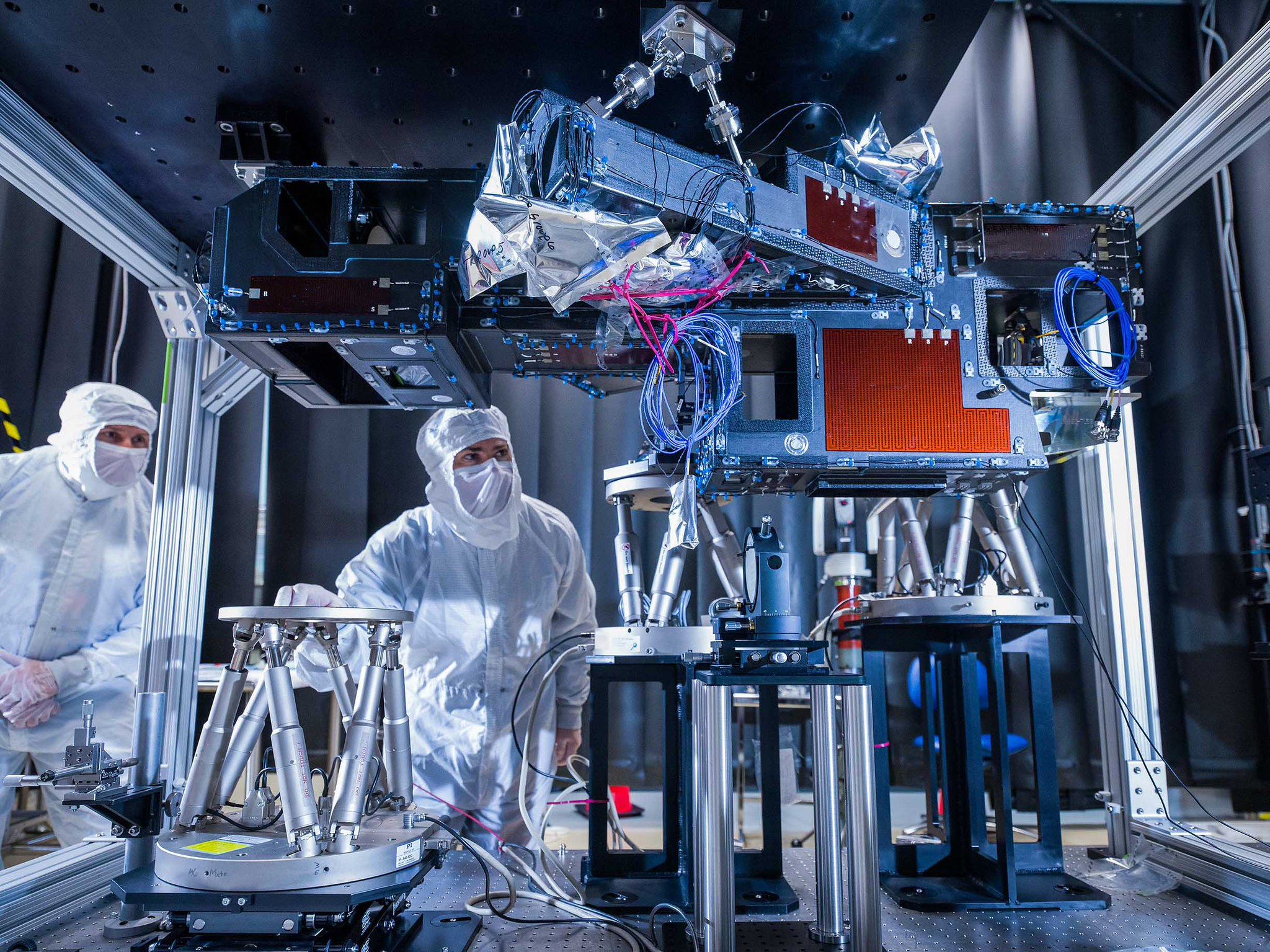
It’s a technology demonstration, an experiment. That instrument will allow Roman to directly image exoplanets.
Although… easier said than done.
BERTRAND: The problem is that when you look at a planet next to a star, the star is extremely bright, so at visible wavelengths, for instance, the star is a billion to 10 billion times brighter than the planet.
JACOB: That is billion with a B! Compared to the light from a planet, that planet’s star is blinding.
To spot a planet directly, you need a device that can block the light of the star enough that you can see the much dimmer planet.
And the device that does that is called a coronagraph.
[SFX: Jet plane flying overhead]
VANESSA: You can imagine if you hear an airplane in the sky and you’re trying to see where it is, you think it’s near the Sun, but the Sun is just blinding you. The intuitive thing for you to do is to hold up your hand and block the Sun’s light, so you can see something much fainter nearby. Fundamentally, that’s what a coronagraph does. It’s a more sophisticated version, of course, but we have a little opaque spot inside of our inside of our instrument, as well as some other optics that will block the star’s light before it ever reaches the camera, but will allow the planet light to pass through.
JACOB: This is a technology with a long history.
A hundred years ago, scientists used the first coronagraphs to block out the super bright disk of our own Sun to simulate an eclipse… and study the Sun’s corona… its wispy atmosphere.
That’s why it’s called a coronagraph.
[Music: Ancient Starlight by Al Lethbridge]
JACOB: Since then, scientists have thought about using the same technology to look for worlds around other stars.
Way back in 1959, Nancy Grace Roman – the woman whose name is now on the Roman Space Telescope – published a short paper in The Astronomical Journal titled “Planets of other suns.”
She suggested a space telescope could theoretically spot Jupiter from Alpha Centauri, the nearest star to our Sun.
VANESSA: So she had this vision that we could build a much more complex and expansive view of our universe if we also launched space telescopes. She wrote a letter saying, “Well, you know, I think it might be possible to image exoplanets around the very nearest by stars if we could get above the blurring effects of the atmosphere.”
JACOB: Nancy Grace Roman wrote, “It does not seem to be a serious problem to get rid of the light of the primary in the absence of an atmosphere.”
Meaning, to block out the light of the star when observing it from space.
Vanessa says she kind of laughs at that line… it has actually turned out to be a very challenging problem.
NASA’s Hubble space telescope has a coronagraph. So does the James Webb Space Telescope.
But those are pretty simple… what astronomers call passive coronagraphs. They aren’t good enough to directly image most exoplanets.
Hubble and James Webb… they’re only able to detect very big, bright, hot, young planets… planets so hot they have clouds made of vaporized rock.
These planets are bright enough they give off their own light… they literally glow!
But scientists want to eventually spot mature, rocky planets… like Earth.
And that’s much harder, because the only light from them is the light they reflect from their star. So, they’re much dimmer.
We’re not there yet. But Roman has a coronagraph that should be good enough to detect large, mature gas giants around other stars planets like Jupiter in our solar system.
[SFX: Ocean waves, ship horn]
JACOB: To put this in perspective… imagine being out at sea on a boat. You see a lighthouse in the distance.
To spot a Jupiter-sized planet around a star like the Sun… you’d need a telescope that could spot a lightning bug next to that lighthouse light.
[SFX: Buzzing insect]
JACOB: After light particles travel for years… and come shooting into the Roman telescope… they will go through a gauntlet of mirrors.
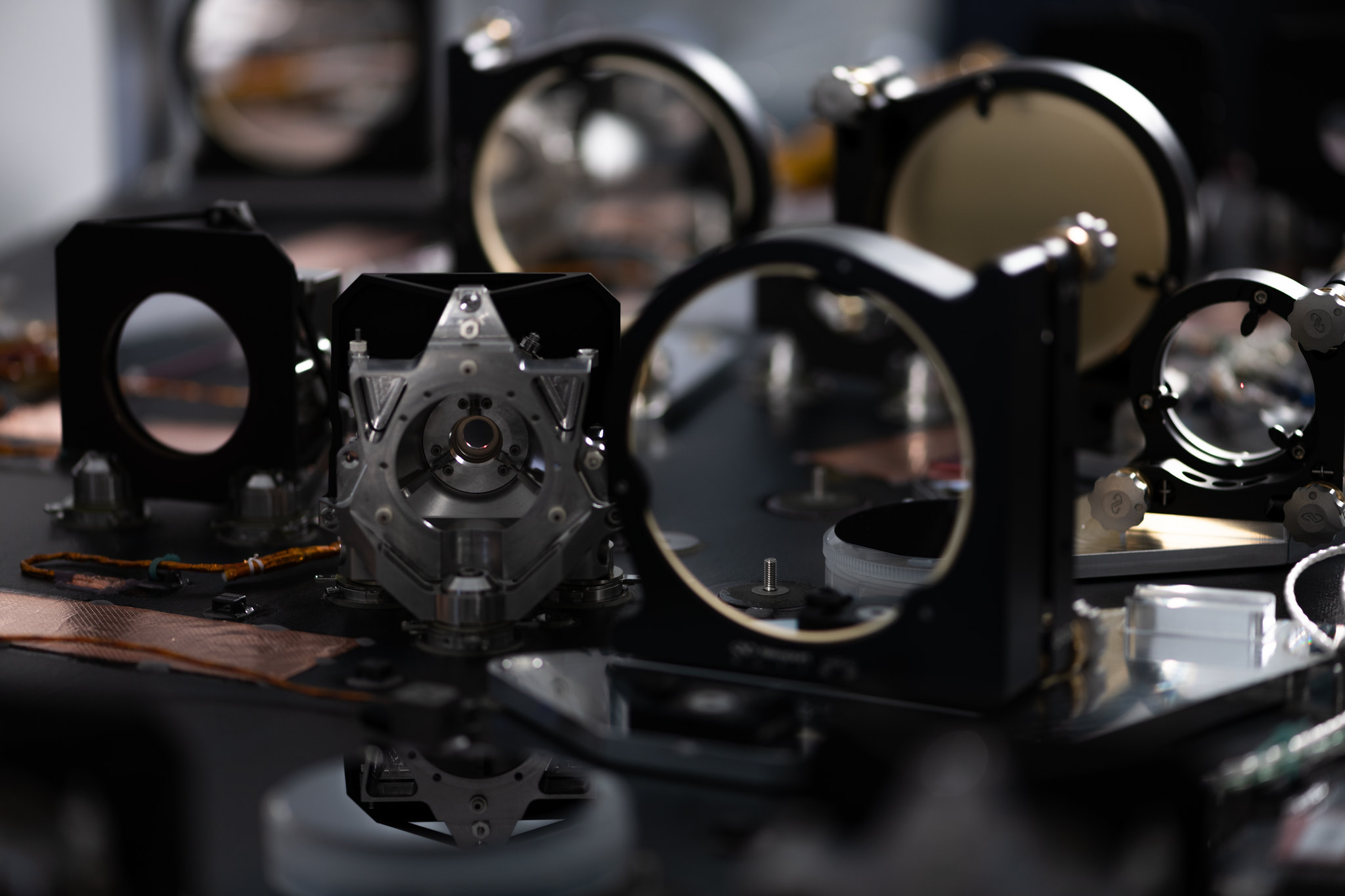
BERTRAND: As the photons go through the telescope, they reflect on different mirrors, so obviously the primary mirror, the large 2.4-meter mirror of Roman, then they bounce off the secondary mirror, then they go through a series of smaller mirrors behind, behind the primary, and then that’s where we have the coronagraph. If you have a photon that comes exactly on axis, you will be propagated and reflected to a little circular dot, which blocks the starlight.
JACOB: That dot is the coronagraph’s mask. It catches most of the starlight that comes in straight on… or “on axis.”
But light is very tricky to suppress. Since it’s a wave and a particle, it bends a little every time it hits something.
Stray photons bending around the telescope’s mirrors can cause glare in the science camera.
BERTRAND: So that’s a problem for us, because these photons, once they have entered the telescope and are getting scattered, will create a glare of residual starlight, and if that glare is too large, we cannot see planets. Generally, we live with this passively. We’re like, “Okay, we’re going to live with it,” but with the Roman coronagraph, we’re going to correct for it in real time using a specific piece of optics, which is what we call a deformable mirror.
[Music: Research Laboratory by Al Lethbridge]
JACOB: Deformable mirrors. If you talk to any Roman scientist or engineer about these, it’s hard to get them to stop. Because theyare an engineering feat.
VANESSA: They have thousands of little pistons on the back of these mirrors that can compensate for incredibly minuscule little polishing errors or very small misalignments that could happen in the instrument to make a much, much sharper image and make the coronagraph mask be better able to suppress that starlight
JACOB: Roman has two deformable mirrors.
The tiny pistons behind the flexible glass surface can deform the mirrors with an accuracy 1000 times better than any existing coronagraph.
Deformable mirrors were first designed to help ground-based telescopes cancel out turbulence in the atmosphere.
The Roman engineering team took inspiration from that technology.
So back to our photon. Hopefully, the mask and the deformable mirrors compensate for the glare, and everything works out.
BERTRAND: And after all of these bounces, etc. we finally go to the science detector image, and in principle the resulting image has a bit of light at the center, then a very deep, dark region in which the starlight has disappeared, and in principle, where we can detect the planets.
JACOB: The target region looks kind of like a donut around the star… totally dark… except for the light of exoplanets.
To put numbers to that, Roman’s coronagraph should be able to suppress starlight by a factor of 100 million to one.
VANESSA: So, I want to see basically no starlight and very, very little glare residuals. if I see almost nothing, I will be so excited.
JACOB: In that nothing… that total blackness. We’ll be able to see planets in other star systems, lightyears away from our own, better than we ever have before.
VANESSA: Once we have, you know, suppressed the starlight so much that we can see fainter planets than ever before, these planets are so incredibly faint that you get one photon, one particle of light arriving at our camera from, from one of those planets once every few seconds, or maybe even once every minute. This is just a level of sensitivity that we’ve never had to reach before, at least at visible light.
JACOB: Each element inside Roman has to work perfectly together… the deformable mirrors, the detectors, the masks for the coronagraph.
To catch a single photon… light coming directly from a faraway planet.
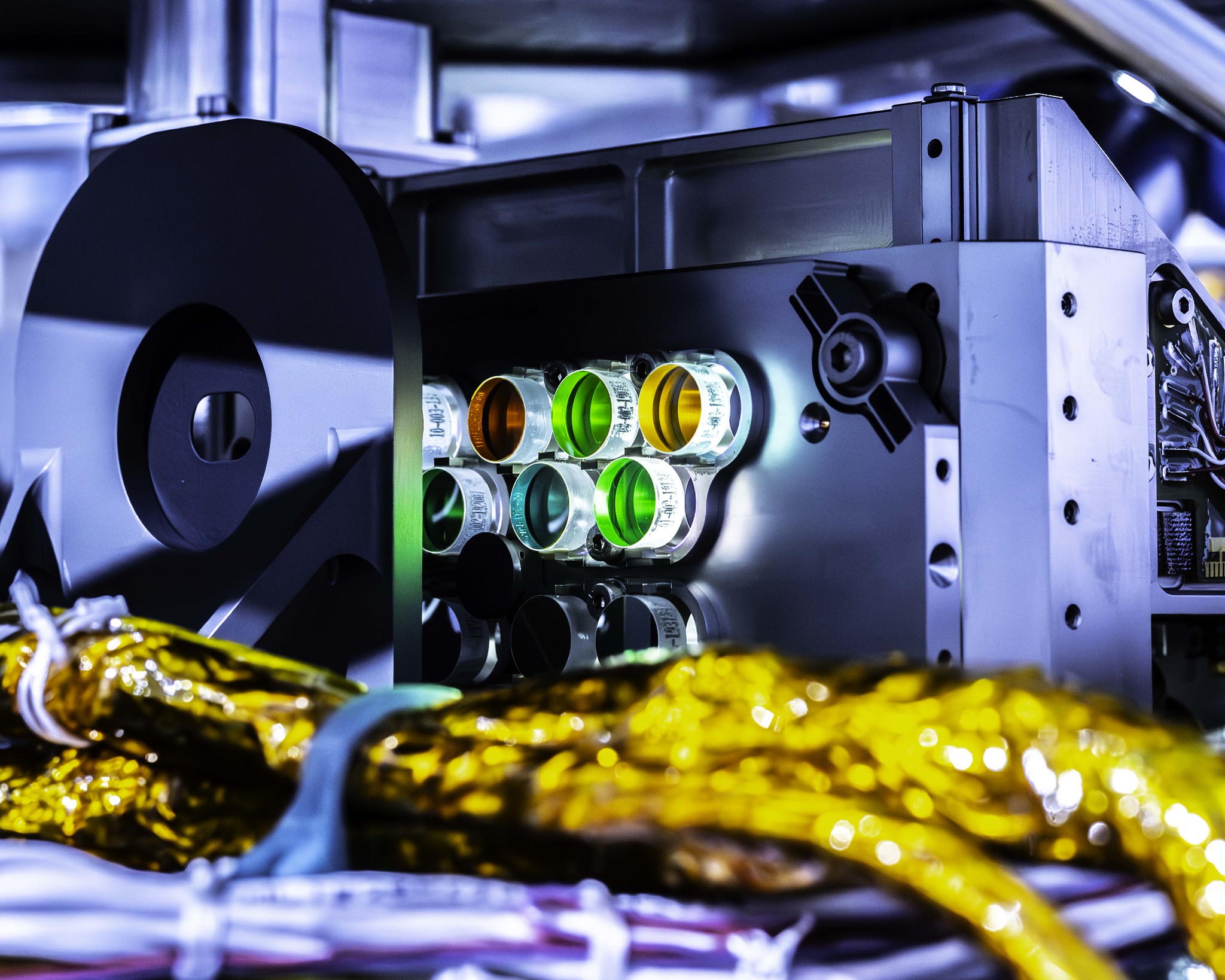
VANESSA: I find it pretty inspiring to think that, you know, that little photon that’s, that I’ve now captured in my image has been traveling from that planet for literally years to end up in this photo, and now I get to try to learn something from it about that planet and where it came from.
JACOB: Now, remember, these aren’t necessarily going to be glorious, beautiful photos. Roman’s Wide Field Instrument will deliver those.
But the images from the coronagraph will be absolutely precious to scientists.
VANESSA: They’re not going to be, you know, spectacular, eye-catching to the average member of the public. What you’re going to see is no star, if we’ve done our job, and then maybe a little fuzzy blob of a planet next to it, so like one little smudge, that’s an image that I’m going to love, but it’s not a beautiful wide panorama of a whole star forming region in many systems. I’ll be really happy if all that I see is one little fuzzy blob and not much else.
JACOB: And again, Roman won’t be able to detect rocky, Earth-sized exoplanets. Its coronagraph just isn’t powerful enough to do that… we don’t have the technology yet.
But these exo-Jupiters are exactly the sort of planets Nancy Grace Roman dreamed we’d someday be able to spot with space telescopes… back in 1959, when she wrote that paper.
And the experimental coronagraph aboard the Roman Space Telescope is an important step along the way toward finding ever-smaller planets… and NASA’s search for life outside our solar system.
Roman’s coronagraph is what NASA calls a technology demonstration. That means the main goal is testing out new technologies… like the deformable mirrors, the photon counting detectors… as a step along the way to the ultimate goal.
VANESSA: The reason that that NASA wants to do this is because we think that’s probably the best way to search for first signs of life on other earth-like planets in our nearby galactic neighborhood.
JACOB: In other words, Roman’s advancing the technology NASA will need in order to eventually take an image of an Earth-like exoplanet and study its atmosphere…
BETRAND: as we get on the way to possibly getting images of earth-like planets and planets like the earth, we need to first go from very young planets to mature planets, old planets, giant planets, and then we’ll go later on with another mission to from the giant mature planets to the rocky mature planets.
VANESSA: So the coronagraph instrument on Roman was very specifically designed to mature technologies that we think help prepare us for that long-term goal.
[Music: Green Fusion by Al Lethbridge]
VANESSA: There’s now a mission concept called the Habitable Worlds Observatory that’s under study, that will build on hopefully what we’ve learned, improve upon it further, because certainly we’re not at the level on Roman where we could image an Earth-like planet, but we hope it serves as inspiration and lessons for making that next mission design.
JACOB: Bertrand is one of the lead scientists working on the Habitable Worlds Observatory concept mission, or HWO.
BERTRAND: And HWO has an even more ambitious goal of this time flying a coronagraph that would search for Earth-like planets and potentially for biosignatures in the atmosphere. We will design the Habitable Observatory to reach contrast 10 to 100 times better than, than Roman.
JACOB: Those are some huge numbers. To understand them, let’s bring it back to our lighthouse.
[SFX: Sound of waves crashing]
JACOB: If Roman has to be able to spot a lightning bug next to the lighthouse bulb… the Habitable Worlds Observatory will have to be able to detect a little teeny tiny bioluminescent algae.
Roman will go a long way towards proving the technology that will make that possible.
BERTRAND: We are adopting a step-by-step approach. It seems like the challenge of directly observing these Earth-like planets, given where we are today on the ground was too difficult to meet in one step, so the Roman chronograph is really a stepping stone, and that makes us confident that if we can do Roman, then we can do HWO too.
JACOB: That might sound impossible.
But Bertrand says, that’s what people were saying about detecting any exoplanets at all, just 30 years ago… when he first went to that internship fair and decided to dedicate his career to finding other Earths.
BERTRAND: You know, in 1995 I had distinguished professors telling me that, you know, “Don’t dream too much, we’re not going to find spectra of exoplanets before you retire.” They were completely wrong, so it’s very hard to guess where the field will be 10 or 15 years from now, so I think that what I would tell myself is just to try to stay open to, to what’s gonna unfold and be up for surprises.
JACOB: Roman is going to discover things we don’t expect at all. Things we haven’t even dreamed of yet… just like all of NASA’s space telescopes have.
We’ll want to follow up on those, with future observatories like Habitable Worlds.
But the first step is finding them. And that’s up to Roman.
[Music: Curiosity by SYSTEM Sounds]
Roman Series: Jupiters Around Other Suns
Curious Universe | Roman series, Episode 2
Episode description:
NASA’s Nancy Grace Roman Space Telescope is on a quest to discover planets outside our solar system. NASA scientists Bertrand Mennesson and Vanessa Bailey explain how Roman’s wide view will spot as many as 100,000 new exoplanets in a galactic census that will change how we understand planetary system formation. And we’ll learn about an experimental camera that will allow scientists to take direct pictures of Jupiter-sized exoplanets around Sun-like stars – and analyze their atmospheres.
Intro
[Music: Curiosity by SYSTEM Sounds]
HOST JACOB PINTER: This is NASA’s Curious Universe. I’m Jacob Pinter.
NASA is launching a new space telescope that will change the way we see the universe.
It’s called the Nancy Grace Roman Space Telescope.
Roman will study some of the biggest mysteries out there.
Answering questions about how the universe has changed over time … what’s driving its expansion … and the worlds that exist beyond our solar system.
Roman has a unique ability to survey vast areas of space with incredible speed and detail.
It will collect huge amounts of data, including more than a billion galaxies … and help discover thousands of planets orbiting distant stars.
Roman will join other space telescopes … including Hubble and Webb.
It builds on NASA’s technology and know-how that have shaped our view of the cosmos for decades.
[Music: Social Progress by Brice Davoli]
JACOB: In this episode … how Roman will discover and study new worlds outside of our solar system… exoplanets.
We’ll learn how Roman will conduct a galactic census… staring into the center of our Milky Way galaxy and adding as many as 100,000 new exoplanets to our catalog of known worlds.
With each new exoplanet detection, we’ll learn a little more about how planets form… and how our own solar system came to be.
We’ll also peek inside an experimental instrument flying aboard this space telescope… which will let scientists zoom in on Jupiter-sized exoplanets in detail for the very first time.
All that will pave the way for a new era of exoplanet science … and get us a few steps closer to eventually finding small, rocky exoplanets like our own. Exo-Earths.
[SFX: Crickets chirping, campfire crackling]
JACOB: If you look up on a clear night, in a place without much light pollution, you can typically see a couple thousand stars.
[Music: Scientific Progress by Thomas Gallicani]
JACOB: We now know that on average, each one of those stars has at least one exoplanet orbiting it.
So far, we’ve detected more than 6,000 of them.
And we’ve learned that exoplanets and planetary systems come in a wide variety of shapes and sizes.
We can still only guess at what those exoplanets are like… but our best guesses would make the most creative sci-fi authors blush.
We’ve discovered planets where it rains glass… planets entirely covered by lava oceans… planets with… and I know this sounds like an oxymoron… hot ice.
[SFX: Raindrops, boiling water, sizzling]
JACOB: Now, this is a brand-new field. We’re still at the very beginning… coming up with new methods and technologies to detect exoplanets and learn the most basic things about them.
In fact, about 30 years ago we didn’t know for sure if exoplanets even existed.
And right there at the start was a young French scientist named Bertrand Mennesson.
BERTRAND MENNESSON: when I was 23 I went to an internship fair. There were a number of topics. One that was very futuristic at the time was about exoplanets.
JACOB: Today, Bertrand is the Deputy Project Scientist for the Roman Space Telescope at NASA’s Jet Propulsion Laboratory… he’s one of the people leading Roman’s exoplanet science.
But at that internship fair, 30 years ago, exoplanet science barely existed… it was a totally theoretical field.
BERTRAND: Nobody had ever detected an exoplanet yet found what its atmosphere was made of, but I thought it was a really interesting topic, so a bit of a bet involved in getting into a field where there’s been no detection yet, but it captured my imagination, I think.
JACOB: That bet on a new field paid off. In 1995, while Bertrand was in graduate school, it happened.
Two Swiss scientists discovered the first exoplanet.
BERTRAND: One of the reviewers for the original paper was a guy that worked with us, and so he told us, “Don’t tell this to anyone else, but we might have detected the first exoplanet.” And the rest is history.
JACOB: That planet was 51 Peg B … nicknamed “Dimidium.”
The researchers found it by looking at the planet’s parent star and noticing that it wobbled a little bit…
BERTRAND: Basically, if a planet is orbiting a star, the star is going to react to that motion by wobbling itself either along the line of sight or perpendicular to the line of sight.
JACOB: Years later, those two scientists would win the Nobel Prize in Physics for that discovery.
BERTRAND: It was very exciting, because nobody expected this type of planet. What you kind of discover first are what we would call the freaks of nature.
[Music: New Development by Frederic Sans]
JACOB: Now, 51 Peg B is definitely a freak. For one thing, it’s huge… a gas giant bigger than Jupiter. And it orbits way closer to its star than Jupiter does in our own solar system.
That made scientists go, “huh.”
Maybe we have to rethink what we think we know about how planetary systems work.
VANESSA BAILEY: So the very first exoplanets that were discovered were totally unlike anything in our own solar system. They were Jupiter-sized things in orbits tighter than Mercury’s, and right away you know that the planet formation model that produced our solar system is not the only type of planet formation that happens in our galaxy.
JACOB: In other words…
VANESSA BAILEY: Our solar system is not the universal blueprint.
JACOB: That’s Vanessa Bailey. She’s an instrument scientist on the Roman telescope team.
She says, picture that map that shows the planets in our solar system in a line out from the Sun…
You know… Mercury, Venus, Earth, Mars… then the big gas giants, Jupiter, Saturn, Uranus, Neptune… and maybe Pluto… depending on when you went to school.
VANESSA: I grew up with, and, you did too, with, with this idea that, okay, all of the small rocky planets are in the interior of the planetary system. All the big giant planets are on the exterior, and astronomers had built up, and planetary scientists had built up a model for how you can form a planetary system to produce rocky planets on the inside and big gas giants on the outside.
JACOB: Exoplanetary systems that we’ve discovered are just… not like that. They have those giants like 51 Peg B… and even stranger things.
VANESSA: So, we’ve seen many of these hot Jupiters, we’ve discovered these things called super Earths, or mini Neptunes, totally unlike anything in our own solar system. And as the name kind of implies, we don’t know, are they scaled-up rocky planets, like a bigger version of Earth, are they super Earths? Or are they scaled-down versions of Neptune with a big hydrogen atmosphere? Mini Neptunes? These are known to be now, in fact, some of the most common type of planets in exoplanetary systems. So, you know, we see just an incredibly diverse array of exoplanets everywhere we look, there’s, there’s something new and interesting.
[Music: Dots and Dashes by Jan Telegra]
JACOB: Scientists think the reason we keep finding these weirdos comes down to the ways we’re looking.
There’s that wobble method…
[SFX: Oscillating woosh]
JACOB: and then another method, where astronomers carefully measure the brightness of stars.
[SFX: Ticking sound]
JACOB: When a star’s brightness dips a little, that’s a sign that an orbiting planet might be passing in front of it.
Vanessa says both of these methods…
VANESSA: It turns out they’re the best at detecting very large planets orbiting very close to their stars.
With both of these methods, you’re looking at a star and inferring things about the planets that orbit it.
VANESSA: Unlike planetary science in our own solar system, where we can send a rover or send a probe, the only tools we have touse as astronomers studying exoplanets are light.
JACOB: Scientists call these techniques “indirect methods.”
VANESSA: Both of these use the look for a signature in the way a planet can affect the light of the star, you don’t see the planet itself, but you see the way it changes the light of the star, and you can infer that a planet is there, and that’s how the vast, vast majority of the more than 6,000 confirmed exoplanets have been discovered, is through one of these indirect methods.
JACOB: But since they’re biased towards a certain type of planet, we know our picture of the universe is incomplete.
VANESSA: What we don’t know yet is how common are solar systems like ours, and that’s simply because planets like ours are very hard to detect.
JACOB: To really understand the scope of possible planetary systems… and to understand how our solar system formed and why it has the planets it does… we need methods that can find smaller planets much further out from their stars.
Like, the distance Earth is away from our Sun.
And we need to find a lot more than 6,000 of them.
That’s where Roman comes in.
Roman’s main instrument is the Wide Field Instrument.
It’s a 300-megapixel camera with a field of view 100 times bigger than Hubble’s. And Roman will use that instrument to look for exoplanets up to 26,000 lightyears away from Earth.
Roman will look for signs of big exoplanets transiting close in front of their stars.
But it’ll also use a newer method for detecting exoplanets: gravitational microlensing.
This one’s a little complicated… but basically it uses stars as magnifying glasses…
The huge gravity of some stars stretches spacetime, making it easier to spot exoplanets orbiting far from their stars.
This doesn’t happen everywhere, but since Roman can see so much of the sky at once, it’ll be able to spot the places where it doeshappen.
VANESSA: And I’m quite excited, because the Nancy Grace Roman mission, one of the two cameras on board the Wide Field instrument, will use the microlensing method to get the most complete census to date of smaller planets orbiting at distances more like Earth, Mars, Jupiter, a real part of parameter space we’ve never been able to access before, and that’s what’s going to tell us, is our solar system common or rare, at least go a long way to answering that question.
JACOB: This new method compliments the older ones well.
VANESSA: The transit method is best at discovering planets orbiting close to their stars, whereas the microlensing method is better at discovering planets orbiting farther from their stars.
JACOB: Once Roman launches, the science team is going to turn the Wide Field Instrument towards the core of the Milky Way galaxy and scan for exoplanets.
VANESSA: The wide field instrument is going to stare towards the center of our galaxy, where it can see literally hundreds of thousands of stars in a single image at once, and it can use one of these two indirect detection methods, the transit method or the microlensing method, to search for planets around hundreds of thousands of stars at once. We know that most stars have planets, and so it’s probably no surprise then that that with these surveys, the Wide Field Instrument will detect perhaps 100,000 planets.
JACOB: That’s more than 16 times as many exoplanets as we know about today.
This project has a cool name… the galactic bulge time domain survey.
It’s like a galactic census. From this, we’ll get a fuller picture of the demographics of planets in our galaxy… and a better understanding of how common our solar system is.
But for a given patch of sky with exoplanets…
BERTRAND: We’re going to see them once and we’re going to be able to tell how far they are from their star and what their mass is, but we’re not going to be able to have a lot of details on them or observe them ever again.
JACOB: That’s Bertrand again.
He says, that means from Roman’s Wide Field Instrument, we’ll learn more about how our solar system formed, and how planetary systems form in general.
But we won’t get much insight from those methods into the other big question in exoplanet science, the one that drives him… could other planets support life?
[Music: Tentative Surge by Jan Telegra]
BERTRAND: so this is not really looking for aliens, which I will talk to my son and nephews about, because they are less than 10 years old, but you know, eventually this is what we are after the search for, for life in the universe like trying to answer these basic questions by actually observing stars and whether they have planets, whether these planets are habitable, whether these habitable planets have life, what kind of life.
JACOB: The biggest quest in exoplanet science is discovering an exo-Earth… a small, rocky planet like ours, that could potentially support life.
To learn about these exoplanets in detail, to figure out what their atmospheres are made of, whether they have oceans of liquid water, whether they could host life… you need to zoom in and take a long, close look.
Roman is advancing key technologies that may someday let us do just that.
For a planet to potentially host life, it has to be in a star’s habitable zone.
We sometimes call that the goldilocks zone… too close to a star, and the planet gets bombarded with radiation.
[SFX: Geiger counter buzzing]
JACOB: Too far away, and it’s too cold for liquid water to exist.
[SFX: Whooshing wind]
JACOB: The planet’s orbit has to be juuuuust right.
But being in the goldilocks zone isn’t a guarantee that a planet is a pleasant place to visit.
Earth and Venus are both within our Sun’s goldilocks zone.
[SFX: Wooshing, sizzling]
JACOB: But one has surface temperatures of almost 900 degrees Fahrenheit… and atmospheric pressure that’s crushed every probe we’ve sent so far. And one is, well, Earth.
[SFX: Birds singing]
JACOB: That’s because Venus’ atmosphere is almost entirely carbon dioxide. Earth’s has oxygen… which life as we know it needs to exist.
So, to really know if a planet is habitable, you need to know what its atmosphere is made of.
And you can’t do that with the indirect methods we’ve been talking about so far.
That’s where the newest, most cutting-edge exoplanet research method comes in… taking pictures of planets directly.
BERTRAND: It’s really you see directly the planet itself and its light, so you’re able to analyze the light of the planet and not merely saying that there’s probably a planet in orbit around that star, because you see the star move. In that case, you really see the planet itself.
JACOB: What you’re seeing is either light the planet is reflecting from its star…
Or light the planet’s emitting itself, if it’s so young that it’s still glowing from the heat of its formation.
Now, the pictures we’re talking about taking… they are not beautiful, clear photos.
VANESSA: Yeah, where maybe some people have in mind that we are taking sharp images where you can see the cloud bands like you could see on Jupiter. It’s nothing like that, right? These systems are light years away. So, we are getting one little smudge, we’lltake an image in several different colors of light, study the relative brightness in those different colors to try to tease out what the atmosphere might be made of.
JACOB: But from that tiny smudge… that pinprick of light, you can actually learn a ton.
You can break that light into its colors with a prism… to study the atmosphere’s spectrum…
That is, how bright the planet is in different colors of light.
Each molecule in a planet’s atmosphere vibrates at a different frequency… imagine a xylophone.
Imagine carbon dioxide sounds like this…
[SFX: Carbon dioxide xylophone note]
JACOB: Nitrogen sounds like this…
[SFX: Nitrogen xylophone note]
JACOB: And Oxygen sounds like this…
[SFX: Oxygen xylophone note]
JACOB: Put them together, and the frequency of Venus would sound like this…
[SFX: Venus xylophone chord with nitrogen and carbon dioxide notes]
JACOB: On the other hand, Earth would sound like this…
[SFX: Earth xylophone chord with nitrogen, carbon dioxide and oxygen notes]
JACOB: From those frequencies of light, we can begin to understand what an exoplanet is like.
That’s where Roman’s second camera comes in.
It’s a technology demonstration, an experiment. That instrument will allow Roman to directly image exoplanets.
Although… easier said than done.
BERTRAND: The problem is that when you look at a planet next to a star, the star is extremely bright, so at visible wavelengths, for instance, the star is a billion to 10 billion times brighter than the planet.
JACOB: That is billion with a B! Compared to the light from a planet, that planet’s star is blinding.
To spot a planet directly, you need a device that can block the light of the star enough that you can see the much dimmer planet.
And the device that does that is called a coronagraph.
[SFX: Jet plane flying overhead]
VANESSA: You can imagine if you hear an airplane in the sky and you’re trying to see where it is, you think it’s near the Sun, but the Sun is just blinding you. The intuitive thing for you to do is to hold up your hand and block the Sun’s light, so you can see something much fainter nearby. Fundamentally, that’s what a coronagraph does. It’s a more sophisticated version, of course, but we have a little opaque spot inside of our inside of our instrument, as well as some other optics that will block the star’s light before it ever reaches the camera, but will allow the planet light to pass through.
JACOB: This is a technology with a long history.
A hundred years ago, scientists used the first coronagraphs to block out the super bright disk of our own Sun to simulate an eclipse… and study the Sun’s corona… its wispy atmosphere.
That’s why it’s called a coronagraph.
[Music: Ancient Starlight by Al Lethbridge]
JACOB: Since then, scientists have thought about using the same technology to look for worlds around other stars.
Way back in 1959, Nancy Grace Roman – the woman whose name is now on the Roman Space Telescope – published a short paper in The Astronomical Journal titled “Planets of other suns.”
She suggested a space telescope could theoretically spot Jupiter from Alpha Centauri, the nearest star to our Sun.
VANESSA: So she had this vision that we could build a much more complex and expansive view of our universe if we also launched space telescopes. She wrote a letter saying, “Well, you know, I think it might be possible to image exoplanets around the very nearest by stars if we could get above the blurring effects of the atmosphere.”
JACOB: Nancy Grace Roman wrote, “It does not seem to be a serious problem to get rid of the light of the primary in the absence of an atmosphere.”
Meaning, to block out the light of the star when observing it from space.
Vanessa says she kind of laughs at that line… it has actually turned out to be a very challenging problem.
NASA’s Hubble space telescope has a coronagraph. So does the James Webb Space Telescope.
But those are pretty simple… what astronomers call passive coronagraphs. They aren’t good enough to directly image most exoplanets.
Hubble and James Webb… they’re only able to detect very big, bright, hot, young planets… planets so hot they have clouds made of vaporized rock.
These planets are bright enough they give off their own light… they literally glow!
But scientists want to eventually spot mature, rocky planets… like Earth.
And that’s much harder, because the only light from them is the light they reflect from their star. So, they’re much dimmer.
We’re not there yet. But Roman has a coronagraph that should be good enough to detect large, mature gas giants around other stars planets like Jupiter in our solar system.
[SFX: Ocean waves, ship horn]
JACOB: To put this in perspective… imagine being out at sea on a boat. You see a lighthouse in the distance.
To spot a Jupiter-sized planet around a star like the Sun… you’d need a telescope that could spot a lightning bug next to that lighthouse light.
[SFX: Buzzing insect]
JACOB: After light particles travel for years… and come shooting into the Roman telescope… they will go through a gauntlet of mirrors.
BERTRAND: As the photons go through the telescope, they reflect on different mirrors, so obviously the primary mirror, the large 2.4-meter mirror of Roman, then they bounce off the secondary mirror, then they go through a series of smaller mirrors behind, behind the primary, and then that’s where we have the coronagraph. If you have a photon that comes exactly on axis, you will be propagated and reflected to a little circular dot, which blocks the starlight.
JACOB: That dot is the coronagraph’s mask. It catches most of the starlight that comes in straight on… or “on axis.”
But light is very tricky to suppress. Since it’s a wave and a particle, it bends a little every time it hits something.
Stray photons bending around the telescope’s mirrors can cause glare in the science camera.
BERTRAND: So that’s a problem for us, because these photons, once they have entered the telescope and are getting scattered, will create a glare of residual starlight, and if that glare is too large, we cannot see planets. Generally, we live with this passively. We’re like, “Okay, we’re going to live with it,” but with the Roman coronagraph, we’re going to correct for it in real time using a specific piece of optics, which is what we call a deformable mirror.
[Music: Research Laboratory by Al Lethbridge]
JACOB: Deformable mirrors. If you talk to any Roman scientist or engineer about these, it’s hard to get them to stop. Because theyare an engineering feat.
VANESSA: They have thousands of little pistons on the back of these mirrors that can compensate for incredibly minuscule little polishing errors or very small misalignments that could happen in the instrument to make a much, much sharper image and make the coronagraph mask be better able to suppress that starlight
JACOB: Roman has two deformable mirrors.
The tiny pistons behind the flexible glass surface can deform the mirrors with an accuracy 1000 times better than any existing coronagraph.
Deformable mirrors were first designed to help ground-based telescopes cancel out turbulence in the atmosphere.
The Roman engineering team took inspiration from that technology.
So back to our photon. Hopefully, the mask and the deformable mirrors compensate for the glare, and everything works out.
BERTRAND: And after all of these bounces, etc. we finally go to the science detector image, and in principle the resulting image has a bit of light at the center, then a very deep, dark region in which the starlight has disappeared, and in principle, where we can detect the planets.
JACOB: The target region looks kind of like a donut around the star… totally dark… except for the light of exoplanets.
To put numbers to that, Roman’s coronagraph should be able to suppress starlight by a factor of 100 million to one.
VANESSA: So, I want to see basically no starlight and very, very little glare residuals. if I see almost nothing, I will be so excited.
JACOB: In that nothing… that total blackness. We’ll be able to see planets in other star systems, lightyears away from our own, better than we ever have before.
VANESSA: Once we have, you know, suppressed the starlight so much that we can see fainter planets than ever before, these planets are so incredibly faint that you get one photon, one particle of light arriving at our camera from, from one of those planets once every few seconds, or maybe even once every minute. This is just a level of sensitivity that we’ve never had to reach before, at least at visible light.
JACOB: Each element inside Roman has to work perfectly together… the deformable mirrors, the detectors, the masks for the coronagraph.
To catch a single photon… light coming directly from a faraway planet.
VANESSA: I find it pretty inspiring to think that, you know, that little photon that’s, that I’ve now captured in my image has been traveling from that planet for literally years to end up in this photo, and now I get to try to learn something from it about that planet and where it came from.
JACOB: Now, remember, these aren’t necessarily going to be glorious, beautiful photos. Roman’s Wide Field Instrument will deliver those.
But the images from the coronagraph will be absolutely precious to scientists.
VANESSA: They’re not going to be, you know, spectacular, eye-catching to the average member of the public. What you’re going to see is no star, if we’ve done our job, and then maybe a little fuzzy blob of a planet next to it, so like one little smudge, that’s an image that I’m going to love, but it’s not a beautiful wide panorama of a whole star forming region in many systems. I’ll be really happy if all that I see is one little fuzzy blob and not much else.
JACOB: And again, Roman won’t be able to detect rocky, Earth-sized exoplanets. Its coronagraph just isn’t powerful enough to do that… we don’t have the technology yet.
But these exo-Jupiters are exactly the sort of planets Nancy Grace Roman dreamed we’d someday be able to spot with space telescopes… back in 1959, when she wrote that paper.
And the experimental coronagraph aboard the Roman Space Telescope is an important step along the way toward finding ever-smaller planets… and NASA’s search for life outside our solar system.
Roman’s coronagraph is what NASA calls a technology demonstration. That means the main goal is testing out new technologies… like the deformable mirrors, the photon counting detectors… as a step along the way to the ultimate goal.
VANESSA: The reason that that NASA wants to do this is because we think that’s probably the best way to search for first signs of life on other earth-like planets in our nearby galactic neighborhood.
JACOB: In other words, Roman’s advancing the technology NASA will need in order to eventually take an image of an Earth-like exoplanet and study its atmosphere…
BETRAND: as we get on the way to possibly getting images of earth-like planets and planets like the earth, we need to first go from very young planets to mature planets, old planets, giant planets, and then we’ll go later on with another mission to from the giant mature planets to the rocky mature planets.
VANESSA: So the coronagraph instrument on Roman was very specifically designed to mature technologies that we think help prepare us for that long-term goal.
[Music: Green Fusion by Al Lethbridge]
VANESSA: There’s now a mission concept called the Habitable Worlds Observatory that’s under study, that will build on hopefully what we’ve learned, improve upon it further, because certainly we’re not at the level on Roman where we could image an Earth-like planet, but we hope it serves as inspiration and lessons for making that next mission design.
JACOB: Bertrand is one of the lead scientists working on the Habitable Worlds Observatory concept mission, or HWO.
BERTRAND: And HWO has an even more ambitious goal of this time flying a coronagraph that would search for Earth-like planets and potentially for biosignatures in the atmosphere. We will design the Habitable Observatory to reach contrast 10 to 100 times better than, than Roman.
JACOB: Those are some huge numbers. To understand them, let’s bring it back to our lighthouse.
[SFX: Sound of waves crashing]
JACOB: If Roman has to be able to spot a lightning bug next to the lighthouse bulb… the Habitable Worlds Observatory will have to be able to detect a little teeny tiny bioluminescent algae.
Roman will go a long way towards proving the technology that will make that possible.
BERTRAND: We are adopting a step-by-step approach. It seems like the challenge of directly observing these Earth-like planets, given where we are today on the ground was too difficult to meet in one step, so the Roman chronograph is really a stepping stone, and that makes us confident that if we can do Roman, then we can do HWO too.
JACOB: That might sound impossible.
But Bertrand says, that’s what people were saying about detecting any exoplanets at all, just 30 years ago… when he first went to that internship fair and decided to dedicate his career to finding other Earths.
BERTRAND: You know, in 1995 I had distinguished professors telling me that, you know, “Don’t dream too much, we’re not going to find spectra of exoplanets before you retire.” They were completely wrong, so it’s very hard to guess where the field will be 10 or 15 years from now, so I think that what I would tell myself is just to try to stay open to, to what’s gonna unfold and be up for surprises.
JACOB: Roman is going to discover things we don’t expect at all. Things we haven’t even dreamed of yet… just like all of NASA’s space telescopes have.
We’ll want to follow up on those, with future observatories like Habitable Worlds.
But the first step is finding them. And that’s up to Roman.
[Music: Curiosity by SYSTEM Sounds]
JACOB: This is NASA’s Curious Universe – an official NASA podcast.
This episode was written and produced by Christian Elliott. Our executive producer is Katie Konans.
Wes Buchanan and Krystofer Kim designed the show art for this series.
Our theme song is by SYSTEM Sounds.
Special thanks to Claire Andreoli, Calla Cofield, Alise Fisher, and Colin McNutt.
You can find transcripts for every episode of Curious Universe — and explore NASA’s other podcasts — at nasa.gov/podcasts.
If you enjoyed this episode of NASA’s Curious Universe … let us know! Leave us a review wherever you’re listening right now. Why not send a link to one of your friends. And you can follow NASA’s Curious Universe in your favorite podcast app to get a notification each time we post a new episode.
This is NASA’s Curious Universe – an official NASA podcast.
This episode was written and produced by Christian Elliott. Our executive producer is Katie Konans.
Wes Buchanan and Krystofer Kim designed the show art for this series.
Our theme song is by SYSTEM Sounds.
Special thanks to Claire Andreoli, Calla Cofield, Alise Fisher, and Colin McNutt.
You can find transcripts for every episode of Curious Universe — and explore NASA’s other podcasts — at nasa.gov/podcasts.
If you enjoyed this episode of NASA’s Curious Universe … let us know! Leave us a review wherever you’re listening right now. Why not send a link to one of your friends. And you can follow NASA’s Curious Universe in your favorite podcast app to get a notification each time we post a new episode.