












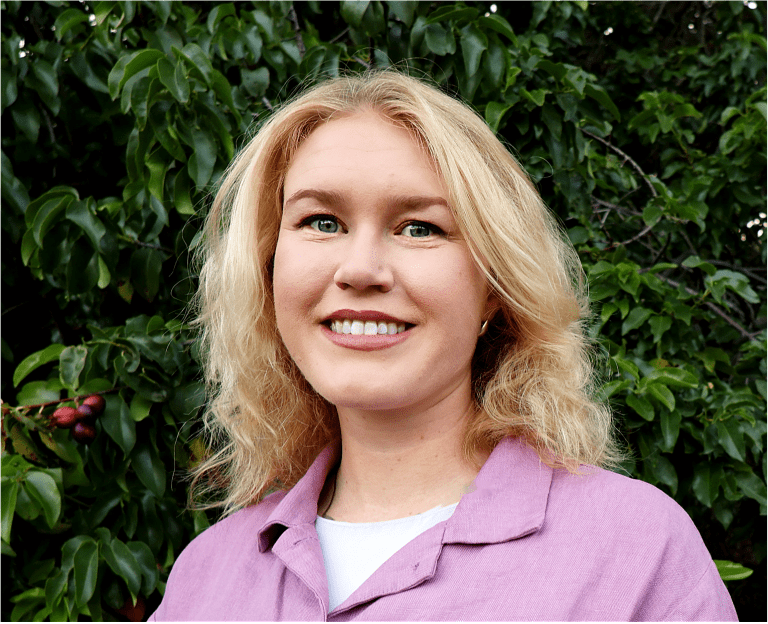
Savannah S. Cooley
Research Scientist
Affiliation: NASA Ames Research Center/Bay Area Environmental Research Institute (BAERI)
Division: Earth Science Division (SG)
Email: savannah.cooley@nasa.gov
Professional Biography
Dr. Savannah Cooley is a Research Scientist at NASA Ames Research Center / Bay Area Environmental Research Institute in the Earth Science Division, specializing in forest ecosystem dynamics and climate change, with expertise spanning tropical, temperate, and boreal systems. She works across advanced Earth observation technologies, including spaceborne lidar systems, ground-based thermal radiometry for satellite validation, and satellite-based thermal infrared remote sensing missions.
Her current research focuses on understanding how forest structure, thermal stress, biodiversity and soil greenhouse gas fluxes change during ecosystem degradation and regeneration, with particular emphasis on evaluating forest regeneration as a climate mitigation strategy. She employs a transdisciplinary approach combining novel spaceborne lidar and thermal radiometry, Bayesian statistical modeling, and meta-analysis, grounded in co-production with local communities and long-standing international collaborations.
Dr. Cooley serves as Co-Investigator on multiple NASA Research Opportunities in Space and Earth Sciences projects. She currently leads a study that investigates how fire, thermal stress and water use efficiency influence long-term forest aboveground biomass regeneration trajectories in the Brazilian Amazon Arc of Deforestation in partnership with international collaborators including Brazil’s National Institute of Space Research (INPE).
She also leads a comprehensive uncertainty quantification study for NASA JPL’s network of ground-based thermal infrared radiometers deployed at validation sites including Lake Tahoe, CA/NV and Salton Sea, CA. That effort is developing NIST-traceable calibration protocols to establish these instruments as Fiducial Reference Measurements for validating satellite land surface temperature products from missions including ECOSTRESS, MODIS, ASTER, Landsat and Sentinel-3 SLSTR. As Subject Matter Expert and Trainer for NASA’s Applied Remote Sensing Training (ARSET) Program, Dr. Cooley designs and delivers training focused on ecology, conservation and climate thematic areas for practitioners worldwide using NASA’s Earth observation data.
Dr. Cooley previously spent over five years at NASA’s Jet Propulsion Laboratory, where she contributed to major Earth Science missions including the ECOsystem Spaceborne Thermal Radiometer Experiment on Space Station (ECOSTRESS) mission and the Gravity Recovery and Climate Experiment Follow-on (GRACE-FO) mission. Her work there spanned developing Level 3 data products and conducting water use efficiency research to leading technology transition initiatives as Impact and Technology Transition Lead for NASA’s Western Water Applications Office.
Beyond research, Dr. Cooley has contributed to high-level climate policy, serving on the Satellite Needs Working Group for the White House National Science and Technology Council and contributing to the Global Risk Assessment Framework for the UN Office for Disaster Risk Reduction. Through these efforts, she actively bridges cutting-edge Earth science research with real-world environmental decision-making.
Across this work, Dr. Cooley is motivated by the question: what can Earth observation reveal about the interconnected structure and functioning of ecosystems that would otherwise go unseen? Dr. Cooley studies forest ecosystems that sustain human and more-than-human life, holding together the planetary view that satellites allow and the local place-based knowledge of those who have stewarded these landscapes for generations. Her work begins from the recognition that forests are living systems rather than inventories of carbon and timber – systems in which soil microbes, canopy structure, floral and faunal diversity, climate and human livelihoods are interdependent.
Education
Ph.D. Ecology, Evolution, and Environmental Biology, 2025, Columbia University
Dissertation title: “Forest dynamics and climate change: a multi-scale analysis of structure, degradation, recovery and greenhouse gas fluxes”
Dissertation advisors: Dr. Duncan Menge and Dr. Ruth DeFries
M.S. Geographic Information Science, 2017, Clark University
B.A. Economics (magna cum laude), Minors in Geography and Mathematics, 2016, Clark University
Research Interests
Ecological applications of thermal and lidar remote sensing, biodiversity modeling, thermal and evaporative stress analysis, ecosystem water use efficiency modeling, forest biogeochemistry (carbon and nitrogen cycles), land use stewardship for climate mitigation and resilience, community-engaged and co-produced Earth science, capacity building for Earth observation applications, thermal radiometer calibration and validation, uncertainty quantification, spaceborne lidar processing, ecosystem structure estimation, land cover classification, Bayesian statistical modeling, differential equation modeling, spatial econometrics, machine learning (random forests, xgboost, CNNs), time series analysis.
Awards & Other
- 2023 – Elected Ph.D. Student Representative, Columbia University Arts and Sciences Graduate Council
- 2022 – Member, New York Academy of Sciences
- 2020 – Harvard University Environmental Fellows Program (declined)
- 2019 – One of eight selected Young Scientists presenting at the Centennial Celebration of the American Geophysical Union in “Young Scientists View of the Future”
- 2017 – Edna Bailey Sussman Fund Graduate Research Fellowship Award Recipient
- 2017 – Graduate Student Representative, Department of Geography, Clark University
- 2016 – Dean’s List for Academic Excellence (GPA > 3.8), Clark University
- 2016 – Davis Project for Peace Award Recipient (Aquaponics Greenhouse Project)
- 2016 – Traina Scholar: Full Tuition Scholarship for students in the Sciences, Clark University
- 2012 – Kenneth A. Brown Faculty Award for Outstanding Scholar
Selected Publications
- Cooley, S. S., Hook, S., Johnson, W., Rivera, G., Abtahi, A. (in review). Uncertainty Quantification of the NASA Jet Propulsion Laboratory Near Nulling Thermal Radiometer.
- Cooley, S., Keller, M., Longo, M., Cawse-Nicholson, K., Menge D.N.L., McCarty, J. (in review). Burned Floors, Lowered Ceilings: Continental-Scale Suppression of Biomass Recovery in Amazonian Second-Growth and Degraded Forests.
- Cooley, S.S., Moore, E., Martinez, J., Fahlen, J., Maybach, E., Gollerkeri, M., Rao Vasa, A., Kou‐Giesbrecht, S., Huddell, A.M., Norton, L., Cawse‐Nicholson, K. and Menge, D.N.L. (2025). Global “climate opportunity benefit” of forest regeneration: Meta‐analysis shows warming from soil CH4 and N2O is small relative to agriculture. Global Biogeochemical Cycles, 39(10). DOI: 10.1029/2024GB008446.
- Cooley, S. S., Hook, S., Johnson, W., Rivera, G., Abtahi, A. (in prep). Uncertainty Quantification of the Calibration and Validation of the Jet Propulsion Lab Teladaq-Apogee SI-121 500 Series Thermal Infrared Radiometer.
- Cooley, S. S., Moore, E., Martinez, J., Fahlen, J., Maybach, E., Gollerkeri, M., Vasa, A., Morton, L., Kou-Giesbrecht, S., Butler, A., Gan, J., Uriarte, M., Menge, D.N.L. (in press). A global ‘climate opportunity benefit’ of regeneration: meta-analysis shows warming from soil CH₄ and N₂O is small in forests relative to agriculture. Global Biogeochemical Cycles.
- Cooley, S. S., Keller, M., Longo, M., Adami, M., Silgueiro, V., Cawse-Nicholson, K., Menge, D.N.L. (2025). Thermal stress in degraded forests in the Brazilian Amazon Arc of Deforestation. Environmental Research Letters.
- Cooley, S. S., Pinto, N., Vela-Alvarado, J., Fahlen, J., Aguilar, N., DeFries, R., Uriarte, M. & Menge, D. (2024). Combining spaceborne lidar from the Global Ecosystem Dynamics Investigation with local knowledge for monitoring fragmented tropical landscapes: A case study in the forest–agriculture interface of Ucayali, Peru. Ecology & Evolution. DOI: 10.1002/ece3.70116
- Menge, D.N., Kou-Giesbrecht, S., Taylor, B.N., Akana, P.R., Butler, A., Carreras Pereira, K.A., Cooley, S.S., Lau, V.M. and Lauterbach, E.L. (2023). Terrestrial Phosphorus Cycling: Responses to Climatic Change. Annual Review of Ecology, Evolution, and Systematics. DOI: 10.1146/annurev-ecolsys-110421-102458.
- Cooley, S.S., Fisher, J.B. & Goldsmith, G.R. (2022). Convergence in water use efficiency within plant functional types across contrasting climates. Nature Plants. DOI: 10.1038/s41477-022-01131-z
- Cooley, S.S., Jenkins, A., Schaeffer, B., Abdallah, A., Granger, S., & Friedl, L. (2022). Paths to research-driven decision making in the realms of environment and water. Technology in Society. DOI: 10.1016/j.techsoc.2022.101994.
- Borges, D., Ramage, S., Green, D., … Cooley, S.S., …, Lloyd, S., & Blake, C. (2022). Earth Observations into Action: Systemic Integration of Earth Observation Applications into National Risk Reduction Decision Structures. United Nations Global Assessment Report (UNGAR) 2022. DOI: 10.1108/dpm-09-2022-0186.
- Cooley, S.S., Pinto, N., Vela-Alvarado, J., Fahlen, J., & Aguilar, N. (2021). Vegetation typology classification and data set generation in Ucayali, Peru (Version 3.0) [Data set]. CaltechDATA. DOI: 10.22002/D1.2318.
- Cooley, S. S., & Landerer, F. (2019). Gravity Recovery and Climate Experiment Follow-on (GRACE-FO) Level-3 Data Product User Handbook. NASA Physical Oceanography Distributed Active Archive Center (PO.DAAC). https://podaac.jpl.nasa.gov/gravity/gracefo-documentation
- Lafia, S., Jablonski, J., Kuhn, W., Cooley, S.S., & Medrano, F. A. (2016). Spatial discovery and the research library. Transactions in GIS, 20(3), 399-412. DOI: 10.1111/tgis.12235.
Press Releases
- Columbia University Climate School State of the Planet press release. October, 2025. “A New Study Indicates Forest Regeneration Provides Climate Benefits, but Won’t Offset Fossil Fuels.” [https://news.climate.columbia.edu/2025/10/17/a-new-study-indicates-forest-regeneration-provides-climate-benefits-but-wont-offset-fossil-fuels/].
- Columbia University Climate School State of the Planet press release. October, 2025. “A New Study Indicates Forest Regeneration Provides Climate Benefits, but Won’t Offset Fossil Fuels.” [https://news.climate.columbia.edu/2025/10/17/a-new-study-indicates-forest-regeneration-provides-climate-benefits-but-wont-offset-fossil-fuels/].
- Columbia University Climate School State of the Planet press release. July, 2025. “Burned Amazon Forests Stay Hot and Stressed for Decades, Finds New NASA-Supported Study.” [https://news.climate.columbia.edu/2025/07/25/burned-amazon-forests-stay-hot-and-stressed-for-decades-finds-new-nasa-supported-study/].
- NASA Western Water Applications Office news release. September, 2022. “Helping Decision-Makers Improve Water Management.” [https://wwao.jpl.nasa.gov/news-insight/articles/improving-water-management-decision-making-agencies/].
- Nature Portfolio blog. June, 2022. “Behind the paper: ecosystem water use efficiency and the urgent need for climate action.” [https://earthenvironmentcommunity.nature.com/posts/ecosystem-water-use-efficiency-and-the-urgent-need-for-climate-action].
- Eyes on Earth podcast interview. April, 2022. “New paper uses ECOSTRESS to examine water use efficiency all across the globe: an interview with the lead author.” [https://www.usgs.gov/media/audio/eyes-earth-episode-73-global-water-use].
- Columbia Climate School news release. April, 2022. “Columbia PhD student publishes paper in Nature Plants on water use efficiency within plant functional types across contrasting climates.” [https://news.climate.columbia.edu/2022/04/14/space-station-instrument-provides-newly-detailed-look-at-plants-drought-resistance/].
- One of eight selected Young Scientists presenting at the Centennial Celebration of the American Geophysical Union in “Young Scientists View of the Future”. December, 2019. “The role of scientists in catalyzing action on climate change”. [minute ~50 of recording: https://www.youtube.com/watch?v=c6MV-O89DC4].