


















Julie McEnery: Decoding the Cosmos
Roman Space Telescope Senior Project Scientist – Goddard Space Flight Center
There’s a deep intellectual satisfaction in figuring things out; it’s why people do crosswords or jigsaw puzzles, and I get to do that for the universe itself! That is one of the many reasons I have always loved my job.”

Julie McEnery
Roman Senior Project Scientist, NASA's Goddard Space Flight Center
Julie McEnery’s path to her current role began when she was a child. Out of a natural inclination toward science, an ever-growing curiosity about the fundamental properties of our universe blossomed. By high school, she had decided that was what she wanted to study, either on very large scales or very small ones.
Julie McEnery, the senior project scientist for NASA’s Nancy Grace Roman Space Telescope at the agency’s Goddard Space Flight Center in Greenbelt, Md., eagerly awaits the opportunity the mission will provide to look at the sky in a new way.
NASA/Sophia Roberts
A cosmic journey begins
McEnery’s upbringing helped her to think big, taking her from Ireland to the Middle East and from Hong Kong to the United Kingdom before she finally moved to the U.S. in 1998.
McEnery was passionately interested in how the universe works, both at the very largest scales described by astrophysics and the very smallest scales described by particle physics. Following her bachelor’s degree from the University of Manchester in the United Kingdom, this interest ultimately led her to The University College Dublin’s high-energy gamma-ray astrophysics doctoral program.
“That’s kind of where particle physics and astrophysics meet,” McEnery said. “All of my interests came together in a single thing: astroparticle physics.”
A pioneering discovery
With support from the Smithsonian Institution, McEnery spent several months during each year of her doctoral program in southern Arizona at the Fred Lawrence Whipple Observatory using the Whipple gamma-ray observatory.
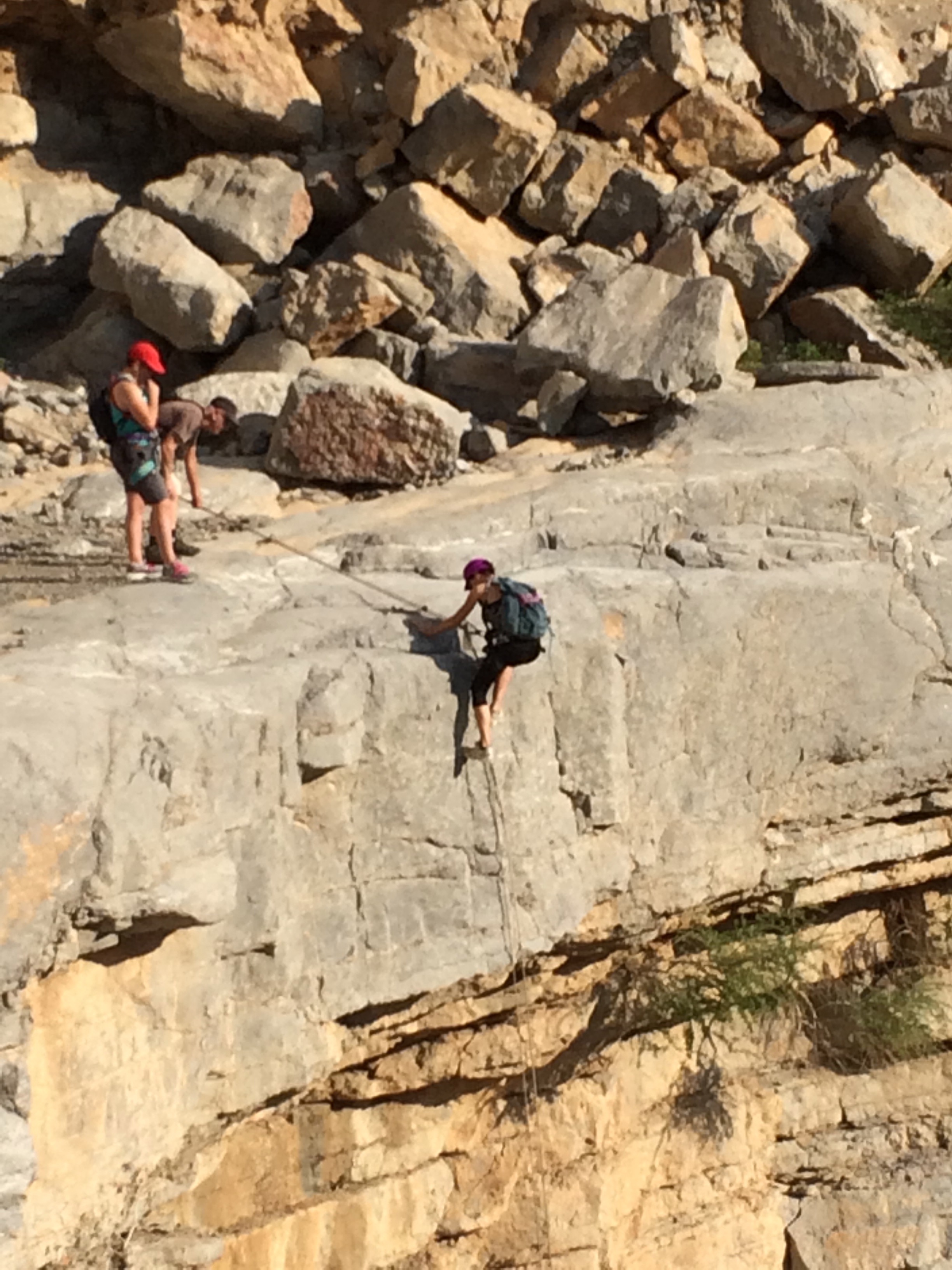
In this photo, Julie McEnery climbs with her mother in the United Arab Emirates. McEnery has traveled to dozens of countries and nearly every continent.
Courtesy of Julie McEnery
“Suddenly I was living on the set of every Western I’d ever seen, and that was completely spectacular,” McEnery said. She enjoyed hiking and skiing when not studying the newly discovered active galaxy Markarian 421.
“I’d done an analysis that suggested we were seeing evidence that this galaxy was varying in dramatic ways on very short timescales, which was thought to be impossible,” she said. “But sure enough, our observations confirmed it!”
Now astronomers know of thousands of galaxies that behave similarly. But at the time, Markarian 421 was one-of-a-kind.
“It was just tremendously exciting, because it really felt like we were breaking new ground, seeing things no one else had ever seen before,” McEnery said.
Celestial surveys
After completing her doctorate, Julie wanted to work outdoors doing something technically oriented. Such options were limited at the time for women, but she soon found a match: She got a job through the University of Utah working on an experiment using another ground-based gamma-ray telescope in Los Alamos, New Mexico.
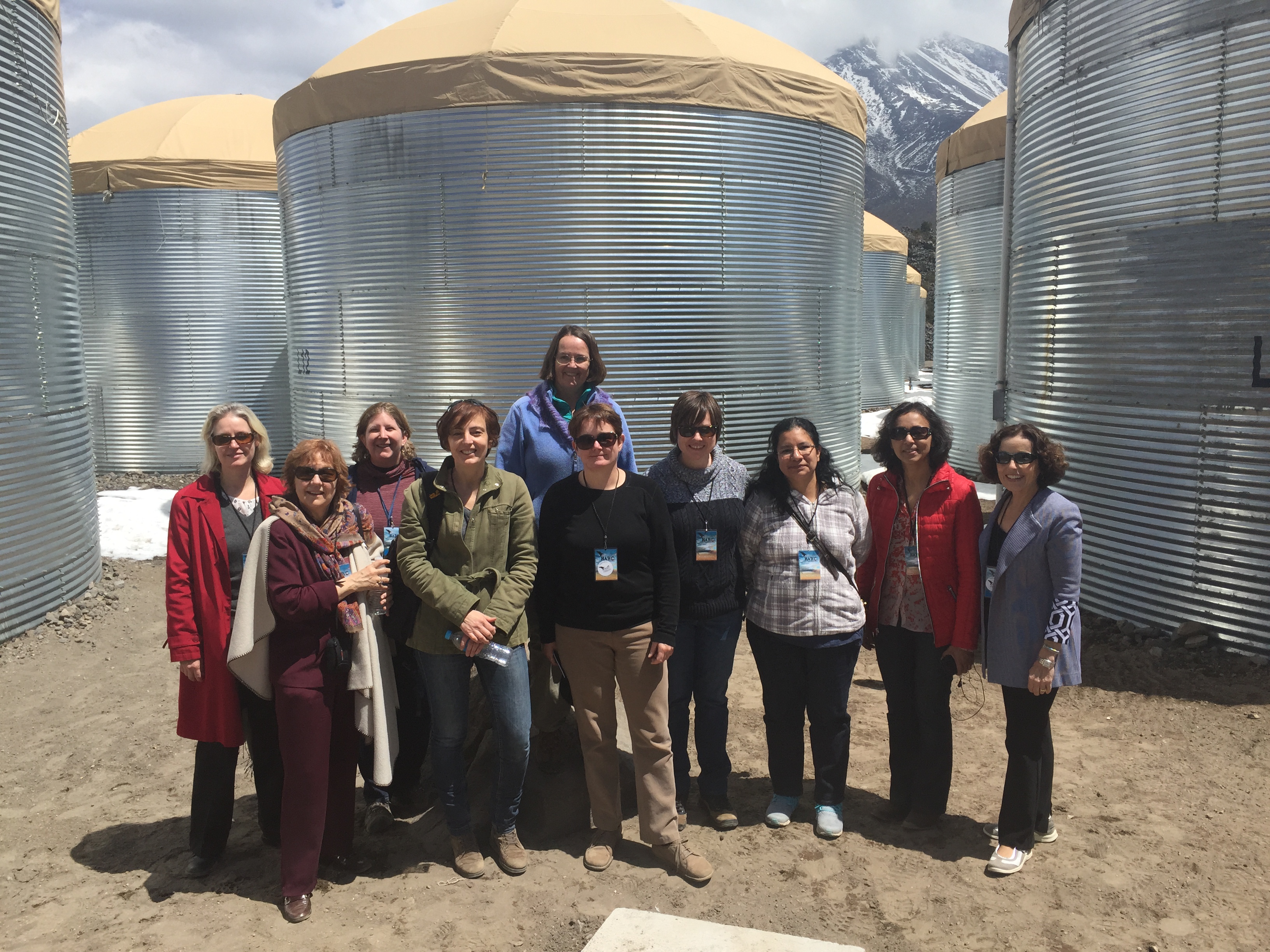
Julie McEnery (front, center) stands with a group of women at the HAWC (High-Altitude Water Cherenkov) Gamma-Ray Observatory inauguration near Puebla, Mexico, in 2015.
Courtesy of Julie McEnery
“I was able to do analysis and science, but also spend time in the beautiful mountains helping to build the observatory,” McEnery said. Her work at Los Alamos involved looking for very high-energy counterparts to a gamma-ray burst, which are among the most energetic explosions in the universe.
When it was time to look for the next job, McEnery had a tougher time. “Finding a faculty job was horrible; I got lots of interviews and the same number of rejections,” she said.
Throughout, McEnery was an active participant in the astrophysics community across the U.S. and internationally, and the time she had invested in talks, meetings, and general networking had established her as a serious scientist in the field. This became apparent to her when NASA Goddard contacted her to ask if she was interested in working with them. They offered two options. One was to work in the science support center for NASA’s Fermi Gamma-Ray Space Telescope — a reasonably secure position. The other was to do self-guided science research, which offered complete intellectual freedom but much weaker job security.
She took the latter option and about a year later became the Fermi deputy project scientist. She then spent a decade as Fermi’s project scientist, working with the mission team and the scientific community to maximize Fermi’s science return.
Fermi launched in 2008 and now surveys the whole sky every three hours.
“We had some specific science goals, but some of the most exciting findings were unexpected results of that large, unexplored dataset,” McEnery said. With Fermi, her interests transitioned to cosmic explosions.
It was a well-timed pivot. In 2017, Fermi detected gamma rays from a neutron star collision so powerful that it jolted the universe, creating a ripple in the fabric of space-time that traveled across the cosmos at the speed of light. Other facilities detected gravitational waves from the same event, marking the first time light and gravitational waves had been detected from a single source.
“It was transformational,” McEnery said. “The era of gravitational wave astrophysics had dawned, and now it’s come of age. We’re able to combine dramatically different ways of viewing the universe, and our level of understanding leaped forward as a result.”
To take exploration of the extreme universe to the next level, McEnery started developing concepts for a successor to Fermi. This took her into new territory going from leading a large mission to building and operating a new laboratory to develop and test new technologies, and developing a small instrument for a balloon flight to test these technologies in a space-like environment. Leveraging her deep roots within the astrophysics community, she also spearheaded a collaborative effort among researchers to develop a concept for a next-generation, large-scale gamma-ray observatory.
Different wavelengths of light offer completely different information. Consider your hand — there’s what we see with our eyes, versus the heat pattern we see with infrared light, versus bones with X-ray, versus nothing at all with gamma rays since they pass right through. It’s the same hand, but we learn so much more by seeing it in multiple wavelengths.”
Julie McEnery
Roman Senior Project Scientist, NASA's Goddard Space Flight Center
In 2018, McEnery leaped at the opportunity to take her career in a new direction and joined the mission team for NASA’s Nancy Grace Roman Space Telescope (then called WFIRST, the Wide-Field Infrared Survey Telescope).
McEnery now leads the Roman mission as senior project scientist, and it has proved to be the pinnacle of her career.
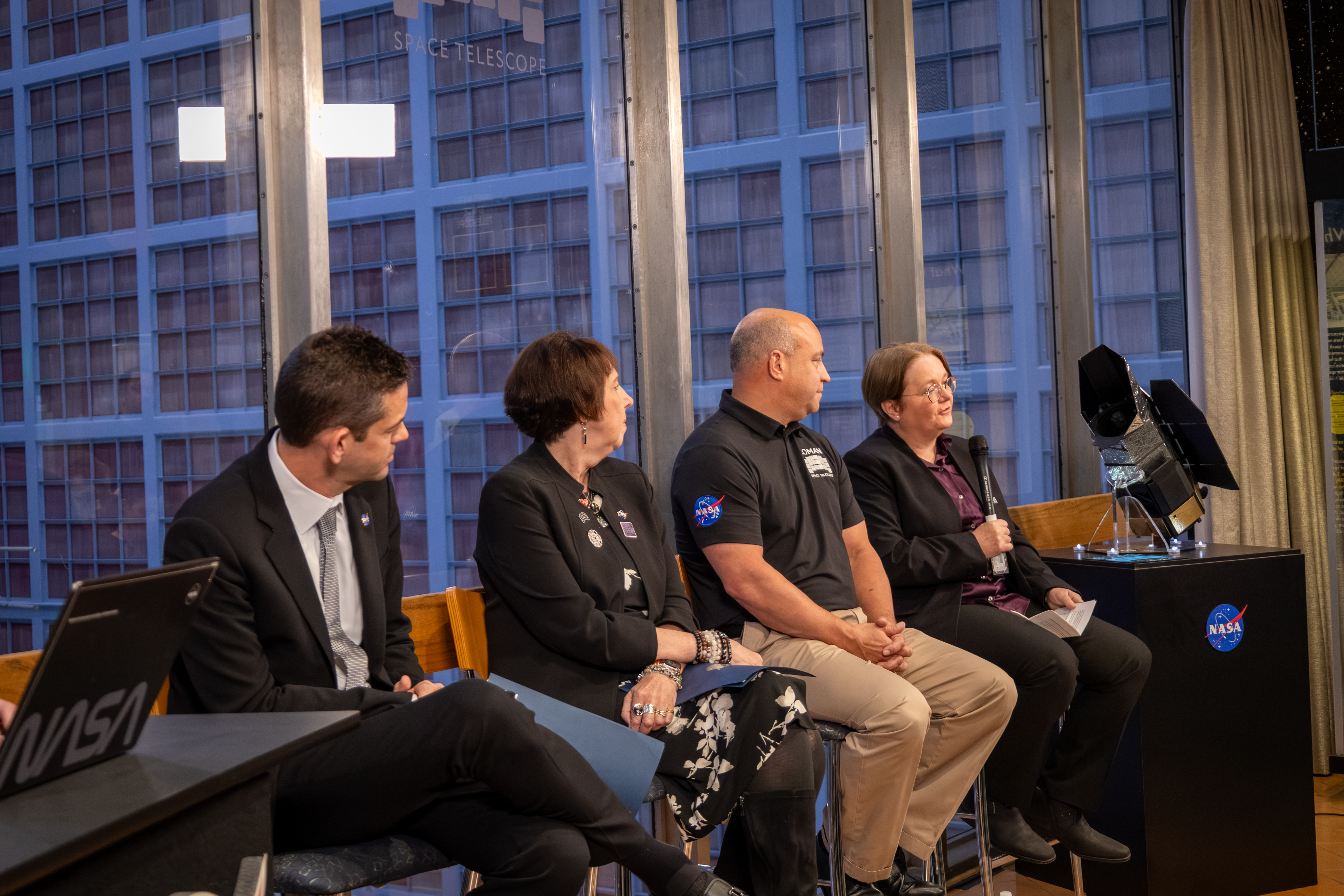
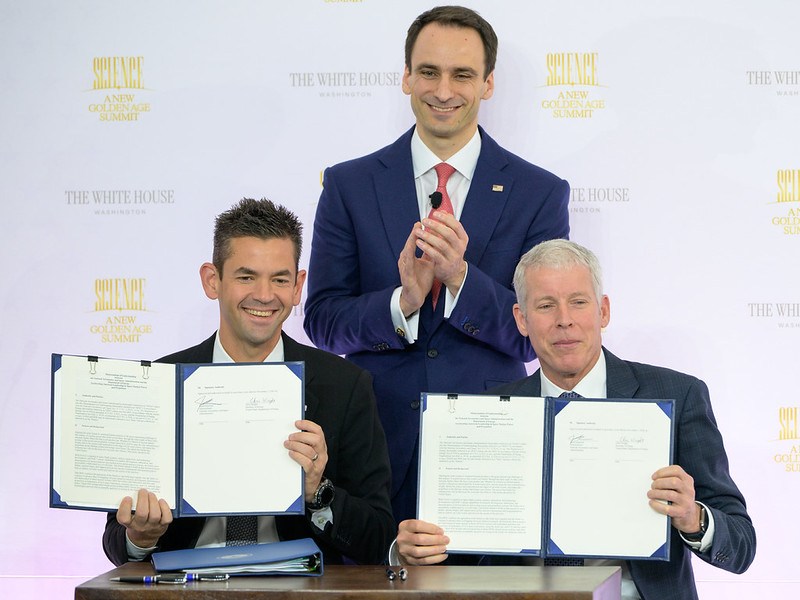
Julie McEnery (far right) addresses members of the media alongside (from left to right) NASA Administrator Jared Isaacman; Nicky Fox, associate administrator for the Science Mission Directorate at NASA Headquarters in Washington; and Jamie Dunn, then project manager for Roman at NASA Goddard.
NASA/Travis Wohlrab
Like Fermi, Roman will set out with particular science goals (like untangling dark matter and dark energy and finding troves of new worlds), but the way it will observe will enable all kinds of other science, too.
“There’s the grand challenge problem, but then there’s a host of other science we’re going to do, and that’s just the science I can tell you about!” McEnery said. “What I’m sure is going to happen is that we’ll make these observations and find new things. And we’re going to find them because we’re going to be looking at the sky with a set of capabilities that are way beyond anything we’ve been able to do before at this scale.”
Such unforeseen finds are not without precedent. Fermi serendipitously found giant bubbles extending from the center of our galaxy and antimatter created by thunderstorms. Likewise, Roman may find entirely new phenomena or classes of objects.
“All the things that we’re planning to do with Roman are extraordinary,” McEnery said. “But I really hope that the most extraordinary thing Roman will uncover is something that we haven’t even thought of.”
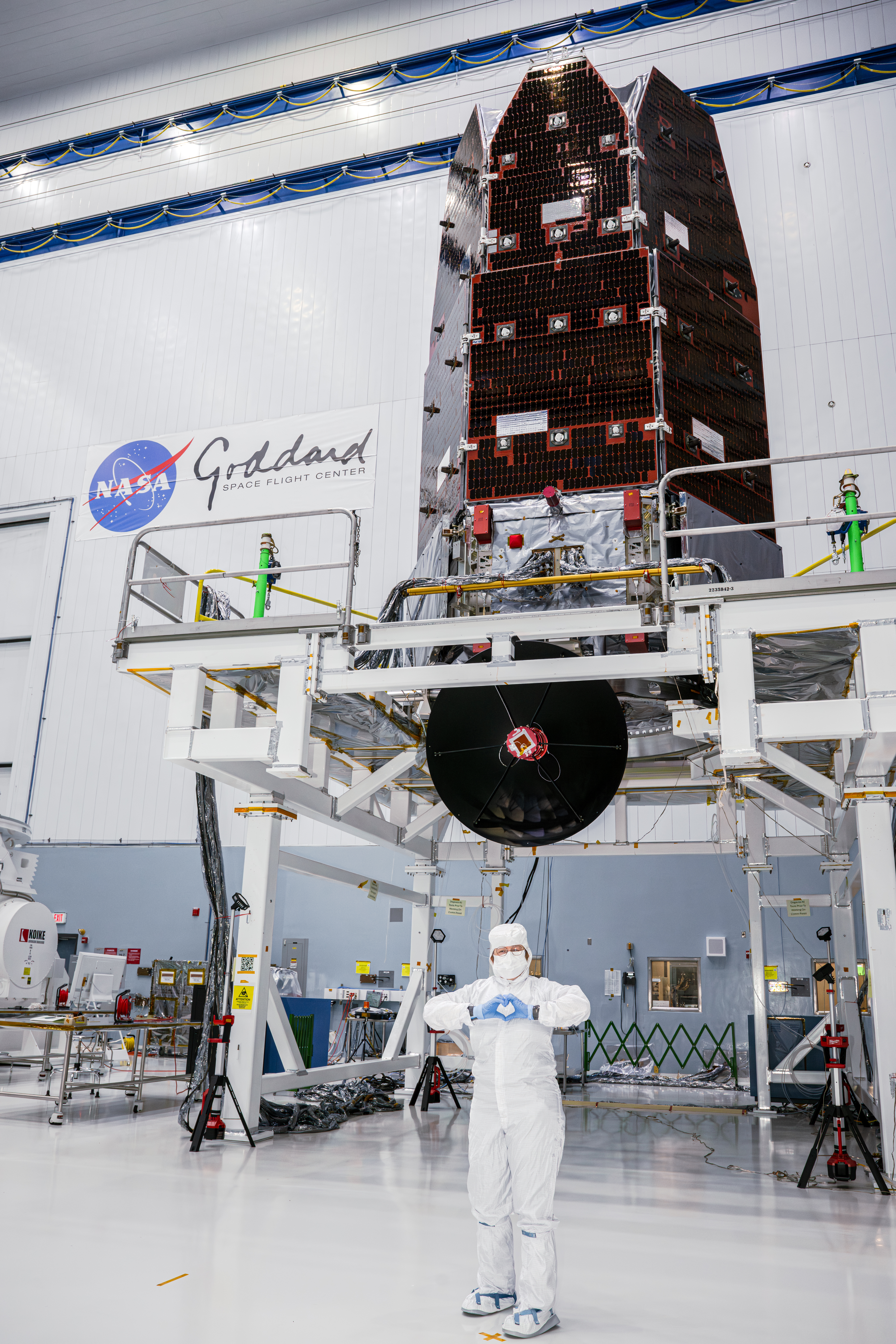
Julie McEnery stands in front of the Roman telescope in a clean room at NASA Goddard.
NASA/Sydney Rohde (Rocz)
For now, McEnery continues preparing to find those unexpected twists in the fabric of the cosmos that could transform our fundamental understanding of the universe.
To others who want to explore the universe, she says, “Make choices based on what interests you.” McEnery also notes that it takes a host of researchers to tackle big cosmic conundrums. “Most of the time you’re not working on the solution to the universe itself. If you imagine a blanket that’s woven together, you’re typically working on some corner patching a hole, but it’s very satisfying work.”
When Roman starts sending its data back, the work and excitement will really begin for the Roman team. In the meantime, McEnery is taking a few precious moments to spend time with her dog Cosmo, enjoy morning rowing on the Anacostia river, and get in a bit of deep-sea fishing off the Eastern Shore. She knows the real work is coming.