


















In late February, people in the Northern Hemisphere can look up for a special sight: six planets will all be visible from clear and dark night skies. New sonifications from NASA’s Chandra X-ray Observatory released Feb. 25 will help commemorate this latest “planetary parade.”
Because the planets in our solar system travel around the Sun in the same plane (known as the ecliptic), they will sometimes appear bunched together in the sky when their orbits find them on the same side of the Sun at the same time. When this happens, it looks like the planets have roughly formed a line from our vantage point on Earth.
In Chandra’s sonifications, which translate astronomical data into sound, three of the planets that will be on display – Jupiter, Saturn, and Uranus – can be seen and heard in ways that they cannot from Earth.
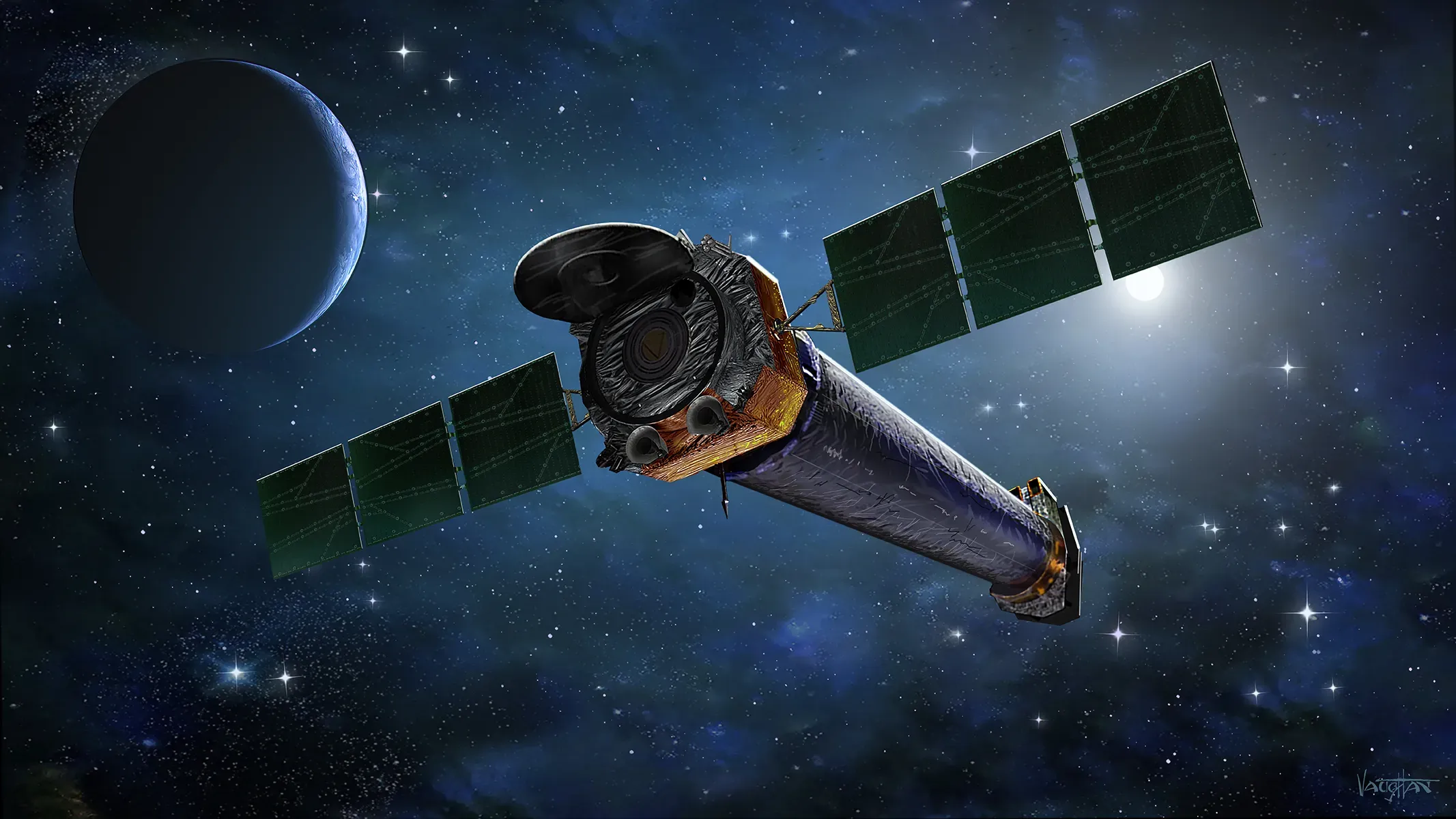
While Chandra is best known for its X-ray insight into black holes and other extreme objects, the telescope has also played an important role in the exploration of our solar system. The Sun gives off X-rays that travel out into the solar system and can be reflected by planets, moons, and other bodies. This gives astronomers a unique window into certain physics that cannot be discovered through other kinds of telescopes.
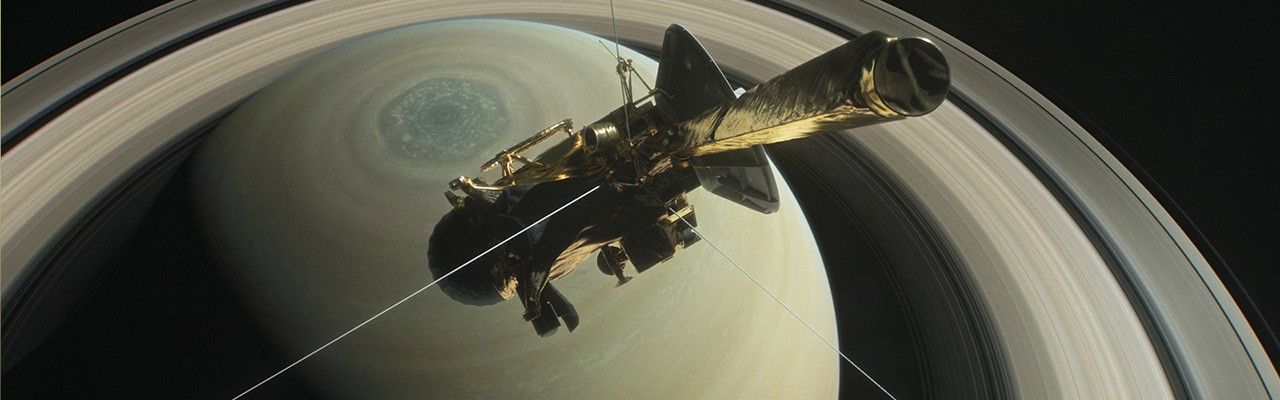
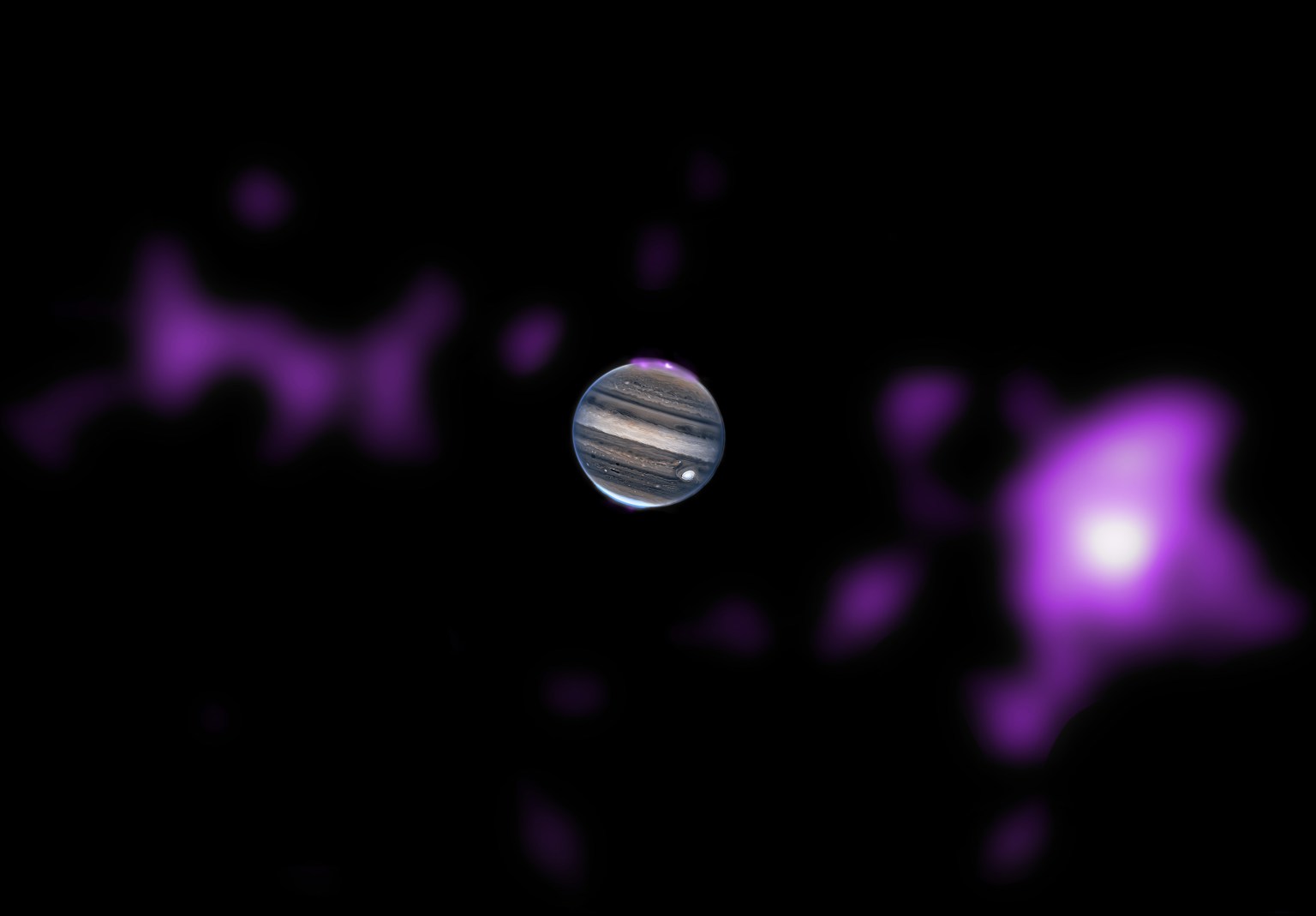
The sonification of Jupiter combines X-ray data from Chandra with an infrared image from NASA’s Hubble Space Telescope. Woodwind sounds reveal Chandra’s X-ray data, including emission from the planet’s auroras. More instruments join in to represent the planet’s complex cloud layers. Next, through the combination of an optical image from NASA’s Cassini mission and X-rays from Chandra, listeners can experience Saturn like never before. A siren-like sound follows the arc of the rings, and different tones of synthesizers play as the scan passes the planet itself. Finally, listeners can hear the ice giant Uranus through the data collected by Chandra and the W.M. Keck Observatory. The data in this sonification reflects the amount of light detected from the planet and the orientation of its ring.
The process of creating a sonification preserves the integrity of the data, which arrives on Earth as a series of ones and zeroes (binary code), and shifts it into a form that can be processed through hearing. Sonifications expand options for people to explore what telescopes discover in space, an example of NASA’s ongoing commitment to share its data as widely as possible.
Jupiter
Saturn
Uranus
NASA’s Marshall Space Flight Center in Huntsville, Alabama, manages the Chandra program. The Smithsonian Astrophysical Observatory’s Chandra X-ray Center controls science operations from Cambridge, Massachusetts, and flight operations from Burlington, Massachusetts.
For more on the Chandra sonification program, visit:
To learn more about Chandra, visit:
https://science.nasa.gov/chandra
Read more from NASA’s Chandra X-ray Observatory
Learn more about the Chandra X-ray Observatory and its mission here:
Visual Description
This release features three sonifications, each focusing on a different planet in our solar system. The sonifications are presented as soundtracks to short videos. Each video features a composite image and an activation line. As the activation line sweeps across the image, it encounters visual elements. These elements are translated into sound, or sonified, according to parameters established by Chandra’s sonification team.
The first sonification focuses on the planet Jupiter. At the center of the associated composite image is the gas giant itself; a seemingly perfect sphere with an atmosphere of latitudinal bands. The bands are different shades of grey, brown, and black, each with its own texture and width. Flanking Jupiter are neon pink and white clouds, representing X-rays from energetic particles in a ring around the planet. In the video, the activation line moves from our left to right. It first encounters a pink cloud, triggering whooshing woodwinds. When the activation line encounters Jupiter, dramatic low notes are triggered. Listen for the dip as the line passes over the Great Red Spot in Jupiter’s southern hemisphere. The activation line continues toward our right, passing more pink X-ray clouds. The largest cloud, the last one encountered, has a bright white core, which translates to loud gusty woodwinds.
The second sonification focuses on the ringed planet, Saturn. In the composite image, the large gas giant fills the frame, its spherical outer layer a pale sandy grey. In this image, the wide bands of rings surrounding the planet are in shades of pale grey and sandy yellow. Here, Saturn is tilted away from us, making the round rings appear oval in shape. Dotting the planet are small pockets of neon blue. These represent reflected X-ray light observed by Chandra. In this video, the activation line moves from our right to left. When the line passes over the rings, a whooshing sounds spreads, conveying the widening middle of the oval shapes. Pockets of neon blue X-ray light trigger synthesizer sounds, with the pitch mapped to each pocket’s vertical position in the image. When the line sweeps across Saturn’s large round body, a low rumbling synth tone is triggered. The volume is linked to brightness, such that the low tone fades when the line reaches the shady side of the planet, on our left.
The third sonification features the planet Uranus. In the composite image, the icy giant is a greenish-blue cyan color, with a blush of neon pink X-rays hovering over its core. Uranus has a collection of very narrow rings, much finer than the wide disk-like rings surrounding Saturn. In this image, the fine rings are near vertical and slightly tilted, creating an oval shape with rounded points at our lower left and upper right. In this sonification, the activation line moves from our left to right. Brightness is mapped to volume and height is mapped to pitch, such that brighter objects at the top of the image sound louder and higher. Here, the curved oval shape of the rings is conveyed as a swooping cello note, with the pitch sliding up as the activation line passes the oval tilted toward our upper right.
News Media Contact
Megan Watzke
Chandra X-ray Center
Cambridge, Mass.
617-496-7998
mwatzke@cfa.harvard.edu
Joel Wallace
Marshall Space Flight Center, Huntsville, Alabama
256-544-0034
joel.w.wallace@nasa.gov