







David Bugby
NASA Jet Propulsion Laboratory
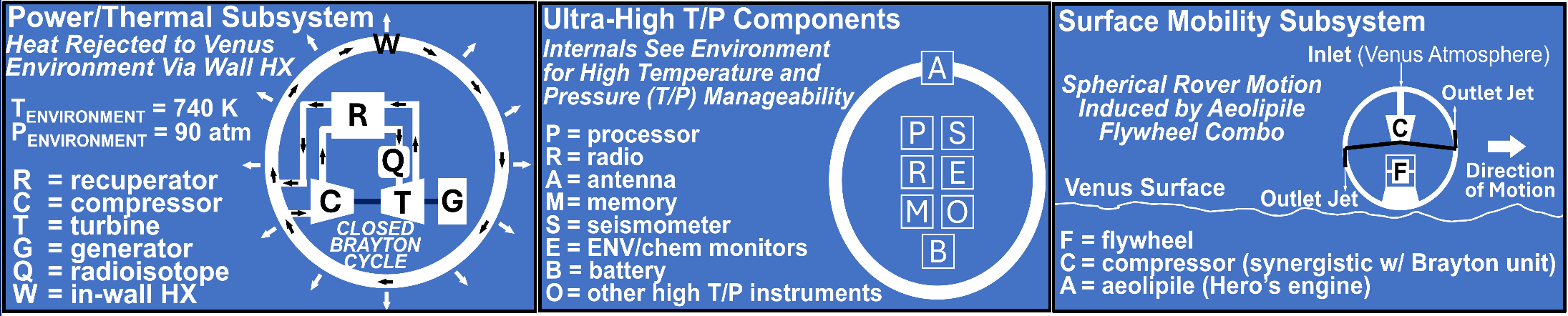
INNOVATION: Venus surface missions have typically targeted short stays in fixed locations due to the extremely harsh conditions there and the lifetime limitations imposed by typical power, thermal, and structural solutions. We propose three key innovations to extend mission lifetime while also providing surface mobility: (1) closed Brayton cycle radioisotope power system that uses the rover exterior spherical surface as its radiator; (2) internal electronic and science components that operate at ultra-high temperatures/pressures (T/P); and (3) a surface mobility subsystem that requires no externally exposed mechanisms. The lifetime of this rover could exceed several Earth years.
IMPACT: Missions with extremely limited durations may have an equally limited duration of appeal to key science, political, and public stakeholders. Thus, missions to the surface of Venus that target minutes or a just few hours of operability are unlikely to maintain stakeholder support. If a means of survival on Venus — while performing science measurements for stays measured in years not hours — can be reasonably postulated, developing that means of survival should be vigorously pursued. Thus, the impact of this proposed effort would be future Venus surface missions that are not simply in vogue one year and out of vogue the next, but missions that have a long-lasting appeal.
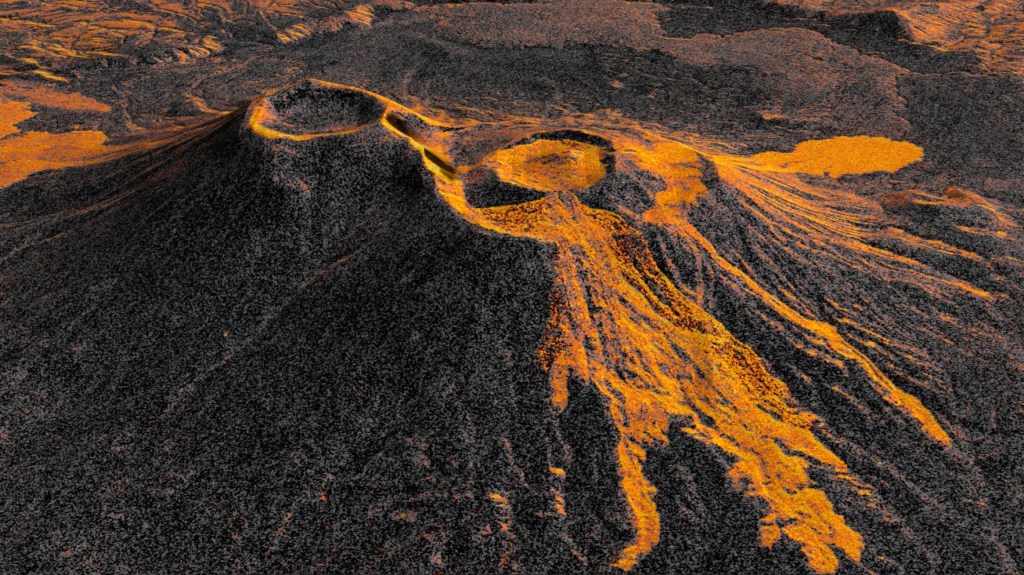
MISSION: One possible proposed mission would be a greatly expanded version of what the DaVinci probe hopes to accomplish over its 18 minutes of on-surface lifetime, but to do so over a much longer period of time and to do so while roving to other locations. Internal science components would include ultra-high T/P (UHTP) capable environmental/chemical monitors, a UHTP-capable seismometer, and other yet to be determined UHTP-capable instruments (including cameras). Comm with Earth data stations would require uploading data to an orbiting Venus relay satellite using a UHTP-capable comm system/external antenna. Data processing requires a UHTP-capable processor. Plus, a new title of DaVinci-CANVAS (or DC) is a subtle nod to key purse-string stakeholders.
APPROACH: The proposed accomplishments include designing, sizing, and selecting: (1) closed Brayton cycle power subsystem elements; (2) ultra-high T/P (UHTP) capable components; and (3) surface mobility subsystem elements. The surface mobility subsystem combines a UHTP-capable flywheel powerful enough to cause the spherical rover to rotate/move and an aeolipile driven by an internal UHTP-capable compressor to compress the Venus atmosphere and eject it from opposing sides of the sphere with enough force (thrust) to cause the spherical rover to rotate/move. To survive exposure to the UHTP and corrosive environment will require novel design/sizing/selection of the required componentry. By the end of Phase III, a working CANVAS prototype is targeted.