






















Suggested Searches

Watch the Skies

    When and How to Spot the ‘Devil Comet’
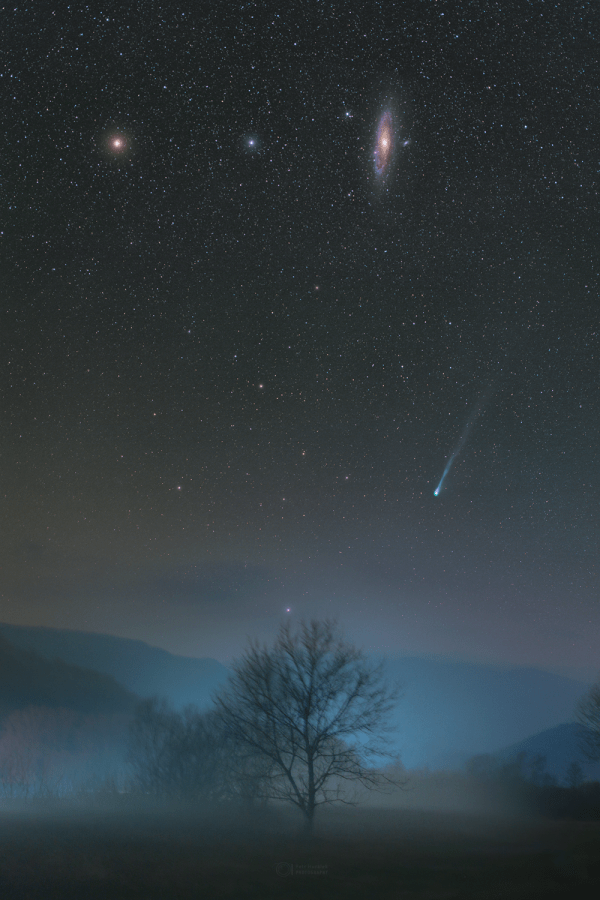
    As spring approaches for northern skygazers, Comet 12P/Pons-Brooks is growing brighter. Currently visible with small telescopes and binoculars, the Halley-type comet could reach naked eye visibility in the coming weeks. Seen despite a foggy atmosphere, the comet's green coma and long tail hover near the horizon in this well-composed deep night skyscape from Revuca, Slovakia recorded on March 5. M31, also known as the Andromeda galaxy, and bright yellowish star Mirach, second brightest star in the constellation Andromeda, hang in the sky above the comet. The Andromeda galaxy is some 2.5 million light-years beyond the Milky Way.

    Comet 12P/Pons-Brooks is one of the brightest known periodic comets. It earned the nickname of “devil comet” in 2023 when an outburst caused the comet to have an asymmetrical appearance, like having horns. It comes around every 71 years and is currently getting brighter as it flies toward the Sun. In the Northern Hemisphere, the …

    Read Full Post

    March’s Lunar Eclipse Before April’s Solar Spectacle

    April’s solar eclipse  has stolen the headlines for many months now, and rightfully so with millions of Americans in the path of totality. But did you know there is also a lunar eclipse before the solar eclipse? As the full moon rises during the late evening of March 24 into the early morning hours of …

    Read Full Post

    View Nova Explosion, ‘New’ Star in Northern Crown

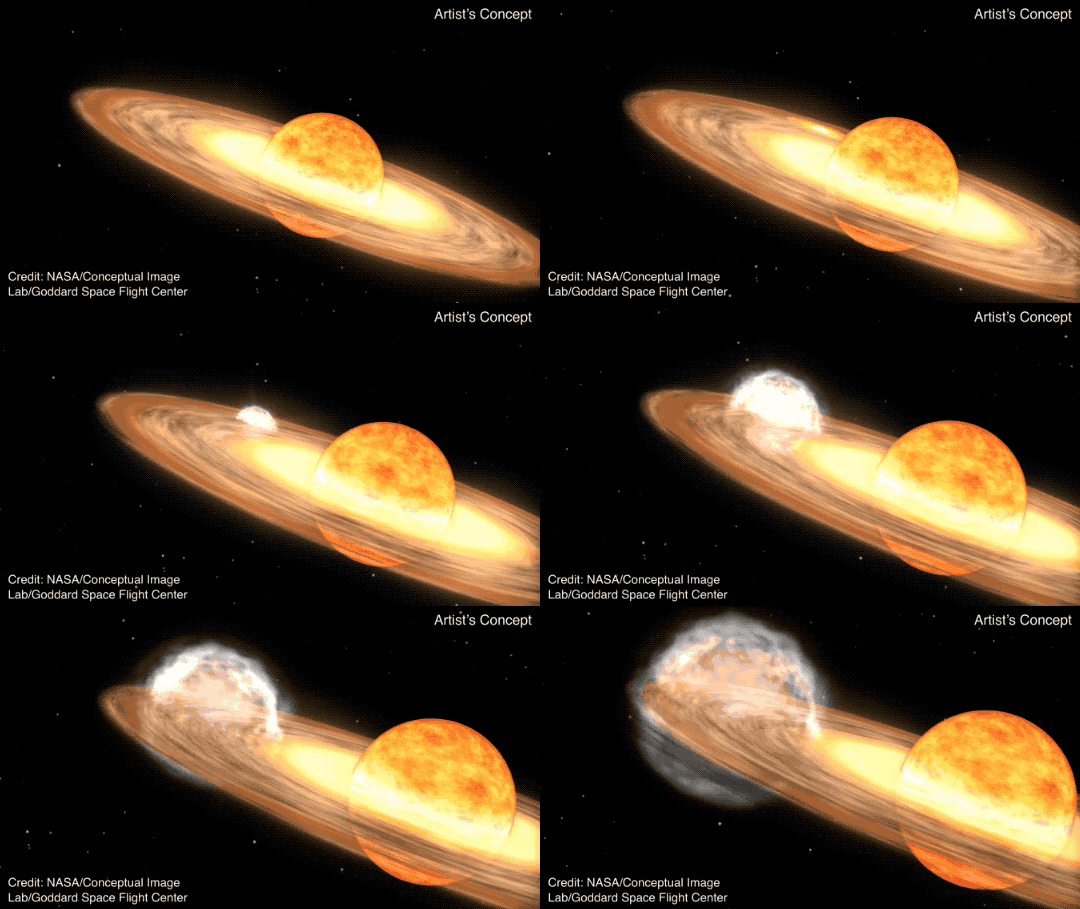
    A star system, located 3,000 light-years away from Earth, is predicted to become visible to the unaided eye soon. This could be a once-in-a-lifetime viewing opportunity as the nova ouburst only occurs about every 80 years. T Coronae Borealis, or T CrB, last exploded in 1946 and astronomers believe it will do so again between …

    Read Full Post

    Mars, Venus Appear Very Close to Each Other this Month

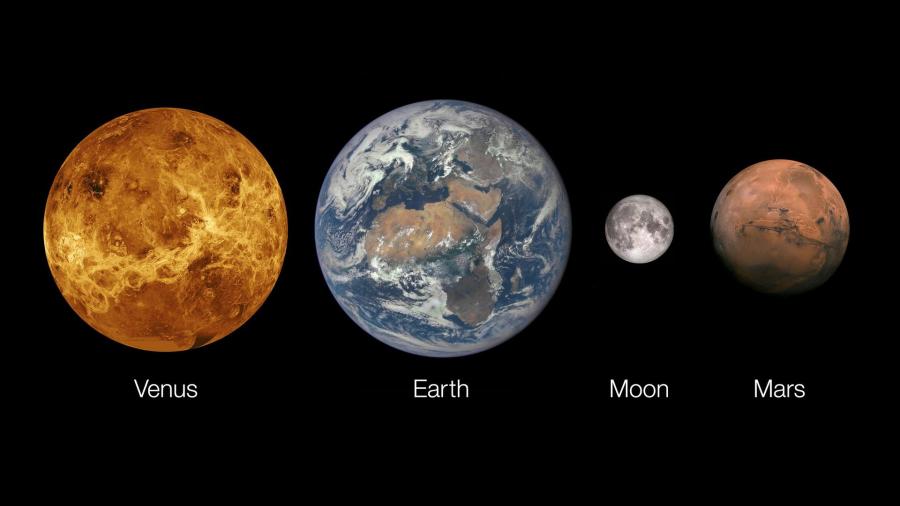
    This graphic shows Venus, Earth and its Moon, and Mars.

    February is a great month for the early rising skygazers. Venus has been bright in the morning sky all year, rising just before the Moon. In the minutes before dawn this week, Venus will rise to the upper left of the waning crescent Moon and will be joined by Mars. Over the coming weeks, Venus …

    Read Full Post

    2024 Highlights: When & Where to Watch the Skies

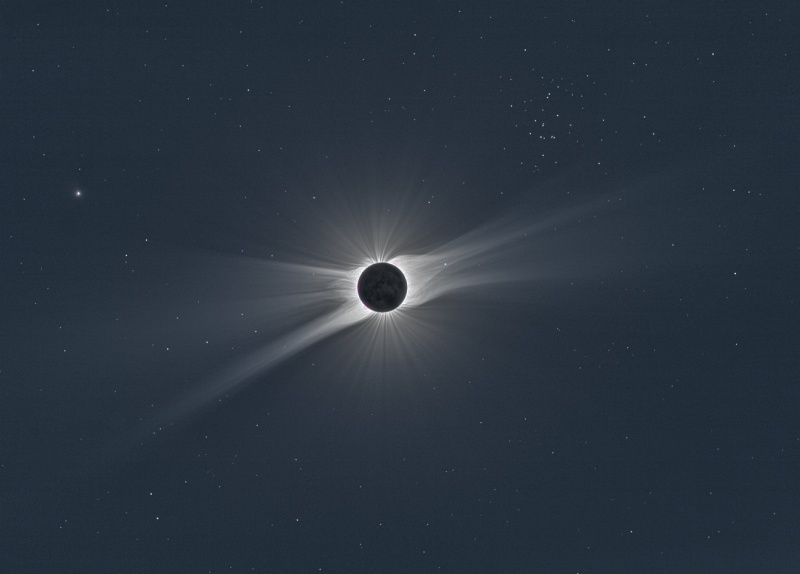
    A view of the Eclipse 2008

    If your New Year’s resolution included more skygazing, you’ll have many fantastic opportunities to view some showstopping astronomical events. Kick off the year by watching the skies on Jan. 17 as the Moon pairs up with Jupiter, appearing high in the southwest, for two evenings. After a near year-long fade from the naked eye, Mars …

    Read Full Post

    Gorgeously Green: Geminids Peak Next Week

    The Geminid meteor shower is active for much of December, but the peak occurs the night of the 13th into the morning of the 14th. Meteor rates in rural areas can be upwards of one per minute this year with minimal moonlight to interfere. Bill Cooke, lead for the Meteoroid Environment Office at NASA’s Marshall …

    Read Full Post

    Spooky Season of the Skies

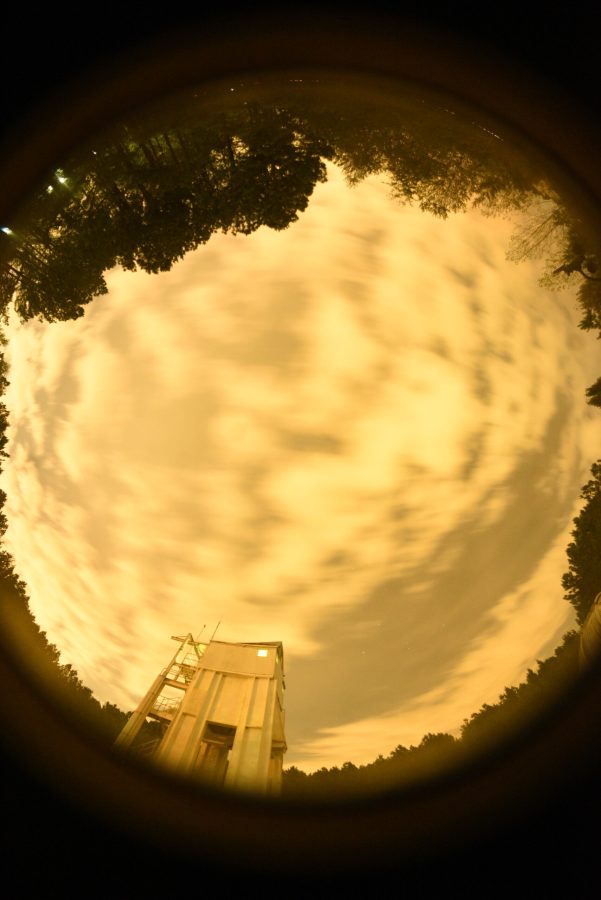
    An orange hue tints the photo of the sky .

    The NASA All-sky Fireball Network is a network of cameras set up by the NASA Meteoroid Environment Office (MEO) with the goal of observing the brightest meteors called fireballs. However, sometimes creepy, crawly, spooky, strange, and mysterious images also get picked up by their cameras. Do you see the jack-o-lantern in the clouds? Long-legged creepy …

    Read Full Post

    The Solar Eclipse Experience

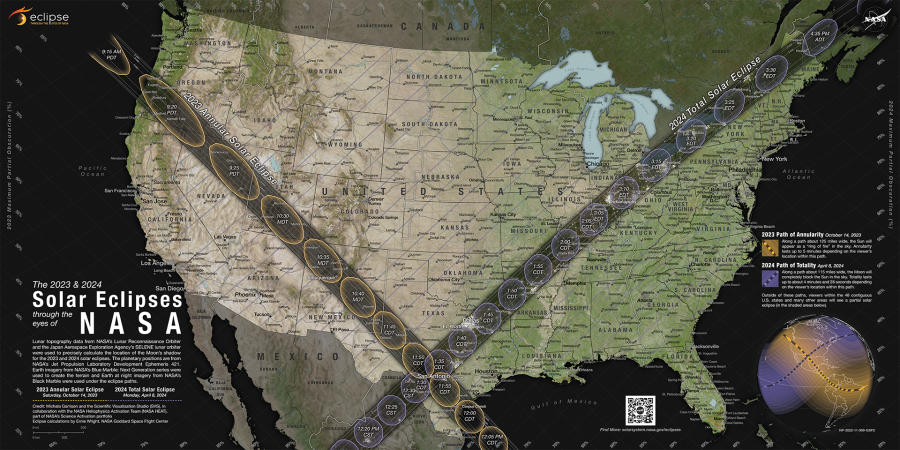
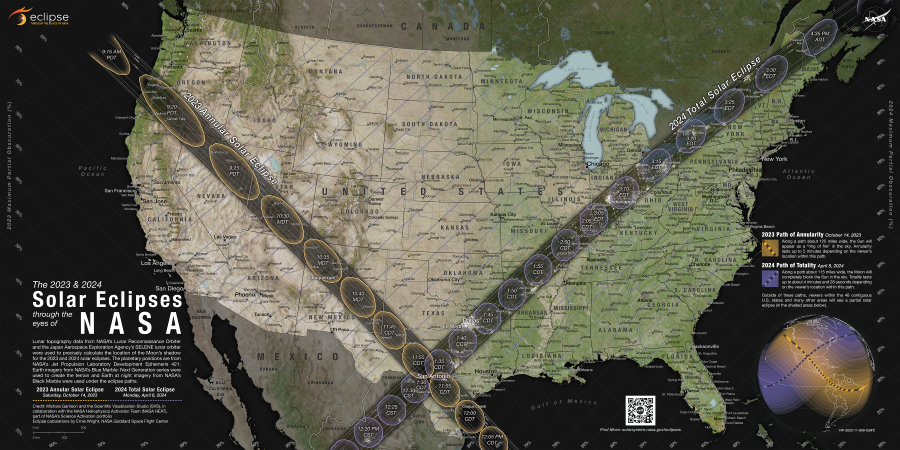
    A map showing where the Moon’s shadow will cross the U.S. during the 2023 annular solar eclipse and 2024 total solar eclipse.

    On Oct. 14, 2023, and April 8, 2024, the entire United States and millions around the world will be able to view a solar eclipse.   There are three different kinds of solar eclipses: total, annular, and partial. When the Moon is far from the Earth, its size is too small to completely cover the …

    Read Full Post

    Coming Soon: A “Ring of Fire” in the Sky

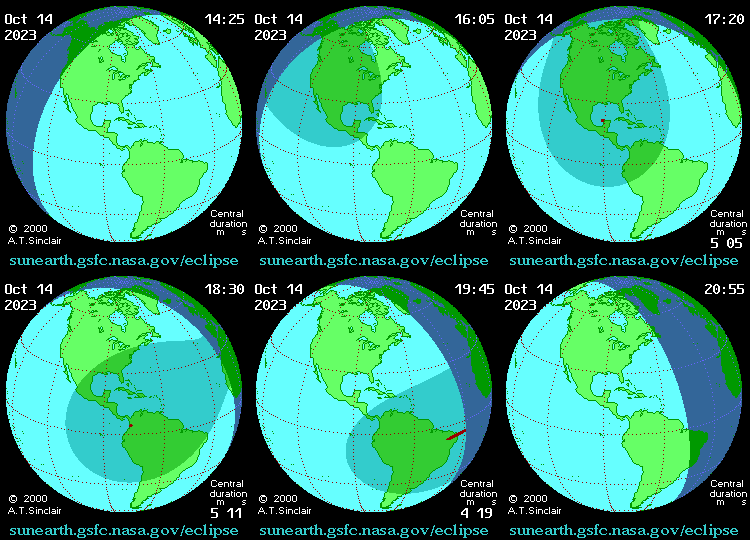
    An animation of the Earth that shows where the annular eclipse path will be in 2023.

    On Oct. 14, 2023, an annular total solar eclipse will be visible to millions across the globe as it sweeps through the skies of the northwestern United States through Mexico and Central America and into South America, exiting the continent in Brazil. Even if you are not in the path of annularity, you will still …

    Read Full Post

    Saturn Shines This Week – 3 Ways to View the Planet’s Opposition

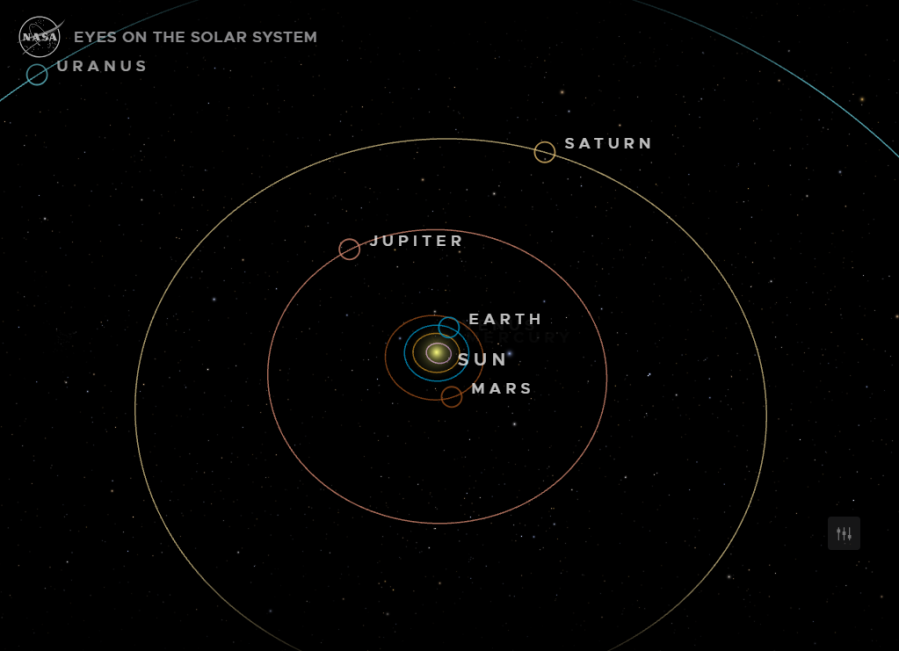
    A graph that shows how far away Saturn is from the sun via concentric circles.

    Saturn will be located directly opposite of the Sun – at opposition – on August 26-27, 2023, as the Earth orbits between the two. From our vantage point, the Sun’s illumination will allow Saturn to appear bigger and brighter in the sky in the weeks leading up to and after the opposition. In fact, Saturn …

    Read Full Post

Subscribe to this blog

Show Past Archives