
















Suggested Searches

Wallops Flight Facility

Launch updates from NASA's Wallops Flight Facility.

    New Mexico Scientific Balloon Campaign Update- Sept. 4

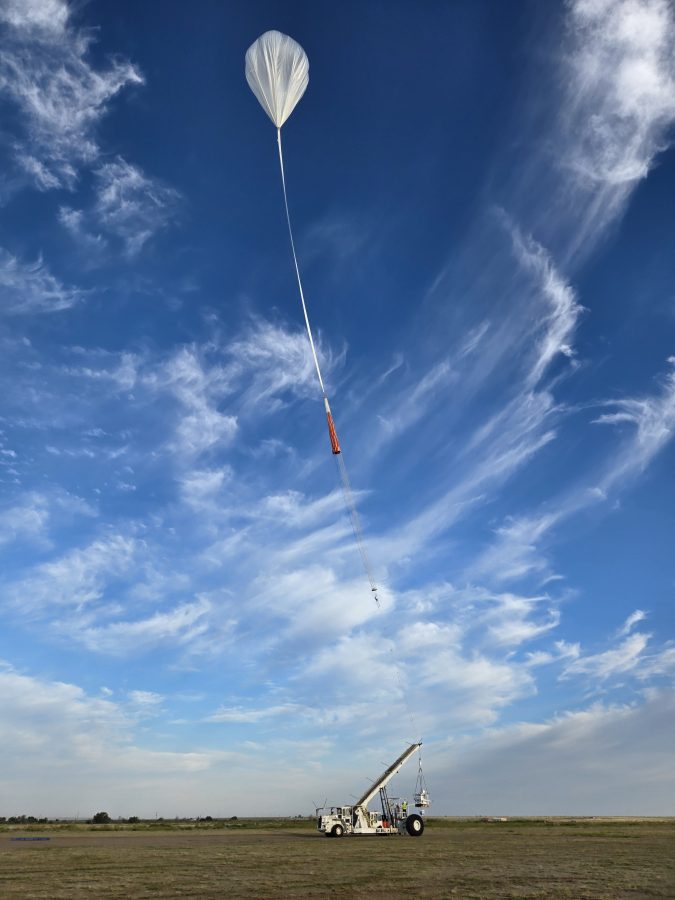
    The High-Altitude Student Platform 2 (HASP2) successfully launched at 8:28 a.m. MDT (10:28 a.m. EDT) Thursday, Sept. 4 and reached a float altitude of nearly 122,000 feet. HASP remained in flight for a total of 11 hours,40 minutes. Science reports a successful flight. The balloon and payload have safely landed, and recovery efforts are underway.

    The HASP2 program is a collaborative effort between Louisiana Space Grant Consortium at Louisiana State University (LaSPACE - LSU), NASA SMD: Astrophysics Division, NASA Balloon Program Office (BPO) and the Columbia Scientific Balloon Facility (CSBF) to develop and operate an inexpensive platform that can be used to flight test compact satellites, prototypes and other small payloads designed and built by students. The High Altitude Student Platform 2 (HASP2) is designed to carry up to twenty-four (24) student payloads at a time to an altitude of about 110,000 feet with flight durations of 15 to 20 hours.

    Student Payloads and Organizations for 2025 include:

    • Big Red Sat 1.5 – The University of Nebraska Lincoln
    • STRAINS 4.0 – Sint-Pieters College Jett
    • Bat Sat – University of Colorado, Colorado Springs
    • FLC Ionizing Radiation vs Solar Insolation (IRSI) Experiment – Fort Lewis College
    • Strato Sentinal – University of Boston Massachusetts
    • Ozone Sensors Payload – University of North Florida
    • Astrolab – Universidad Nacional de Ingeniería
    • Spectra Solis – College of the Canyons
    • Astro Tracker II - Universidad Nacional de Ingeniería
    • MSTRI – McMaster University
    •  OLIMPO - Universidad Nacional de Ingeniería

    NASA Sounding Rocket Mission Targeting Aug. 25 Launch Attempt

    The TOMEX+ sounding rocket mission is targeting Monday, Aug. 25, for the first launch attempt. The window will open 10 p.m.-3 a.m. EDT. Follow live updates on Wallops Facebook and X, with a livestream beginning five minutes before launch.

    Those in the mid-Atlantic region may catch a glimpse of the rockets, weather permitting.

    A visibility map showing the mid-Atlantic region. The map shows how many seconds after launch people in the area may be able to see the sounding rocket in the sky. The land is green and the ocean is dark blue. Visibility of 30-44 seconds is represented by a purple semi-circle reaching north to Massachusetts, west to West Virginia, and almost as south as Wilmington, North Carolina. 10-30 seconds is represented by a bright blue semi-circle reaching north to New Jersey, west into Virginia, and south to the upper part of North Carolina. Visibility from 0-10 seconds is indicated by a bright green semi-circle mostly covering the Eastern Shore of Maryland and Virginia. On the right is a black box with white words: "Colors indicate when viewers will have line-of-sight access to the vehicle, with 3° elevation or more. Measured in seconds after takeoff.
    Launch visibility map indicating visibility zones for when the TOMEX+ rockets will be visible, in seconds after launch: green (0-10 sec), blue (10-30 sec), and purple (30-40+ sec).
    NASA

    TOMEX+ Launch Update – Aug. 22

    The TOMEX+ sounding rocket mission launch attempt for Sunday, Aug. 24, will be rescheduled to a later date due to cloud cover and continued high sea states in the recovery area. The teams are evaluating a new launch attempt for the upcoming week. The window for the mission runs through Sept. 3. 

    New Mexico Scientific Balloon Campaign Update- Aug. 21

    Aug. 21, 2025: The Salter Test Flight launched at 9:21 a.m. EDT (7:21 a.m. MDT) Thursday, Aug. 21 from the agency’s balloon launch facility, marking the first successful balloon flight of the campaign. The balloon and payload reached a float altitude of 124,000 feet, and flew for a total of 5 hours, 4 minutes. The hardware test flight reported a healthy balloon and flight systems, and requirements were met before successful termination. Several smaller payloads, or piggyback missions, rode along to support science and technology development, including numerous student experiments. Recovery efforts are underway.  

    Aerial view of a high-altitude scientific balloon launch preparation in a desert setting at sunset. The white balloon is partially inflated and tethered to a launch vehicle, with support vehicles and personnel positioned around the launch area on a cracked desert surface
    NASA's high-altitude scientific balloon being prepared for launch at Fort Sumner, N.M., during the agency's 2024 fall balloon campaign. The mission carried research instruments to the stratosphere to conduct experiments above 99.5% of Earth's atmosphere.
    NASA/Francis Reddy

    TOMEX+ Launch Update – Aug. 21

    The TOMEX+ sounding rocket mission is now targeting no earlier than Sunday, Aug. 24, for the first launch attempt due to high sea states in the recovery area from Hurricane Erin.

    TOMEX+ Launch Update – Aug. 20

    The TOMEX+ sounding rocket mission is now targeting no earlier than Saturday, Aug. 23, for the first launch attempt due to high sea states in the recovery area from Hurricane Erin.

    Three sounding rockets, each on their own launch pad, standing vertical at a nearly 90 degree angle. One rocket is closest to the camera in the center. The other two flank it, sitting farther away. In the foreground is a grassy green hill, and beside each rocket is a long white building.
    Three sounding rockets for the TOMEX+ mission are raised vertical on their launch pads during a mission dress rehearsal on August 20, 2025, in Wallops Island, Virginia.
    NASA/Danielle Johnson

    TOMEX+ Launch Update – Aug. 19

    The TOMEX+ sounding rocket mission is now targeting no earlier than Friday, Aug. 22, for the first launch attempt due to cloud cover and high sea states in the recovery area from Hurricane Erin.

    TOMEX+ Launch Update – Aug. 18

    The TOMEX+ sounding rocket mission is now targeting no earlier than Thursday, Aug. 21, for the first launch attempt due to cloud cover in the area and high sea states from Hurricane Erin.