









Suggested Searches

Blogs

  • Strong Flare Erupts from Sun 

    The Sun emitted a strong solar flare, peaking at 12:01 a.m. on Dec. 8, 2025. NASA’s Solar Dynamics Observatory, which watches the Sun constantly, captured an image of the event.  Solar flares are powerful bursts of energy. Flares and solar eruptions can impact radio communications, electric power grids, navigation signals, and pose risks to spacecraft […]

  • Two NASA Scientific Balloon Launches Planned From Antarctica

    A large scientific balloon payload is being lifted by a black crane against a bright blue Antarctic sky. The payload consists of multiple tiers of white protective panels or covers arranged in a cylindrical configuration, with solar panels visible on the top section and various antennas protruding upward. The equipment is suspended by cables and positioned over a wheeled transport cart on the snow-covered ground. A technician in a bright yellow safety vest operates the crane from an elevated platform on the left side of the image

    NASA’s Scientific Balloon Program is back in Antarctica for another long-duration scientific balloon campaign, with two launches planned from the icy surface. Launch operations will begin early December from the agency’s facility located near the U.S. National Science Foundation’s McMurdo Station on the Ross Ice Shelf. To follow the missions, visit NASA’s Columbia Scientific Balloon […]

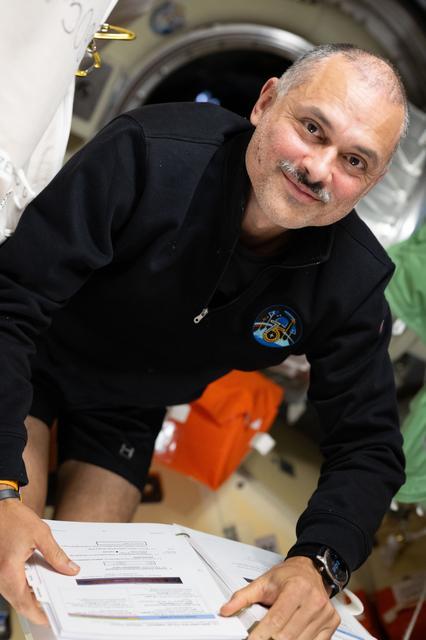
  • Station Trio Nears Departure During Busy Day of Blood Research

    The seven-member Expedition 73 crew gathers together for a portrait inside the International Space Station's Kibo laboratory module celebrating NASA astronaut Mike Fincke's (center) 500 cumulative days in space over four missions since 2004. In the front from left are, Roscosmos cosmonaut Sergey Ryzhikov, NASA astronaut Zena Cardman, Mike Fincke, and NASA astronaut Jonny Kim. In the back are, JAXA (Japan Aerospace Exploration Agency) astronaut Kimiya Yui and Roscosmos cosmonauts Oleg Platonov and Alexey Zubritsky.

    Three Expedition 73 crewmates will end their stay aboard the International Space Station when they undock Dec. 8 and return to Earth a few hours later. In the meantime, blood research took precedence on Thursday ensuring astronauts stay healthy while living long-term in weightlessness.

  • NASA’s Hubble Space Telescope Revisits Interstellar Comet

    NASA’s Hubble Space Telescope reobserved interstellar comet 3I/ATLAS Nov. 30, with its Wide Field Camera 3 instrument. At the time, the comet was about 178 million miles (286 million kilometers) from Earth. Hubble tracked the comet as it moved across the sky. As a result, background stars appear as streaks of light. Hubble previously observed […]

  • NASA’s Psyche Mission Tracks Interstellar Comet 3I/ATLAS

    NASA’s Psyche observed interstellar comet 3I/ATLAS over the course of eight hours on Sept. 8 and 9, when the comet was about 33 million miles (53 million kilometers) from the spacecraft. Captured by the mission’s multispectral imager, these observations help astronomers refine the trajectory of 3I/ATLAS. Psyche’s multispectral imager instrument comprises a pair of identical […]